How AI is Transforming Fabric Shrinkage Management in Textile Manufacturing
Fabric shrinkage is one of those challenges every textile manufacturer knows well but few have truly mastered. A batch rolls off the production line looking flawless — then your customer washes it, and it shrinks past acceptable limits. The batch gets rejected, you absorb rework costs, and your customer starts looking elsewhere.
For decades, the textile industry has managed shrinkage reactively: produce, test, and hope it passes. But a shift is underway. Artificial intelligence is enabling manufacturers to predict how fabric will behave before bulk production begins — allowing adjustments to dyeing and finishing parameters upfront rather than firefighting afterward.
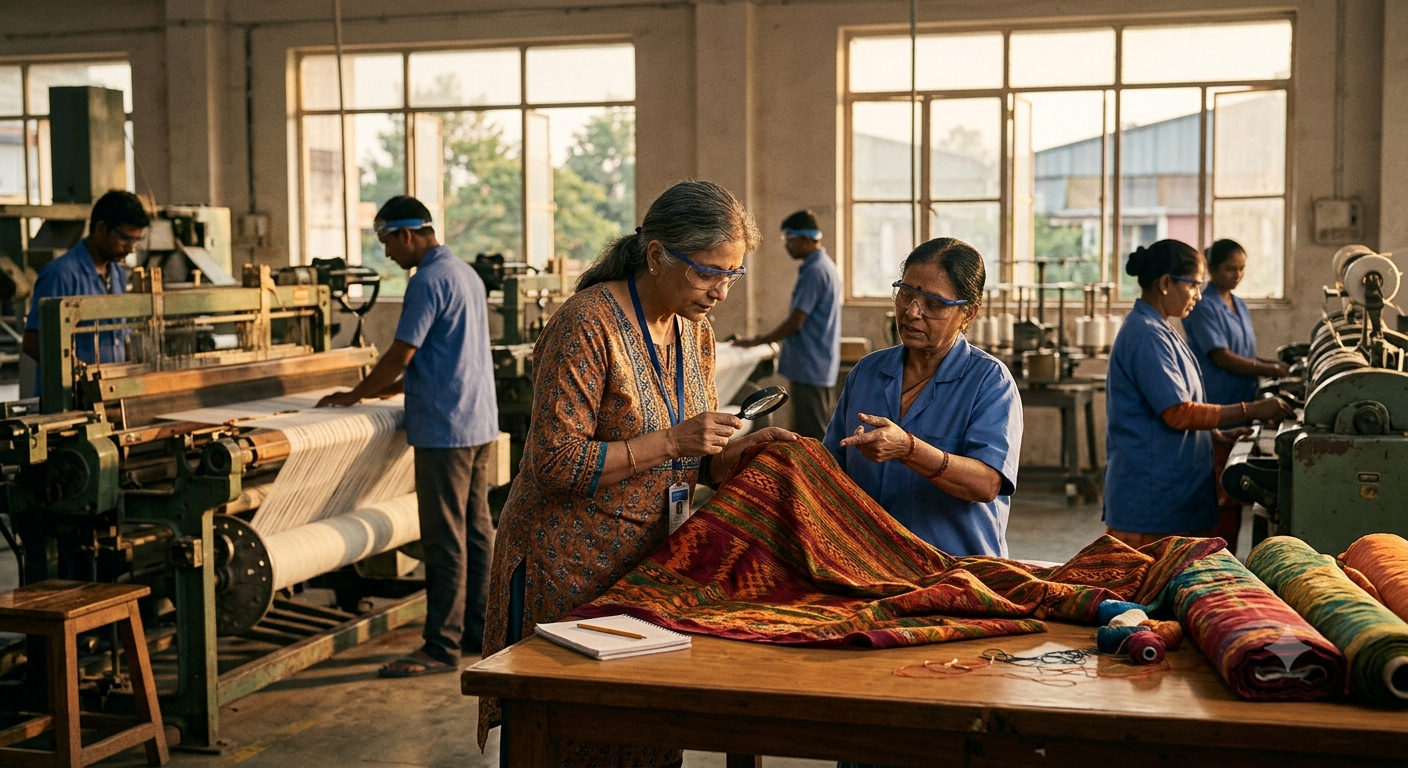
This article explores , How Artificial Intelligence is changing the way of textile manufacturers to predict and manage the Fabric shrinkage
What Is Fabric Shrinkage Prediction?
Understanding Fabric Shrinkage
Fabric shrinkage is the change in length or width after washing, drying, or wet processing. When fabric absorbs water, fibers swell; as they dry, they contract. Any tension held during manufacturing relaxes as shrinkage occurs.
Not all fabrics behave the same way. Natural fibers like cotton, rayon, and wool shrink more than stable synthetics like polyester and nylon. Looser knit constructions shrink more than tight weaves. Understanding these material behaviors is the foundation of any shrinkage management strategy.
What Prediction Actually Means
Traditionally, prediction meant lab testing: mark a sample, wash and dry it under controlled conditions, and measure the change. It works, but it is slow — by the time results are available, bulk production may have already started.
AI prediction takes a different approach. It uses data from previous batches to estimate shrinkage based on fabric composition, dyeing parameters, and processing conditions — before production begins, not after.
Why Traditional Testing Falls Short
Laboratory testing has three fundamental limitations:
It is reactive — money is already spent by the time you test
It is slow — results take hours or days
It is sample-based — one swatch stands in for a whole batch that can vary internally
AI addresses all three limitations — it runs in real time, on actual production data, across full batches.
Why Textile Manufacturers Should Care
Uncontrolled shrinkage is not just a quality issue — it is a cost issue that affects multiple areas of the business:
Production Rework
Fabric that shrinks beyond specification must be reprocessed or written off entirely, adding cost with no output to show for itFabric Waste
Cutting markers without proper shrinkage allowances result in wasted material and garments that do not fitCustomer Complaints
Buyers expect fabric that performs as specified. When it does not, replacements, discounts, and disputes followDelayed Deliveries
Every rework cycle eats into production schedules, leading to missed deadlines and penalty clausesReturns and Credits
Shrinkage failures caught downstream mean returns, credits, and lost margin on product already shippedBrand Reputation
Buyers talk. A reputation for inconsistent quality spreads quickly and is difficult to regain
To put this in perspective: consider a mid-sized unit producing 100,000 meters per month. Even a 2% rejection rate from shrinkage means 2,000 wasted meters every month — and that is before counting rework, delays, and relationship damage on top.
How AI Predicts Fabric Shrinkage
The process can be broken down into five clear steps:
Collect Production Data
The foundation of any AI prediction system is data. This includes fabric composition, dyeing parameters, finishing settings, machine conditions, and past shrinkage results.Train the Model
The AI model learns the relationship between production actions and shrinkage outcomes — similar to training a new supervisor on past examples.Make Predictions
Input the fabric and process details for a new run, and the model estimates shrinkage before production starts.Adjust Parameters
If the predicted shrinkage is outside acceptable limits, manufacturers can adjust dyeing and finishing parameters before committing to bulk production.Continuous Improvement
As more production data becomes available, the model becomes increasingly accurate — creating a cycle of continuous quality improvement.
Data Requirements for AI Implementation
For AI to deliver reliable shrinkage predictions, manufacturers need to collect and organize specific data points. The table below outlines the key data categories:
Fabric Composition
Fiber type (cotton, polyester, wool, etc.), blend ratio, yarn count, construction type.Dyeing Parameters
Dye type, temperature profile, duration, liquor ratio, pH levels.Finishing Settings
Stenter settings, overfeed rate, temperature, speed, tension controlMachine Conditions
Calender pressure, cylinder temperature, machine speed, maintenance historyEnvironmental Factors
Humidity, ambient temperature, water qualityShrinkage Results
Length shrinkage %, width shrinkage %, test method used
Model Selection and Training Considerations
Not all AI models are created equal. When building a shrinkage prediction system, manufacturers should consider:
Data Quality Over Quantity
A smaller dataset with accurate, consistent measurements is more valuable than a large dataset with noisy or inconsistent data.Feature Engineering
Identifying which parameters most influence shrinkage — such as stenter overfeed rate or dyeing temperature — improves model accuracy significantly.Model Interpretability
For manufacturers, understanding why a prediction was made is as important as the prediction itself. Transparent models allow operators to trust and act on the results.Continuous Retraining
As production conditions change — new fabrics, new dyes, new machines — the model must be updated with fresh data to remain accurate.
Practical Implementation Roadmap
For textile manufacturers considering AI for shrinkage prediction, a phased approach is recommended:
Phase 1: Assessment and Data Audit (4–6 weeks)
Evaluate current data collection practices
Identify data gaps and quality issues
Define prediction targets and acceptable tolerance ranges
Phase 2: Pilot Implementation (8–12 weeks)
Select a specific product line or machine for initial deployment
Collect baseline data and run parallel predictions alongside traditional testing
Validate model accuracy against laboratory results
Phase 3: Integration and Scaling (12–16 weeks)
Integrate predictions into production planning workflows
Train operators on interpreting and acting on predictions
Expand to additional product lines and machines
Phase 4: Optimization (Ongoing)
Monitor prediction accuracy and refine models
Expand data collection to include additional parameters
Explore integration with production execution systems
Challenges and Considerations
While AI offers significant benefits, manufacturers should be aware of potential challenges:
Data Availability
Many textile mills lack structured data collection systems. Implementing basic data logging is often the first and most critical step.
Change Management
Operators and supervisors accustomed to traditional methods may resist AI-driven recommendations. Training and clear communication of benefits are essential.
Integration Complexity
Connecting AI predictions to existing production systems — such as ERP or MES — requires planning and technical expertise.
Cost and ROI
While AI implementation requires upfront investment, the return comes from reduced waste, fewer reworks, and improved customer satisfaction.
The Future of AI in Textile Manufacturing
Shrinkage prediction is just the beginning. The same AI capabilities can be applied to other quality challenges in textile manufacturing:
Color matching — predicting dye uptake and shade consistency
Fabric strength — estimating tensile and tear strength from process parameters
Defect detection — identifying quality issues in real time during production
Production optimization — recommending optimal process settings for quality and efficiency
As AI becomes more accessible and textile manufacturers become more data-savvy, predictive quality management is moving from early adopters to industry standard.
Conclusion
Fabric shrinkage has long been an accepted cost of doing business in textile manufacturing. But it does not have to be.
AI-powered prediction transforms shrinkage management from a reactive, costly process into a proactive, data-driven capability. By understanding how fabric will behave before production begins, manufacturers can reduce waste, improve quality, and strengthen customer relationships.
The journey requires investment in data collection, model development, and change management. But for manufacturers committed to quality and efficiency, the returns — in reduced costs, improved reputation, and competitive advantage — make it a journey worth taking.
Tengo mis dudas sobre algunas cosas que decís, pero está bueno tener con quien discutir constructivamente.