Stamping Leaves with Poster Paint
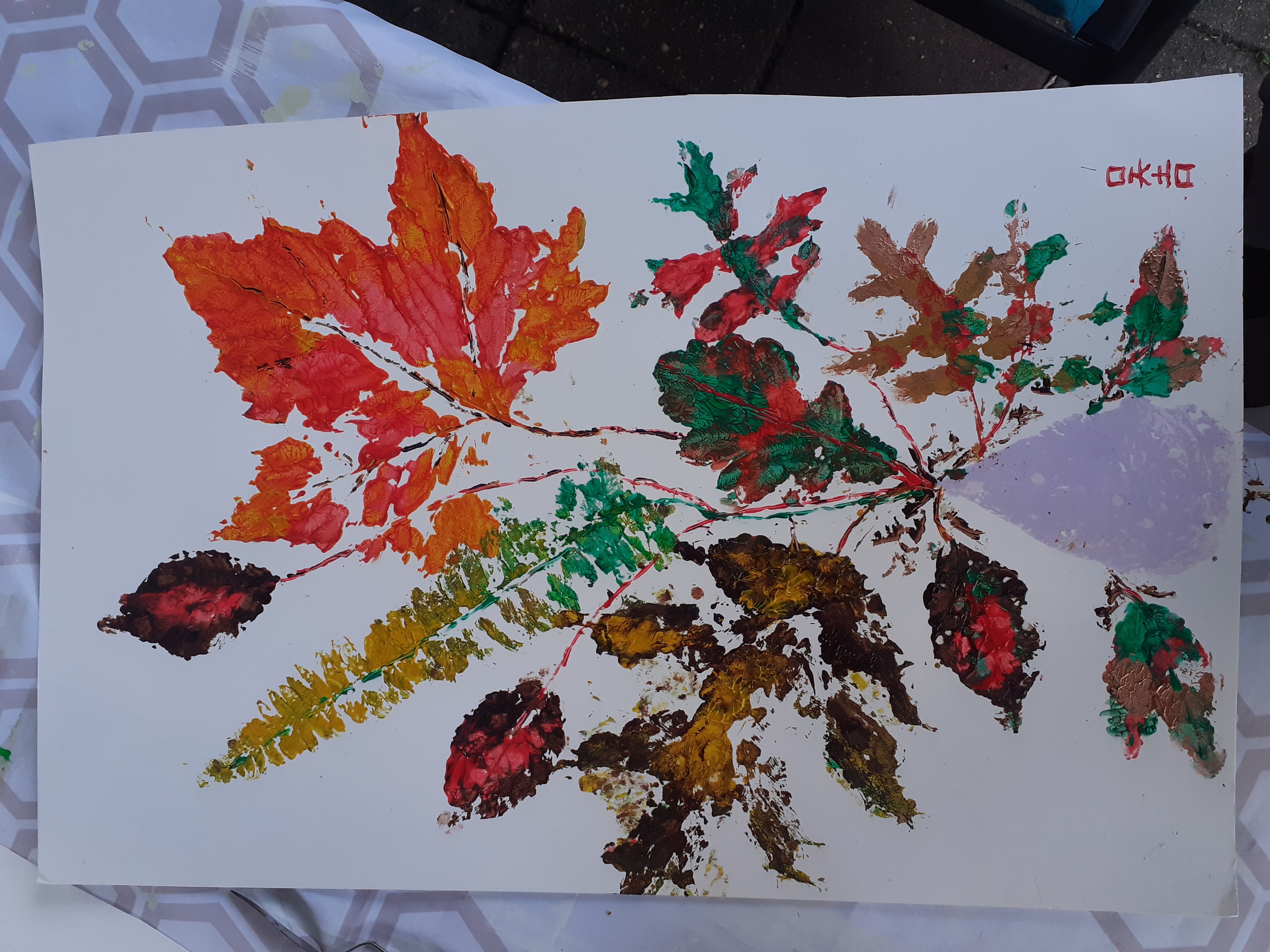
I’m not easily impressed when it comes to anything on YouTube about painting techniques. The teacher shows more interest because she was trained the old-fashioned way, but I can’t shake the feeling that we’re still stuck in the nursery school phase. Of course, it’s nice to try something different for a change, but it doesn’t really feel like painting, even though it might well be creative and could be developed further.
First, she wanted to make prints using feathers. She’d collected all sorts from her garden. Whilst she was chatting, I gave it a go, but it didn’t work out. I tried using a brush to hold the feathers in place and let the paint soak in, but of course that didn’t work. Feathers have tiny barbs that keep them stuck together. The end result wasn’t really worth showing, and I kept two little feathers simply because of the way they were coloured by the paint and because they’re lovely to draw with.
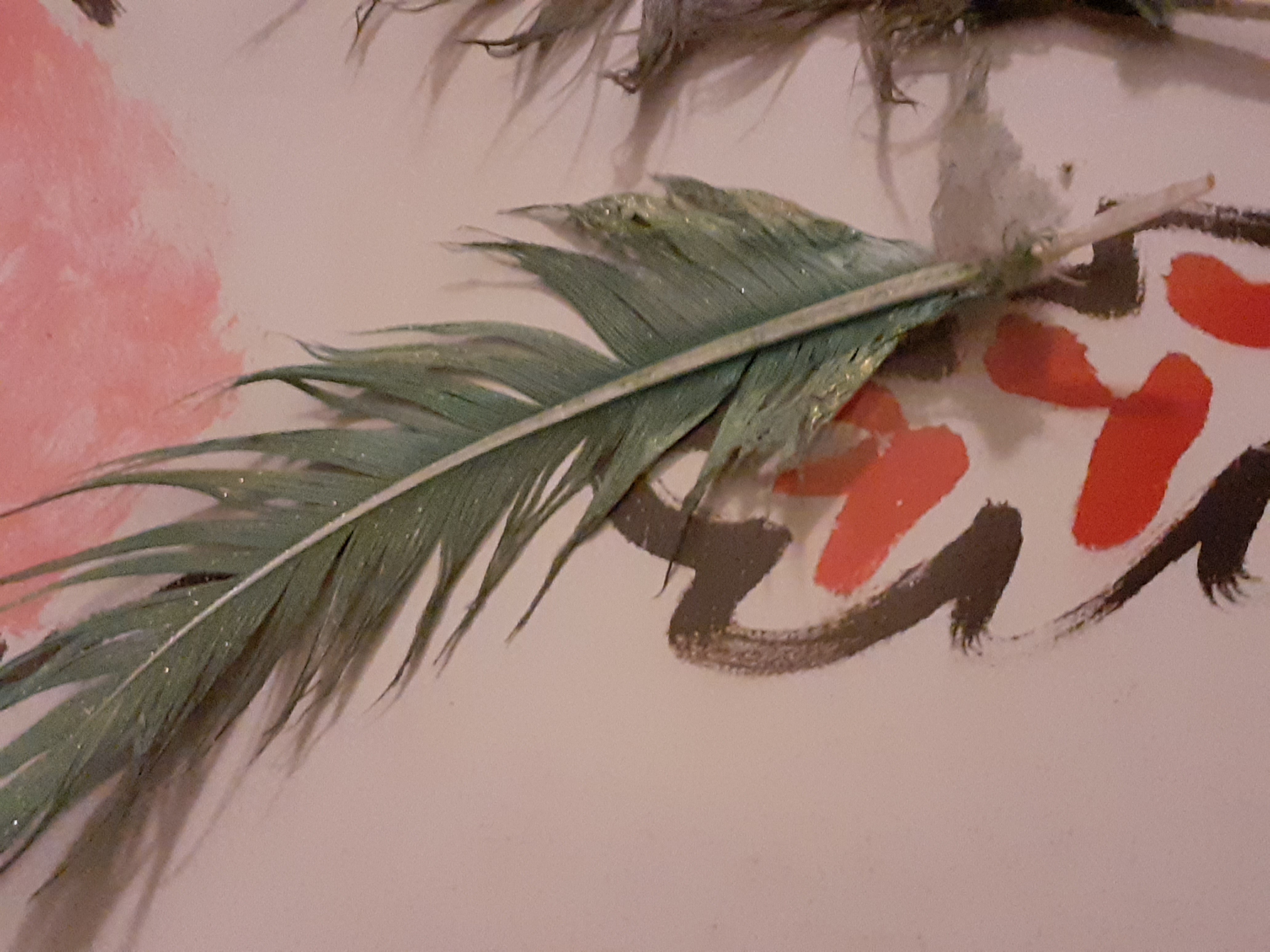
In the meantime, some canvas was cut to size by me, treated with gesso and hung on the washing line to dry. The plan was to try stamping with feathers and autumn leaves on this too, but we lacked time.
So, as the canvas wasn’t dry yet, the next experiment was stamping on paper. This was because she needed examples for a workshop she wants to run in October. As if they need examples...
"They don’t have enough creativity to come up with anything themselves", she said.
I didn’t say anything about that.
First, I arranged a few leaves on the sheet of paper. The next step was to apply paint. And yes, I used far more paint than she did or would advice, or perhaps than she imagined, and I also smeared the paint onto the underside of the leaf, as the veins are more clearly visible there.
I used one or more colours on one leaf, placed it in the right spot on the paper, and next pressed it down with my hand or fingers. As I could see that the impression on her paper was very faint, I decided to leave my leaf lying in the paint on the surface for a little while longer before removing it. On to the next leaf.
The leaf stalks didn’t produce a very clear impression, even though there was paint on them; so it’s better to paint these separately.
I’d probably chosen the right leaves as well, because I was able to remove them all quite easily, unlike the teacher who struggled removing a leaf after a short time.
It’s a bit unclear whether this leaf was too thin or had been left to dry for too long, but it was stuck fast to her paper and so it had to be scraped off with a spatula. In the end, she just left small bits in place, which wasn’t unsightly in itself.
Incidentally, the first leaf I tried had been plucked from the grapevine. This leaf hadn’t been dried, and I’d coated it with gold paint that was quite thin. It didn’t really leave a clear imprint, but the leaf itself looked quite nice.
Next she told that I couldn’t really use that leaf because it isn’t an autumn leaf (???). Funny, because she herself said I should just pluck it from her grapevine to have a go.
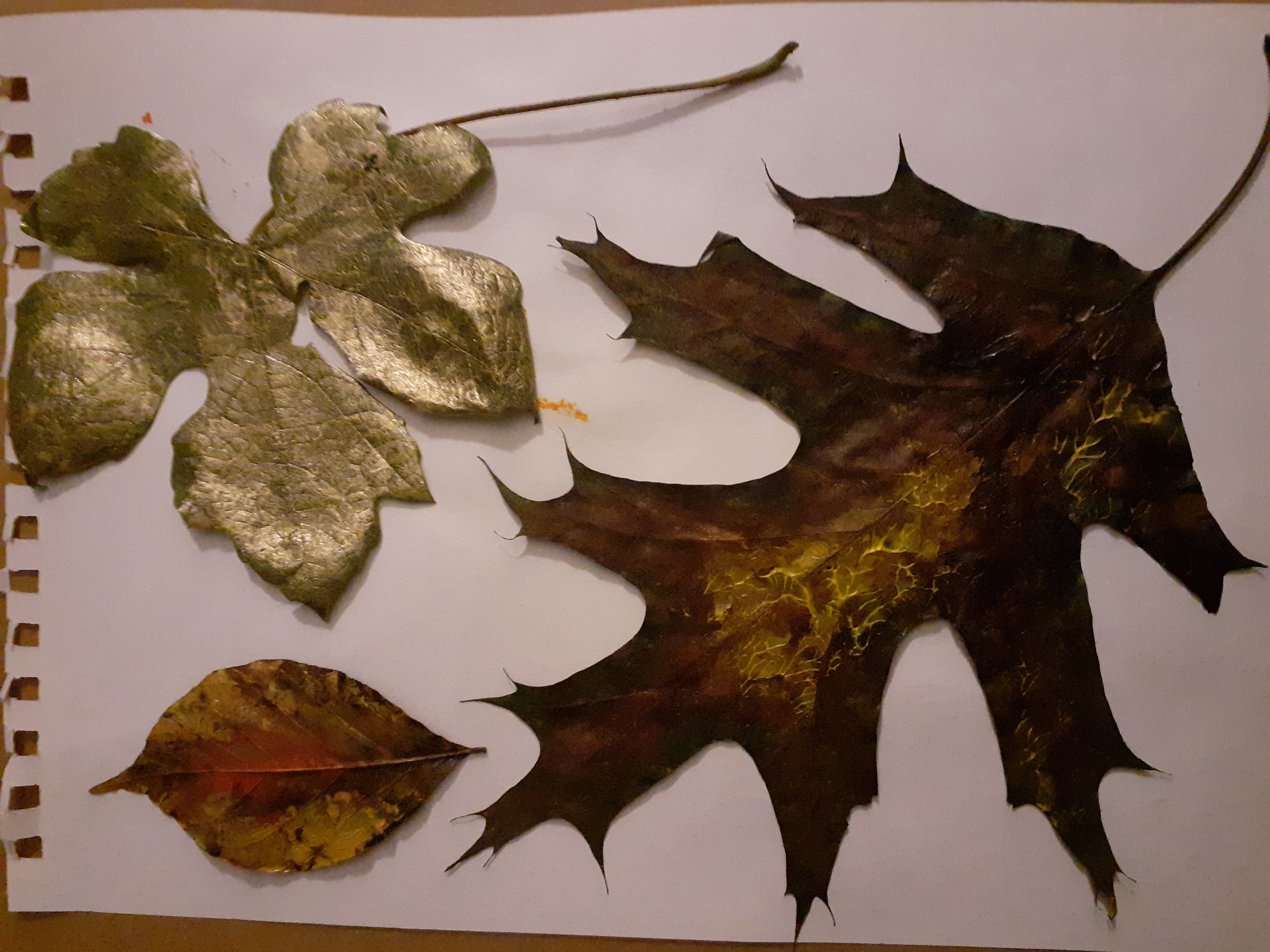
Let me just say that the end result isn’t half bad; I’d do it differently next time; I didn’t take it home with me, after all, she’s the one who wants an example, but I did take the painted leaves with me.
Incidentally, I’ve used some of those leaves several times, which is perfectly possible if you handle them with care.
A dried leaf works perfectly – it just mustn’t be so dry that it crumbles into tiny pieces.
What I don’t particularly like, incidentally, is that the background has simply remained white; I’m not quite sure how to address that. Perhaps this technique would work better on a piece of wood? I also think that anyone using this sort of technique could improve, or refine, the final result by adding a few more details to make it come to life a bit more.
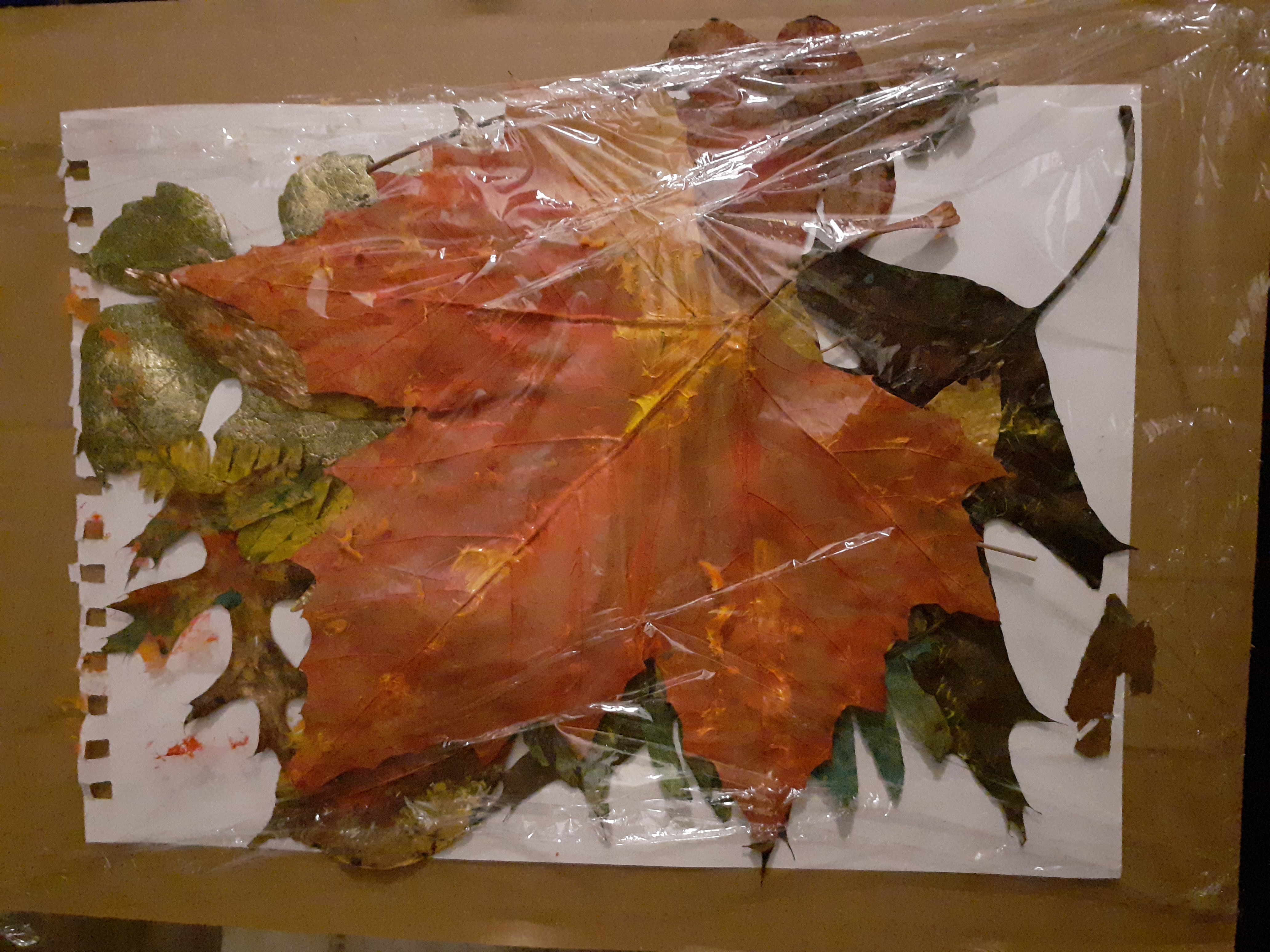
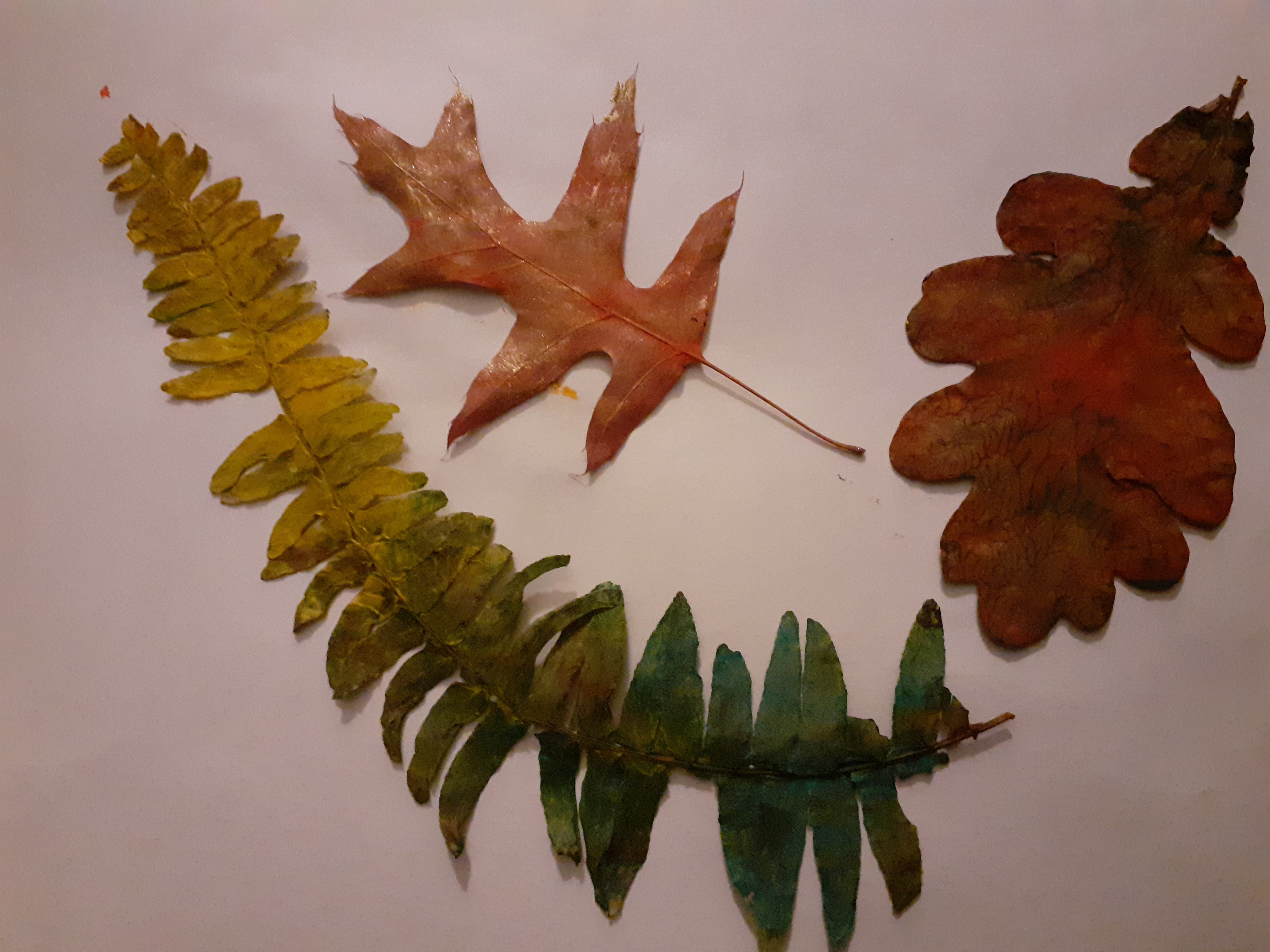
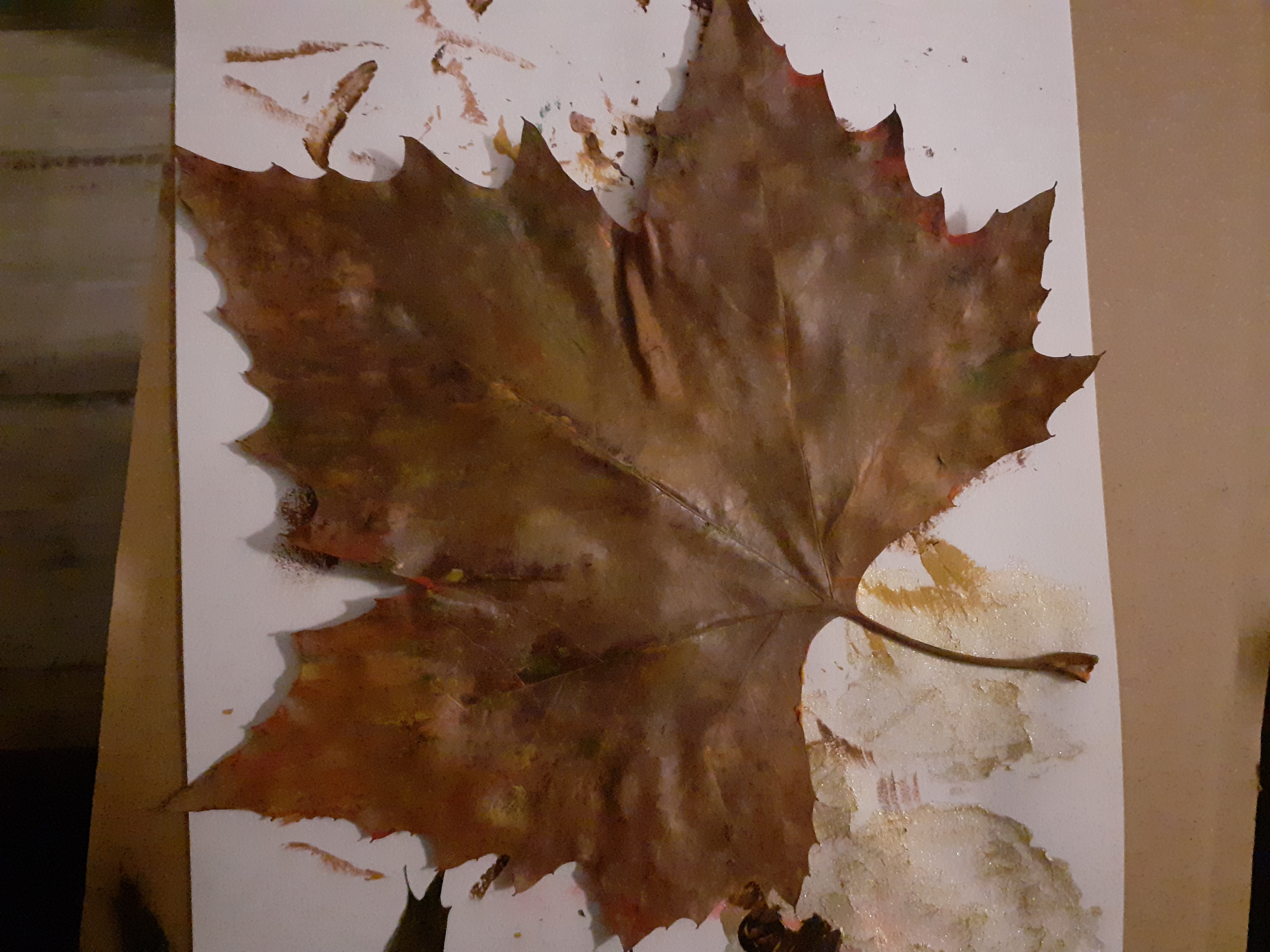
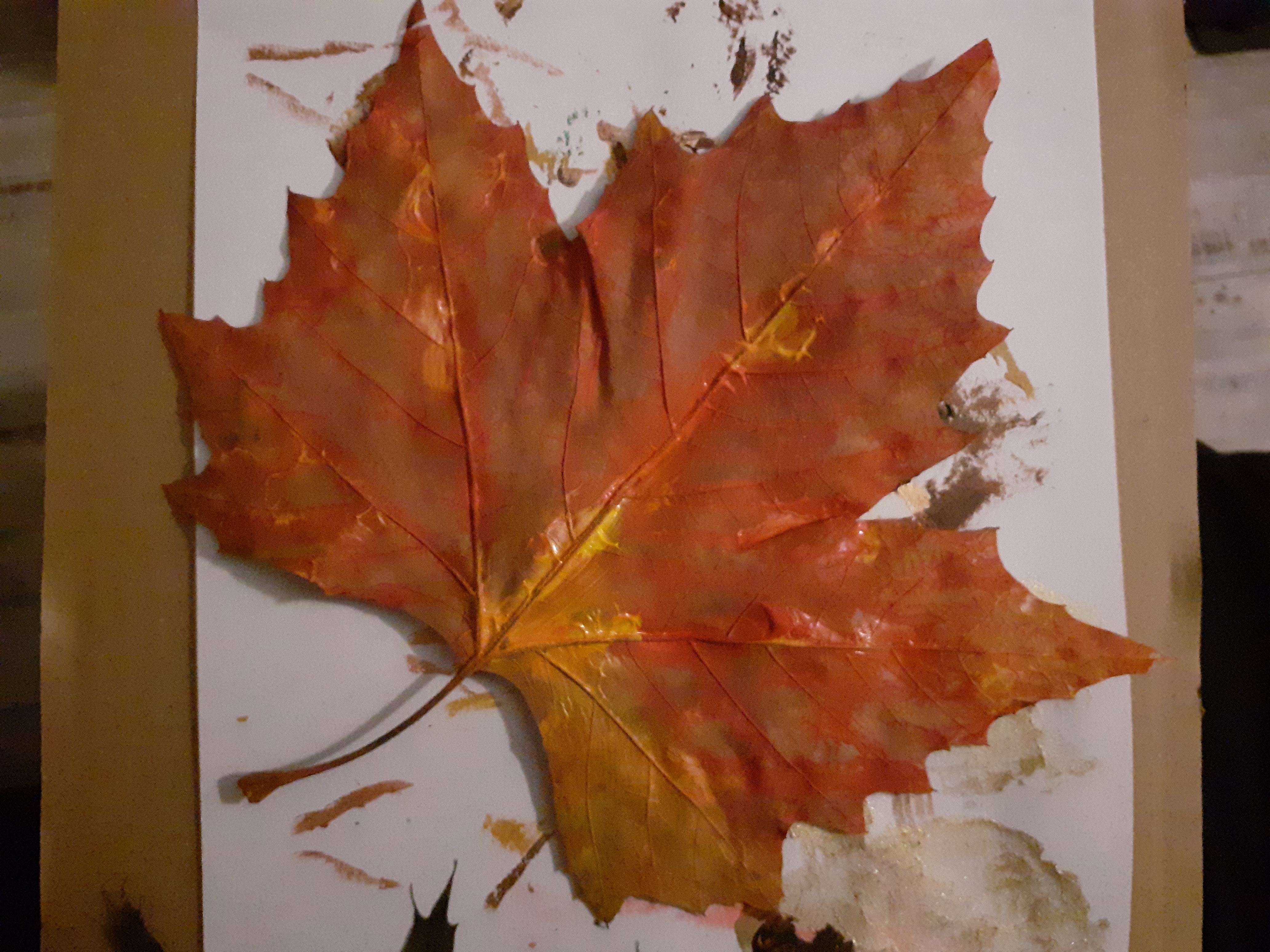
And yes, autumn begins around 21 September overhere, which means that in nursery classes and primary schools, just like in the Scouts, attention will once again be turned to making autumn-themed displays (tables) and decorations.
There are a few other printing techniques I’d like to take up again, but for that I’ll need more time and, above all, time when I won’t be disturbed.
To everyone: I hope you enjoy the last few days of summer and have a colourful autumn without too much rain.
Materials used: several dried leaves of different trees, poster paint, acrylic paint, my fingers, a brush, thicker paper provides by the teacher.
6.9.26
The contest Art & Writing is hosted by @solperez
</sub
What you say is true: In childhood, we enjoy genuine creativity. As the years go by, we become stuck in social and artistic patterns. That's why I find it wonderful to return to those creative activities we did in preschool, because perhaps in that way we can "recapture" the ingenuity we had as children. I loved your work.
Es cierto lo que dices: En la infancia gozamos de una creatividad genuina. Con los años nos vamos dejando estancar dentro de patrones sociales y pictóricos también. Por eso me resulta maravilloso el volver a esas actividades creativas que hacíamos en el preescolar, pues tal vez de esa manera lograremos "recuperar" el ingenio de cuando éramos niños. Me encantó tu trabajo.
Thank you for visiting and for your kind words. I don’t think we’re going back to nursery-school activities to relive those times, but rather that it’s down to a lack of skills among the last two generations. Who knows, perhaps we’ll catch up on that, or teach people once again to keep themselves occupied without staring at a screen or clutching a mobile phone. I think that’s necessary, particularly given that power cuts are becoming more frequent and social connections are fading. On top of that, we’re also plagued by loitering youths. These are young people who have nowhere to go and no interest in anything anymore. I’ve got an idea to keep these young people occupied: give them a few walls of an old building and let them get stuck into graffiti, murals and whatever else takes their fancy. Perhaps the lack of people to talk to, like-minded individuals and social connections is also the reason why that teacher talks non-stop, and this is also the case in the group where I paint – at least when she’s there. Last time it was incredibly quiet and everyone was just getting on with their work. It’s probably also the case that when one person starts talking, everyone else immediately joins in – well, almost everyone. I prefer to paint.
If the leaves can be reused, I’ll turn them into something else. Who knows, I might show you that one day.
Ver tu publicación me traslado a mi niñez recuerda que en quinto grado de primaria la maestra de artes plásticas nos hizo buscar hojas de diferentes formas y pintarlas.
En ese momento yo lo veía difícil con los años me doy cuenta que no era complicado solo dejarla secar un poco claro ahora hay tutoriales por todos lados.
Me gustó tu arte al igual que a ti tampoco me impresiona todos los vídeos de YouTube.
Gracias por compartir tu arte que me llevo a mi niñez
Bendiciones 🫂
I suppose it was quite difficult for us, as we were just little children. Our motor skills probably weren’t very good, and the quality of the paper surely left a lot to be desired too. And then there were the little shoes – many of us were fighting over the same colour of paint. I’m sure that pot was half empty.
At primary school we learnt loads of creative things, such as weaving cane, doing batik, engraving, soldering, working with a jigsaw… and so on and so forth. It’s clear that this wasn’t dependent on age.
The only place I know of where young children, from the age of 3 or 4, can also do all sorts of things, create and use a drill, a jigsaw and other tools (and from the age of 12 they can weld) is ‘Uitvinder ik’. A park created by an artist.
I get the feeling that, half a century ago, children’s development was viewed very differently from how it is today. Nowadays, everything is dangerous and nobody knows how to do anything anymore. And that also causes frustration. I see it right here on Steemit. Here, no progress is being made in terms of developing writing style, drawing or anything else. Perhaps my art teacher is right.
Supongo que para nosotros, que éramos niños pequeños, fue bastante difícil. Probablemente nuestra motricidad no era muy buena y la calidad de las hojas seguramente también dejaba mucho que desear. Y luego estaban los zapatitos, con muchos de nosotros peleándonos por el mismo color de pintura. Seguro que ese bote estaba medio vacío.
En la escuela primaria aprendimos un montón de cosas creativas, como trenzar caña, hacer batik, grabar, soldar, trabajar con la sierra de calar… y un largo etcétera. Está claro que esto no dependía de la edad.
El único lugar que conozco donde los niños pequeños, a partir de los 3 o 4 años, también pueden hacer de todo, crear y manejar el taladro, la sierra de calar y demás herramientas (y a partir de los 12 años pueden soldar) es «Uitvinder ik». Un parque creado por un artista.
Tengo la sensación de que, hace medio siglo, se veía el desarrollo de los niños de una forma muy diferente a como se ve hoy en día. Ahora todo es peligroso y ya nadie sabe hacer nada. Y eso también genera frustraciones. Lo veo aquí mismo, en Steemit. Aquí no se avanza nada en cuanto al desarrollo del estilo de escritura, el dibujo o cualquier otra cosa. Quizá mi profesora de dibujo tenga razón.
Education today is very different from what it was in the ’80s and ’90s, with all this technology—which I don’t think is a bad thing—but now we see kids glued to their screens... I remember studying with books and visiting libraries; that doesn’t exist anymore, and now, with artificial intelligence, people don’t even want to think anymore.
Do you need to flatten those leaves using books or something like that? Some fallen leaves might curled up abit...
Yes, there are flower presses also used for leaves but I place them between paper and place some heavy books on it. It might take a year. Easier is to take dry ones from the streets or partly dry ones to stamp with. A part of those I used weren't flat. With paint on it you can still press them in paper, wood, concrete or the wall. Just press with your vingers every part of the leaf.
If the leaf is too dry you might have issues pulling it off.
Those very dry ones you could leave on the paper, canvas or ...if you intend to protect it afterwards.