Halloween Film Essays #3: Uzumaki (2000) 🎃👻🕸️
Higuchinsky, Junji Ito, and the shape that swallows the world
Director: Higuchinsky
Year: 2000
Starring: Eriko Hatsune, Fhi Fan, Ren Osugi, Hinako Saeki
Based on: the manga by Junji Ito
Warning: This essay contains major spoilers.
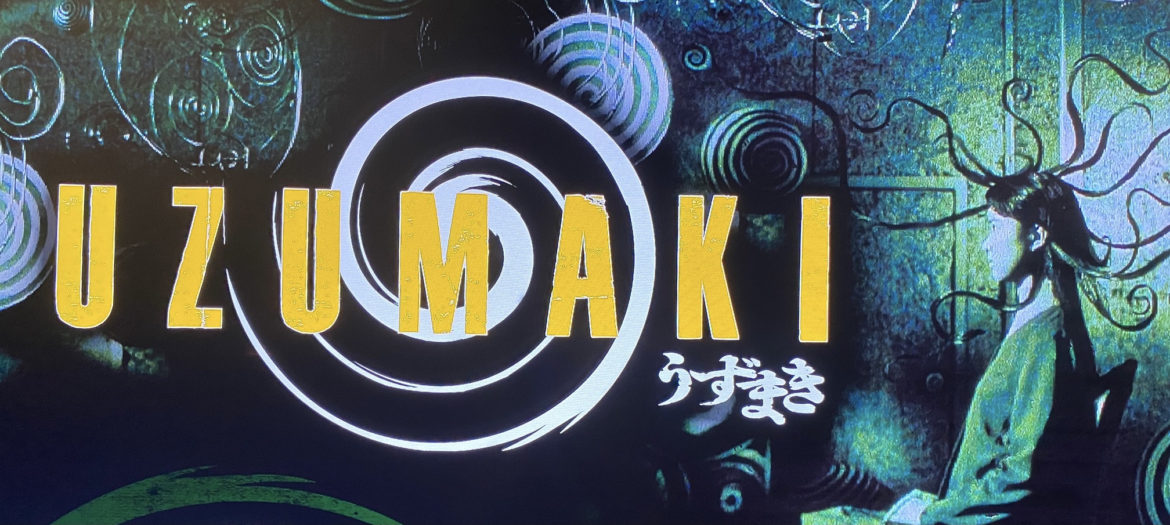
In the first two essays of this series, the threat came from stories and from the dead. This time, the threat is a shape.
Uzumaki, adapted from Junji Ito's celebrated manga, is set in a small Japanese town that slowly falls under the spell of the spiral. People become fascinated by it, then obsessed, then terrified, and finally they begin to turn into it. There is no killer, no curse with rules, no ghost to appease. There is only a pattern, and the pattern wants everything.
It sounds absurd, and in places the film is absurd. But beneath its strange, deadpan surface lies one of the oldest questions in religious thought: what happens to people who give themselves over completely to something that is not God?
A Town Called Black Vortex
The story is told by Kirie, a schoolgirl in the town of Kurouzu-cho. Her boyfriend Shuichi is the first to sense that something is wrong. He tells her the town is contaminated by spirals and that they need to leave. She thinks he is being melodramatic. We soon learn he was the only one seeing clearly.
The name of the town gives the game away. Kuro means black, and uzu means a whirlpool or vortex. Kurouzu is, quite literally, the Black Vortex. The town is not merely the place where the horror happens. It is the horror, already named before anything begins.
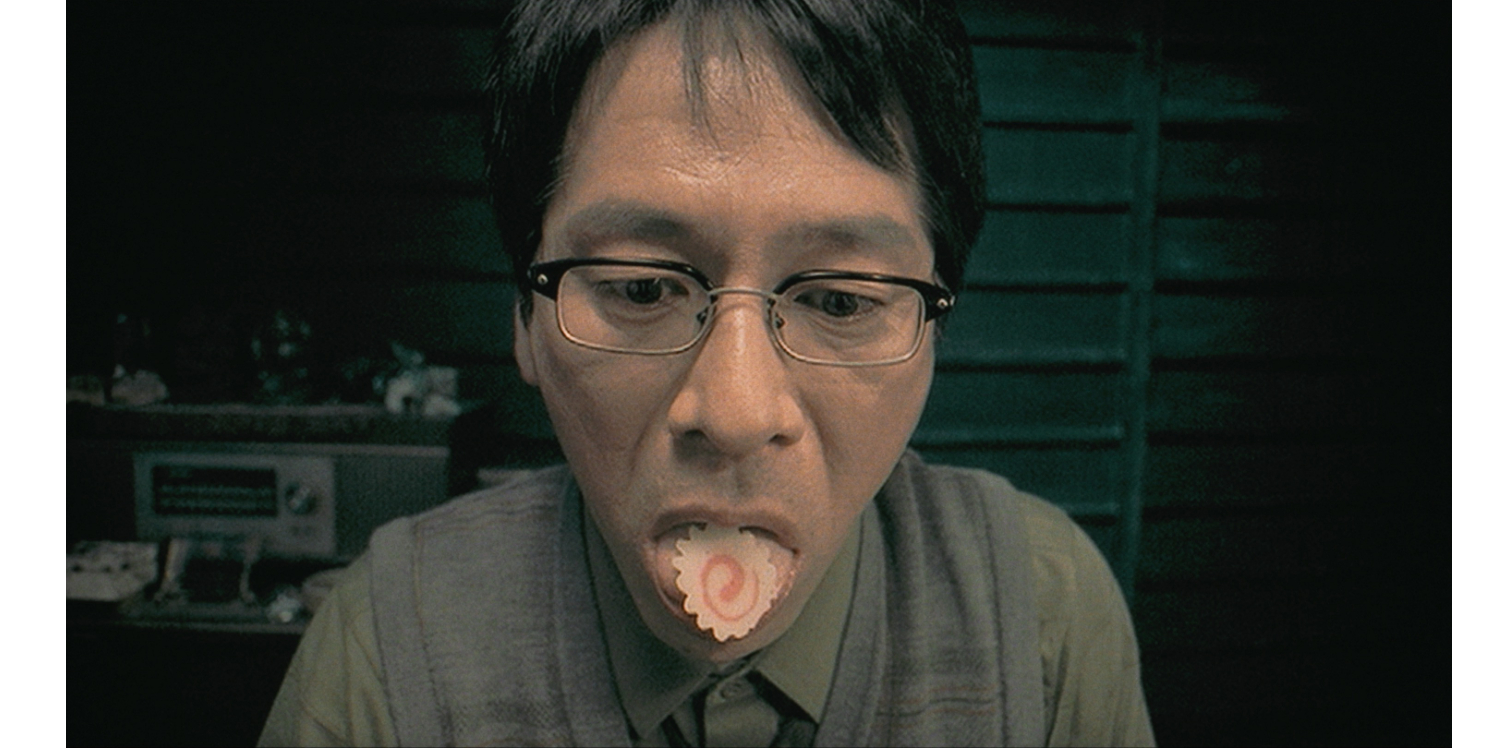
Higuchinsky understood this, and he fills the film with spirals that are never pointed out: in a wallpaper pattern, a cloud of steam, a coil of wire, the swirl on a fishcake, the curve of a road. The whole film is shot through a sickly green filter, as if the light itself has gone slightly bad. Once you start noticing the spirals, you cannot stop, and that is exactly the point. The audience is put in the same position as the townspeople. To look for the pattern is already to be drawn into it.
Becoming What You Worship
The first victim is Shuichi's father. He begins by filming snail shells. Then he collects spiral objects, filling a room with them, staring at them for hours. He stops going to work. His wife becomes frightened of him. In the end, he climbs into a washing machine and dies twisted into a spiral himself, his body finally taking the shape he could not stop looking at. At his cremation, the smoke rises from the chimney, coils into a great spiral in the sky, and sinks into the pond outside town.
This is the film's central insight, and it is a deeply religious one. The Psalms describe the idols of the nations as having eyes that cannot see and ears that cannot hear, and then add a chilling line: those who make them will become like them. Human beings are shaped by what they gaze upon. We are, in a sense, worshipping creatures. Whatever we place at the centre of our attention will eventually begin to remake us in its image.
Shuichi's father is a man who has found his god. It is not a person, a spirit or even an idea. It is a form, empty and endlessly repeating. He gives it his time, his work, his marriage and finally his body. What makes the film so unsettling is that his devotion looks so much like piety. He is calm, rapt, almost serene. He speaks of the spiral as the highest form of art, the most perfect shape.
The early Christian writers had a word for this kind of fixation: passion, in its older sense of something that acts upon us rather than something we act on. A passion begins as attention and ends as captivity. The father does not decide to become a spiral. He simply keeps looking until there is nothing left of him that is not looking.
The Oldest Symbol
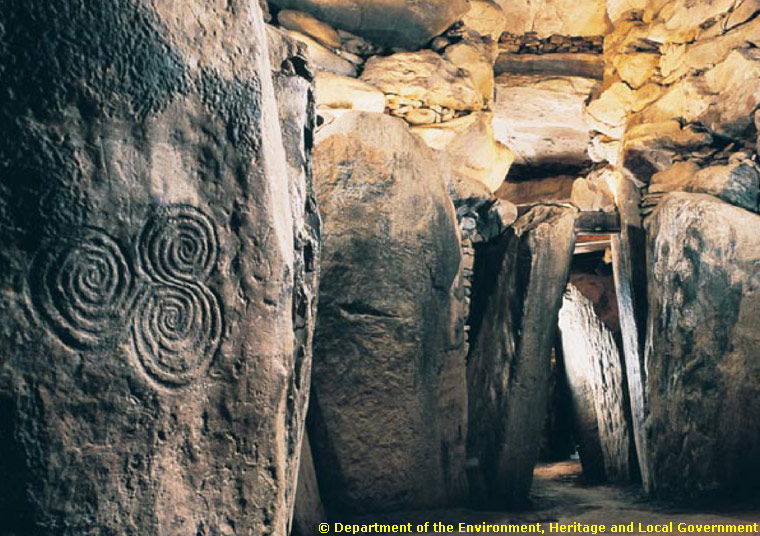
The spiral may be the oldest sacred sign humanity has. It is carved into the entrance stone at Newgrange in Ireland, a passage tomb older than Stonehenge and the pyramids of Giza. It appears in Neolithic rock art across Europe, on Celtic metalwork, in Maori carving and in the swirling tomoe emblems painted on Shinto shrine drums. Whoever first drew it, they seem to have felt that it said something about life, death and the passage between them.
Nature seems to agree. The spiral is in the nautilus shell, the sunflower head, the hurricane, the galaxy and the double helix of our own DNA. The Swiss mathematician Jacob Bernoulli was so taken with the logarithmic spiral that he called it the spira mirabilis, the marvellous spiral, and asked for it to be engraved on his tombstone with the Latin motto Eadem mutata resurgo: "Changed, I shall arise the same." For Bernoulli, the spiral was an image of resurrection, a form that grows without ever losing itself. (In a twist Junji Ito would appreciate, the stonemason carved the wrong kind of spiral.)
This is the key to the symbol. A spiral has two directions. Followed outward, it opens, expands and ascends. Followed inward, it narrows, tightens and falls towards a single point from which there is no escape.
Dante understood this. His Inferno is a vast funnel of narrowing circles, each tighter and darker than the last, descending to the frozen centre of the earth. His Purgatory is the same shape reversed: a mountain climbed in terraces, spiralling upward towards light. The pilgrim walks the same geometry in both, but in opposite directions. One is the path of the soul turning in on itself. The other is the path of the soul being drawn out of itself towards God.
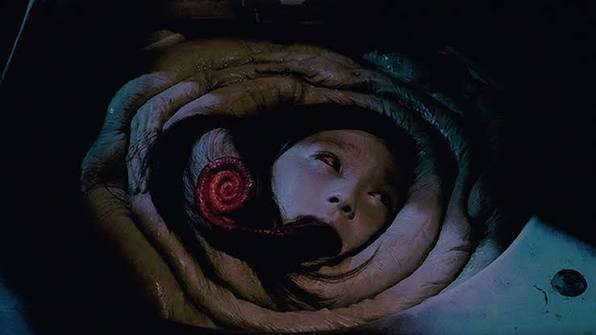
Kurouzu-cho knows only the downward spiral. Its people do not grow. They contract. They are pulled inward, towards the pond where the smoke went, towards the dark centre of a town that will not let them leave. Yeats, writing in the wake of the First World War, pictured history as a widening gyre in which the falcon can no longer hear the falconer, and things fall apart. Higuchinsky's town is the opposite image, but just as apocalyptic: a gyre that keeps tightening until nothing can get out.
The Spiral Within
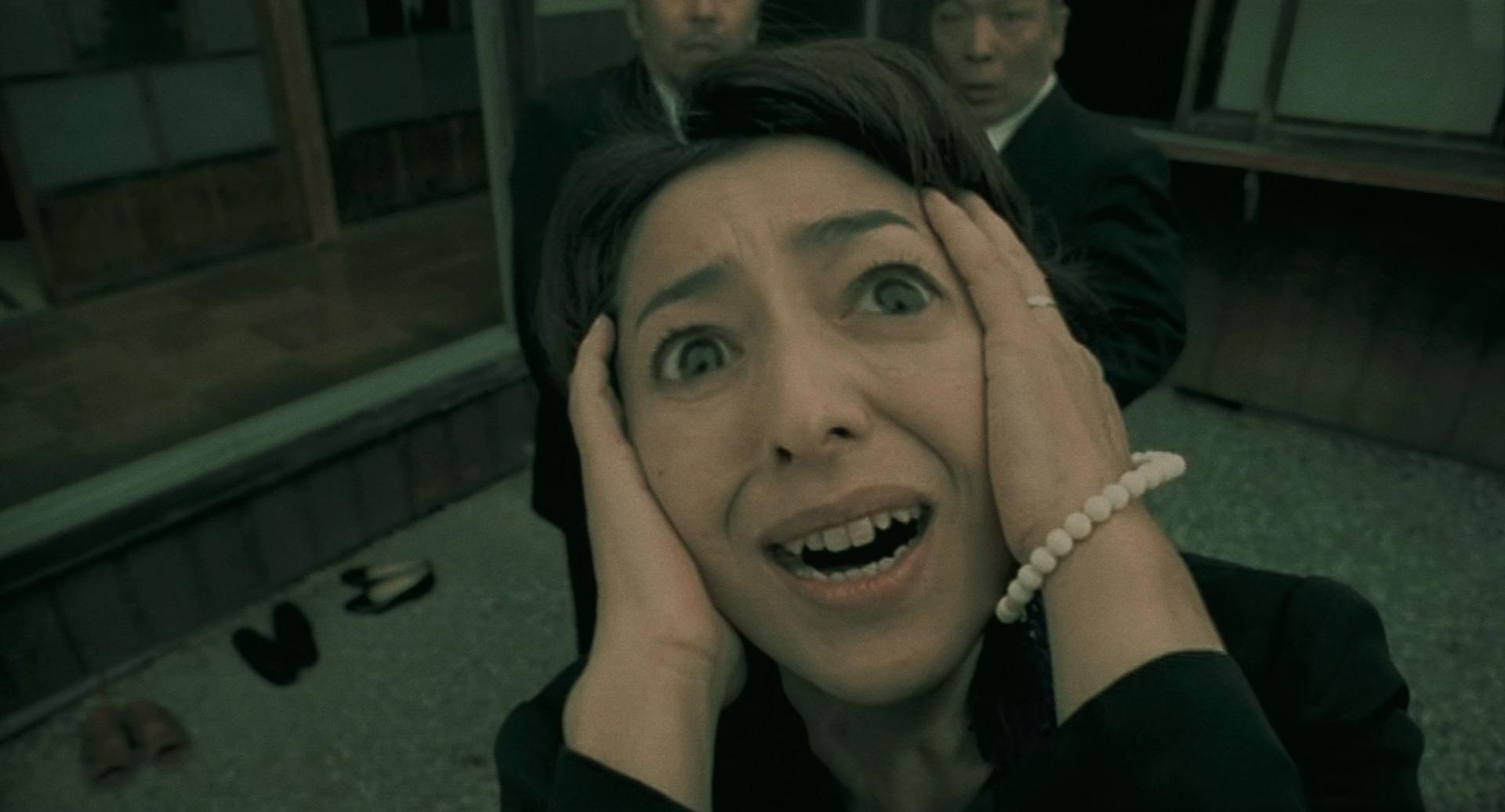
The most disturbing realisation in Uzumaki is that there is no escaping the spiral, because we are already made of it. Shuichi's mother, horrified by what has happened to her husband, becomes terrified of the spirals she cannot get away from: the whorls of her own fingertips, the coiled passage of the inner ear. In Ito's original story she goes as far as cutting away her fingertips. You can run from the town. You cannot run from your own body.
The film's other victims are claimed in ways that feel almost like a medieval morality play. Each person is caught by the spiral through their own particular weakness.
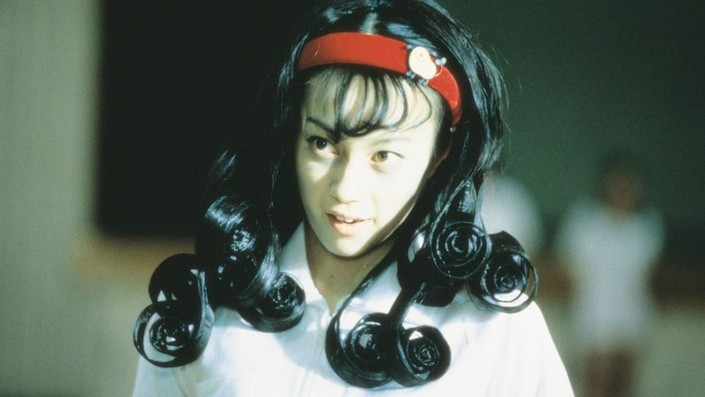
Kyoko, Kirie's vain classmate, is consumed by her hair. It begins to curl into enormous spirals that move with a life of their own, feeding on her strength and demanding attention. She becomes the servant of her own vanity, until there is almost nothing left of her but the hair. In the old catalogue of deadly sins, pride and vanity came first, and here the image is almost literal: the self, admired and adorned, becomes a parasite that devours its host.
Katayama, a slow and dreamy classmate who is mocked by the other boys, takes a different path. He becomes damp, sluggish and withdrawn, and finally turns into a snail, crawling up the school walls. It is grotesque and oddly pitiful. The snail carries its spiral house on its back and retreats into it at the first sign of danger. The monks of the desert spoke of acedia, the spiritual sloth that makes a person turn away from life and curl into themselves. Katayama does exactly that, until his body follows his soul.
In each case, the spiral does not invent a new evil. It finds what is already there and draws it inward, tighter and tighter, until the person and the flaw are the same thing.
No Way Out
The film was made while Ito's manga was still being serialised, and it shows. Its final act is abrupt and fragmentary, closer to a fever dream than a conclusion. Even Shuichi, the one person who saw the danger clearly from the start, is not spared. Kirie is left alone in a town that has stopped pretending to be normal.
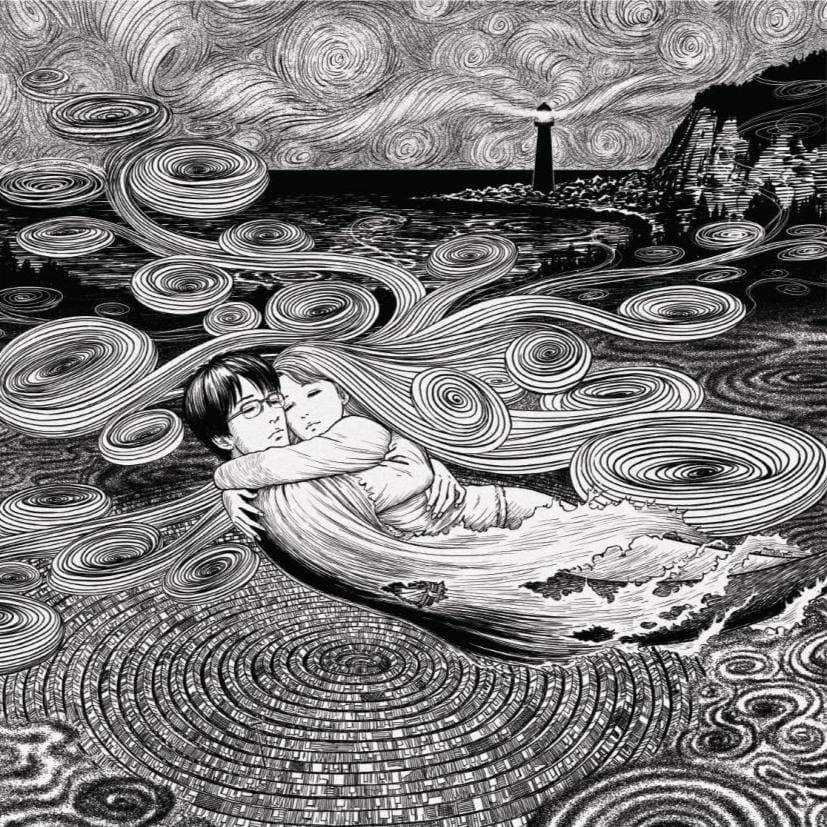
Ito's manga goes further, and its ending is worth mentioning because it completes the symbolism. At the very centre of the spiral, the story reveals that all of this has happened before, and will happen again. The town has been through the cycle in the distant past, and it will be rebuilt and destroyed in the future. The spiral is not just a shape. It is a theory of time.
This is where the film's cosmology becomes truly bleak. Many ancient traditions imagined time as a wheel: the Greek idea of eternal recurrence, the Hindu and Buddhist cycles of birth and death from which the soul longs to be freed. Against this, the biblical tradition introduced something radical: history as a line with a beginning and an end, moving towards fulfilment. Bernoulli's motto belongs to that second vision. Changed, I shall arise the same. A spiral that opens towards resurrection.
Kurouzu-cho belongs to the first vision at its darkest. Its spiral does not open. It turns, and turns, and closes, and begins again.
A Few Reservations
Uzumaki is an odd film, and I understand why some viewers bounce off it. The tone swings between horror, satire and something close to slapstick, and not every swing lands. The early-2000s computer effects have aged poorly, and the rushed ending will frustrate anyone looking for answers. If you have read Ito's manga, the film will feel like a sketch of something much larger.
But its strangeness is also its strength. The deadpan performances and green-tinted images create a world that feels slightly off from the first frame, like a dream you cannot quite wake from. Few horror films are so committed to a single image, and so willing to follow it to the end.
Final Thoughts
The first two films in this series asked whether stories can replace reality, and whether connection can become a kind of damnation. Uzumaki asks something simpler and older: what do you keep looking at?
The spiral itself is innocent. It is in shells and galaxies and in our own bodies, and for thousands of years human beings carved it as a sign of life, rebirth and the journey of the soul. The horror of Kurouzu-cho is not the shape. It is what happens when people turn a form of creation into an object of worship, and follow it inward instead of upward.
We all have our spirals. Our screens, our habits, our obsessions, the things we cannot stop circling back to. The film's quiet warning is that attention is never neutral. Whatever we gaze upon long enough, we become.
Happy Halloween, and welcome to the third instalment of my Halloween film series.
Have you seen Uzumaki, or read Junji Ito's manga? Do you see the spiral as a curse, a god, or a mirror of something already inside us? I'd be interested to hear your thoughts.