It turns out I do like poetry.
The Goblins
Gertrudis Gómez de Avellaneda
Palaces and hovels,
fields and city sleep,
beast and bird and mortal,
all in slumber deep;
for the shadows cover
heaven's face from sight,
and the winds and ocean
hold their silence tight.
Only one faint murmur,
vague and weak and fleet—
the breath of night is stirring,
filling all complete;
like a soul that's grieving,
hunted, never freed,
by some unseen flame that
hell itself did breed.
But the murmur's swelling… yes, it swells,
and none has ever been
so relentless, so uncanny,
so fearsome and so keen!
Now it seems the owls'
hollow, tomb-deep cry;
now a boundless crowd's
breathing, drawing nigh;
now some fateful bell-toll
trembling through the dark,
whose thousand echoes scatter,
circling, leaving mark.
But no—like little bells that
a lively hand has spun,
discordant notes I'm hearing
wander, one by one.
Now they're shifting—one might
well presume it true
that playful children dance there
on rolls of crystal too,
that clash and burst to pieces,
that leap from here to there,
tumbling into fragments
with clamor past compare.
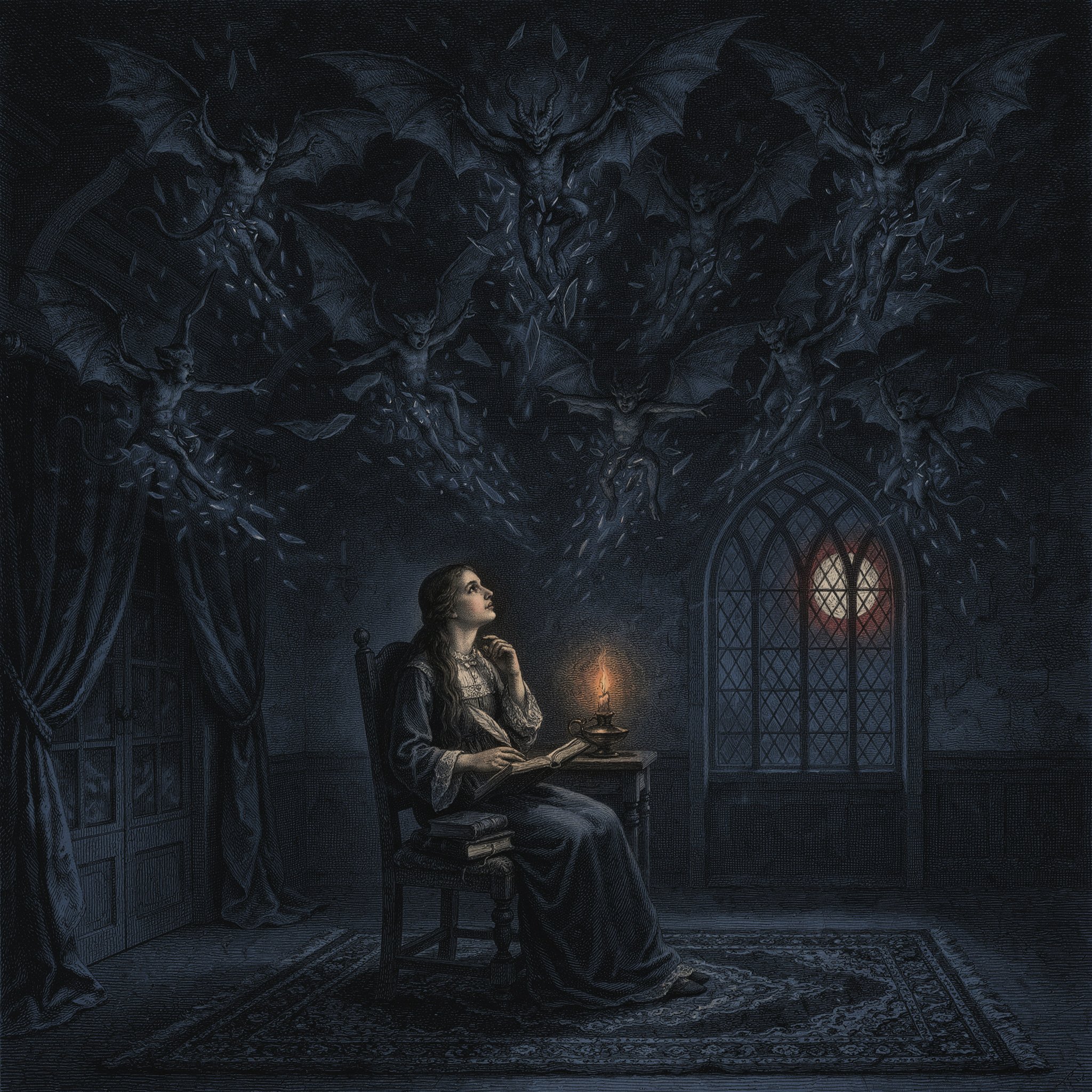
They are, oh heavens! they're the goblins,
who, enemies of my peace,
each night, in swarms unnumbered,
visit my solitude's release.
They are the goblins that my insomnia
seems always to call near,
to mock me, to bewilder me,
to drive me mad, I fear.
Ah! my lamp is dying,
and I hear the fatal swarm
that crosses in confusion,
cutting through night's form!
The ceiling shakes and shudders
above me, tossed and stirred!
Like burning pine I hear it
groaning, word by word!
The rafter bends and buckles
like a reed gone soft!
The door begins to open,
turning slow aloft!
The rusted hinges shrieking
grind with rasping sound!
With a hoarse explosion
the lintel splits around!
And there, among the vapors,
impure clouds unfold,
of strange and shifting colors,
a swarm confused, untold!
The dreadful legion gathers,
forming battle-lines.
Vampires, dragons swarming,
rise in coiling lines,
and pass by, letting loose
their long and grieving moans—
their roaring wings are lent them
by the North Wind's tones!
Perhaps, alas! they'll settle
upon my dwelling place,
the ancient wall, unhinged, will
yield and give them space,
and swept along, I'll tumble
before the cursed horde,
like some dry withered leaf that
the wind has cast abroad.
O Muse! if your hand offers
me freedom from this plight,
I'll bow my brow before your
altar, day and night.
From these unclean offspring
of the fatal night,
save me in your mercy,
save me, pity my plight!
Let their wings, in vain and
stubborn, beat unheard
against my ancient balconies,
their glass forever blurred,
and let my doors stay shuttered,
never letting through
the cursed breath that issues
from their infernal maw.
Ah! they've passed! the cohorts
flee now, full of rage,
though in the air their chains still
seem to creak and gauge.
There, to the far horizon,
the dreadful squadron flies,
and far away one still can hear
the beating wings, their sighs.
Beneath their surging passage
the neighboring forests shake,
the oaks bend low and shudder,
their roots torn loose, awake.
How, circling round the full moon,
they trace a bloodied band,
and in the clouds she silvers
strange colors, strangely spanned!
But now my fleeing enemies
are torn apart in flight…
their clashing, jarring voices
grow fainter from my sight;
so tangled is the murmur,
the further it recedes,
it mimics now the raven's
grim, fateful croak that bleeds,
and now the sound of hailstones
that fall on some old eave,
or tumble, shattered, rolling
down gutters, and then leave
a gentler sound behind them—
now it's a fountain's sigh,
now the mournful cooing
of the faithful turtledove nearby,
now the pious murmur's
last and dying phrase…
now the wave's expiring
whisper on the shore's edge plays,
or is it just the breeze that
plays light among the boughs,
or, far off, just the echo
of the sleepless nightingale's vows.
All now ceases…
no sound is stirring,
to my hearing
comes at all;
all falls silent,
and the stillness,
hushed and peaceful,
comes to call.
Now, benign,
sleep is pouring
its numbing potion
on my brow,
and in such deep
tranquility
the world sleeps…
and so do I now!I used to think I didn't like poetry — it always struck me as syrupy and naive. But it turns out what I actually disliked wasn't poetry, it was the topics.
I discovered a fragment of this poem, and loved it, in a YouTube video from my favorite fiction channel: Noviembre Nocturno. I couldn't resist looking up the full text, and I was surprised to find the author was a woman — born almost 200 years ago!
Born in Cuba on March 23, 1814, she was without a doubt a rebellious soul, rebellious enough to reject a child marriage (they wanted her married off at 14), losing her inheritance in the process.
In short, what I'm getting at is that poetry doesn't have to be boring, and it doesn't have to be inspired by romantic love. Of course, for whatever reason, love poems are the ones that get taught in literature class, and therefore the ones that get famous.
I'm no teacher, but looking back at my own education, I suspect whoever designed the curriculum for Literature and Spanish Language class had one goal: to bore the students to death.
I'm sure there are magnificent works on all kinds of subjects resting forgotten in some dusty corner, simply because they were written about feelings that weren't politically correct enough for whoever gets to decide what counts as poetry.
Rambling aside, I think in the end I do like poetry — I just don't like the subjects it usually covers.
So, do you have a favorite poem you'd like to share? I won't promise I'll like it, but I'd love to read it.
Los duendes
[Poema - Texto completo.]
Gertrudis Gómez de Avellaneda
Palacios y chozas,
Campos y ciudad,
Brutos, aves, hombres,
Todo duerme ya;
Que cubren las sombras
Del cielo la faz,
Y guardan silencio
Los vientos y el mar.
Sólo un rumor se percibe,
Vago, débil y fugaz
El aliento de la noche,
Que llena la inmensidad;
Y cual un alma se queja
Perseguida sin cesar
Por una llama invisible
De la región infernal.
Mas crece el rumor… Sí, ¡crece,
Y ninguno fue jamás
Tan importuno y extraño,
Tan pavoroso y tenaz!
Ya parece de los búhos
La horrible voz sepulcral;
Ya de un inmenso gentío
El confuso respirar;
Ya fatídica campana
vibrando en la oscuridad,
Cuyos sonidos mil ecos
Repitiendo en torno van.
Pero no; cual cascabeles
Que mueve mano vivaz,
Que inarmónicos sones
Oigo en los aires vagar.
Ora se cambian… Podría
Presumirse, que a compás
Bailan niños juguetones
Sobre rollos de cristal,
Que se chocan, que se quiebran,
Que saltan acá y allá,
Revolviéndose en fragmentos
Con un ruido sin igual.
Son, ¡oh cielo! son los duendes,
Que enemigos de mi paz
Cada noche, en turba inmensa,
Visitan mi soledad.
Son los duendes, que mi insomnio
Parece siempre evocar,
Para burlarme, aturdirme,
Volverme loca quizás.
¡Ay! mi lámpara se extingue,
Y oigo al enjambre fatal
Que en confuso tropel cruza,
Surcando la inmensidad!
¡El techo retiembla
Sobre mí agitado!
¡Cual pino quemado
Lo escucho crujir!
¡La viga se dobla
Como junco blando!
¡La puerta, girando,
Se comienza a abrir!
¡Los goznes mohosos
Rechinan con ruido!
¡Con bronco estallido
Se parte el dintel!
¡Y veo entre nubes
De impuros vapores,
De extraños colores
Confuso tropel!
La horrible falange
Forma batallones.
Vampiros, dragones
Vuelan en montón,
Y pasan lanzando
Gemidos dolientes
¡Sus alas rugientes
Les presta Aquilón!
Acaso ¡ay! se posen
Sobre mi morada,
Ceda desquiciada
La antigua pared,
Y al impulso ruede
De la horda maldita,
Cual hoja marchita
Del viento a merced.
¡Oh Musa! si tu mano
Me ofrece libertad,
Prosternaré mi frente
Delante de tu altar.
De estos hijos impuros
De la noche fatal,
Sálvame compasiva,
Sálvame por piedad!
Haz que en vano sus alas,
Con capricho tenaz,
De mis viejos balcones
Azoten el cristal,
Y cerradas mis puertas
No dejen penetrar
El aliento maldito
De su boca infernal.
¡Ah! pasaron! las cohortes
Huyen ya, de furor llenas
Mas en los aires cadenas
Aún me parecen crujir.
Allá al remoto horizonte
La horrible cuadrilla avanza,
Y se escucha en lontananza
De sus alas el batir.
Bajo su vuelo impetuoso
Tiemblan las selvas vecinas,
Doblándose las encinas,
Removida su raíz.
¡Cómo en torno de la luna
Dibujan faja sangrienta,
Y en las nubes, que ella argenta,
Forman extraño matiz!
Mas ya las rasgan -huyendo-
Mis enemigos veloces…
Ya sus discordantes voces
Apenas puedo escuchar;
Siendo el ruido tan confuso,
A proporción que se aleja,
Que imita de la corneja
El fatídico graznar,
Y del granizo el sonido
Cayendo en un viejo techo,
O bien rodando deshecho
Desde elevada canal.
Pero más dulce se torna
Ya es de una fuente el murmullo
Ya el melancólico arrullo
De la tórtola leal
Ya de piadosa plegaria
Es la sílaba postrera…
Ya de la ola, en la ribera,
El espirante rumor
O es el aura -que en las ramas
Juega con vuelo liviano-
O acaso el eco lejano
Del insomne ruiseñor.
Todo cesa…
Ningún ruido
A mi oído
Llega ya;
Todo calla,
Y el reposo
Silencioso
Tornará.
Ya benigno
Vierte el sueño
Su beleño
Por mi sien,
Y en sosiego
Tan profundo
Duerme el mundo…
¡Y yo también!
Pensaba que no me gustaba la poesía, me resultaba muy almibarada y también muy ingenua. Pero lo que aparentemente no me gustaba de la poesía eran los temas.
Descubrí un fragmento de este poema, que me encantó, en un video de Youtube de mi canal de ficción favorito: Noviembre Nocturno , y no pude menos que buscar el texto completo, y me sorprendió que la autora era una mujer, que además nació hace casi 200 años!
Nacida en Cuba el 23 de marzo de 1814, fue sin dudas un alma rebelde, al punto que rechazó un matrimonio infantil - pues la querían casar a los 14 años - perdiendo así su herencia.
En síntesis, lo que quiero decir, es que no toda la poesía debe ser aburrida y debe inspirarse en el amor romántico. Por supuesto, por alguna razón, los poemas de amor son los que se estudian en clases de literatura y por ende los que se hacen famosos.
No soy profesora, pero pensando en mi educación, sospecho que quien diseñó la malla curricular de la materia Literatura y Lengua Española, tenía como meta aburrir al alumnado.
Estoy segura de que hay obras magníficas de diversos temas que descansan escondidos en el rincón del olvido, porque escribieron sobre otros sentimientos que no son los políticamente correctos para quienes deciden qué es o no poesía.
Divagues aparte, creo que al final de cuentas, sí me gusta la poesía, solo que no me gustan las temáticas que suelen abarcar.
Y tú, tienes un poema favorito que quieras compartir? No prometo que me guste, pero amaría leerlo.
https://ciudadseva.com/texto/los-duendes-gomez/
Idioma original: Español | Traducción: Claude (Anthropic) | Generación de imagen: Ideogram AI |
Charlemagne and Elegast is a medieval chivalric tale in which Charlemagne receives a divine mission to steal, together with his loyal knight Elegast. The story revolves around loyalty, deceit and a plot against Charlemagne.
Interestingly, I’m a descendant of Charlemagne – not that I knew it at the time, although my grandmother claimed I was.
It’s written in Old Dutch, and this story, along with Reynaert the Fox, was on the reading list. Together with Deirdre and Naosi, a Celtic tale, it was the only thing on the reading list that wasn’t utterly boring and incomprehensible.
A more modern poem is by the satirist Toon Hermans (now deceased).
Every day you die a little
The strange thing is
You forget all those little bits.
Then one day you say
I’m a bit tired
And
Then you’ve reached your very last bit.
I believe that very ancient literature should be for advanced studies, or otherwise, adapted to the modern language.
See how there's poetry that isn't boring? That excerpt you shared is great. I like it!
By the way, tracing your family tree back to Charlemagne is a long story. I don't even know who my paternal grandfather was.
Upvoted! Thank you for supporting witness @jswit.
mirá, cuando decís “the dreadful legion gathers, forming battle‑lines” me recordó a la lucha espiritual que Pablo describe en Efesios. pensá en cómo la oración puede ser la lámpara que no se apaga, es así nomás.
Veo que describes la lámpara muriendo mientras los goblins invaden tu noche; eso suena a una señal de que tu rutina de sueño está rompiendo la productividad. En la práctica, reserva 30 min antes de dormir para cerrar tareas y anotar ideas, así la mente no convierte la creatividad en insomnio. Paso a paso, conviértelo en contenido pagado: publica micro‑poemas en una newsletter y monetiza la audiencia.
Queridos hermanos, en mi experiencia los goblins que aparecen en la noche de insomnio pueden ser símbolos de nuestras propias sombras que el Señor nos invita a enfrentar. ¿Qué sentido le das tú al verso “mi lámpara se apaga” al contemplar la fragilidad humana? 🙏
Miren esto, la imagen de la lámpara que se apaga y el techo que tiembla me hizo sentir la sombra de un bosque paraguayo bajo la lluvia nocturna; valió la pena sumergirme en esa tormenta de goblins. No se lo pierdan, el contraste de “vampiros, dragones” con el crujir de las bisagras suena como un canto de la selva que nunca olvidaré. 🌙
This booming vote is yours and well deserved.
❤️🍀
Thanks a lot for your support 😊 Have a great weekend !
We have a similar issue in our country's educational syllabus—subjects are rarely taught in a way that sparks genuine interest, though some of that comes down to individual teachers.
I had a notoriously lazy English teacher who barely taught a thing. While most of the students were thrilled to have free time, it crushed me because I really loved the subject.
As for poetry, we only ever encountered it in our national language, Malay, and the approach was rigid. It was strictly about reading existing works, never about creating our own.
I didn't even know how to write a poem until I was in my late 30s. But once I started, I couldn't stop. The true beauty of poetry is how fluid it is.
It's sad how many people are involved in education without any real passion for it. If you don't love teaching and you don't love your subject, I doubt you'll be able to convey anything.
It's great that you discovered your passion for writing, because it's not the technique or the form that gives life to verses, it's the passion you put into them.
Happy weekend!
Right now I could only think of how teachers that don't really like their job shouldn't be a teacher. Not sure about other profession. Because a bad teacher could scar a child forever.
Happy Sunday to you!
Exactly, it's one of the most important jobs, and as you rightly said, it can make a difference in many lives. Thanks, have a nice day!