How Feedstock Moisture Affects biomass pyrolysis plant Performance and Energy Consumption
Feedstock moisture is one of the most critical operational variables governing the performance, thermochemical efficiency, and energy balance of a modern biomass pyrolysis plant. While biomass serves as a valuable renewable precursor for biochar, syngas, and bio-oil, its intrinsic water content directly dictates reactor thermodynamics, heat transfer dynamics, and final product quality. Managing this moisture profile is fundamental to unlocking high throughput and maintaining continuous operational efficiency.
The Thermodynamics of Moisture Removal
Pyrolysis is fundamentally an endothermic process requiring precise, controlled thermal input within an oxygen-deprived reaction chamber. When raw biomass containing elevated moisture enters the primary reactor, thermal energy is preferentially diverted toward phase-change vaporization rather than the essential thermal cracking of complex lignocellulosic polymers. The latent heat of vaporization for water—requiring roughly 2.26 megajoules per kilogram—demands a massive portion of the burner's energy before the core material can even reach devolatilization thresholds.
This parasitic heat sink drastically alters the temperature profile within the reaction zone. Sensible heat is consumed rapidly to bring inherent moisture up to boiling point, followed by heavy thermal expenditure to convert that liquid water into superheated steam. Consequently, core reactor temperatures plummet, delaying the onset of hemicellulose and cellulose depolymerization. The primary thermal degradation zone shifts further down the kiln axis, effectively shortening the active residence time available for deep carbonization and producing inconsistent biochar quality.
Impact on Vapors, Product Yields, and Syngas Quality
Beyond pure thermal drag, excessive water vapor inside the reactor alters the chemical equilibrium of volatile species through secondary reactions like the water-gas shift. High moisture levels severely degrade liquid bio-oil quality by flooding the condensation system with an overabundance of pyroligneous acid and water. This aqueous contamination dilutes the organic fraction, lowers the gross calorific value of the liquid fuel, increases corrosive acidity, and triggers unwanted phase separation during storage.
Gas handling systems face additional operational burdens when processing wet feedstock. Excess water vapor swells the volumetric flow rate of non-condensable off-gases, forcing draft fans to work substantially harder while expanding the volumetric footprint required for cooling and scrubbing arrays. Furthermore, this heavy moisture vapor dilutes the recovered syngas, dropping its volumetric calorific density and making it far less effective when recirculated into the furnace burners to sustain the self-heating thermal loop.
Pre-Drying Integration and Process Energy Optimization
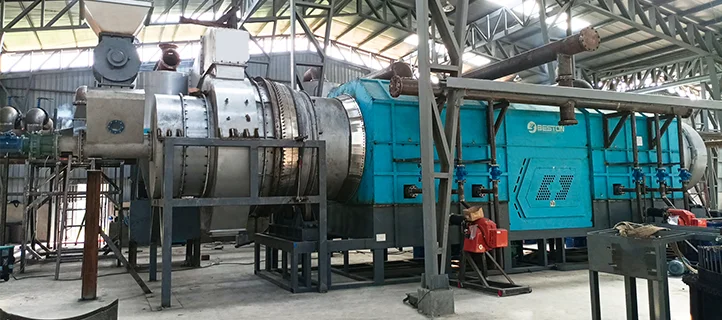
To protect thermal efficiency, an advanced biomass pyrolysis plant relies on integrated pre-drying architectures—such as multi-pass rotary or fluid-bed dryers—positioned immediately before the reactor feed mechanism. Isolating water evaporation from the main anoxic reaction chamber prevents localized thermal shocks and preserves reactor heat exclusively for bond-cleaving devolatilization.
Process integration achieves its highest efficiency by utilizing waste heat harvested from flue gas exhausts or excess syngas combustion to drive these upstream dryers. Driving off both free surface water and bound intracellular moisture in a low-temperature pre-dryer using recovered energy transforms what would be a heavy parasitic energy loss into a balanced closed-loop operation. Lowering feedstock moisture below 10% ensures rapid particle heat transfer, reduces overall specific fuel consumption, stabilizes temperature controls across varying biomass batches, and maximizes the yield of high-value fixed carbon.