Meirdreach an Oincuish!
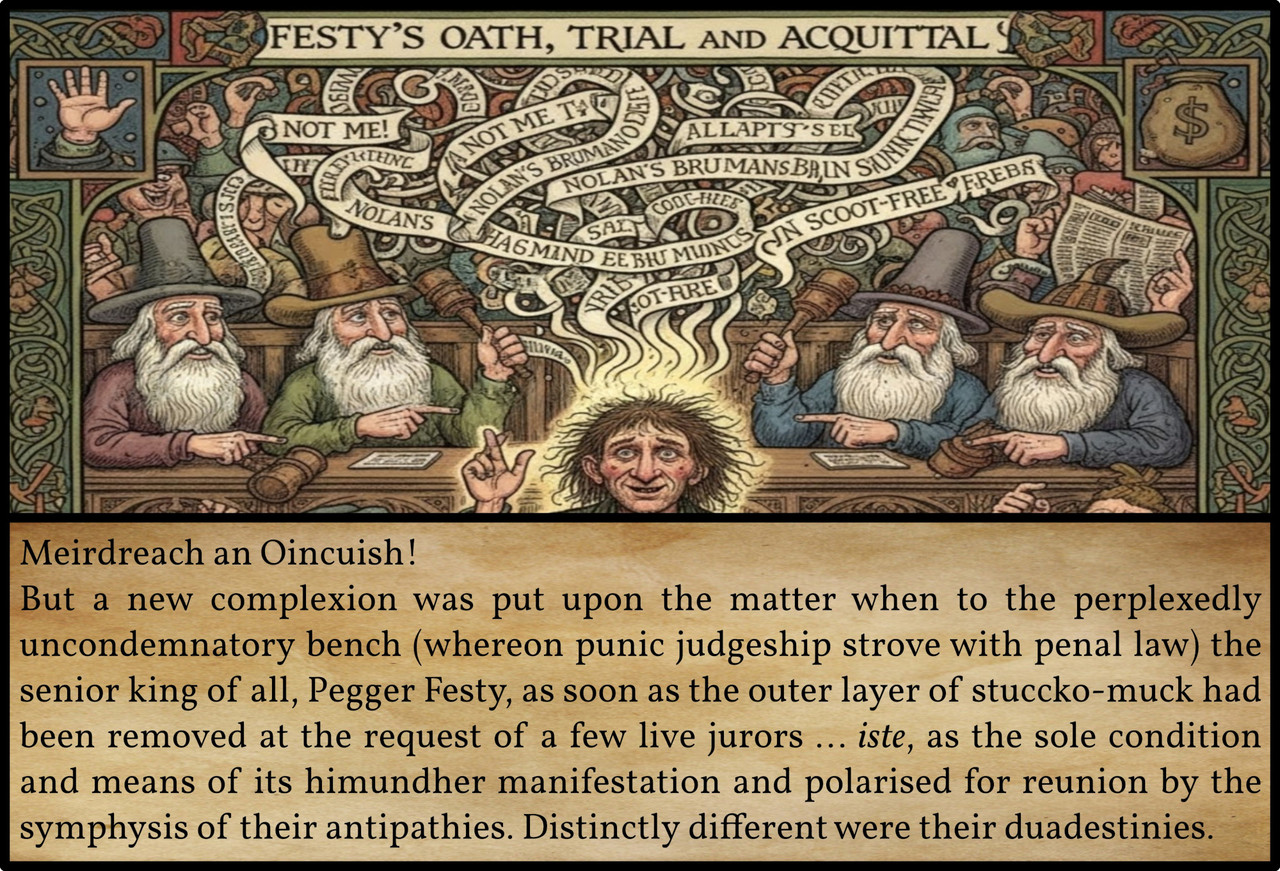
The trial of Festy King continues. He contradicts the testimony of the Wet Pinter (Hyacinth O’Donnell), underscoring the fact that the plaintiff and the defendant in this trial are polar opposites, like Shem & Shaun. Pigs (oink!) and prostitutes (Irish: meirdreach) abound, as in the preceding paragraph, and the difficulty of conducting a trial in a language which the defendant barely understands continues to play its part in the construction of the text.
First-Draft Version
As usual, we begin our analysis by examining the first draft recorded by David Hayman:
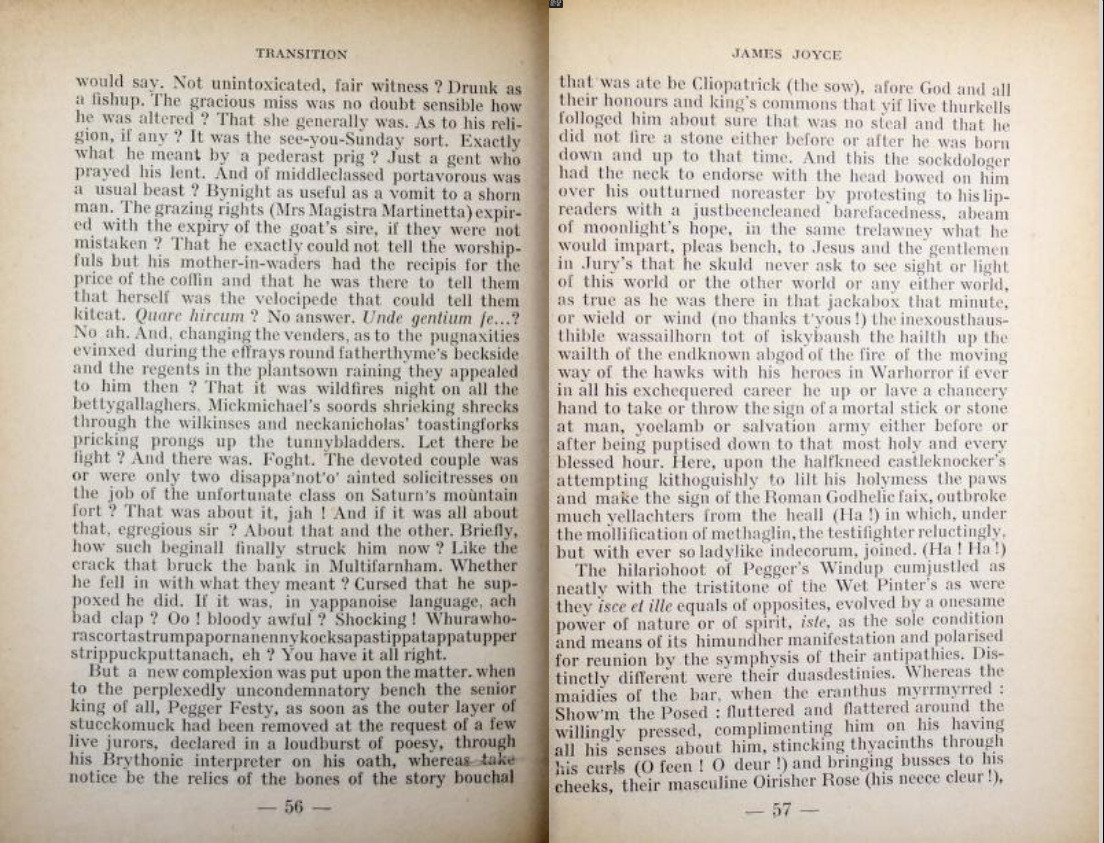
and to the perplexedly uncondemnatory bench, the first King, Festy, declared on his oath & before God & their honours that he did not fire a stone either before or after he was born up to that day & this he supplemented in the same language by postasserting that he might never see sight or light of this world or the next if ever he took or threw the sign of a stone either before or after being baptised up to that blessed hour.
Though Pegger’s Windup contrasted so neatly with the tristitone of the wet pinter’s as were they opposites, evolved by the power of nature & spirit as the sole means & condition of its manifestation, polarised for reunion by the symphysis of their antipathies. Distinctly different were their destinies. ―David Hayman 77
These few lines grew to fifty by the time Joyce was through with them. Between the first and last drafts, however, there was an intermediate version―forty-one lines―that appeared in Number 4 of Eugene Jolas’s literary journal transition in July 1927. The first draft draws on the report of a conflict between Pat O’Donnell and the Kings, which Joyce came across in The Connacht Tribune and Tuam News:
Festy King deposed that he saw O’Donnell arrested. He gave terrible abuse to the soldiers.
―Mr. Ward: Did you fire a stone on the occasion?
―I did not.
―On your oath, did you not strike O’Donnell with a stone?
―On my oath, before God and his honor, I did not fire a stone either before or after I was born up to this day (laughter).
―The Connacht Tribune and Tuam News, 20 October 1923, Page 7, Columns 4–5
The infamous trial of Myles Joyce, the Irish-speaker who was wrongfully convicted of the Maamtrasna Murders in a trial conducted wholly in English, is also a principal source for the trial of Festy King.
Classical Allusions
Festy’s testimony contains several curious allusions to classical history:
punic Phoenician (as in the Punic Wars between Rome and the Phoenician city of Carthage).
Cliopatrick Cleopatra, the last of the Ptolemaic rulers of Egypt and the lover of both Julius Caesar and Mark Antony. There is also an allusion to an episode in Dean Kinane’s St Patrick: His Life, His Heroic Virtues, His Labours, and the Fruits of His Labours:
The words of the Tripartite Life will be of special interest to many in Tipperary and Limerick:
“He (St Patrick) went afterwards to Aradha-Cliach (the present parish of Kilteely) until he was in Iochtar-Cuillem (now Cullen) .... and Ailill met him. His wife went on the hillock where they the clerics were, and said the pigs have eaten our son Ailill through savageness. And Ailill said, ‛I will believe if you resuscitate my son for me.’ Patrick commanded the boy’s bones to be collected, and he directed a Célé-Dé of his people, i.e., Malach Britt, to resuscitate him. ‛I will not offend the Lord,’ said he (he was seized with doubt. Patrick said, ‛That is pitiful, O Malach’ ... Patrick afterwards commanded bishops Ibar and Ailbhe to resuscitate the boy, and he prayed the Lord with them. The boy was afterwards resuscitated through Patrick’s prayers. The boy subsequently preached to the hosts and multitudes in Patrick’s presence. Ailill and his wife thereupon believed, and all the Ui-Cuanach (the people of Cullen) believed and were baptized in that place.” ―Kinane 197–198 fn
Markarthy This may contain allusions to both Mark Antony and the Phoenician god Melqart, who was closely associated with Carthage and its mother city Tyre, and was regarded as the equivalent of the Greek Heracles.
Baalastartey Baal and Astarte were Phoenician deities, associated with the Sun and the Moon respectively.
had the neck to endorse with the head bowed on him The original meaning of endorse was to carry on one’s back. In Greek mythology, Heracles for a time carried the heavens on his back. The Phoenicians referred to the Pillars of Heracles, which originally supported the vault of heaven, as the Pillars of Melqart.
Tyre Phoenician city state, and mother city of Carthage.
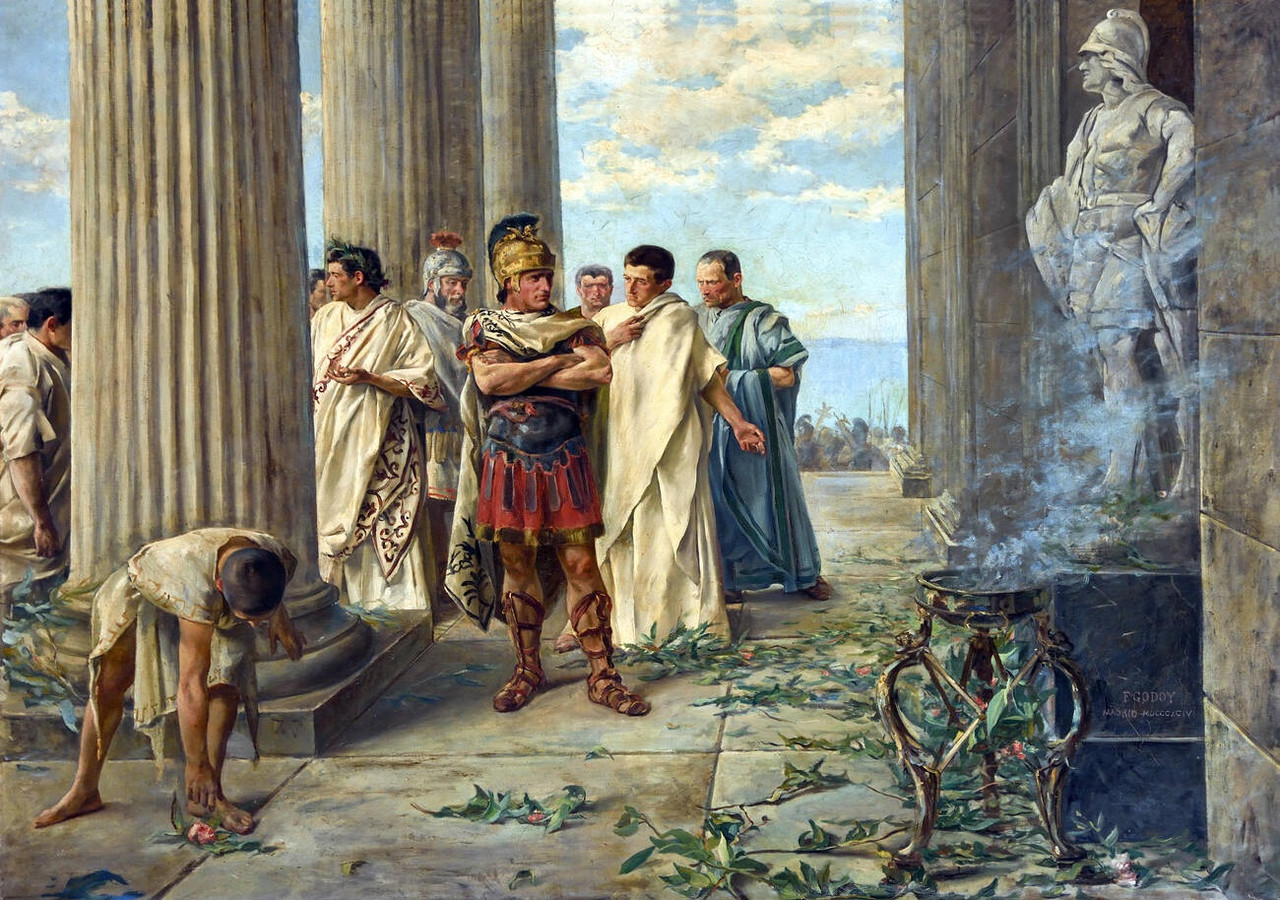
I can only assume that most of the allusions in Finnegans Wake to the Phoenicians are prompted by HCE’s shenanigans in the Phoenix Park. As for the allusions to Cleopatra and Mark Antony, I suggest that Caesar, Cleopatra, and Mark Antony comprise one of the Wake’s love triangles, in which HCE (Caesar) is supplanted by the Oedipal younger man (Mark Antony). According to the James Joyce Digital Archive, Joyce’s principal source for the Phoenician details was the article on Carthage in the Eleventh Edition of the Encyclopædia Britannica, of which Joyce possessed a set.
Giordano Bruno
The hilariohoot of Pegger’s Windup cumjostled as neatly with the tristitone of the Wet Pinter’s as were they, isce et ille, equals of opposites, evolved by a onesame power of nature or of spirit, iste, as the sole condition and means of its himundher manifestation and polarised for reunion by the symphysis of their antipathies. Distinctly different were their duadestinies.
This closing paragraph clarifies the relationship between Festy King and Hyacinth O’Donnell: they are polar opposites, in the sense understood by the 16th-century philosopher Giordano Bruno. On the title page of his play Il Candelaio (The Candlemaker) Bruno wrote the epigraph: In tristitia hilaris, in hilaritate tristis, which is Latin for Cheerful in the midst of sadness : Sad in the midst of cheerfulness.
Bruno’s philosophy of the coincidentia oppositorum, or coincidence of opposites, was succinctly described by Samuel Taylor Coleridge in the eleventh of his _Philosophical Lectures:
In short, the groundwork of [Bruno’s] philosophy was ... the law of likeness, arising from what is called the polar principle, (ie in order to manifest itself every power must appear in two opposites, but these two opposites having a ground of identity were constantly striving to reunite, but not being permitted to pass back to their original state, which would amount to annihilation, they pressed forward and the two formed a third something) and in this manner [he] traced in [his] [trichotomous] philosophy the facts in nature and oftentimes with most wonderful and happy effects. ―Coleridge 323 (edited for clarity)
Joyce was probably echoing Coleridge when he explained Bruno’s philosophy to his patron Harriet Shaw Weaver:
His [Giordano Bruno’s] philosophy is a kind of dualism―every power in nature must evolve an opposite in order to realize itself and opposition brings reunion etc etc. ―Selected Letters 27 January 1925
isce et ille ... iste Latin: this & that ... that. In Finnegans Wake the Brunonian philosophy is exemplified most clearly by Shem & Shaun (the polar opposites, C & V) and the Oedipal Figure (Coleridge’s third something, Y).
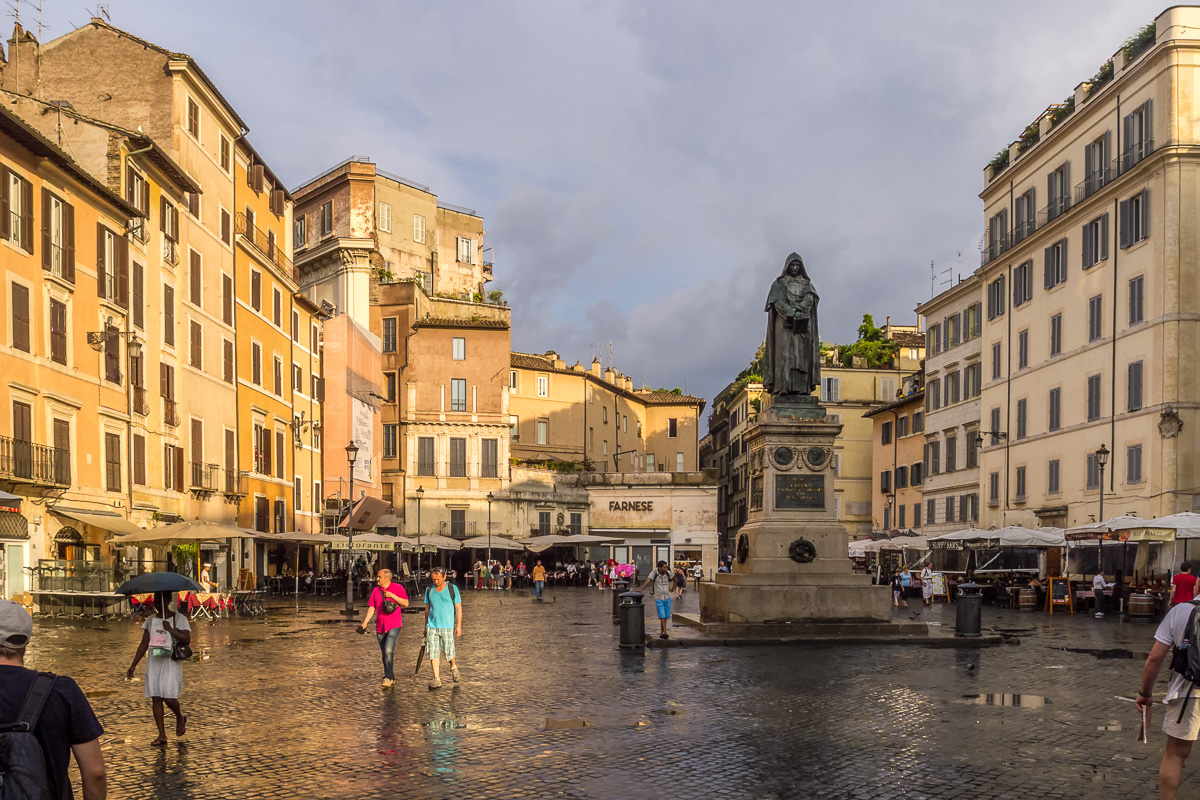
if he was to parish by the market steak Giordano Bruno was burned at the stake in the Campo de’ Fiori, Rome, which is now a marketplace. A statue of Bruno was erected in the centre of the Campo de’ Fiori in 1889. There is also an allusion to one of Thomas Moore’s Irish Melodies, Thee, Thee, Only Thee, which begins with the words: The dawning of the morn. The traditional air to which this song is sung is Stacca an Mharaga, from the Irish Staca an Mhargaidh, which means literally stack of the market, or figuratively Pillar of Society.
this world or the other world or any either world Giordano Bruno famously postulated that the so-called fixed stars were in fact distant suns like our own Sun, and that these suns were orbited by other earths, inhabited by other races.
And here are the details
mhuith peisth mhuiseas fearra bheura muirre hriosmas with best wishes for a very merry Christmas. The English expression is spelled as if it were Irish―an obvious allusion to the linguistic problems that bedeviled Myles Joyce’s trial.
what was deposited from that eyebold earbig noseknaving gutthroat Referring to W.P., or Hyacinth O’Donnell, who was introduced to us as an eye, ear, nose and throat witness.
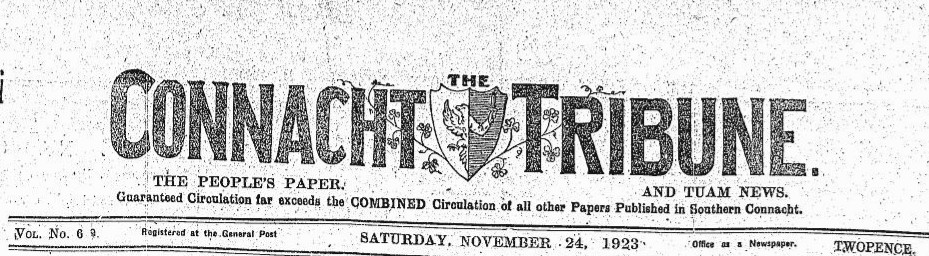
yellachters ... Ha! ... Ha! Ha! German: Gelächter = laughter. Ancient Greek: γέλως [gélōs] = laughter. Joyce’s source was yet another story in The Connacht Tribune and Tuam News:
Outrageous Act
Stationmaster’s House Fired Into
Youth of 16 and His Oath.At Galway District Court, before Mr. Sean Ford, Edward Connelly and John Keller were charged with firing into the residence of Mr. J. Bristley, stationmaster, Moycullen, smashing the windows and otherwise damaging tho house.
The statement of John Keller, 16, a brother of Michael Keller, made before a peace commissioner, was read. He stated that he was within thirty yards of Bristley’s house after midnight on Easter Monday when he saw Connelly fire two shots through the windows, while his brother, Michael, smashed other windows with a stick.
Asked to sign tho statement, the witness refused, stating that it was all lies and was made under pressure of the Civic Guards, whom he was afraid of.
Suptd. Gilroy asked the justice to regard the witness as hostile.
“Do you remember the statement you made and that you were on your oath?” asked the justice, and the witness replied “It was all lies,” at which there was some laughter in which the witness joined.
The justice remonstrated with the witness, reminding him that he was in a court of justice and not a concert room. He said it was a disgraceful thing that a youth of sixteen should take an oath and then swear that everything he had sworn was untrue. He made no further comment on the evidence except to remark that it was an outrageous act to fire into the stationmaster’s house. He would refuse informations.
The Connacht Tribune and Tuam News Saturday 24 May 1924, Page 5, Column 2
And that’s as good a place as any to beach the bark of our tale.
References
- Joseph Campbell, Henry Morton Robinson, A Skeleton Key to Finnegans Wake, Harcourt, Brace and Company, New York (1944)
- Samuel Taylor Coleridge, The Philosophical Lectures of Samuel Taylor Coleridge, Edited by Kathleen Coburn, The Pilot Press Limited, London (1949)
- David Hayman, A First-Draft Version of Finnegans Wake, University of Texas Press, Austin, Texas (1963)
- Eugene Jolas & Elliot Paul (editors), transition, Number 4, Shakespeare & Co, Paris (1927)
- James Joyce, Finnegans Wake, The Viking Press, New York (1958, 1966)
- James Joyce, James Joyce: The Complete Works, Pynch (editor), Online (2013)
- Dean Kinane, St Patrick: His Life, His Heroic Virtues, His Labours, and the Fruits of His Labours, Twelfth Edition, Burns, Oates and Washbourne, London (1920)
- Roland McHugh, Annotations to Finnegans Wake, Third Edition, The Johns Hopkins University Press, Baltimore, Maryland (2006)
- Danis Rose, John O’Hanlon, The Restored Finnegans Wake, Penguin Classics, London (2012)
- Susan Swartzlander, Multiple Meaning and Misunderstanding: The Mistrial of Festy King, James Joyce Quarterly, Volume 23, Number 4, Pages 465–476, University of Tulsa, Tulsa, Oklahoma (1986)
- William York Tindall, A Reader’s Guide to Finnegans Wake, Farrar, Straus and Giroux, New York (1969)
Image Credits
- Meirdreach an Oincuish!: © Finnegans Wake Notes, Fair Use
- Julius Caesar and the Statue of Alexander the Great in the Temple of Melqart at Cádiz: Federico Godoy Castro (artist), Private Collection, Public Domain
- Campo de’ Fiori, Rome: © Benjamin Dahlhoff (photographer), Creative Commons License
Useful Resources
- FWEET
- Jorn Barger: Robotwisdom
- Joyce Tools
- The James Joyce Scholars’ Collection
- FinnegansWiki
- James Joyce Digital Archive
- From Swerve of Shore to Bend of Bay
- John Gordon’s Finnegans Wake Blog