Whereas the maidies of the bar
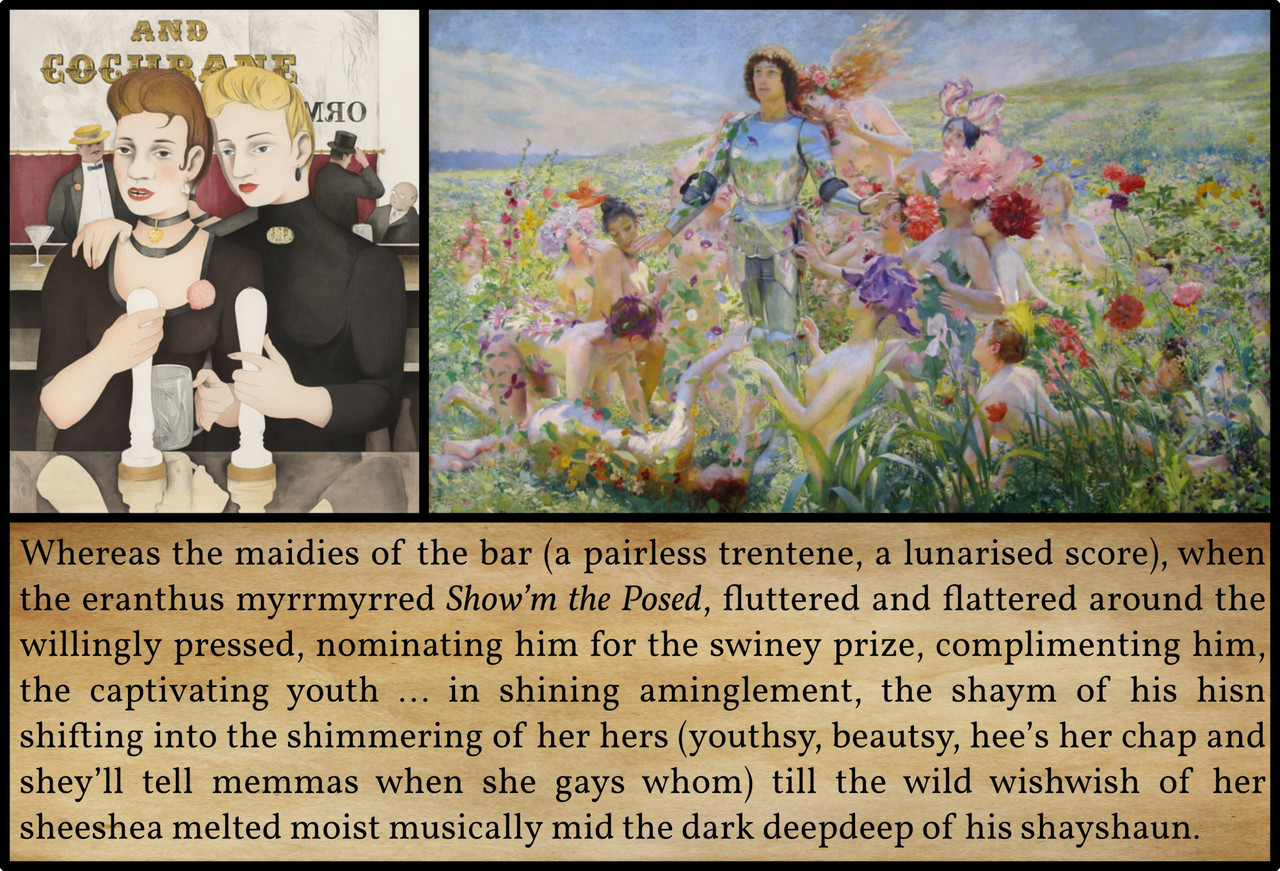
The trial draws towards its conclusion. In the previous section, the defendant Festy King and the plaintiff Hyacinth O’Donnell, were cast in the Brunonian roles of polar opposites―the two legs of an isosceles love triangle. From this perspective, they represent the rival brothers Shem & Shaun respectively. At the apex of the triangle stands their sister Issy. In Finnegans Wake, Issy’s schizophrenic nature is usually depicted by the splitting of her personality into two divergent characters―another pair of Brunonian opposites. Sometimes, however―as occurs in this paragraph―Issy’s multiple-personality syndrome is exemplified by the fragmentation of her ego into a bevy of twenty-eight Rainbow Maidens. Issy was born on 29 February, so she is the Leap-Year Girl (leapgirl), the twenty-ninth member of this troupe.
As elsewhere in Finnegans Wake, the twenty-eight gravitate towards Shaun (Hyacinth O’Donnell), but he has eyes only for the Leap-Year Girl, who remains aloof from the other twenty-eight and seems more interested in Shaun’s darker brother Shem (Festy King). This episode anticipates the children’s game of Angels & Devil (or Colours) in chapter II.1. As though to confirm the connection, Joyce added several allusions to children’s games to this paragraph. These were taken from Norman Douglas’s London Street Games.
In the original 1939 edition of Finnegans Wake this section and the preceding five or six lines made up a single paragraph, but in The Restored Finnegans Wake Danis Rose & John O’Hanlon have broken this into two short paragraphs.
First-Draft Version
As usual, we begin our analysis by examining the first draft of this passage as recorded by David Hayman:
While the maidies of the bar clustered & flattered around the willingly pressed, complimenting him on having all his senses about him, sticking hyacinths in his hair, & bringing busses to his cheeks, legando round his nice new neck for him & pizzicando at his willywags[,] it was not unobserved by the court that for one among all, with unmixed admiration he seemed blindly, mutely, hands over ears fascinated when she shining aminglement, the shay of his shifting into the shimmering of hers till the wishwish of her shashay melted musically mid the deepdeep of his shayshaun ―David Hayman 77
These lines were first drafted around November-December 1923. Over the course of the following fifteen years, they swelled to about three times their original length. Between this draft and the final published version was an intermediate version, which appeared in Number 4 of Eugene Jolas’s literary journal transition in July 1927.
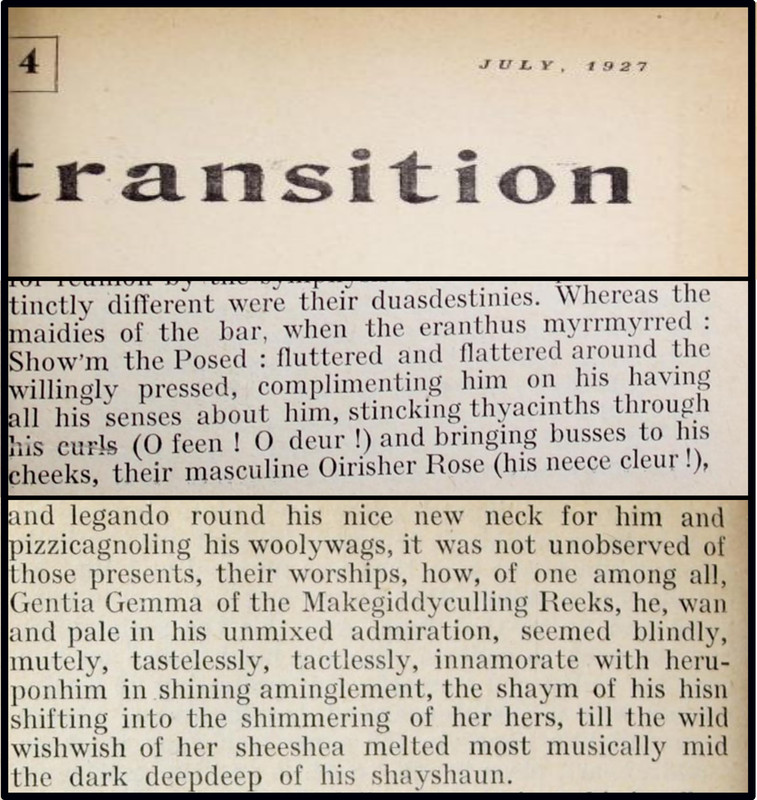
A Brunonian Analysis of the Trial
In an earlier article I pointed out how little consensus there is among Joycean scholars concerning the identities of the characters in this confusing trial. This is exemplified in the present instance by Joseph Campbell & Henry Morton Robinson, whose summary of this passage reads as follows:
No sooner had Pegger concluded his statement than the maidies of the bar fluttered and flattered around him, complimenting him, sticking hyacinths through his curls, and bringing busses to his cheeks. And it was not unobserved that of one among them all he seemed blindly, mutely, tastelessly innamorate. ―Campbell & Robinson 86
They clearly identify Pegger Festy with Shaun, who is mobbed by the Rainbow Maidens, and the Wet Pinter with Shem. But in this passage the character who is mobbed is also described as the willingly pressed, which suggests that he is also W. P. The confusion is partly due to the fact that Brunonian opposites always seek reconciliation by fusing to create a third character, the Oedipal Figure (Shayshaun), who embodies both brothers. Joyce makes this point by associating the initials WP with both characters.
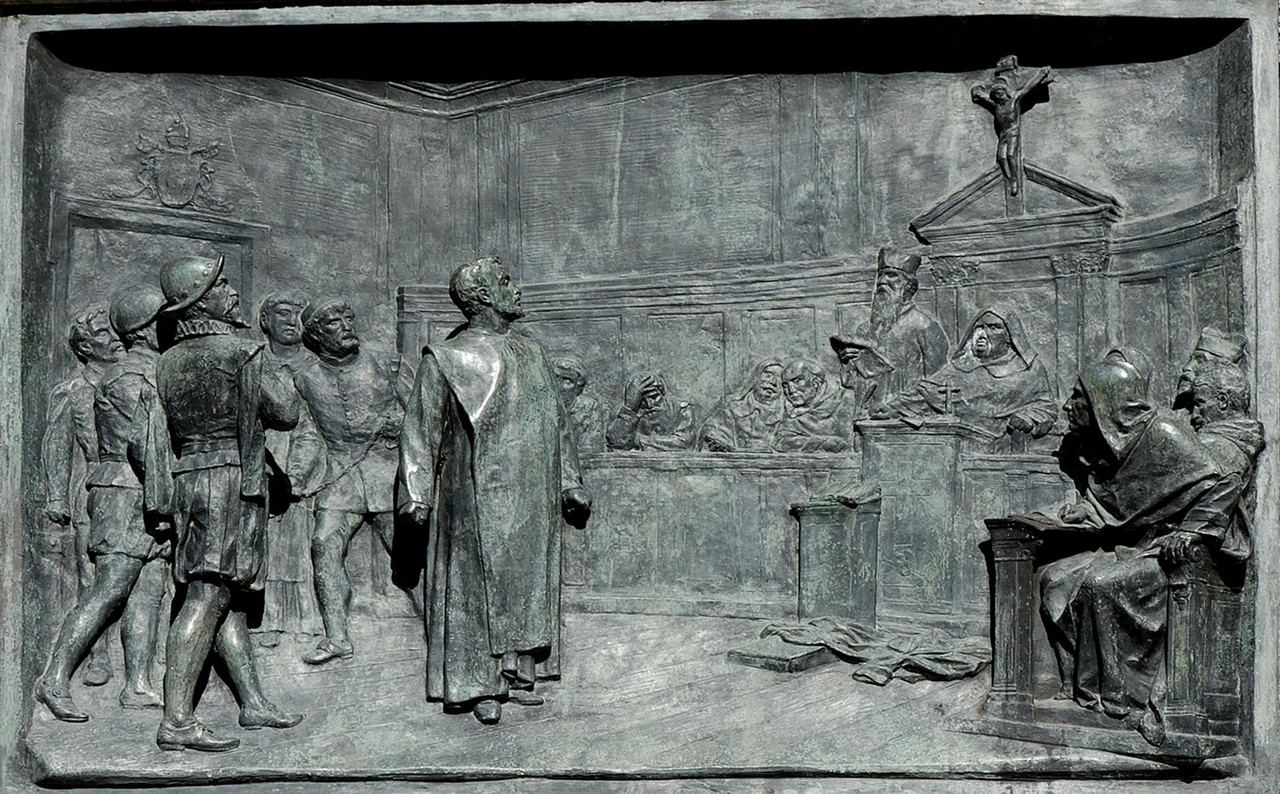
From the Brunonian point of view, the trial opens with Festy King being haled into court. The description of Festy―a drunkard charged with disreputable deeds―seems to imply that he is Shem. When Shaun first enters the witness box he is referred to as W.P. and is described as an eye-ear-nose-and-throat doctor, like Oliver St John Gogarty, who is a Shaunlike figure (Glasheen 107). In the course of his testimony he introduces Hyacinth O’Donnell, who is described as a wordpainter, which seems to imply that Shaun is talking about himself―always his favourite subject. At the end of the trial, however, Festy King has been replaced by the character Pegger Festy, who is given the last word. The implication seems to be that Pegger Festy is the Oedipal Figure, who embodies both Festy King and W.P. The hilariohoot of Pegger’s Windup perhaps confirms this suspicion. As we saw in the previous article, hilariohoot alludes to Bruno’s motto (In tristitia hilaris, in hilaritate tristis = Mirthful in the midst of sorrows : sorrowful in the midst of mirth), while Pegger’s Windup mirrors the WP initials. In Finnegans Wake, one of the principal avatars of the Oedipal Figure is Tristan, who may be alluded to in the phrase send treats in (Gordon 92.22). Saint Tristan was supposedly a Breton monk who took part in the evangelization of Ireland, but his existence is doubtful. He may be no more than the Tristan of Arthurian legend.
William Tindall also identifies Festy with Shaun and W.P. with Shem, but he realizes that the brothers exchange personalities in the course of the trial:
But Pegger as Shaun is the witness against Earwicker, and the Wet Pinter is the attorney for the defense. (A West Pointer is a cadet or Cad from the new world, and a Wet Pinter is a drunk―or Shem.) But Shaun, giving a “hilariohoot,” has changed places with Hilary-Shem; and Shem’s “tristitone” shows that he has become Tristopher-Shaun. ―Tindall 89. The New World (St Brendan’s Land Promised to the Saints) is usually associated with Shaun, and Australia (the infernal down-under) with Shem.
The two maidies of the bar also form a pair of Brunonian rivals. In the context of a trial, bar refers to the legal profession, but in a book like Finnegans Wake the phrase also means barmaids. Was Joyce thinking of Mina Kennedy and Lydia Douce, the two barmaids in the Ormond Hotel in the Sirens episode of Ulysses? Issy’s name in this paragraph, Gemma Gentia hints at the Latin: gemina = twin, double (feminine), and echoes sosie sesthers from page 1: French: sosie = lookalike, doppelganger.
And here are the details
a pairless trentene, a lunarised score 30 – 2 = 28. In English common law a lunar month is precisely twenty-eight days long. French: trentaine = about thirty. Also present, peerless and Trent, a river with which Issy is identified in II.3.
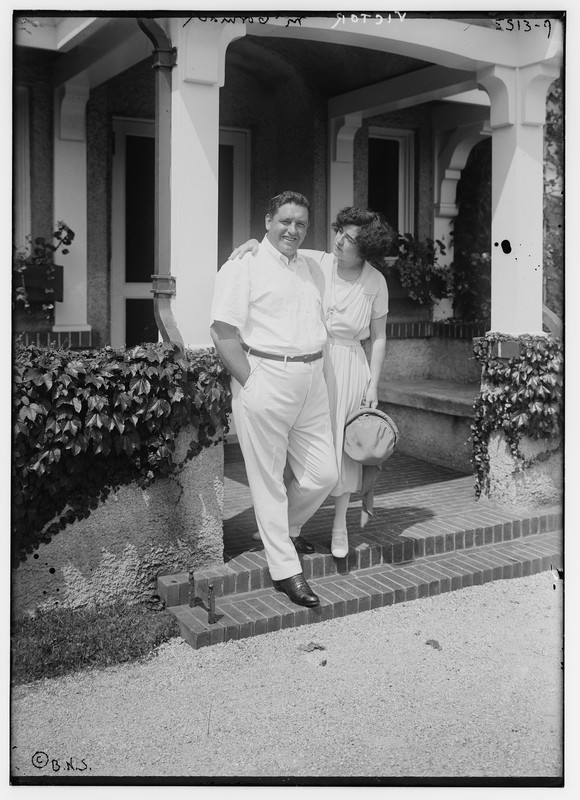
their masculine Oirisher Rose As Adaline Glasheen pointed out, the Irish tenor John McCormack was one of Joyce’s principal models for the character of Shaun the Post (Show’m the Posed) in Finnegans Wake (Glasheen 177). In Pierre V R Key’s John McCormack: His Own Life Story, the tenor describes the impression made upon him by the singing of his future wife, the soprano Lily Foley:
Miss Foley sang, in that glorious lyric soprano of hers, and I listened and was glad. Others appeared glad, also, if their applause may count as the measure of their gladness. But for me it was her art and the finished authority she displayed. It seemed so very easy, as she sang; none of the facial distortion or writhing of body which is too customarily to be seen. She just stood there,―like a feminine Irish rose, and brought everyone to her feet. ―Key 73–74
This passage contains allusions to some musical terms: bar, legato, pizzicato. There are also snatches from two of Thomas Moore’s Irish Melodies:
Sweet Innisfallen [Air: The Captivating Youth]
Believe Me, If All Those Endearing Young Charms [Air: My Lodging’s in the Cold Cold Ground]
Other musical allusions include:
The Maid Behind the Bar An Irish reel.
The Maids of Castlebar Another Irish reel.
My Wild Irish Rose A popular song by the Irish-American performer Chauncey Olcott.
Mother Machree Another Irish-American sentimental song connected with Chauncey Olcott. This one was composed in 1910, with lyrics by Olcott & Rida Johnson Young and music by Ernest Ball. Irish: mo chroí = my heart, a traditional term of endearment.
Pastheen Fionn A traditional Irish hornpipe. Irish: An Páistín Fionn = The Fair-Haired Little Child.
Flowers and Precious Stones
In Finnegans Wake the Rainbow Maidens are typically depicted flirting with Shaun in a manner that always reminds me of the scene in Richard Wagner’s opera Parsifal in which Parsifal is seduced by the Flower Maidens in Klingsor’s Enchanted Garden. This association accounts for the flowery allusions that run through this passage. Connected with this botanical theme is a mineralogical one, involving allusions to precious stones. This anticipates the role played by the heliotrope in the children’s game in II.1.
when the eranthus myrrmyrred Eranthis hyemalis is the botanical name for the winter aconite, a flowering plant of the buttercup family. It generic name comes from the Ancient Greek: ἔαρ = spring : ἄνθος = flower. The common myrrh is one of the species of trees from which the precious resin of the same name is harvested. Myrrh was also one of the gifts (treats ... presents) of the Magi.
willingly pressed Flowers are pressed between the pages of a book to preserve them and to prepare them for botanical study.
thyacinths The hyacinth is both a flowering plant and a precious stone.
Oirisher Rose Not only the rose but also the lily. Although Lily Foley is not explicitly named in this passage, the allusion to her as a feminine Irish rose is clear.
Gemma Gentia Italian: (botany) gemma = bud : (mineralogy) = gem, jewel. The gentian is a blue flowering plant.

And that’s as good a place as any to beach the bark of our tale.
References
- Joseph Campbell, Henry Morton Robinson, A Skeleton Key to Finnegans Wake, Harcourt, Brace and Company, New York (1944)
- Norman Douglas, London Street Games, Second Edition, Chatto and Windus, London (1931)
- David Hayman, A First-Draft Version of Finnegans Wake, University of Texas Press, Austin, Texas (1963)
- Eugene Jolas & Elliot Paul (editors), transition, Number 4, Shakespeare & Co, Paris (1927)
- James Joyce, Finnegans Wake, The Viking Press, New York (1958, 1966)
- James Joyce, James Joyce: The Complete Works, Pynch (editor), Online (2013)
- Pierre V R Key, John McCormack: His Own Life Story, Small, Maynard & Company, Boston (1918)
- Roland McHugh, Annotations to Finnegans Wake, Third Edition, The Johns Hopkins University Press, Baltimore, Maryland (2006)
- Danis Rose, John O’Hanlon, The Restored Finnegans Wake, Penguin Classics, London (2012)
- Susan Swartzlander, Multiple Meaning and Misunderstanding: The Mistrial of Festy King, James Joyce Quarterly, Volume 23, Number 4, Pages 465–476, University of Tulsa, Tulsa, Oklhoma (1986)
- William York Tindall, A Reader’s Guide to Finnegans Wake, Farrar, Straus and Giroux, New York (1969)
Image Credits
- Bronze by Gold: Richard Hamilton (artist), © 2018 Artists Rights Society (ARS), New York / DACS, London : Art Institute Chicago, Fair Use
- Le Chevalier aux fleurs: Georges Rochegrosse (artist), Musée d’Orsay, Paris, Public Domain
- The Trial of Giordano Bruno: Ettore Ferrari (sculptor), Campo de’ Fiori, Rome, Public Domain
- John McCormack & His Wife Lily: Bains News Service, Library of Congress, Washington, DC, George Grantham Bain Collection, Public Domain
- Winter Aconite (Eranthis hyemalis): © gaucho (photographer), Creative Commons License
Useful Resources
- FWEET
- Joyce Tools
- The James Joyce Scholars’ Collection
- FinnegansWiki
- James Joyce Digital Archive
- John Gordon’s Finnegans Wake Blog