Urgent need for climate justice
Communities living in vulnerable areas should have reliable early warning systems. People should know what a warning means, where to go and how quickly they need to move. Relocation of communities at high risk should also be considered. Sometimes relocation is the most responsible thing a government can do. This is where climate justice becomes more than a phrase. The international community has already recognised the concept of Loss and Damage. The Loss and Damage Fund was created to help vulnerable developing countries address economic and non-economic losses linked to climate change. Nepal should now work to turn that international commitment into practical support.
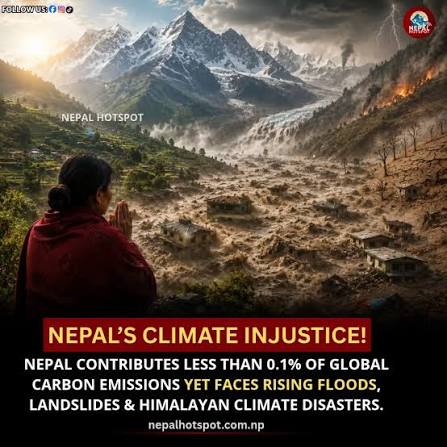
When a flood destroys a bridge, a road, it costs money. When a hydropower project is damaged, it costs money. When a family loses its home, farmland, livestock, or business, it costs money. Unfortunately, every loss can be measured in money. What is the value of a village where generations have lived? What is the value of a cultural site that disappears? What is the value of a life that might have been saved if a reliable warning system had existed? These are also the costs of climate change, and Nepal must be honest about its own responsibilities. Asking for climate justice does not mean asking others to solve all our problems. We must protect forests and watersheds. We must control unplanned construction in high-risk areas. We must improve building standards and disaster preparedness. Roads, bridges and hydropower projects must be designed for future climate risks, not simply the conditions of the past.
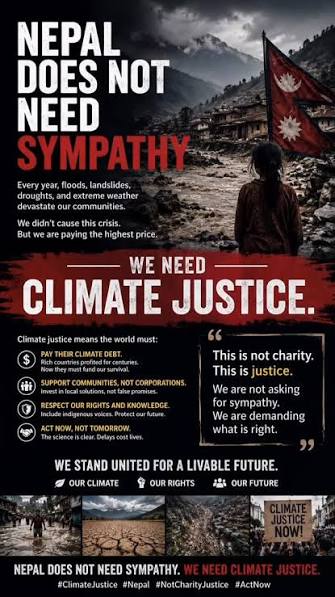
Early warning systems
Our local governments need stronger disaster management capacity. Early warning systems must reach ordinary people, not remain inside government offices and technical reports. Federal, provincial and local governments must work together before disasters happen. Nepal can say two things at the same time: We will take responsibility for the risks we can control, and we expect the international community to take responsibility for climate risks we did not create. That is not charity. It is fairness.
For too long, the response to disasters in countries like Nepal has followed a familiar pattern. A disaster happens. Sympathy arrives. Relief is provided. Nepal rebuilds. International attention moves on. Then another disaster comes, and we begin again. Rasuwa should be a turning point. Instead of waiting for the next disaster, Nepal should make a stronger international case for Himalayan climate adaptation, disaster preparedness, scientific monitoring and Loss and Damage financing.
We should seek help when disasters happen, but we also need to change the conversation. Nepal must move from asking only for relief after a disaster to demanding investment in prevention before the next one. We should tell the world that Nepal is ready to do its part. But we cannot carry the full cost of a global crisis we did not create. That is not begging. That is climate justice. And perhaps the question Rasuwa has left for Nepal and the world is this: When will Nepal stop being a country that waits for relief after every disaster and become a country that demands climate justice before the next disaster happens?
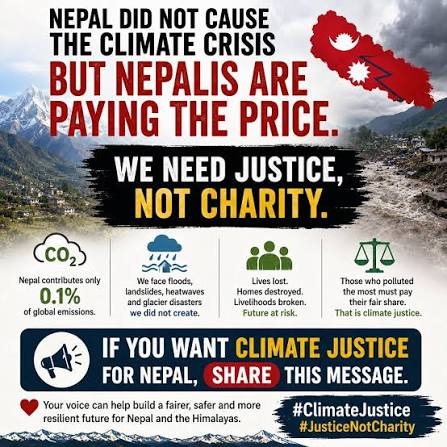
Thank you for your time