Do Hot and Cold Streaks Predict the Next Slot Result? Understanding the Gambler’s Fallacy
Do Hot and Cold Streaks Predict the Next Slot Result? Understanding the Gambler’s Fallacy
Why short runs of wins or losses can look meaningful even when the next random outcome is still unpredictable — August 13, 2026
An independent educational editorial on randomness, streaks, sample size, and why recent outcomes should not be treated as predictions.
A streak can feel like information. Three losses in a row may make the next result seem “due” to improve. Several wins close together can create the opposite impression: that a game has become “hot” and is likely to keep paying. Both reactions are understandable because the human brain is built to detect patterns. The problem is that random sequences naturally produce clusters, repeats, dry spells and bursts without those patterns becoming reliable forecasts.
This is where the gambler’s fallacy matters. In its classic form, it is the belief that an outcome becomes more likely because it has not appeared recently — for example, assuming a win is now more likely simply because several losses came first. A related mistake runs in the other direction: treating a recent run of wins as evidence that the next random result is more likely to be another win. For readers who encounter labels such as Slot Win Game
, “hot slots,” “cold games” or streak trackers, the useful question is not what the recent sequence looks like. It is whether the rules actually give earlier outcomes any influence over the next one.
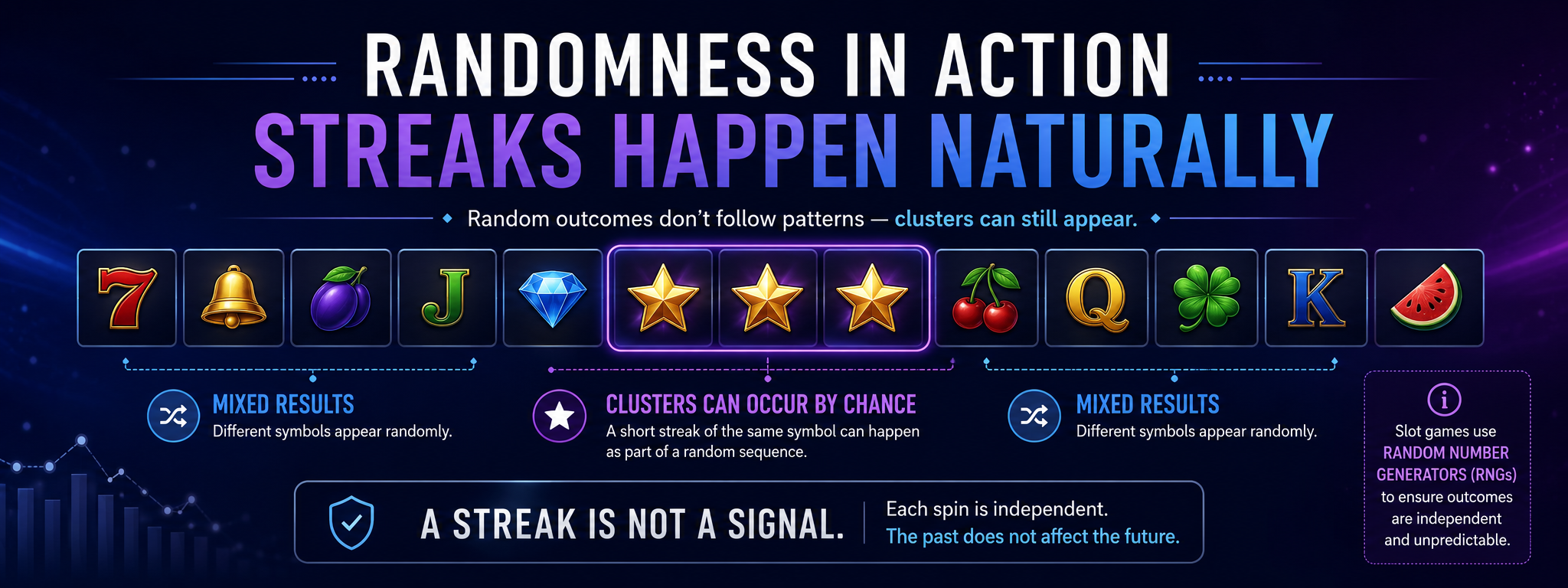
A Random Sequence Does Not Have to Look Random
People often expect randomness to alternate neatly: win, loss, win, loss, with few long runs. Real random data is messier. Repeated outcomes and visible clusters are part of randomness, not evidence against it. Toss a fair coin enough times and you will eventually see several heads or tails together. The same statistical intuition applies when a game outcome is generated by a properly implemented random process: a short run can look dramatic while still being compatible with the underlying probabilities.
That distinction matters because the eye tends to treat a cluster as a signal. A group of losses may be described as “cold,” while a cluster of wins may be called “hot.” Those descriptions summarize the past; they do not automatically explain it and they do not, by themselves, change the next probability.
What the Gambler’s Fallacy Actually Gets Wrong
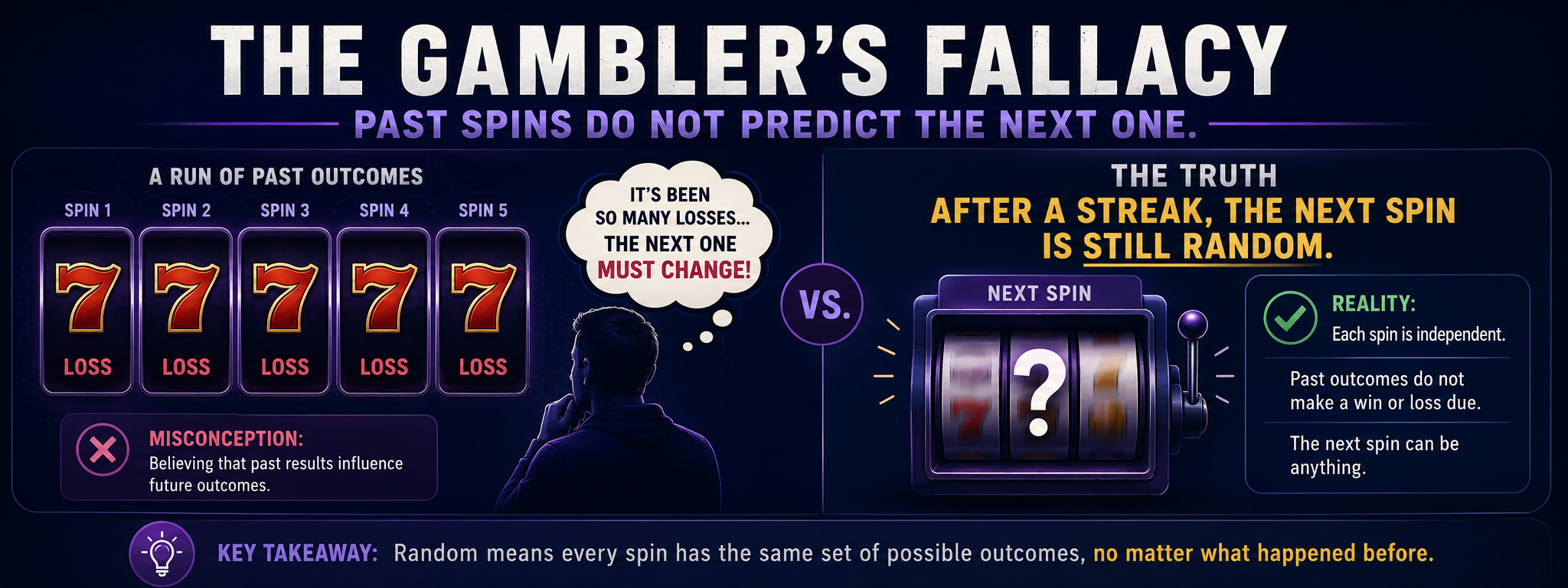
The gambler’s fallacy confuses balance over a large number of trials with compensation on the very next trial. If an independent event has the same probability each time, the process does not need to “make up” for a recent streak. Five losses do not create a debt that the next result must repay. Likewise, several wins do not create momentum inside a random number generator.
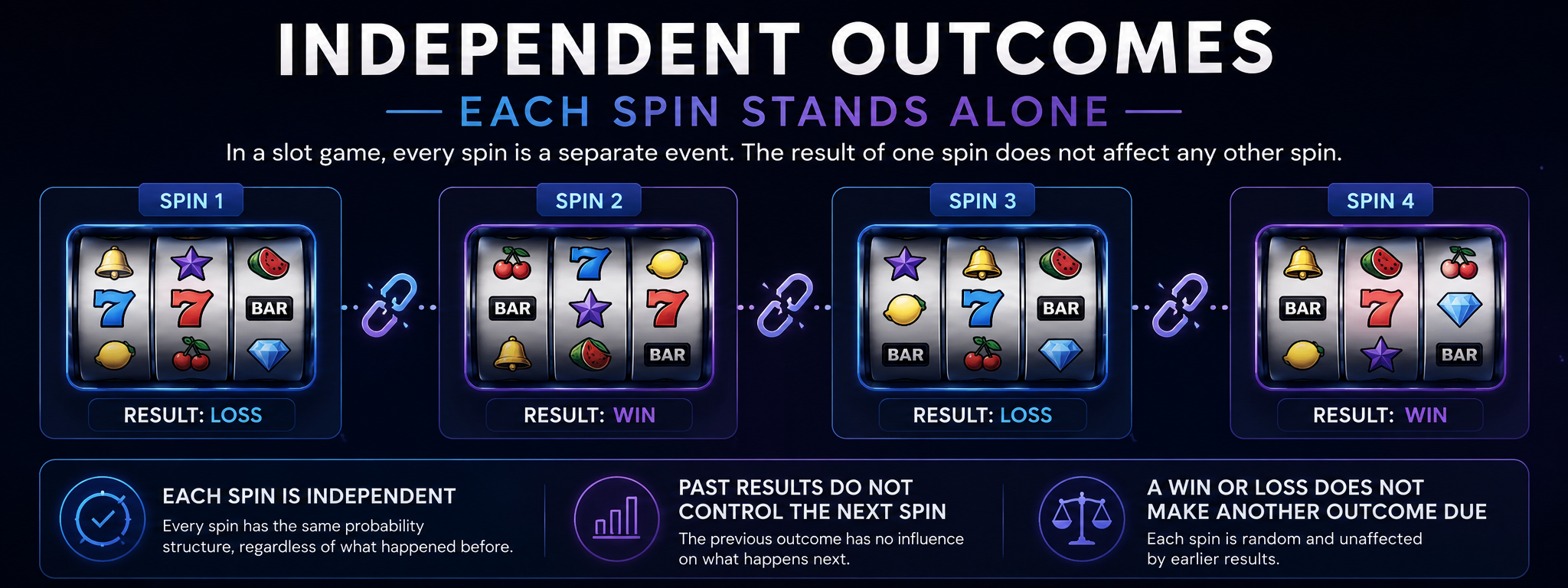
The Responsible Gambling Council describes the gambler’s fallacy as the mistaken belief that a future outcome becomes more likely because it has not occurred recently. Its explanation is useful because it focuses on independence: when events are independent, previous results do not alter the probability of the next one. The UK Gambling Commission’s technical standards similarly require regulated random outcomes to be unpredictable and prohibit adaptive behaviour in which a game changes future random results to compensate for earlier ones.
There is an important qualification. Not every feature in every game is identical. Some games may have progressive jackpots, persistent bonus meters, collected symbols or other state-based mechanics whose rules carry information forward. The correct habit is therefore to read the game rules rather than assume that every visible element is memoryless. But when the next result is defined by an independent random process, a streak is history, not a forecast.
Why Small Samples Create Convincing Stories
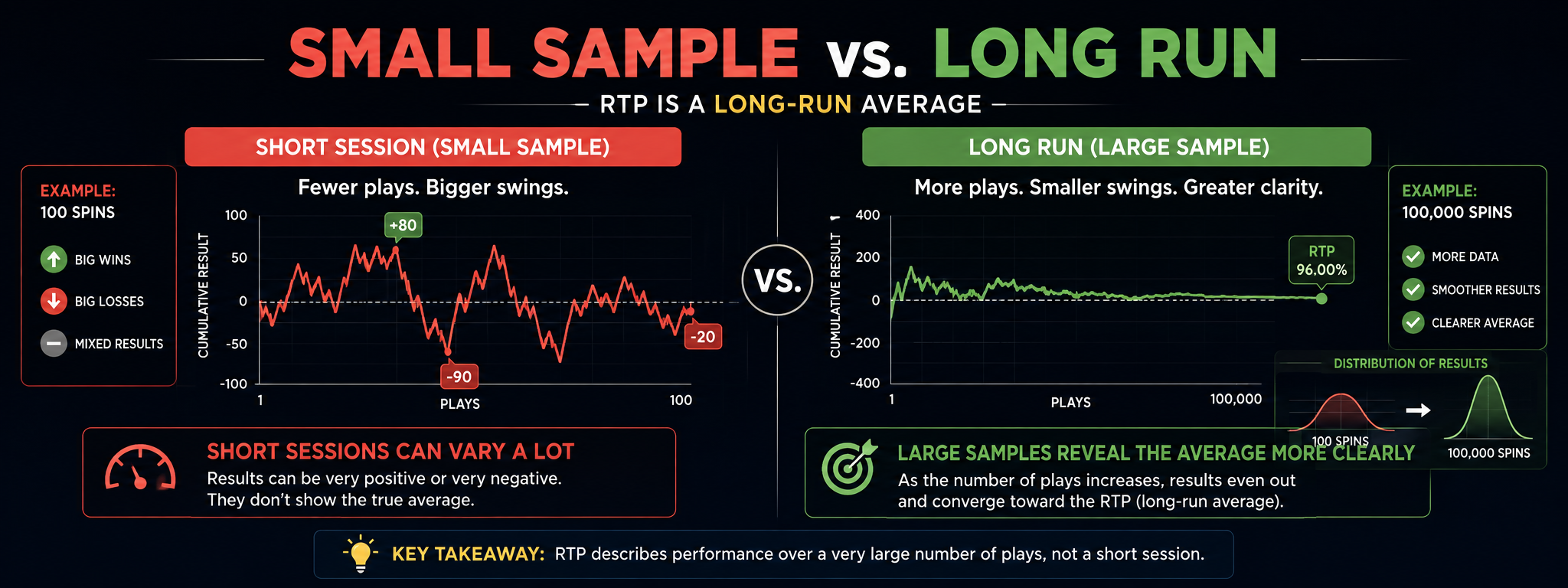
Short sessions are especially good at producing misleading narratives. With only a handful of outcomes, ordinary statistical variation can dominate what the player sees. A person might experience an unusually good or unusually poor run and then generalize from it, even though the sample is far too small to describe the long-run behaviour of the game.
This is closely related to why return-to-player percentages are often misunderstood. RTP is a long-run theoretical measure, not a schedule that forces short sessions to finish near a published percentage. A game can have a stated long-run RTP while individual sessions vary widely above or below it. The larger the sample, the more useful averages become for describing a process; the smaller the sample, the more room there is for noise to look like a pattern.
That is also why screenshots of “hot” histories, recent payout lists or a handful of dramatic results should not be treated as predictive evidence. They may accurately describe what already happened. They do not establish what must happen next.
Hot-Hand Thinking Is the Mirror Image
The gambler’s fallacy usually expects reversal: after enough losses, a win feels due. Hot-hand thinking expects continuation: after several wins, another win feels more likely. In a genuinely independent random process, both can be wrong for the same reason. The past sequence is being given predictive weight that the rules do not provide.
This distinction is useful when evaluating language on gaming pages. If a page using the Slot Win Game name, or any similar site, labels a game as “hot” or “cold,” treat that wording as descriptive or promotional unless there is a clearly explained rule showing that game state actually changes future probabilities. A recent history panel can be useful for record-keeping, but it should not be confused with a forecasting tool.
A Better Way to Read Streaks
Instead of asking whether a game is hot, cold or due, ask four narrower questions. Is the outcome generated randomly? Do the published rules say earlier outcomes affect the next event? Is a displayed meter a real game-state mechanic or merely a record of past activity? And am I looking at enough data to support the conclusion I am drawing?
Those questions shift attention away from intuition and toward mechanism. They also make it easier to recognize the limits of historical data. A long losing streak can be frustrating, but it does not create a mathematical obligation for the next spin to win. A winning streak can be exciting, but it does not create a mathematical guarantee that the run will continue.
For anyone choosing to participate in real-money gaming, this is also a useful responsible-play boundary. Do not increase spending because a win feels overdue, and do not extend a session because a streak feels too good to stop. PAGCOR states that gambling in the Philippines is for people aged 21 and above and provides responsible-gaming and player-exclusion resources for people who want additional control or support.
Final Thoughts: Prediction, Not Pattern Spotting
Humans will continue to see patterns in random data; that tendency is not going away. The practical skill is learning when a pattern has predictive meaning and when it is simply a description of a short sequence. Random systems can produce streaks. Long-run averages can coexist with extreme short-run variation. Neither fact means the next independent result has become “due.”
For readers encountering Slot Win Game
Game or any other gaming interface, the safest interpretation is straightforward: use published rules and verified probability information to understand how a game works, and treat recent outcomes as history unless the rules explicitly say that game state carries forward. A streak may be real as a record of the past. It is not, by itself, a map of what comes next.
Responsible-Use Note
Gaming for 21 years old and above only. Random outcomes can produce losses as well as wins. Treat gambling as entertainment, not income, and do not chase losses or extend play because a result feels “due.” PAGCOR provides responsible-gaming, exclusion and helpline resources for people who want support or stronger limits.
Sources & References
UK Gambling Commission — Remote Gambling and Software Technical Standards, RTS 7: Generation of Random Outcomes.
Responsible Gambling Council — Gambling Dictionary: Gambler’s Fallacy and The Science Behind Gambling.
PAGCOR — Responsible Gaming, Player Exclusion, and National Problem Gambling Helpline information.
Steemit — Terms of Service and FAQ (reviewed for publication-format and account/content-permanence considerations).