Who Owns Google? Understanding Google’s Ownership and Control
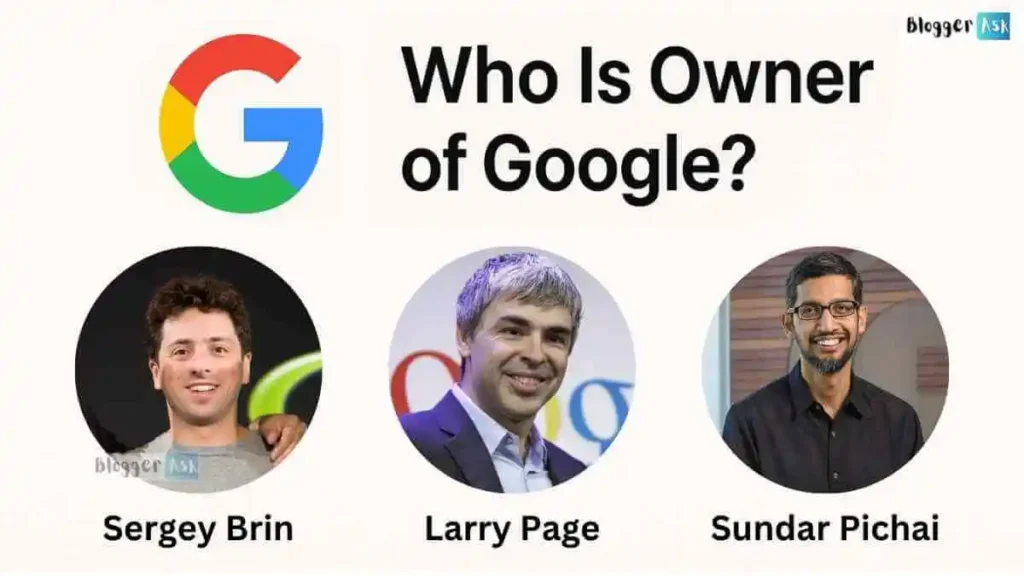
Google is one of the most influential technology companies in the world, powering search, advertising, YouTube, Android, Google Maps, Gmail, and numerous other products used by billions of people.
Because of its enormous size, a common question is: Who actually owns Google?
The short answer is that Google is owned by Alphabet Inc., the parent company created during Google's corporate restructuring in 2015. However, understanding who controls Google requires looking beyond the name of its parent company.
Google's ownership involves three different concepts: legal ownership, economic ownership, and voting control.
Google Is Owned by Alphabet Inc.
Google LLC is a subsidiary of Alphabet Inc. Alphabet became Google's parent company in October 2015 when Google reorganized its corporate structure.
Under this arrangement, Google became the company's main operating business, while Alphabet became the holding company overseeing Google and several other businesses.
This means Google itself is not a separately publicly traded company.
When investors purchase Google's publicly traded stock, they are actually purchasing shares of Alphabet Inc. Alphabet trades on the Nasdaq under two primary ticker symbols:
- GOOGL — Class A shares with voting rights
- GOOG — Class C shares without ordinary voting rights
Google's major businesses, including Search, YouTube, Android, Google Cloud, Gmail, and Google Maps, operate within the Google business structure under Alphabet.
Who Controls Google?
Legal ownership and control aren't necessarily the same thing.
Alphabet is publicly owned through millions of shareholders around the world. However, Google's founders, Larry Page and Sergey Brin, retain substantial voting influence through Alphabet's special Class B shares.
Class B shares carry significantly more voting power than ordinary Class A shares. This dual-class structure allows the founders to maintain considerable control over Alphabet even though they don't own a majority of the company's economic value.
According to Alphabet's 2026 proxy disclosures, Page and Brin together hold approximately 52.7% of Alphabet's voting power.
That distinction is important.
A person can own Alphabet stock without having anything close to the same voting influence as the founders.
Ownership vs. Voting Control
| Category | Who? | Role |
|---|---|---|
| Legal parent | Alphabet Inc. | Owns Google LLC |
| Founders | Larry Page & Sergey Brin | Majority voting control |
| CEO | Sundar Pichai | Runs day-to-day operations |
| Public investors | Millions of shareholders | Own economic interests in Alphabet |
| Institutional investors | Investment firms and funds | Hold significant amounts of Alphabet stock |
So, while Alphabet is the legal owner of Google, Page and Brin remain the most important individuals when discussing voting control.
For a more detailed breakdown of the founders' ownership percentages, voting structure, shareholders, and the difference between ownership and control, this guide to who owns Google provides a useful explanation.
Larry Page and Sergey Brin: Google's Founders
Larry Page and Sergey Brin founded Google while they were graduate students at Stanford University.
The project initially began as a research project called BackRub, which focused on analyzing relationships between websites. The founders eventually renamed the company Google and incorporated it in 1998.
Their ownership structure evolved considerably as Google raised capital, expanded internationally, and eventually went public.
Google's 2004 initial public offering introduced a dual-class share structure that helped Page and Brin preserve voting control.
That structure became particularly important after Google created Alphabet.
Even after Page and Brin stepped away from their executive positions, they retained their special voting shares.
Does Sundar Pichai Own Google?
This is another common misunderstanding.
Sundar Pichai is the CEO of Google and Alphabet, but he is not the owner of Google.
Pichai joined Google in 2004 and eventually became CEO of Google in 2015. Following the Alphabet restructuring, he also became CEO of Alphabet in 2019.
As CEO, Pichai is responsible for Google's daily operations and strategic execution.
His responsibilities include areas such as:
- Google Search
- YouTube
- Android
- Google Cloud
- Google advertising
- Gemini and Google's AI products
- Chrome
- Other major Google businesses
However, being CEO does not mean owning the company.
A CEO is appointed to lead the business, while ownership comes from holding shares and the associated economic and voting rights.
Is Google a Public Company?
There is an important distinction here.
Google LLC is not separately publicly traded. Alphabet Inc. is.
Investors can purchase Alphabet shares through the stock market, but there isn't a standalone “Google stock” representing direct ownership of Google LLC.
The relationship can be simplified like this:
Public shareholders → Alphabet Inc. → Google LLC → Google products and businesses
This structure is why people commonly say they own Google stock even though their legal investment is actually in Alphabet.
Who Are Alphabet's Other Shareholders?
Alphabet has a broad shareholder base that includes:
- Individual investors
- Pension funds
- Mutual funds
- Index funds
- Asset management companies
- Institutional investors
- Company executives and employees
Large institutional investment firms can own substantial amounts of Alphabet stock.
However, the number of shares owned isn't necessarily equivalent to voting influence because Alphabet has multiple share classes.
This is the key reason why Page and Brin can retain majority voting control without owning more than half of Alphabet's total economic value.
Why Did Google Create Alphabet?
Alphabet's creation wasn't primarily about changing who owned Google.
Instead, it was designed to reorganize Google's expanding collection of businesses.
Before Alphabet, Google's corporate structure included numerous projects that went well beyond its core internet business.
The restructuring separated Google's primary operations from businesses commonly grouped under Other Bets.
Google remained responsible for its major technology and advertising businesses, while Alphabet became the parent organization overseeing Google and companies such as:
- Waymo
- Verily
- Wing
- Other long-term technology ventures
This structure also gave investors greater visibility into different parts of the business.
Who Owns YouTube, Android and Gmail?
These services ultimately belong to the Google business under Alphabet.
For example:
Alphabet Inc.
↓
Google LLC
↓
YouTube, Android, Gmail, Google Search, Google Maps, Chrome, Google Cloud and other Google products
They aren't separate companies that are independently owned by different individuals.
YouTube, for example, became part of Google after Google acquired YouTube in 2006.
Android was also acquired by Google before Google's later Alphabet restructuring.
Can Someone Buy Google?
Not in the ordinary sense.
An individual investor can purchase Alphabet shares through the stock market, but that doesn't mean they can buy Google LLC outright.
A complete acquisition would involve Alphabet and its enormous collection of assets, businesses, intellectual property, employees, infrastructure, and subsidiaries.
There is another complication: the founders' voting structure gives them significant influence over Alphabet.
Therefore, simply buying large quantities of publicly traded Alphabet shares would not automatically give an investor control of Google.
The Simple Answer
If someone asks “Who owns Google?”, the best answer depends on what they mean by “owns.”
Legally: Alphabet Inc. owns Google LLC.
Economically: Alphabet is owned by millions of shareholders who own its publicly traded shares.
In terms of voting control: Larry Page and Sergey Brin remain the dominant individual shareholders because of their Class B super-voting shares.
Operationally: Sundar Pichai runs Google as CEO.
These aren't contradictory answers. They describe different layers of the same corporate structure.
Final Takeaway
Google isn't owned by a single billionaire, government, or investment company.
The company operates as a subsidiary of Alphabet Inc., which is publicly traded on the Nasdaq. Millions of investors therefore have an economic interest in Alphabet.
At the same time, Google's founders, Larry Page and Sergey Brin, retain substantial voting control through Alphabet's dual-class share structure.
And while Sundar Pichai is the person responsible for running Google's operations, CEO and owner are two very different roles.
Understanding that distinction makes Google's corporate structure much easier to understand: Alphabet owns Google, public shareholders own Alphabet economically, while Page and Brin retain majority voting control.