ON FIRE: $ZEC Goes Parabolic — And Privacy Coins Are Suddenly “Institutional”
Zcash is not grinding. It is ripping.
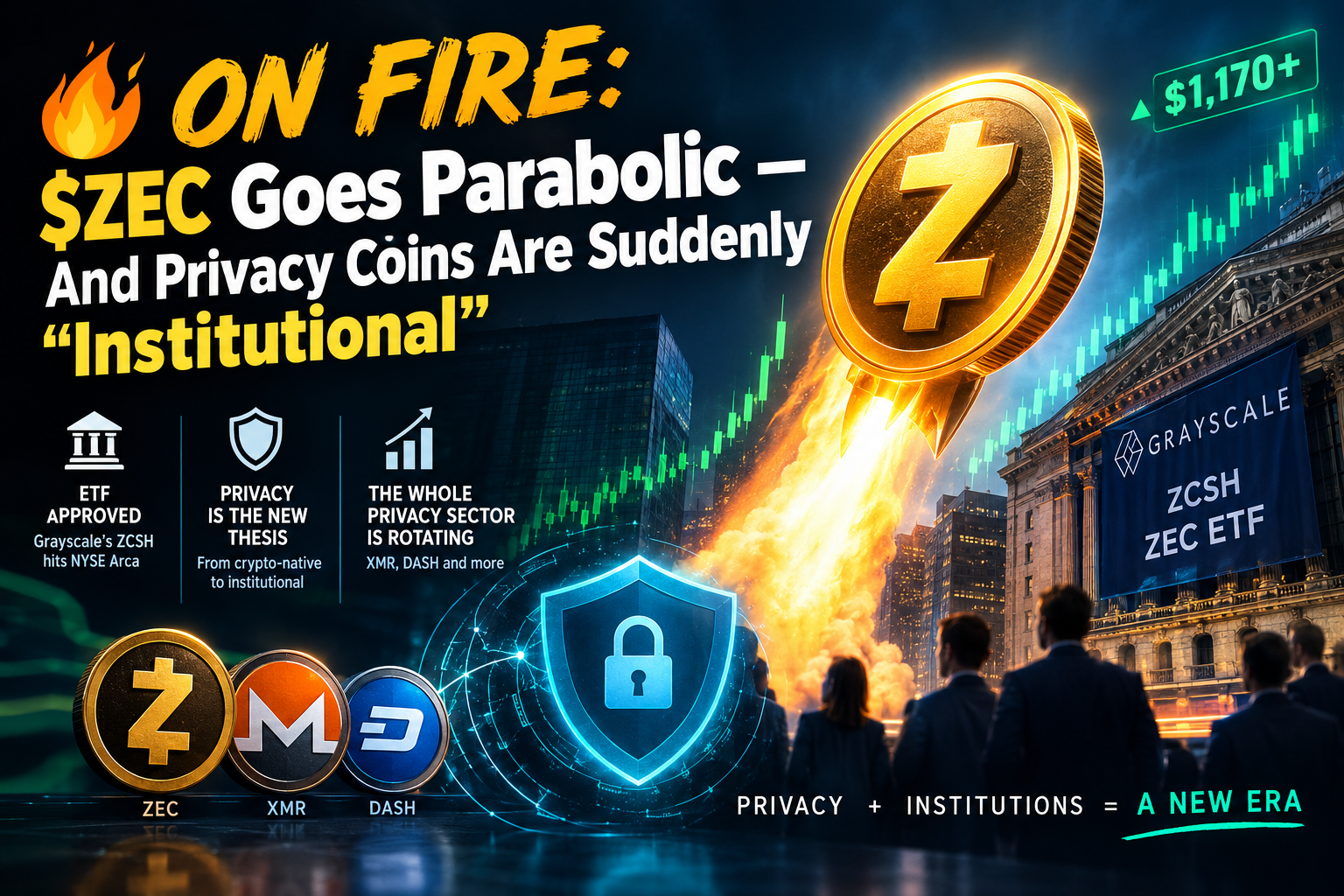
$ZEC has gone from around $40 to over $1,200 in about a year — a move on the order of 2,900%. From its 2026 low it is already up roughly 530%. From last year’s bottom the gain is closer to 4,000%. Market cap is now in the high-teens to ~$20B range, circulating supply is about 16.9 million of a 21 million cap, and it is trading like a top-10 coin again.
That is one of the most violent repricings of this cycle. The more interesting question is not “did it pump?” Everyone can see the candle. The question is why privacy is being bid again, and how long a move like this can last.
Why privacy coins are in demand again
For years the market treated privacy as a liability. Transparent chains won listings, ETFs, and narratives. Privacy coins got delisted, ignored, or written off as leftovers from 2017.
That trade is flipping for a simple reason: public blockchains leak too much.
Every payment, treasury transfer, payroll, and savings stack on Bitcoin, Ethereum, and stablecoins is visible by default. As on-chain finance grew, so did the audience that can watch it: governments, tax authorities, employers, competitors, chain-analytics firms, and anyone with a block explorer. Wealth concentration plus always-on surveillance is a product problem. People with something to protect will pay for tools that hide balances and flows.
The 2026 bid is not only cypherpunk nostalgia. It is also:
- Fear of wealth taxes, seizures, and political targeting of known holdings
- The “AI + surveillance” story: more data, cheaper analysis, less room to hide on transparent rails
- Institutions finally getting a compliant-looking way to buy the theme
Naval’s line keeps getting recycled because it is clean: Bitcoin is insurance against fiat. Zcash is insurance against a fully transparent Bitcoin world.
Why Zcash, not just “privacy”
Monero is still the purist’s coin: privacy by default, no optional transparent mode. That is also why it is harder to list, harder to custody, and has no US spot ETF.
Zcash made a different bet: optional privacy via zk-SNARKs. Transparent addresses for exchanges and ETFs. Shielded addresses when you actually want privacy. Viewing keys for selective disclosure. That design is why ZEC could stay on major venues and become the first US-listed spot product for a privacy coin.
The catalysts stacked:
- Grayscale’s ZCSH started trading on NYSE Arca on August 25, 2026 — the first US spot Zcash ETF. AUM jumped into the hundreds of millions within days/weeks. That is a new, persistent buyer that does not need a self-custody wallet.
- Regulatory overhang faded. The long SEC look at the Zcash Foundation closed without enforcement. That removed a multi-year discount.
- Usage of the product, not just the ticker. Reports put ~30% of supply in shielded pools, with shielded txs a large share of network activity. Coins that go into the shielded pool tend to stay there. That tightens the float even if the headline supply is 16.9M.
- Bitcoin-like monetary policy. 21 million cap, halvings, ~80% already issued. Next halving is still years out (late 2028), so this rally is demand-driven, not a supply-shock event.
- A mid-year scare that the market decided to forget. A serious shielded-pool vulnerability in 2026 crushed the price; the Ironwood upgrade and pool migration were the comeback story. Surviving that, then listing an ETF, is catnip for momentum.
So the market is not only buying “privacy.” It is buying privacy that Wall Street can hold.
How long can it go?
Nobody knows. Anyone giving you a date or a target as certainty is selling a story.
What you can separate is structural demand from parabolic mechanics.
What can keep it going
- ETF inflows that stay positive week after week
- More coins locked in shielded pools (less liquid float)
- Broader privacy-sector bid (XMR and others still catch a bid when the theme is hot)
- New listings, treasuries, and “privacy as portfolio insurance” allocations
- A risk-on crypto tape that does not choke alt liquidity
What usually kills a vertical move
- ETF inflows stall or reverse
- Open interest gets crowded (futures OI was already measured in the billions during the squeeze)
- A sharp BTC risk-off day that liquidates the whole alt complex
- Regulatory headlines aimed at privacy rails, even if ZEC’s optional model is the “acceptable” version
- Simple mean-reversion: a 2,900% year is already an extreme. Late buyers become exit liquidity fast.
Historically, crypto parabolas do not “expire on a calendar.” They expire when the next buyer is smaller than the next seller. That can take weeks or months after the first blow-off. It can also end in a 40–70% drawdown that still leaves the coin far above last year’s base. Both outcomes are normal.
A useful way to think about duration:
| Phase | What it looks like | How long it often lasts |
|---|---|---|
| Repricing | Narrative + product (ETF) + thin float | Weeks to a few months |
| Blow-off | Vertical candles, short squeezes, social mania | Days to a few weeks |
| Digest | Violent range, 20–40% swings, “is it over?” | Weeks to months |
| Trend or fade | Either higher highs on real inflows, or a long grind down | Unknowable |
Zcash is already through the first two. Whether this becomes a multi-quarter trend depends on whether ZCSH keeps absorbing supply and whether shielded adoption keeps rising. If those two stay alive, the move can last longer than the chart looks “allowed” to. If they don’t, $1,200 is just a spike.
Also keep the long chart honest: ZEC’s 2016 high was far above here on some datasets. A new cycle high is not the same as “no more overhead.” Old ghosts exist.
The clean takeaway
Privacy is no longer a dead sector. Surveillance-heavy finance created the demand. Zcash won the accessible version of that trade: optional privacy, hard cap, ETF wrapper, and a float that is quietly disappearing into shielded pools.
That combination can support a much higher price if the flows persist. It cannot protect you from a 50% wipe if the flows don’t.
This is not financial advice. Parabolic coins are entertainment until they are inventory. Size like you might be wrong for months.
How are you treating $ZEC — core privacy allocation, momentum trade, or too late?
El mercado muestra que ZEC rompió el soporte de $500 y está acumulando cerca del 20 % del volumen on‑chain en direcciones shielded, lo que explica la subida del 2 900 % y la capitalización en los high‑teens. La presión de la vigilancia AI y el miedo a impuestos sobre la riqueza están impulsando la demanda institucional de privacidad, lo que sugiere que la tendencia puede sostenerse mientras persista la acumulación en exchanges. 📈
True !