In-Game Advertising Market in North America: Regional Demand & Competitive Landscape Analysis 2026-2034
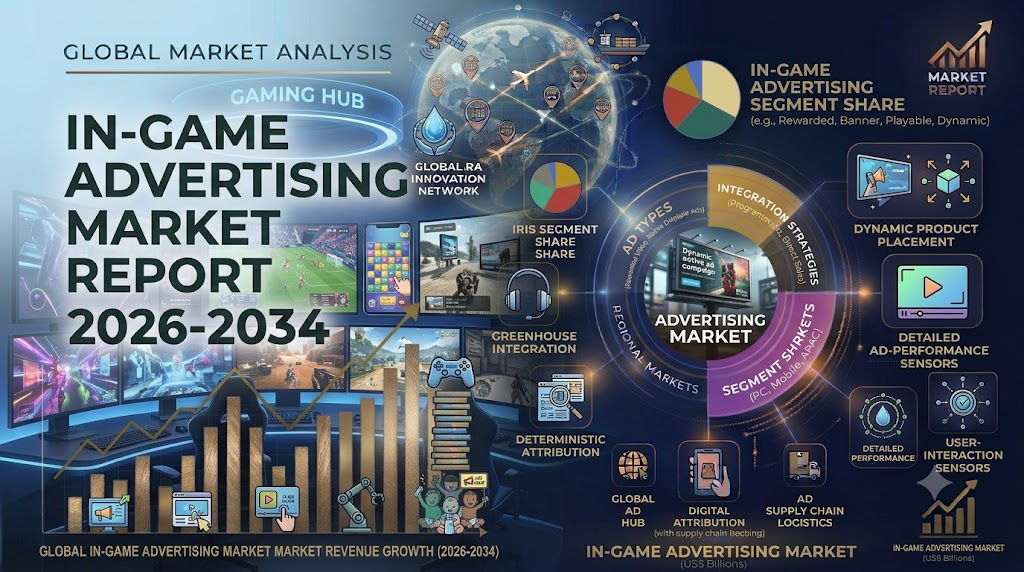
IMARC Group, a leading global market research and management consulting firm, has published its latest market intelligence report on the in-game advertising market. The in-game advertising market size grew from USD 9.41 Billion in 2025 to USD 10.43 Billion in 2026 and is projected to reach USD 19.92 Billion by 2034, exhibiting a CAGR of 8.43% during 2026-2034. driven by rising mobile gaming penetration, the maturation of programmatic and intrinsic ad-tech, brand demand for Gen Z and Gen Alpha audiences, and growing esports and live-streaming viewership.
The market is on a sustained growth path as advertising inside video games matures from simple banner placements into intrinsic, programmatically delivered creatives that integrate naturally into gameplay. PC/laptop remains the largest device-type segment given deep engagement times in high-immersion titles, even as smartphone/tablet inventory expands fastest on the back of free-to-play mobile gaming and rewarded video formats. Static ads continue to lead on ease of integration and predictable monetization, while dynamic ads are scaling quickly through real-time creative refresh and programmatic buying compatibility. North America anchors the largest regional share on mature programmatic ecosystems and deep advertiser networks, while Asia-Pacific is growing fastest on mobile gaming adoption across China, Japan, India, and South Korea. Esports is reinforcing this momentum, with the Entertainment Software Association reporting that more than 205 million Americans regularly played video games in 2025, giving brand advertisers access to one of the world’s largest single-country gaming audiences.
In-Game Advertising Market at a Glance:
- Market Size 2025: USD 9.41 Billion
- Market Size 2026: USD 10.43 Billion
- Forecast Size 2034: USD 19.92 Billion
- Growth Rate 2026-2034: CAGR of 8.43%
- Leading Device Type: PC/Laptop, 57.6% share in 2025
- Leading Type: Static Ads, 43.2% share in 2025
- Dominant Region: North America, with a 36.8% revenue share in 2025
How AI is Reshaping the Future of the In-Game Advertising Market
- AI-Driven Dynamic Ad Insertion: AI-powered creative optimization and contextual targeting are reshaping dynamic ad placements, with algorithms matching brand messaging to player profiles, in-game context, and time-of-day signals to refresh creative in real time without code changes, lifting completion rates across mobile, PC, and cloud gaming.
- AI-Powered Ad Platforms at Scale: Unity’s Vector ad platform, housed inside its Grow Solutions segment, expanded 35% year-over-year to USD 389 Million in Q2 2026 revenue, while AppLovin’s AI-driven AXON engine helped push the company’s Q2 2026 advertising revenue to USD 1.92 Billion, up 53% year-over-year, illustrating how AI-based bidding and creative optimization are now core revenue drivers in gaming ad-tech.
- AI-Based Brand Safety and Measurement: Third-party verification vendors are deploying AI-driven viewability, attention, and brand-safety classification models purpose-built for 3D environments, helping close the measurement gap between in-game inventory and mature display and CTV ecosystems.
Grab a sample PDF of this report: https://www.imarcgroup.com/in-game-advertising-market/requestsample
In-Game Advertising Market Trends and Drivers:
Rising mobile gaming penetration and the expansion of programmatic ad delivery form the foundational driver of market growth, as smartphone and tablet adoption combined with low-latency 5G networks widen the audience for free-to-play titles that monetize heavily through interstitials, rewarded video, and intrinsic placements. Brand demand for Gen Z and Gen Alpha audiences is compounding this trend: Roblox Corporation reported average daily active users growing 35% year-over-year to 132 million in Q1 2026, with Q1 revenue up 39% to USD 1.4 Billion, giving advertisers a single platform with audience scale comparable to major social networks.
Esports and live-streaming audiences are creating premium adjacent inventory as tournament viewership and influencer-driven content expand; interest in esports among individuals aged 18-29 rose from 27% in Q1 2021 to 31% in Q2 2024, reinforcing gaming’s position as a mainstream entertainment and brand-reach channel. Valve disclosed at GDC 2026 that Steam reached an all-time concurrent peak of 42,042,778 simultaneous players on January 11, 2026, underscoring the depth of the PC gaming audience advertisers are increasingly targeting.
Tightening data-protection regulation is reshaping how that audience can be reached, pushing publishers and ad-tech platforms toward contextual and consent-driven targeting rather than cross-app behavioral tracking, a dynamic that spans the United States, the European Union, and Asia and is detailed further below. Rewarded video has emerged as the industry’s preferred response: Roblox reported that more than 1,000 brands had used its rewarded video format as of early 2026, achieving completion rates above 90% and viewability over 95%.
Ask an analyst for customized report: https://www.imarcgroup.com/request?type=report&id=10024&flag=E
Global Regulatory, Trade, and Sustainability Landscape Shaping Demand:
- US COPPA Rule Amendments: The FTC’s amended Children’s Online Privacy Protection Rule took full effect on April 22, 2026, requiring separate verifiable parental consent before sharing children’s personal data for targeted advertising, directly reshaping how in-game ad networks can target under-13 audiences in the United States.
- EU Digital Services Act Ad-Targeting Ban: Article 28 of the DSA prohibits advertising based on profiling to users known to be minors across the EU, forcing gaming platforms to shift toward contextual advertising based on game content rather than user profiling, with non-compliance exposing providers to fines of up to 6% of worldwide annual turnover under the newly proposed EU Kids Act.
- China’s Minor Playtime and Ad Content Rules: China restricts minors to roughly three hours of gaming per week, confined to 8-9 PM on Fridays, Saturdays, Sundays, and holidays, while draft Measures for the Management of Online Games require advertising and promotional content to pass compliance checks before publication, materially shaping ad-load design for titles targeting Chinese audiences.
- Global Shift to Contextual and Consent-Based Advertising: Regulatory convergence across major markets is accelerating industry migration from behavioral tracking toward contextual targeting and value-exchange formats such as rewarded video, aligning commercial incentives with tightening global privacy standards.
Key Government Schemes and Policy Programs Supporting the Industry:
- India, Union Budget 2026-27 AVGC Creator Labs: India’s Ministry of Information & Broadcasting allocated Rs 250 Crore (approximately USD 27.3 Million) to establish AVGC (Animation, Visual Effects, Gaming, and Comics) Content Creator Labs across 15,000 schools and 500 colleges, targeting a sector projected to need roughly 2 million skilled professionals by 2030.
- Maharashtra and Tamil Nadu, State AVGC-XR Policies: Maharashtra approved its AVGC-XR Policy 2025 with a Rs 3,268 Crore outlay targeting 200,000 jobs by 2050, while Tamil Nadu’s AVGC-XR Policy 2026, notified in March 2026, commits Rs 250 Crore in R&D funding and up to Rs 1 Crore in startup grants, aiming for 200-plus startups and 2 lakh jobs by 2030.
- United States, FTC Enforcement and Age-Verification Incentives: Alongside the amended COPPA Rule, the FTC’s February 2026 Policy Statement incentivizes operators to adopt innovative age-verification technologies, with recent enforcement actions, including a USD 1.1 Million state-level fine against PlayOn Sports, signaling that advertising-related data sharing is now the highest-risk compliance activity for gaming platforms.
- European Union, DSA Minors’ Protection Guidelines and EU Kids Act: The European Commission’s July 2025 Guidelines on the Protection of Minors under the DSA, followed by the proposed EU Kids Act of September 2026, extend safety-by-design and age-verification obligations to online games, with non-compliant providers facing fines of up to 6% of global annual turnover.
- China, NPPA Anti-Addiction and Real-Name Verification Mandate: China’s National Press and Publication Administration enforces a nationwide real-name identity verification system restricting minors to roughly three hours of weekly playtime, requiring game operators to build server-side behavioral detection models that indirectly constrain ad-monetization design for youth-skewing titles.
In-Game Advertising Industry Segmentation:
The report has segmented the market into the following categories:
Breakup By Type:
- Static Ads
- Dynamic Ads
- Advergaming
Static ads lead the type segment with a 43.2% share in 2025, driven by ease of integration, low complexity, and stable monetization economics, making them the default choice for AAA sports titles featuring in-stadium signage and persistent in-world placements. Dynamic ads hold 35.6% share and are the fastest-growing type, benefiting from real-time creative refresh and programmatic buying compatibility that let brands update campaigns without patching the underlying game build.
Breakup By Device Type:
- PC/Laptop
- Smartphone/Tablet
PC/laptop commands 57.6% share in 2025, supported by deep engagement times in high-performance, high-immersion gaming environments that enable richer ad formats and brand integrations. Smartphone/tablet holds 42.4% share, capturing the bulk of free-to-play and casual gaming inventory where rewarded video, interstitial, and playable ad formats dominate monetization.
Breakup By Region:
- North America (United States, Canada)
- Europe (Germany, France, United Kingdom, Italy, Spain, Others)
- Asia-Pacific (China, Japan, India, South Korea, Australia, Indonesia, Others)
- Latin America (Brazil, Mexico, Others)
- Middle East and Africa
North America leads with a 36.8% revenue share in 2025, driven by mature programmatic ad ecosystems, deep advertiser networks, and strong console and PC gaming culture across the United States and Canada. Asia-Pacific, at 28.4% share, is the fastest-growing region through 2034 on rapid mobile gaming adoption in China, Japan, India, and South Korea, while Europe (22.6%) is shaped by sophisticated digital advertising markets and strong privacy frameworks driving contextual ad innovation, and Latin America (7.5%) and the Middle East and Africa (4.7%) are scaling on rising smartphone affordability and expanding 4G/5G connectivity.
Competitive Landscape:
The report provides a comprehensive analysis of the competitive landscape in the in-game advertising market with detailed profiles of key companies, including:
- Amazon.com, Inc.
- Unity Technologies
- Microsoft
- AppLovin Corp
- Roblox Corporation
The competitive landscape is moderately fragmented, with global ad-platform leaders dominating mediation and demand aggregation while gaming-native platforms increasingly build first-party ad businesses. AppLovin’s advertising-driven revenue reached USD 1.92 Billion in Q2 2026, up 53% year-over-year, with guidance of USD 2.055-2.085 Billion for Q3 2026, while Unity’s Grow Solutions segment, anchored by its Vector ad platform, grew 35% year-over-year to USD 389 Million in the same quarter, and Roblox grew Q1 2026 revenue 39% to USD 1.4 Billion on 132 million daily active users.
Market Concentration Analysis:
- Moderately Concentrated Around Five Platform Leaders: Amazon.com, Unity Technologies, Microsoft, AppLovin, and Roblox collectively shape a significant share of programmatic in-game inventory and demand aggregation, with barriers to entry including established advertiser-and-agency relationships and scale of mediation infrastructure.
- AppLovin Consolidating Mobile Ad-Network Share: AppLovin extended its lead in mobile ad-network revenue share to 53% on iOS and 29% on Android in Q3 2026, up from 42% and 23% a year earlier respectively, illustrating rapid share concentration within mobile mediation even as the broader market stays fragmented.
- Platform-Native Businesses Building First-Party Ad Capabilities: Roblox and other gaming-native platforms are increasingly building proprietary ad products rather than relying solely on third-party mediation, a trend reinforced by Roblox’s Cannes Lions 2026 measurement partnerships with Ipsos and EDO to validate in-game ad attention and recall.
What Does The Full Report Cover?
- Complete market sizing with revenue forecasts covering the full 2020-2034 projection period
- Quantified growth driver analysis with impact scoring across type, device type, and regional markets
- Sub-segment breakdowns for static ads, dynamic ads, and advergaming with individual share data
- Country-level data for the United States, Canada, Germany, France, United Kingdom, Italy, Spain, China, Japan, India, South Korea, Australia, Indonesia, Brazil, and Mexico
- Competitive and key company profiles with strategic landscape assessment
- Porter’s Five Forces, value chain analysis, and technology landscape mapping
- Investment and growth opportunity mapping across cloud gaming ad inventory, AI-driven creative optimization, and rewarded video infrastructure
Recent News and Developments in In-Game Advertising Market
- August 2026: AppLovin reported second-quarter 2026 revenue of USD 1.92 Billion, up 53% year-over-year, with adjusted EBITDA of USD 1.61 Billion, and guided Q3 2026 revenue to USD 2.055-2.085 Billion, reflecting continued strength in its AI-driven advertising platform.
- August 2026: Unity Software reported Q2 2026 revenue of USD 546.47 Million, up 23.9% year-over-year, with its Grow Solutions segment, housing the Vector ad platform, expanding 35% to USD 389 Million as it positions to compete directly with AppLovin for mobile ad spend.
- June 2026: Roblox announced new ad research and measurement partnerships with Ipsos and EDO at Cannes Lions, publishing its “Immersive Is Effective” study showing that 52% of surveyed 13-34-year-old Roblox users pay more attention to in-game ads than ads on streaming or social platforms.
- May 2026: Roblox reported Q1 2026 revenue growth of 39% to USD 1.4 Billion and bookings growth of 43% to USD 1.7 Billion, with average daily active users up 35% year-over-year to 132 million.
- April 2026: The FTC’s amended COPPA Rule took full effect, requiring separate verifiable parental consent for sharing children’s data with third parties for targeted advertising, directly affecting how in-game ad networks can monetize under-13 audiences in the United States.
- March 2026: Tamil Nadu formally notified its AVGC-XR Policy 2026, backed by a Rs 50 Crore Centre of Excellence and Rs 250 Crore in R&D funding, targeting 200-plus gaming and animation startups by 2030.
Note: If you require specific details, data, or insights that are not currently included in the scope of this report, we are happy to accommodate your request. As part of our customization service, we will gather and provide the additional information you need, tailored to your specific requirements. Please let us know your exact needs, and we will ensure the report is updated accordingly to meet your expectations.
Key Questions This Report Answers
- What is the current global in-game advertising market size and what is its projected value?
- Which device type and ad type segments hold the largest share in the global in-game advertising market?
- What are the key drivers of global in-game advertising market growth?
- Which region dominates the global in-game advertising market and why?
- How are children’s privacy regulations such as COPPA, the DSA, and China’s anti-addiction rules reshaping in-game ad targeting worldwide?
- Who are the top companies in the global in-game advertising market and what are their competitive strategies?
- What are the investment and market entry opportunities across cloud gaming ad inventory, AI-driven creative optimization, and rewarded video formats?
About Us:
IMARC Group is a global management consulting firm that helps the world’s most ambitious changemakers to create a lasting impact. The company provides a comprehensive suite of market entry and expansion services. IMARC offerings include thorough market assessment, feasibility studies, company incorporation assistance, factory setup support, regulatory approvals and licensing navigation, branding, marketing and sales strategies, competitive landscape and benchmarking analyses, pricing and cost research, and procurement research.
Media and Sales Contact
IMARC Group
Email: sales@imarcgroup.com
United States: +1-201-971-6302
India: +91-120-433-0800
United Kingdom: +44-753-714-6104