14-09-2026 – Today we are talking about... family units in Italy [EN]-[IT]
Cover background image created with AI. The software used is Microsoft Copilot
~~~ La versione in italiano inizia subito dopo la versione in inglese ~~~
ENGLISH
14-09-2026 – Today we are talking about... family units in Italy [EN]-[IT]
Family units in 2024–2025
Based on research I conducted—including an analysis of ISTAT data—it appears that the number of Italian families in 2025 stood at 26.7 million.
However, let us clarify the concept of a "family unit."
A family unit is defined by a couple relationship or a parent-child relationship. For instance, a person living alone constitutes a family, but not a family unit.
Some data
Let’s look at couples with children. In 2001, there were 9.3 million couples with children, whereas by 2021, that figure had dropped to 7.5 million. This represents an 18.7% decline—a significant drop, I would say.
As for couples without children, there were 4.7 million in 2001, a figure that rose to 5 million by 2021.
Between 2001 and 2021, there was an increase in both single mothers with children and single fathers with children.
The number of single mothers with children rose from 1.7 million in 2001 to 2.9 million in 2021.
The number of single fathers with children rose from 0.3 million in 2001 to 0.8 million in 2021.
If we examine the data on couples with children, we can see that these family units decreased between 2001 and 2021; however, rather than a simple decline, what we are witnessing is a transformation. Compared to 2001, we certainly have more couples without children, more single mothers with children, and more single fathers with children today. Singles
A clarification: statistically, people living alone in a home are counted as a "household" but not as a "family unit." It is also crucial to consider the data regarding singles. According to the latest ISTAT projections, the number of people living alone could rise from approximately 10 million in 2025 to 11.6 million in 2050.
Families in Italy Today
There are currently about 26.6 million households in Italy, but we must recognize that the Italian family is vastly different from what it was twenty or thirty years ago.
One key figure to note is that more than one in three Italian households consists of a single person.
Below is an overview of the situation, broken down by household type and percentage share:
People living alone = 37%
Couples with children = 28%
Couples without children = 23%
Single-parent households = 12%
Below is an image summarizing the information above:
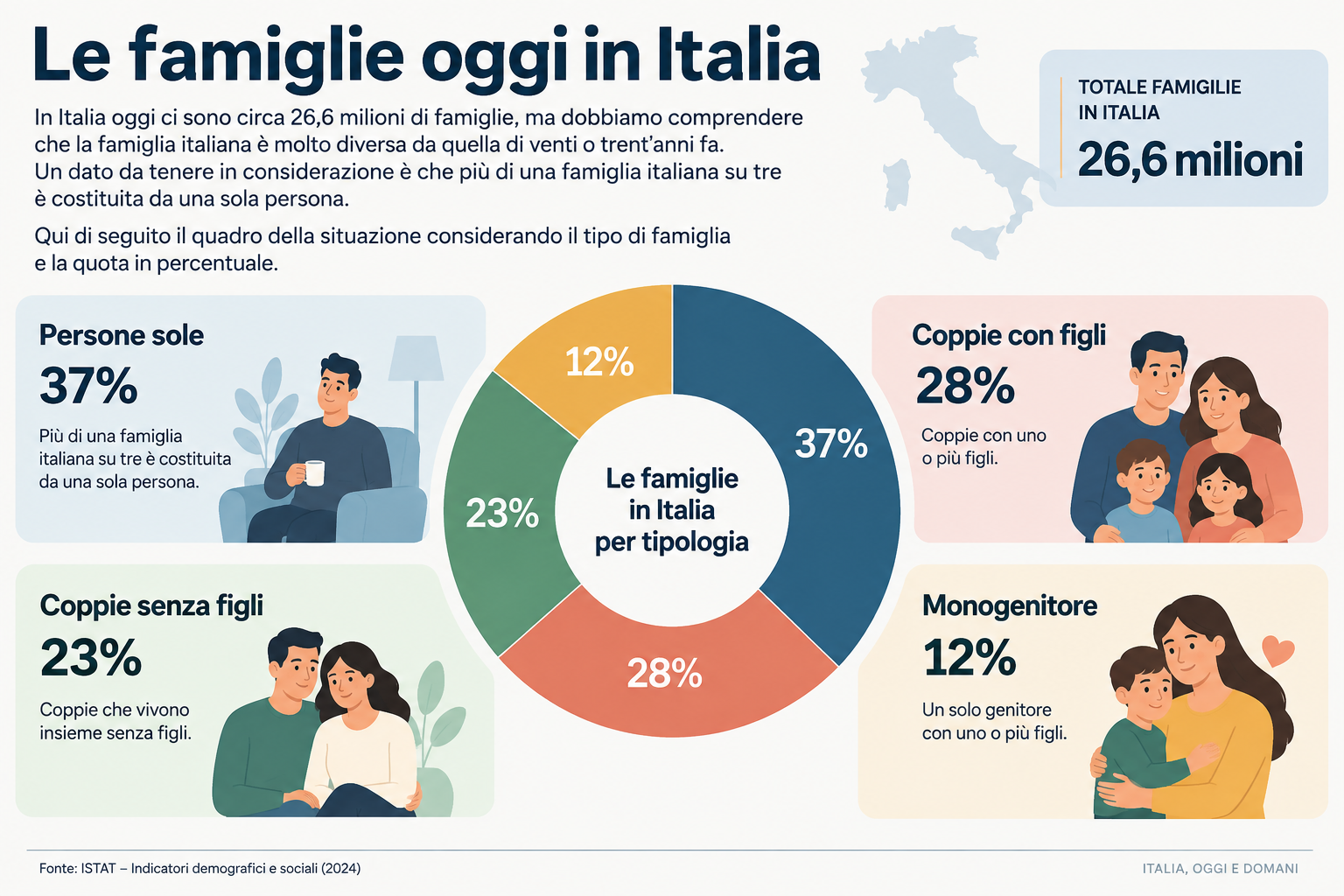
Image generated using artificial intelligence (specifically, ChatGPT).
Impact on Housing
This shift in the Italian family structure suggests growing interest in smaller homes, alongside increased demand for rental properties and alternative housing arrangements. A need is emerging for apartments that are not overly large, are affordable, and are move-in ready; such properties can cater to a structural demographic transformation rather than a mere trend.
Conclusions
In conclusion, the structure of the Italian family has undergone profound changes between the early 2000s and 2025. The primary phenomenon is not so much the disappearance of the family, but rather its fragmentation into smaller, more diverse units. Question
Have you also noticed this change in the country where you live? In other words, have you observed that there are fewer couples with children? Have single-parent families increased where you live, too?
ITALIAN
14-09-2026-Oggi parliamo di...nuclei familiari in Italia [EN]-[IT]
I nuclei famigliari nel 2024-2025
Da una ricerca che ho cercato di fare, analizzando anche alcuni dati ISTAT, sembra che il numero di famiglie italiane nel 2025 sia stato di 26,7 milioni.
Chiariamo però il concetto di nucleo famigliare.
Per nucleo famigliare si intende una relazione di coppia o genitore-figlio. Per esempio, una persona che vive sola costituisce una famiglia, ma non un nucleo familiare.
Alcuni dati
Parliamo delle coppie con figli. Le copie con figli nel 2001 erano 9,3 milioni, mentre nel 2021 sono scese a 7,5 milioni. Questo indica un calo del 18,7%. Lo definirei un calo evidente.
Per quanto riguarda le coppie senza figli nel 2001 erano 4,7 milioni, mentre nel 2021 erano aumentate a 5 milioni.
Sia le madri sole con figli che i padri soli con figli dal 2001 al 2021 sono entrambi aumentati.
Le madri sole con figli nel 2001 erano 1,7 milioni, mentre nel 2021 erano 2,9 milioni.
Le padri soli con figli nel 2001 erano 0,3 milioni, mentre nel 2021 erano 0,8 milioni.
Se diamo un'occhiata al dato delle coppie con figli, possiamo vedere che questi nuclei famigliari sono diminuiti dal 2001 al 2021, ma in realtà, più che una diminuzione si nota una trasformazione. Rispetto al 2001 oggi abbiamo certamente più coppie senza figli, più madri sole con figli e più padri soli con figli.
I single
Precisazione: le persone che vivono da sole in un abitazione sono considerate dalle statistiche come famiglia, ma non come nucleo famigliare. E' molto importante considerare anche sul dato dei single. Secondo le più recenti proiezioni ISTAT, le persone che vivono sole potrebbero passare da circa 10 milioni nel 2025 a 11,6 milioni nel 2050.
Le famiglie oggi in Italia
In Italia oggi ci sono circa 26,6 milioni di famiglie, ma dobbiamo comprendere che la famiglia italiana è molto diversa da quella di venti o trent'anni fa.
Un dato da tenere in considerazione è che più di una famiglia italiana su tre è costituita da una sola persona.
Qui di seguito il quadro della situazione considerando il tipo di famiglia e la quota in percentuale.
Persone sole = 37%
Coppie con figli = 28%
Coppie senza figli = 23%
Monogenitore = 12%
Qui di seguito un immagine che riassume quanto appena scritto:
Immagine generata con l’intelligenza artificiale. In questo caso è stato usato ChatGPT
L'impatto sulle abitazioni
Questo cambiamento della famiglia italiana fa pensare ad una crescita dell'interesse verso abitazioni più piccole, insieme a una maggiore domanda di affitto e di formule abitative alternative. Inizia a diffondersi la necessità di appartamenti non enormi, economicamente accessibili e già sistemati possono intercettare una trasformazione demografica strutturale, non semplicemente una moda.
Conclusioni
Possiamo concludere dicendo che tra l'inizio degli anni Duemila e il 2025 la struttura della famiglia italiana è cambiata profondamente. Il fenomeno principale non è tanto la scomparsa della famiglia, quanto la sua frammentazione in nuclei più piccoli e più diversificati.
Domanda
Avete percepito anche voi questo cambiamento nella nazione in cui vivete? Cioè avete notato che ci sono meno coppie con figli? Anche da voi sono aumentate le famiglie monogenitore?
THE END