Daguerreotype of the Virginia regiment and Webster's battalion in Saltillo, Mexico GIANT
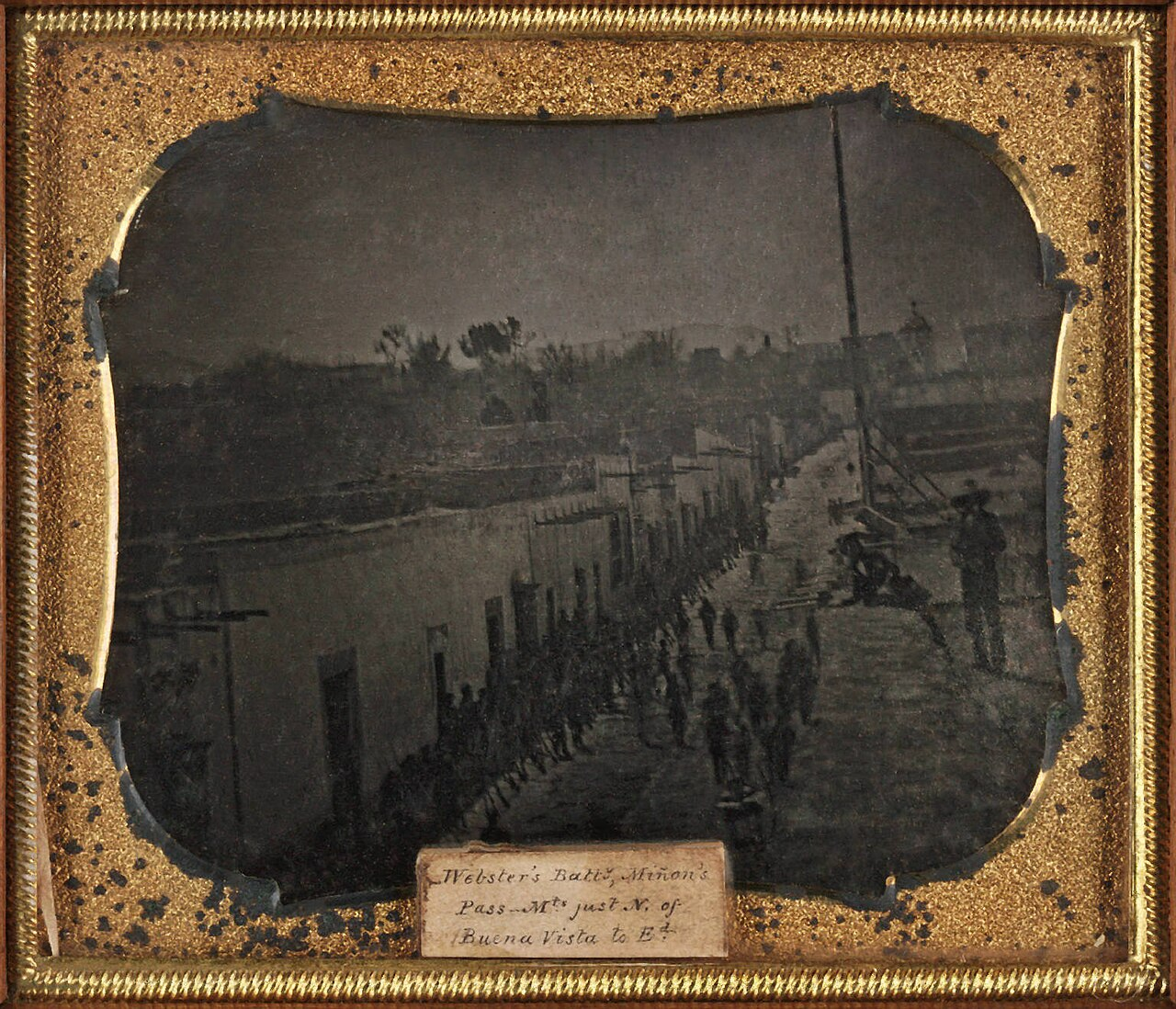
Daguerreotype of the Virginia regiment and Webster's battalion in Saltillo, Mexico, during the Mexican-American War. Courtesy of the Yale Collection of Western Americana, Beinecke Rare Book & Manuscript Library, Yale University, New Haven, Conn
This rare daguerreotype depicts Captain Lucien B. Webster’s Artillery Battalion alongside troops from the 1st Virginia Volunteer Regiment. It stands out historically as one of the earliest surviving photographic representations of American soldiers deployed in the field.
The image was captured in Saltillo, Mexico. As noted on the original paper label affixed to the mat, the view looks toward the "Pass [to the] Mts. just N. of Buena Vista to E."
The photograph was taken between 1847 and 1848 during the Mexican-American War.
What you are seeing is an illusion of scale caused by an accidental double exposure.
During the Mexican-American War, photographic materials were scarce.
The photographer accidentally exposed the same silver-plated copper sheet twice:
The Main Scene: A line of regular-sized soldiers marching down a street in Saltillo, Mexico.
The "Giant" Silhouette: The dark shape of a man standing much closer to the camera lens during a separate or slightly shifted exposure.
Because the closer figure's silhouette is layered over the street background, his head aligns with the rooftops and his feet align with the street. This makes him look like a massive, towering entity walking alongside the buildings.
The photographer remains unidentified, but the collection is famously housed at the Amon Carter Museum of American Art and the Beinecke Rare Book & Manuscript Library at Yale University.
Giant? Technical glitch with an old fashioned camera?