🖼️ Arthur’s Stone | Older Than Stonehenge, Older Than the Legend
Arthur’s Stone | Older Than Stonehenge, Older Than the Legend
After castles, medieval walls and centuries of recorded history, suddenly the landscape changes completely.
There is no fortress here.
No towers.
No battlements.
No written record of who built it.
Just enormous stones sitting quietly on a hill above the Golden Valley in Herefordshire.
This is Arthur’s Stone.
And it is more than 5,000 years old.
A Monument from Another World
Arthur’s Stone is a Neolithic chambered tomb, built by communities of early farmers long before the Romans arrived in Britain, and thousands of years before the medieval stories of King Arthur.
The enormous capstone is estimated to weigh more than 25 tonnes, resting on a chamber formed by nine upright stones.
Originally, however, the monument looked very different.
The stones were enclosed within a much larger mound, creating a substantial prehistoric monument in the landscape.
What survives today is only the stone heart of that structure.
The Legend Came Much Later
The name is medieval rather than prehistoric.
Arthur’s Stone has been associated with King Arthur since at least the 13th century.
According to local legend, Arthur fought and killed a giant here. As the giant fell, he supposedly left the impressions of his elbows on the great stone.
There is, of course, no archaeological evidence for Arthur's presence.
But the legend tells us something fascinating about how people have continued to reinterpret ancient monuments.
The stones were already impossibly old when the Arthurian stories arrived.
Yet somehow, the monument acquired a new identity that has lasted for centuries.
And Then Came Narnia
There is another remarkable chapter in the story.
Arthur’s Stone has been identified by archaeologists as the monument that inspired the Stone Table in C. S. Lewis’s The Lion, the Witch and the Wardrobe.
Lewis transformed an ancient stone monument into one of the most memorable places in Narnia — the setting for one of the book's central events.
It is an extraordinary chain of cultural memory:
Neolithic monument → medieval legend → modern literature.
The people who raised these stones could never have imagined any of it.
Five Thousand Years in One Photograph
What I find most striking about this place is the scale of time.
The castle photographs I have just finished were looking at several centuries of human history.
Here, we are looking at something thousands of years older.
The people who built Arthur’s Stone belonged to a world of early farming communities, seasonal landscapes and beliefs that we can only partially reconstruct.
They left no written explanation.
Only stone.
And somehow, that was enough for the monument to survive into our imagination.
📷 Photo Notes
Location: Dorstone, Herefordshire, England
Site: Arthur’s Stone
Date: Neolithic, more than 5,000 years old
Monument type: Chambered tomb / long barrow
Capstone: Estimated at more than 25 tonnes
Landscape: Golden Valley
Photographic approach: Prehistoric monument and landscape
“Before castles were built, before legends were written, someone stood here and moved these stones.”
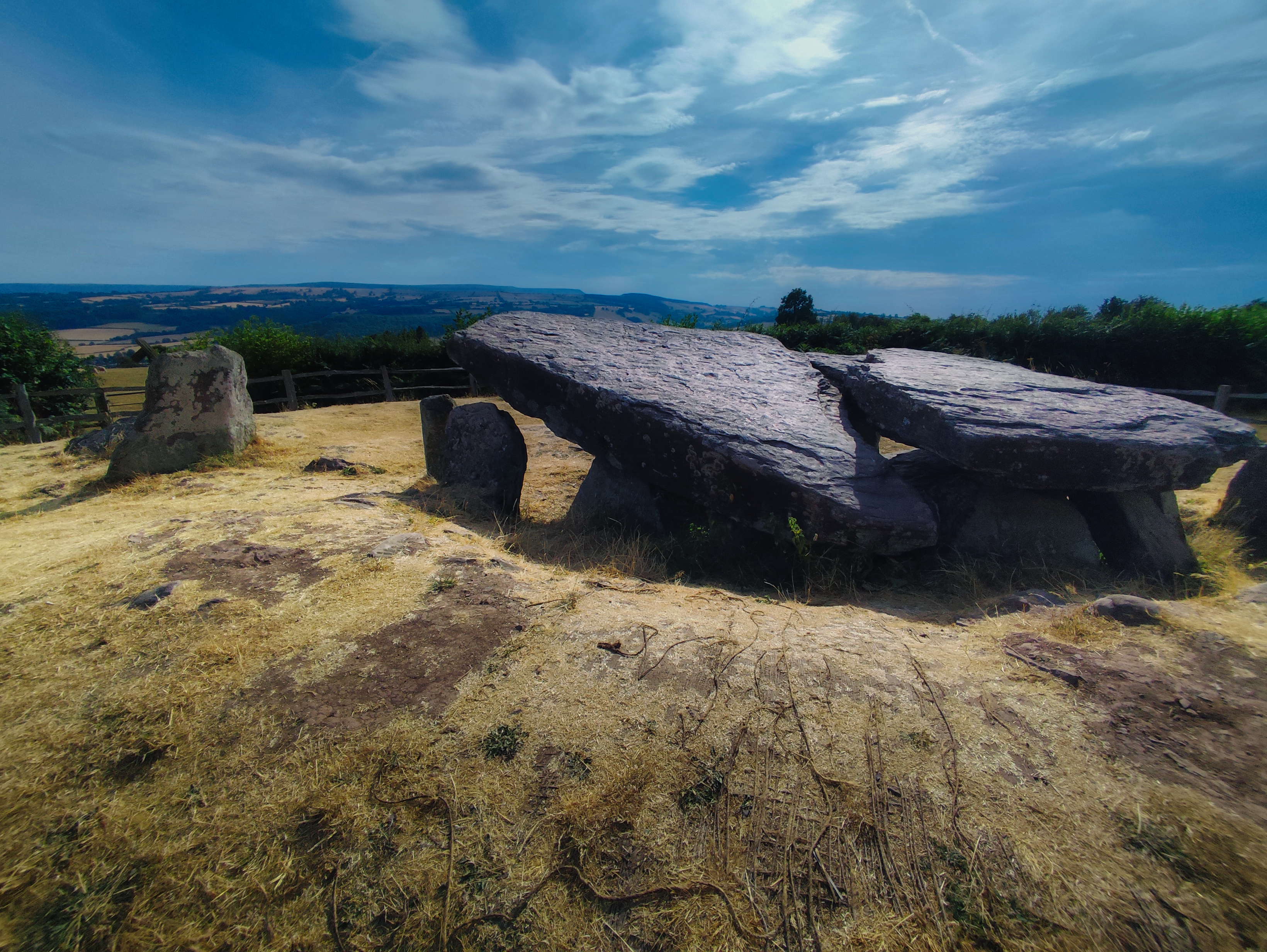
📷Prehistoric monument and landscape
| Category | #momentsinfocus |
| Photo taken at | Wales |

@marcoteixeira
Upvoted! Thank you for supporting witness @jswit.
The description of the 25‑tonne capstone really highlights the engineering skill of those early farmers—did you find any clues about how they might have moved such a weight? 🌄🪨✨