🖼️Goodrich Castle | The Architecture of Defence
Goodrich Castle | The Architecture of Defence
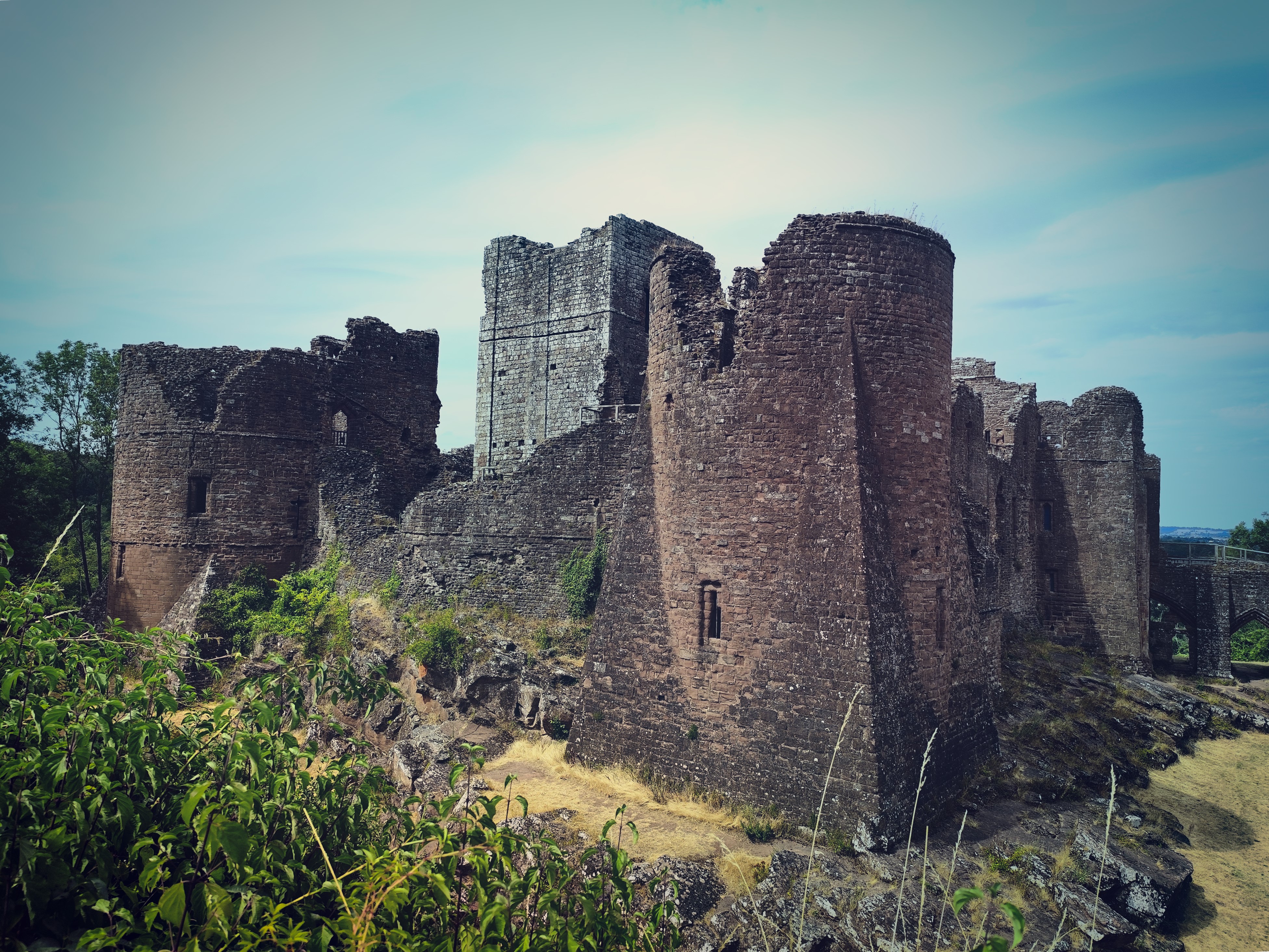
Continuing my photographic journey through Goodrich Castle, this view reveals something that is easy to miss when walking through the ruins: the castle was not simply a collection of towers and walls.
It was a carefully designed defensive system.
The massive round towers, projecting walls and narrow openings were all part of an architecture intended to control movement, protect the interior and give defenders a clear view of anyone approaching the castle.
A Castle Built to Watch
Goodrich stands above the River Wye, close to the historic route between England and Wales. Its position was important, but its strength came from the way the buildings were arranged around the site.
The castle we see today is largely the result of rebuilding undertaken by William and Joan de Valence in the late 13th century.
The result was an imposing quadrangular fortress, combining strong military defences with surprisingly sophisticated residential spaces.
From this angle, the different generations of the castle almost appear layered together: the older keep rising behind later walls, massive towers protecting the corners, and ruined buildings filling the spaces between them.
Stone, Light and Geometry
What attracted me to this particular view was the contrast between the geometry of the architecture and the irregularity created by centuries of decay.
The round towers project beyond the walls, allowing defenders to observe and protect areas that would have been difficult to reach from a straight curtain wall. Narrow openings provided positions from which weapons could be used while offering relatively little exposure to attackers.
The architecture therefore had a very practical purpose.
Even in ruins, that purpose remains visible.
The towers still dominate the composition, while the broken walls reveal how much of the original structure has disappeared.
From Fortress to Ruin
Goodrich remained remarkably intact for centuries.
Its final transformation came during the English Civil War, when the castle was besieged by Parliamentarian forces in 1646. The use of the enormous mortar known as Roaring Meg caused severe damage to the castle, contributing to the ruined appearance that survives today.
Looking at these walls now, it is fascinating to realise that their destruction was not simply the result of centuries of abandonment.
Much of the ruin is the physical record of a very specific moment in history.
📷 Photo Notes
Location: Goodrich, Herefordshire, England
Site: Goodrich Castle
Period: Medieval, with major rebuilding in the late 13th century
Architectural focus: Defensive towers and curtain walls
Photographic approach: Colour / architectural landscape
Series: Goodrich Castle, Wye Valley
“The walls may have fallen, but the logic behind them is still standing.”
📷 Colour / Architectural Landscape
| Category | #momentsinfocus |
| Photo taken at | Wales |

@marcoteixeira
Upvoted! Thank you for supporting witness @jswit.
Love how you highlighted the subtle defensive layout—those narrow embrasures you pointed out really show how the castle’s design was a tactical masterclass. Did you notice any hidden sightlines that the modern ruins obscure? 🌄🏰✨