🖼️Prince Albert in Tenby | A Welsh Memorial with a Victorian Story
Prince Albert in Tenby | A Welsh Memorial with a Victorian Story
During my August journey through Wales, I spent some time exploring Castle Hill, one of the historic areas of Tenby.
Among the remains of the old castle, I came across a monument that seemed to belong to a rather different chapter of British history.
A white marble figure stood high above an imposing stone pedestal, overlooking a landscape of dry grass, weathered ruins and open sky.
In the foreground, a dark bird was walking across the grass, apparently more interested in searching for food than in the history surrounding it.
It was an ordinary moment in a place with an extraordinary past.
The statue represents Prince Albert, the husband of Queen Victoria, and its presence in Tenby tells a story that extends far beyond this small coastal town.
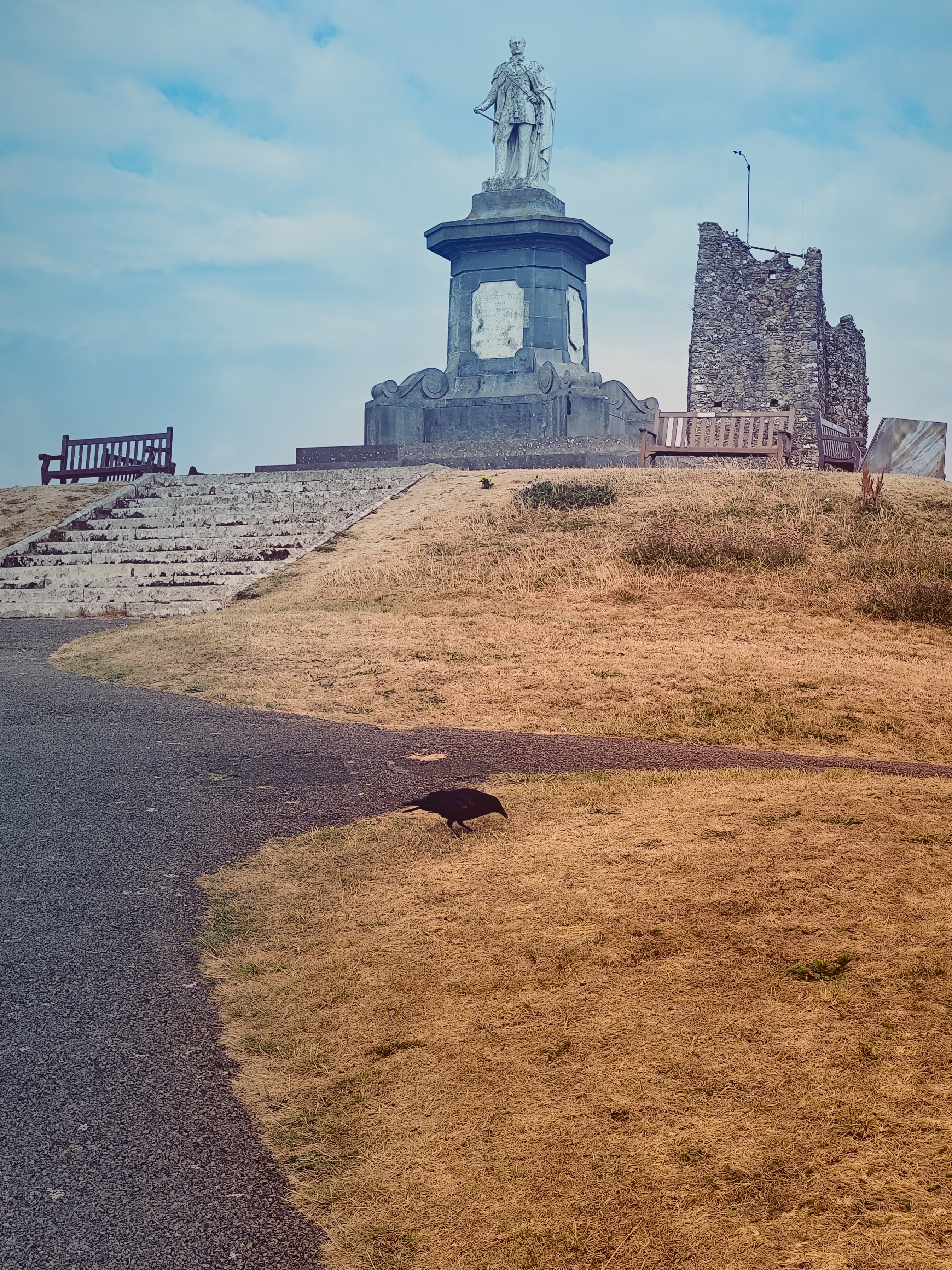
📷 The Prince Albert Memorial on Castle Hill, Tenby, Pembrokeshire, Wales — August 2026.
Why Prince Albert?
Prince Albert of Saxe-Coburg and Gotha was born in 1819 and married Queen Victoria in 1840.
Although he was never king, his influence on Victorian Britain was considerable.
He became closely associated with education, scientific progress, industrial development and the arts.
One of his best-known contributions was his involvement in organising the Great Exhibition of 1851, held at London's Crystal Palace.
The exhibition celebrated technological innovation, manufacturing and artistic achievement from Britain and other parts of the world.
Albert believed that education, culture and scientific knowledge could contribute to social and economic progress.
His sudden death in December 1861, at the age of just 42, deeply affected Queen Victoria and prompted the creation of memorials throughout Britain.
The monument I photographed in Tenby was one of those commemorative projects.
But there is something particularly interesting about its location.
A National Memorial in a Small Welsh Town
Why was such an important memorial erected in Tenby rather than in Cardiff or another major Welsh town?
The answer lies partly in the initiative of local civic leaders.
Following Prince Albert's death, a proposal emerged to establish a Welsh national memorial in his honour.
Tenby's mayor and other influential supporters promoted the town as an appropriate location.
Eventually, Castle Hill was chosen as the site.
The memorial was unveiled on 2 August 1865 by Prince Arthur, the third son of Queen Victoria and Prince Albert.
The ceremony attracted considerable attention, with representatives of Welsh towns, military personnel and other dignitaries attending the event.
For a seaside town, it was a significant occasion.
What makes the story particularly interesting is that the monument was not intended merely as a local tribute.
It was presented as a memorial erected by the people of Wales.
That ambition is still visible in the inscriptions and heraldic decorations incorporated into its pedestal.
A Welsh Sculptor and a Sicilian Marble Statue
The statue was created by John Evan Thomas, a sculptor born in Brecon, Wales, in 1810.
Thomas established a reputation for portrait sculpture and public monuments during the nineteenth century.
For the Tenby memorial, he represented Prince Albert standing in the uniform of a field marshal, wearing the mantle and collar of the Order of the Garter.
The figure was carved from Sicilian marble.
The pale material creates a strong contrast with the darker limestone pedestal supporting it.
From the viewpoint captured in my photograph, this contrast is particularly noticeable.
The sculpted figure appears almost luminous against the cloudy sky, while the pedestal gives the monument a sense of weight and permanence.
The monument was designed to be seen from a distance.
Its elevated position on Castle Hill reinforces that intention.
But the pedestal also deserves attention.
It incorporates heraldic references associated with both the British monarchy and Welsh history, including symbols connected with Llywelyn ap Gruffydd and the Welsh dragon.
These details reveal that the memorial was designed to communicate more than personal remembrance.
It also expressed ideas about Wales and its relationship with the British monarchy during the Victorian period.
The Words Beneath the Statue
One of the most distinctive features of the monument is its bilingual inscription.
It includes the Welsh expression “Albert Dda”, meaning Albert the Good.
The accompanying English inscription identifies him as the consort of Queen Victoria.
The use of both languages is an interesting detail.
Public monuments are not simply decorative objects.
They reflect the values, political circumstances and cultural identities of the societies that create them.
In nineteenth-century Wales, language and national identity were already subjects of considerable importance.
The combination of Welsh and English inscriptions, together with the heraldic symbols, gives the monument a cultural dimension that might easily escape someone who sees it only as a statue of a royal figure.
I find this particularly fascinating.
Sometimes the most interesting historical information is not found in the figure represented by a monument, but in the decisions made about how that figure should be remembered.
Two Very Different Histories in One Frame
There is another detail in my photograph that deserves attention.
To the right of the statue stand the remains of Tenby Castle.
These ruins belong to a much earlier period of Welsh history.
The castle developed during the medieval centuries, when control of fortified coastal settlements was of considerable strategic importance.
The Prince Albert Memorial, by contrast, belongs to the nineteenth century.
It was created in a period when public monuments became important expressions of civic identity, remembrance and political symbolism.
The two structures stand remarkably close to one another.
One is a surviving fragment of medieval defensive architecture.
The other is a carefully designed Victorian commemorative monument.
They represent very different historical circumstances, yet they now form part of the same public landscape.
I appreciate this kind of historical juxtaposition.
It reminds us that places are rarely defined by a single period.
Different generations leave their own marks, sometimes without removing those that came before.
The Smallest Detail in the Photograph
Although the statue is clearly the main subject, there is something else in the composition that I particularly like.
Near the bottom of the image, a dark bird walks across the dry grass.
It occupies only a small portion of the photograph, yet it introduces an entirely different scale and rhythm.
Above, a monument built to preserve the memory of a historical figure.
Below, an animal simply going about its ordinary activities.
The contrast is almost amusing.
The statue has stood there for more than 160 years, carefully preserving the appearance of someone who died in 1861.
The bird, meanwhile, seems completely indifferent to the monument.
There is no need to assign any particular symbolism to this encounter.
But I enjoy the way it introduces a spontaneous element into an otherwise formal architectural composition.
The photograph becomes less like a conventional record of a monument and more like a small observation of everyday life around it.
What Remains of Victorian Memory?
Public monuments can survive for centuries, even when the circumstances surrounding their construction become unfamiliar to later generations.
Visitors may recognise Prince Albert's name without knowing much about his influence on Victorian society.
Others may walk past the statue without realising that it was intended as a national Welsh memorial.
And some may simply appreciate the views from Castle Hill.
That is part of what makes historic places interesting.
Their meaning is not necessarily fixed.
They can be admired as works of art, studied as historical documents or encountered almost accidentally during an afternoon walk.
For me, this photograph is a reminder of how much history can remain hidden in apparently familiar surroundings.
A statue on a hill may seem like a simple landmark. But sometimes it tells us as much about the people who erected it as about the person it was built to honour.
📷 Photo Notes
Location: Castle Hill, Tenby, Pembrokeshire, Wales
Date: August 2026
Main subject: Prince Albert Memorial, inaugurated in 1865
Sculptor: John Evan Thomas (1810–1873)
Photographic approach: Travel photography, historical monuments and architectural heritage
Composition: Vertical framing, with the memorial occupying the upper central area, medieval castle ruins to the right and a dark bird in the foreground
Atmosphere: Cloudy sky, subdued blue tones and dry summer grass
Main interest: The relationship between Victorian commemorative sculpture, Welsh cultural identity and the everyday life surrounding a historic monument
Historical References
Cadw — Prince Consort Memorial, Listed Building 6114
Pembrokeshire Historical Society — The Wales Memorial to Prince Albert in Tenby
Royal Collection Trust — Prince Consort Memorial, Castle Hill, Tenby (1871)
| Category | #momentsinfocus |
|---|---|
| Photo taken at | Castle Hill, Tenby, Pembrokeshire, Wales |
| Main subject | Prince Albert Memorial |
| Historical period | Victorian era |

Upvoted! Thank you for supporting witness @jswit.
0.00 SBD,
21.48 STEEM,
21.48 SP