🖼️St Davids Cathedral | A Sanctuary at the Edge of Wales
St Davids Cathedral | A Sanctuary at the Edge of Wales
Some buildings are impressive because of their size. Others because of their location, history or architectural character.
St Davids Cathedral, in Pembrokeshire, brings several of these qualities together.
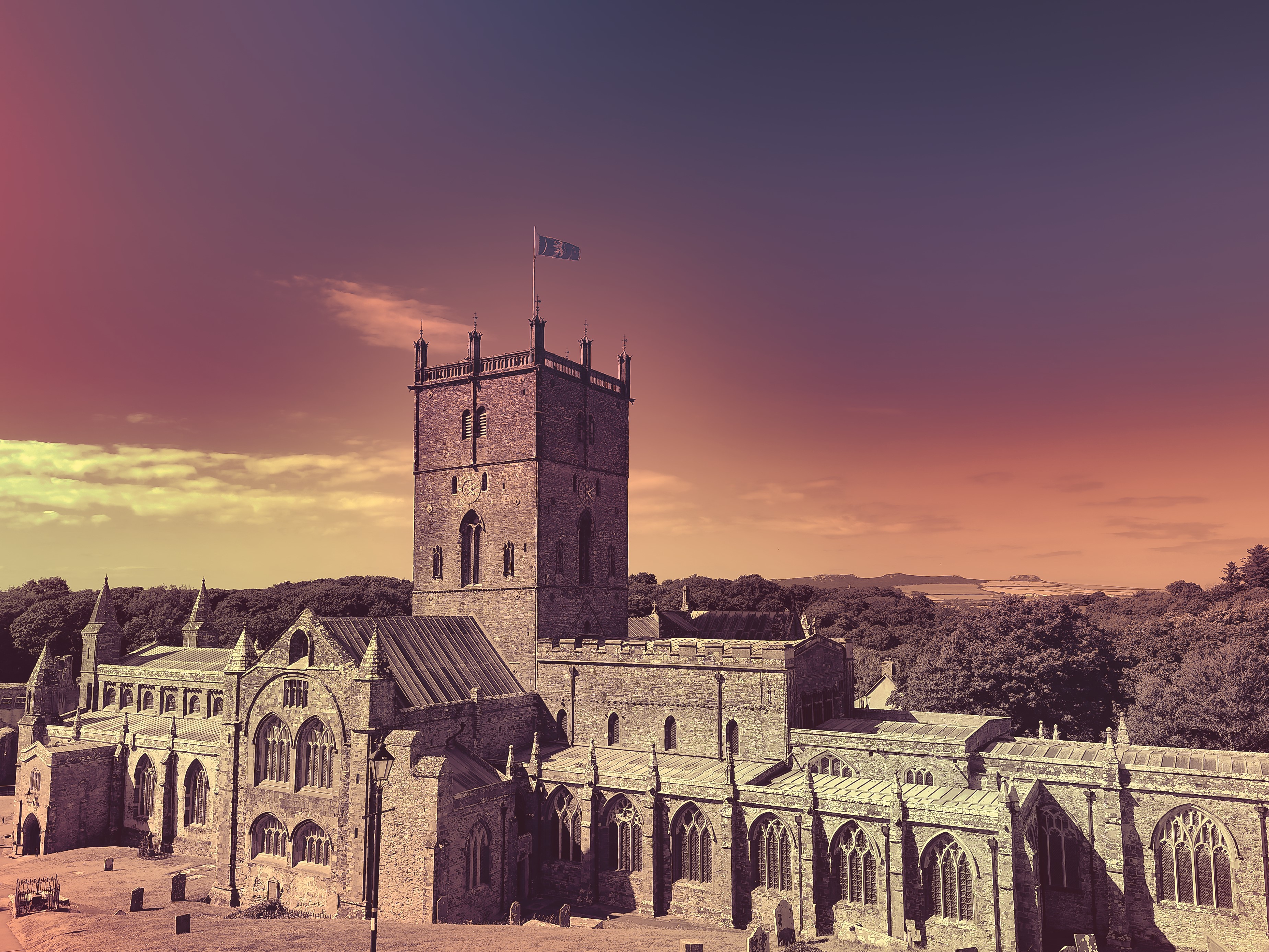
During my journey through Wales in August 2026, I photographed the cathedral from an elevated viewpoint, allowing its extensive stone structure to occupy almost the entire lower half of the composition.
Above it, the sky takes on a very different character.
Deep purple, rose and warm golden tones create an atmosphere that contrasts with the solidity of the medieval architecture.
The result is not intended as a neutral architectural record.
It is my photographic interpretation of one of the most important religious landmarks in Wales.
A Cathedral in Britain's Smallest City
St Davids is widely recognised as the smallest city in Britain by population.
Situated in the far west of Pembrokeshire, it occupies a relatively remote position compared with the country's larger urban centres.
Yet its historical and religious importance is considerable.
The city takes its name from Saint David, the patron saint of Wales, traditionally associated with the establishment of a religious community in this area during the sixth century.
The cathedral became one of the principal destinations for Christian pilgrimage in medieval Wales.
Its significance extended well beyond the surrounding settlement.
For centuries, pilgrims travelled here to visit a place associated with the country's most important saint.
That contrast between geographical remoteness and spiritual importance is one of the most interesting aspects of St Davids.
A Building Shaped by Several Centuries
Construction of the present cathedral began in the twelfth century, with substantial additions and alterations during subsequent centuries.
Its architecture reflects this long development.
Romanesque and Gothic elements coexist within the building, revealing different periods of construction and changing architectural preferences.
From the viewpoint captured in the photograph, the central tower is particularly prominent.
Its square form rises above the surrounding roofs, with narrow openings, decorative stonework and a flag flying from the top.
The long elevations below are punctuated by pointed windows and projecting buttresses.
These repeated elements create a rhythm across the façade.
The cathedral is not a simple, uniform structure.
It is an extensive architectural complex whose different sections reveal the accumulation of centuries of building activity.
This complexity is especially visible when the building is photographed from above rather than directly from ground level.
A Place Connected to Welsh Identity
The importance of St Davids Cathedral is not limited to its architectural qualities.
Its association with Saint David gives it a central place in the religious and cultural history of Wales.
Saint David's Day, celebrated on 1 March, remains an important occasion in Welsh cultural life.
The cathedral also reflects the historical relationship between religion, pilgrimage and regional identity.
In medieval Europe, major religious centres often became places where communities, traditions and political influences intersected.
St Davids developed within that wider context, while retaining a particularly strong connection to Welsh history.
Today, the cathedral continues to function as a place of worship and as a major heritage destination.
For visitors, it offers an opportunity to encounter a building whose importance cannot be measured simply by the size of the city around it.
A Different Interpretation Through Colour
One of the most distinctive aspects of this photograph is its colour treatment.
The sky moves from dark purple at the top to warmer pink and golden tones closer to the horizon.
These colours are part of the creative editing of the image.
They are not intended to reproduce the precise natural colours of the sky at the moment of capture.
Instead, I wanted to create a visual contrast between the architectural subject and the surrounding atmosphere.
The cathedral retains much of its stone texture, allowing individual windows, arches and rooflines to remain recognisable.
The warm colour palette also emphasises the relationship between the building and the landscape beyond it.
The distant hills and trees provide a quieter background, while the sky becomes a strong compositional element.
For me, this is one of the possibilities offered by photographic editing: not merely correcting an image, but developing a particular visual interpretation of the scene.
Photographing an Architectural Ensemble
The photograph was taken from a viewpoint that allowed me to include most of the cathedral's visible exterior.
Rather than concentrating on a single doorway, window or sculptural detail, I wanted to show how the different architectural volumes relate to one another.
The central tower provides the main vertical element.
The long nave and adjoining sections extend horizontally across the frame.
Pointed windows, buttresses and rooflines create smaller patterns within the overall structure.
The surrounding vegetation helps establish the setting without competing with the building.
I also chose to retain a substantial area of sky.
This gives the image a strong contrast between the detailed architectural forms below and the comparatively open space above.
The composition therefore operates at two scales.
At first glance, the viewer sees the cathedral as a complete monument.
On closer examination, the many architectural details become visible.
A Cathedral Beyond Its Architecture
St Davids Cathedral is an impressive building, but its significance extends beyond stone walls and Gothic windows.
It represents a connection between a relatively small settlement and a much wider religious and cultural history.
That relationship is what makes the place distinctive.
During my visit, I was particularly interested in the contrast between the scale of the cathedral and the landscape surrounding it.
The building dominates the immediate scene, yet it remains closely connected to the countryside of western Wales.
In this photograph, I wanted to preserve that relationship while introducing a more personal visual interpretation through colour.
The result combines architectural observation, historical context and creative photographic editing.
For me, that combination is what makes travel photography particularly rewarding.
A photograph can document a place while also expressing how we choose to see it.
📷 Photo Notes
Location: St Davids Cathedral, St Davids, Pembrokeshire, Wales
Date: August 2026
Main subject: St Davids Cathedral, with its central tower, Gothic windows and extensive medieval architectural ensemble
Photographic approach: Travel photography, religious heritage, architectural observation and creative photographic interpretation
Composition: Horizontal framing from an elevated viewpoint, with the cathedral occupying the lower part of the image and its central tower extending into the sky
Editing: Creative colour grading with purple, rose and golden tones, preserving the architectural textures and details of the stonework
Lighting: Daylight with a strongly stylised sky in post-processing
Atmosphere: Dramatic and cinematic, combining medieval architecture with an expressive colour palette
Main interest: The relationship between the cathedral's architectural scale, its importance in Welsh religious history and the possibilities of creative colour editing
Historical References
St Davids Cathedral — Official Website
Visit Pembrokeshire — St Davids
Cadw — Welsh Historic Environment
| Category | #momentsinfocus |
|---|---|
| Photo taken at | St Davids, Pembrokeshire, Wales |
| Main subject | St Davids Cathedral |
| Historical period | Medieval architecture, from the 12th century onwards |
| Photographic genre | Travel, architectural and heritage photography |

The elevated perspective and dramatic color grading really give this piece a distinct, cinematic quality!
Framing the cathedral to anchor the bottom half highlights the sheer expanse of the complex, while the rich purple and golden horizon tones create a captivating contrast with the medieval stonework. Your point about the tension between St Davids' geographical isolation and its massive spiritual footprint in Welsh history adds a great layer of depth to the visual analysis. Beautiful work capturing both the architectural rhythm and the mood of Pembrokeshire!
0.00 SBD,
9.60 STEEM,
9.60 SP
Upvoted! Thank you for supporting witness @jswit.