🖼️Tintern Abbey | Beauty Without a Roof
Tintern Abbey | Beauty Without a Roof
There is something unusual about entering a building that has no roof and discovering that it somehow feels even more impressive because of it.
This is Tintern Abbey, one of the great medieval ruins of Wales.
Standing beneath its enormous Gothic windows, the sky becomes part of the architecture. Where stained glass once filtered the daylight, there is now nothing but open air. Where monks once walked beneath a stone roof, clouds move silently overhead.
More than seven centuries after its great church was built, the structure is incomplete.
And yet, visually, it feels extraordinarily powerful.
🏛️ Tintern Abbey — A Landmark of the Wye Valley
Tintern Abbey stands beside the River Wye in Monmouthshire, close to the border between Wales and England.
The abbey was founded in 1131 for monks of the Cistercian order.
The Cistercians sought a life centred on prayer, work and relative isolation, and the Wye Valley offered an ideal setting for their community.
The first buildings were modest.
What dominates the site today came much later.
In 1269, construction began on a magnificent new abbey church. Supported by wealthy Marcher lords, the project eventually produced one of the finest examples of Gothic architecture in Britain.
Its soaring arches and immense windows must have created a very different experience when the church was complete.
Today, we have to imagine the rest.
⚔️ 1536 — When the Monastic Life Ended
For centuries, generations of monks lived and worshipped here.
Then came the reign of Henry VIII.
During the Dissolution of the Monasteries, religious houses across England and Wales were closed and their property transferred to the Crown.
Tintern surrendered in 1536.
The community that had occupied the site for more than four centuries disappeared, and the buildings gradually lost their original purpose.
Without monks to maintain them, and with valuable materials removed or reused elsewhere, the abbey slowly became the ruin we know today.
Ironically, its decline created something that would later make Tintern famous all over again.
🎨 When a Ruin Became an Inspiration
By the 18th century, attitudes towards ruins were changing.
Travellers began exploring the Wye Valley in search of wild scenery, ancient buildings and what became known as the Picturesque and the Sublime.
Tintern Abbey was perfect.
Nature was gradually invading medieval architecture. Vegetation covered parts of the stonework, enormous windows opened directly onto the sky, and the surrounding valley provided a dramatic setting.
Artists and writers came looking for inspiration.
The young J. M. W. Turner visited Tintern in 1792 and produced sketches that later contributed to his watercolours.
A few years later, William Wordsworth returned to the area and wrote his celebrated poem Lines Composed a Few Miles above Tintern Abbey, published in 1798.
The monastery had disappeared.
But Tintern had acquired a second life — as a place of art, poetry and imagination.
📷 The Window That Became My Frame
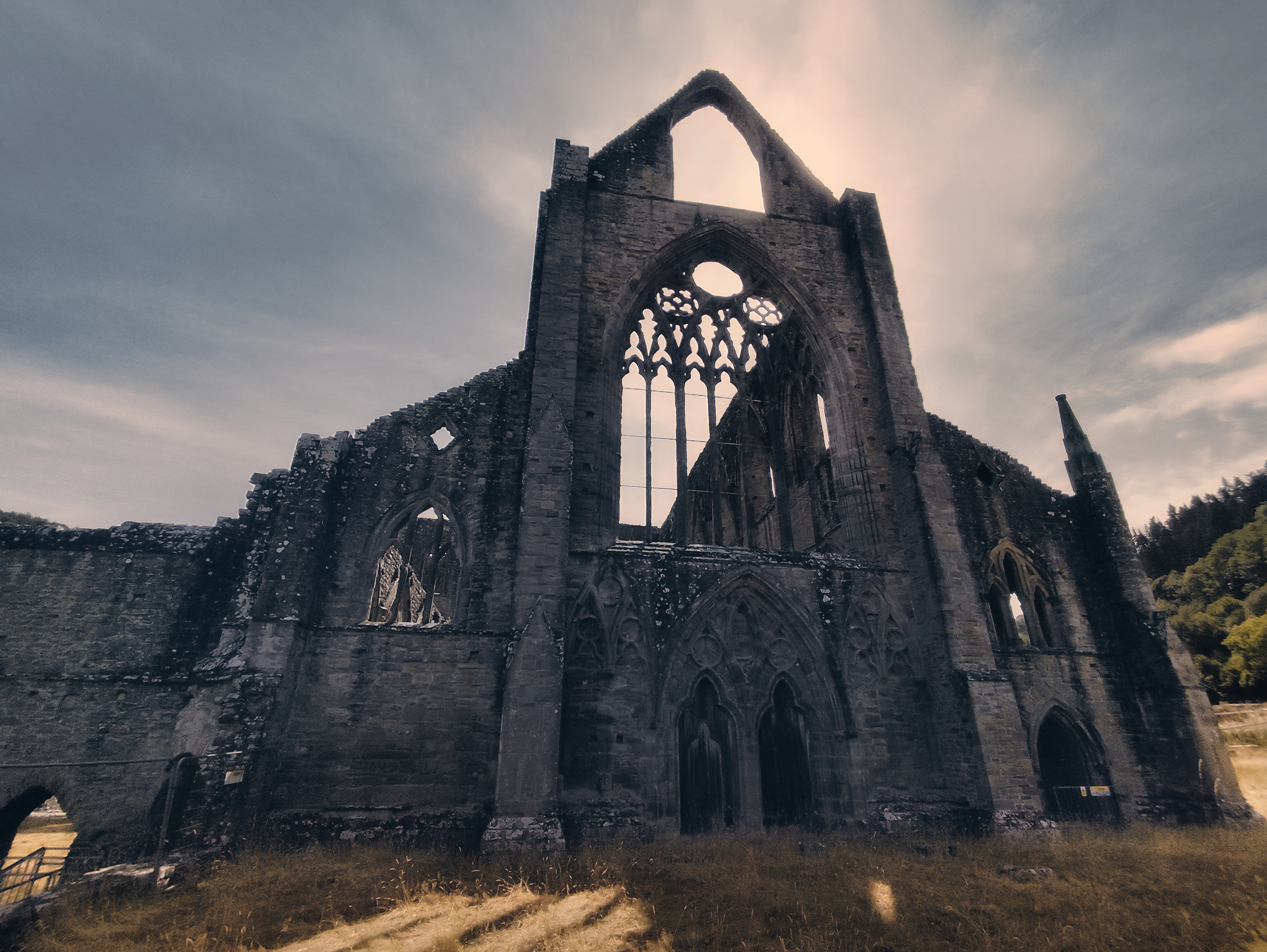
My photograph concentrates on one of the elements that immediately dominates the ruins:
the Gothic window.
I photographed it from below because I wanted the stone structure to rise through the frame rather than simply document the building from a distance.
The perspective exaggerates its vertical character.
Dark medieval stone occupies most of the image, while the pale sky passes directly through the empty window openings.
There is no glass anymore.
That absence is precisely what makes the scene work.
The window no longer frames a religious interior.
It frames the sky.
🕰️ What Survives
A ruin is an interesting contradiction.
We are looking at something that has been damaged, abandoned and transformed for centuries — yet the fact that so much remains can feel more remarkable than what has disappeared.
At Tintern, the roof is gone.
The medieval interiors have vanished.
The daily routines of the Cistercian monks ended almost five hundred years ago.
But the proportions remain.
The arches remain.
The windows remain.
And when you stand beside these enormous walls, it is still possible to understand the ambition of the people who built them.
Perhaps that is the real attraction of Tintern Abbey.
It doesn't reconstruct the past for you.
It leaves enough empty space for you to imagine it.
📷 Photo Notes
Series: Wales Through My Lens
Location: Tintern, Monmouthshire, Wales
Monument: Tintern Abbey / Abaty Tyndyrn
Founded: 1131
Order: Cistercian
Great church begun: 1269
Monastery dissolved: 1536
Architecture: Gothic
Genre: Architecture & Travel Photography
Photographic approach: Low perspective • Strong vertical lines • Architectural framing • Dramatic sky
"At Tintern Abbey, the missing roof does not hide the past — it opens it to the sky."
📷Architectural framing
| Category | #momentsinfocus |
| Photo taken at | Wales |

@marcoteixeira
Upvoted! Thank you for supporting witness @jswit.
What do you think is the reason you still aren't noticed, still do not receive upvotes?
The photo is good.
This BOOMING vote is yours and well deserved!
❤️🍀
Thanks for stopping by :) I really appreciate the support :) Cheers :)