🖼️Wales | Where the Coast Refuses to Be Straight
Wales | Where the Coast Refuses to Be Straight
The coastline of Wales has a remarkable ability to change its appearance from one stretch to the next.
There are sheltered bays, steep cliffs, sandy beaches and long expanses of pebbles exposed to the wind.
During my journey through Wales in August 2026, I encountered this particularly open section of coastline, where the landscape seemed to be defined by three elements: stone, wind and the sea.
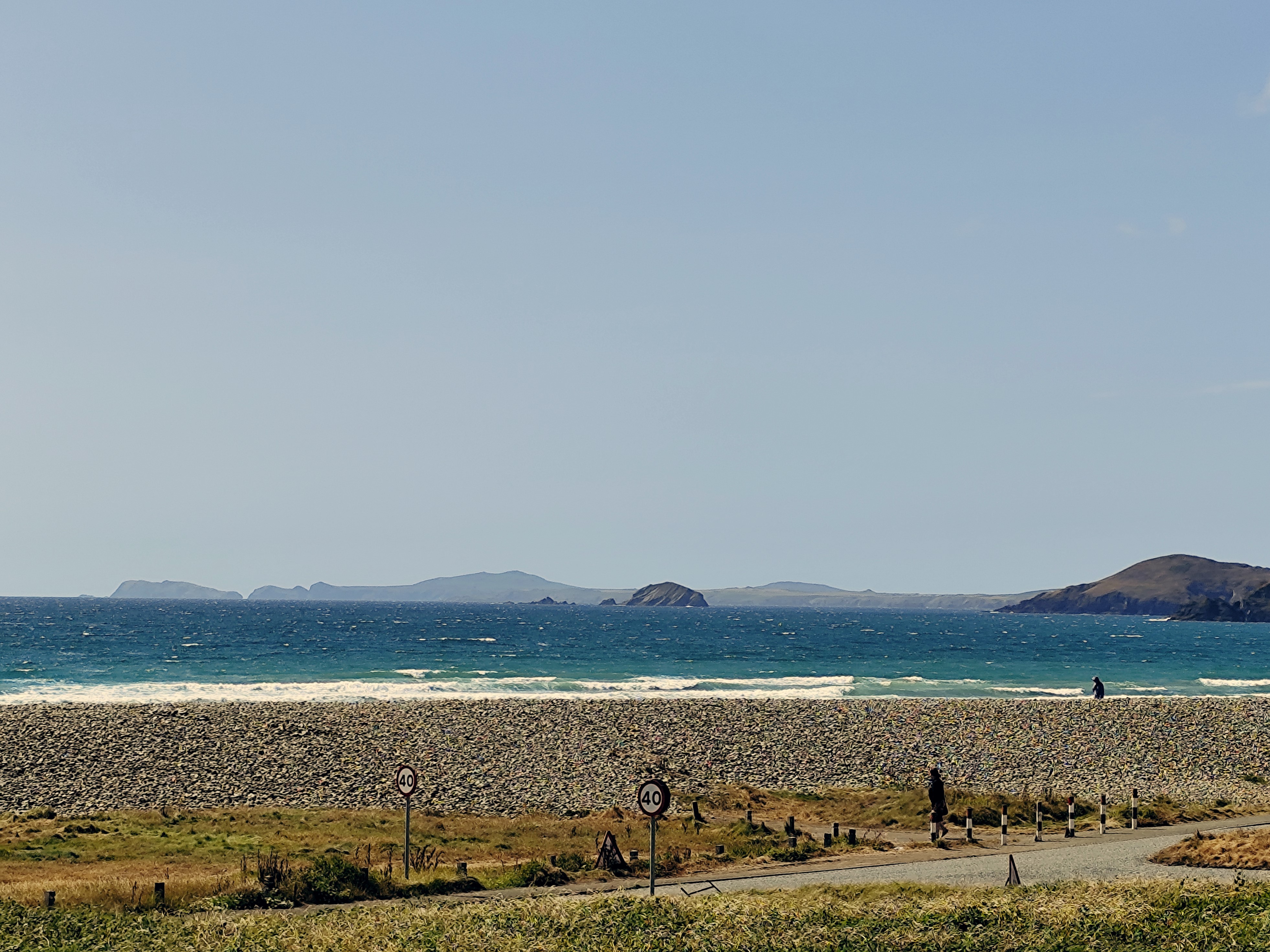
The beach stretched across the foreground as an enormous band of rounded pebbles. Beyond it, the water was restless, its surface broken by small whitecaps and waves approaching the shore.
In the distance, a succession of headlands extended across the horizon.
It was not a dramatic scene in the conventional sense.
There were no towering cliffs immediately beside me, no spectacular waterfall and no famous monument demanding attention.
What made the landscape interesting was its geographical character.
The coast seemed to unfold in successive layers, each one revealing another variation in the shape of the land.
🌊 A Coastline Written in Stone
One of the first things that caught my attention was the beach itself.
Instead of a broad expanse of fine sand, the shoreline was covered with countless pebbles.
From a distance, they formed an almost continuous textured surface, interrupted only by the narrow band of breaking waves.
Pebble beaches are the result of long processes involving erosion, transport and the repeated movement of material by waves.
As fragments of rock are moved and collide with one another, their edges can gradually become smoother and more rounded.
The precise composition and origin of the stones vary from place to place, depending on the local geology and coastal processes.
In this photograph, the individual pebbles are too distant to examine, but their collective presence creates one of the strongest visual features of the landscape.
They give the beach a very different appearance from the sandy shores often associated with seaside holidays.
It is a coastline where the ground itself tells part of the story.
💨 The Wind Across the Water
The sea was another element that made this location distinctive.
Its surface was covered with small irregular waves, and scattered whitecaps were visible farther offshore.
Closer to the beach, successive lines of surf marked the point where the waves were breaking.
The wind was clearly influencing the appearance of the water.
Unlike a calm sea, which can create broad reflections and relatively uniform colours, wind-roughened water produces a constantly changing pattern of darker and lighter areas.
In this photograph, those variations create a strong contrast with the relatively stable shapes of the distant headlands.
The waves also introduce a sense of movement into an otherwise expansive landscape.
The coastline may appear still in a photograph, but the water never truly is.
🗺️ Headlands Along the Horizon
Perhaps the most interesting geographical feature is the distant coastline.
Several headlands and elevated stretches of land appear one behind another, gradually fading into the atmosphere.
Their outlines are irregular.
Some rise gently from the sea, while others form more abrupt rocky shapes.
This succession of landforms gives the photograph a sense of distance that would be difficult to achieve with a completely straight coastline.
The eye moves from the nearest headland on the right towards the smaller and more distant silhouettes on the left.
Each change in elevation adds another layer to the scene.
Without knowing the precise location, I would not attempt to identify the individual headlands.
What matters here is their collective shape and the way they reveal the complexity of the Welsh coastline.
It is a landscape that seems to continue beyond the limits of the photograph.
📷 Photographing a Landscape in Layers
For this image, I chose a horizontal composition to emphasise the width of the coastal setting.
The photograph is organised into several distinct bands.
At the bottom, the road and grassy margins introduce the human presence in the landscape.
Beyond them, the pebble beach forms a broad textured strip.
The sea creates a darker band of blue, interrupted by breaking waves.
The distant headlands establish the horizon, while the sky occupies much of the upper part of the frame.
I deliberately retained that generous area of sky.
Its pale blue tones and subtle cloud formations help convey the openness of the location.
The road signs and the two small human figures also contribute to the composition.
They provide familiar references against which the dimensions of the beach and coastline can be appreciated.
Rather than removing these elements, I preferred to preserve the relationship between the natural landscape and the infrastructure that allows people to experience it.
🪨 A Landscape Without a Single Focal Point
Not every landscape photograph needs one dominant subject.
Sometimes, the interest lies in the relationship between several elements.
Here, the pebble beach, wind-driven sea and distant headlands are equally important.
The photograph does not depend on a spectacular rock formation or a recognisable landmark.
Instead, it invites the viewer to explore the landscape gradually.
From the road in the foreground to the stones covering the beach.
From the breaking waves to the darker water offshore.
And finally, from one headland to another along the horizon.
For me, this was one of the interesting aspects of travelling along the Welsh coast.
The scenery was not defined by a single type of beach or coastal formation.
Its variety was part of the experience.
And this particular photograph captures a stretch where the combination of stone, wind and geography creates a distinctive coastal landscape.
📷 Photo Notes
Location: An unspecified coastal location in Wales, United Kingdom
Date: August 2026
Main subject: Extensive pebble beach, wind-roughened sea and a succession of distant coastal headlands
Photographic approach: Travel photography, coastal landscape, geographical observation and the relationship between natural landforms and human infrastructure
Composition: Horizontal framing organised into successive layers: roadside vegetation and signs in the foreground, a broad pebble beach, breaking waves, open sea, distant headlands and an expansive sky
Lighting: Natural daylight under a pale blue sky with thin cloud cover, producing relatively soft contrasts across the landscape
Atmosphere: Open, windswept and expansive, with visible whitecaps and surf suggesting an exposed coastal environment
Main interest: The diversity of coastal landforms, the texture of a pebble beach and the visual depth created by successive headlands along the Welsh coastline
| Category | #momentsinfocus |
|---|---|
| Photo taken at | Coastal Wales, United Kingdom |
| Main subject | Pebble beach, wind-roughened sea and distant headlands |
| Photographic genre | Travel, coastal landscape and nature photography |

Upvoted! Thank you for supporting witness @jswit.