🌊 When the Mountains Broke: Nepal’s Deadly Flood and the Warning It Leaves for the World
Today’s Global News | September 1, 2026
Imagine waking up one morning and discovering that the road outside your home has disappeared.
Not because someone closed it.
Not because of an ordinary storm.
But because an enormous wall of water, mud, rocks and debris has moved through the valley.
You look around.
Homes are damaged.
Bridges are gone.
Communication is down.
People are searching for relatives.
And in the distance, rescue helicopters are trying to reach places that may no longer even have a road leading to them.
This is the reality facing communities in Nepal after a catastrophic Himalayan flood triggered by a glacier collapse on August 26.
Today, the human cost has reached a shocking scale.
Reuters reports that 1,003 people have been confirmed dead and around 4,000 remain missing, including about 590 foreign nationals from 39 countries. More than 11,000 people have been rescued, while thousands of homes, roads and other infrastructure have been devastated.
But the numbers are only one part of the story.
Behind every number is a person.
A family.
A home.
A future that has suddenly changed.
And perhaps the most important question is no longer simply:
“What happened in Nepal?”
It is:
“What is this disaster warning the rest of the world about?”
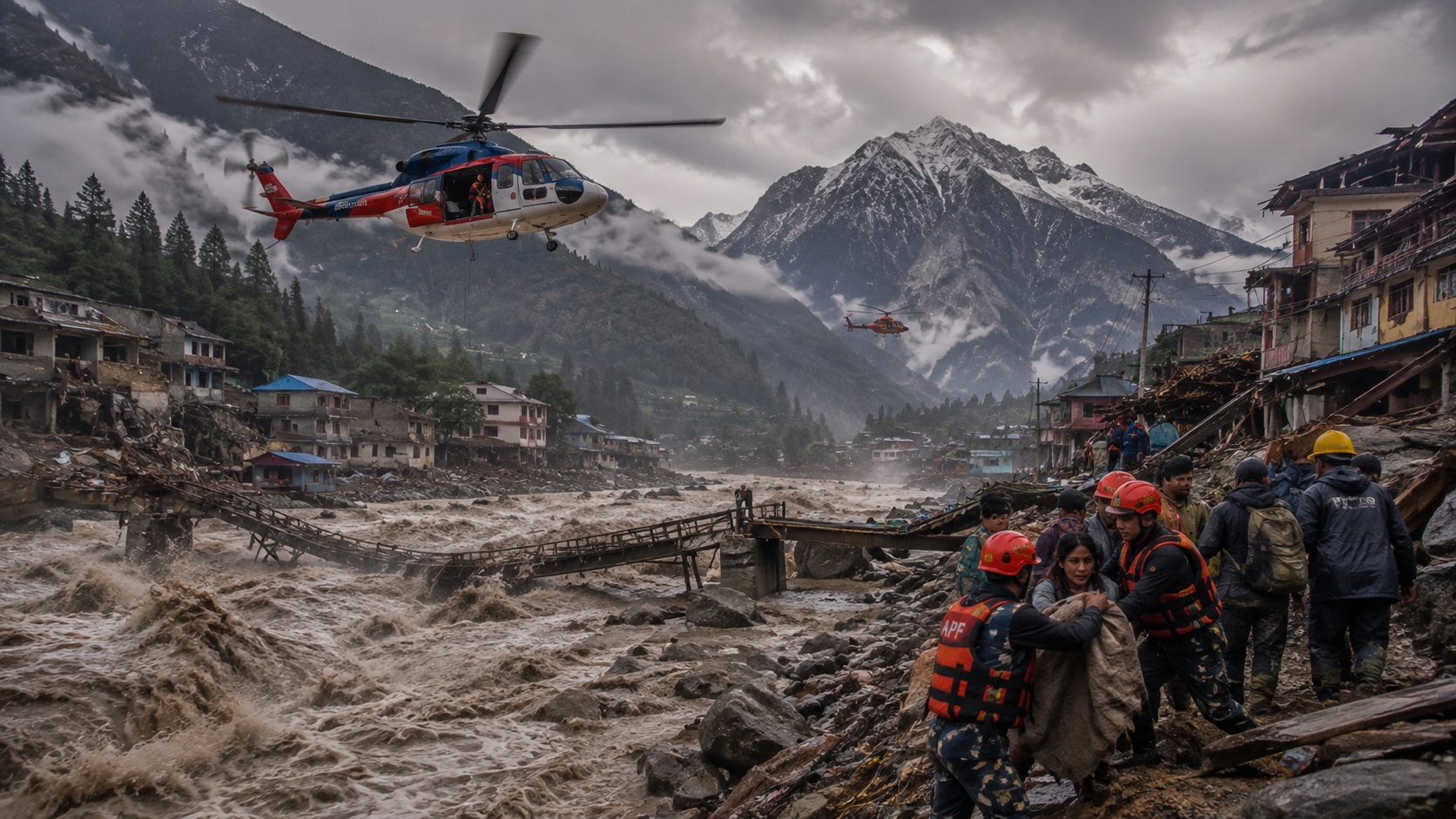
🌧️ This Was More Than a Normal Flood
When people hear the word “flood,” many imagine heavy rain slowly filling streets.
This event was very different.
Reuters reports that a glacier collapse in the Himalayan region triggered a huge flow of ice, rock and mud that swept through border areas of Nepal and China.
That difference matters.
Because when enormous amounts of ice, rock and water suddenly move together through narrow mountain valleys, communities may have very little time to react.
There is no comfortable warning period.
There may not be enough time to collect documents.
There may not even be enough time to understand what is happening.
One survivor from hard-hit Rasuwa district described leaving with nothing except the clothes she was wearing, which were still wet from the rain.
That single detail says more about this disaster than a hundred statistics.
Imagine having minutes to leave your home.
What would you take?
Your phone?
Your passport?
Your children's clothes?
Important documents?
Some food?
Or perhaps nothing at all because there simply isn't enough time?
🚁 The Rescue Operation Is Now a Race Against Geography
The disaster happened in one of the world's most difficult environments for emergency response.
Steep Himalayan valleys.
Unstable slopes.
Fast-flowing rivers.
Destroyed roads.
Collapsed infrastructure.
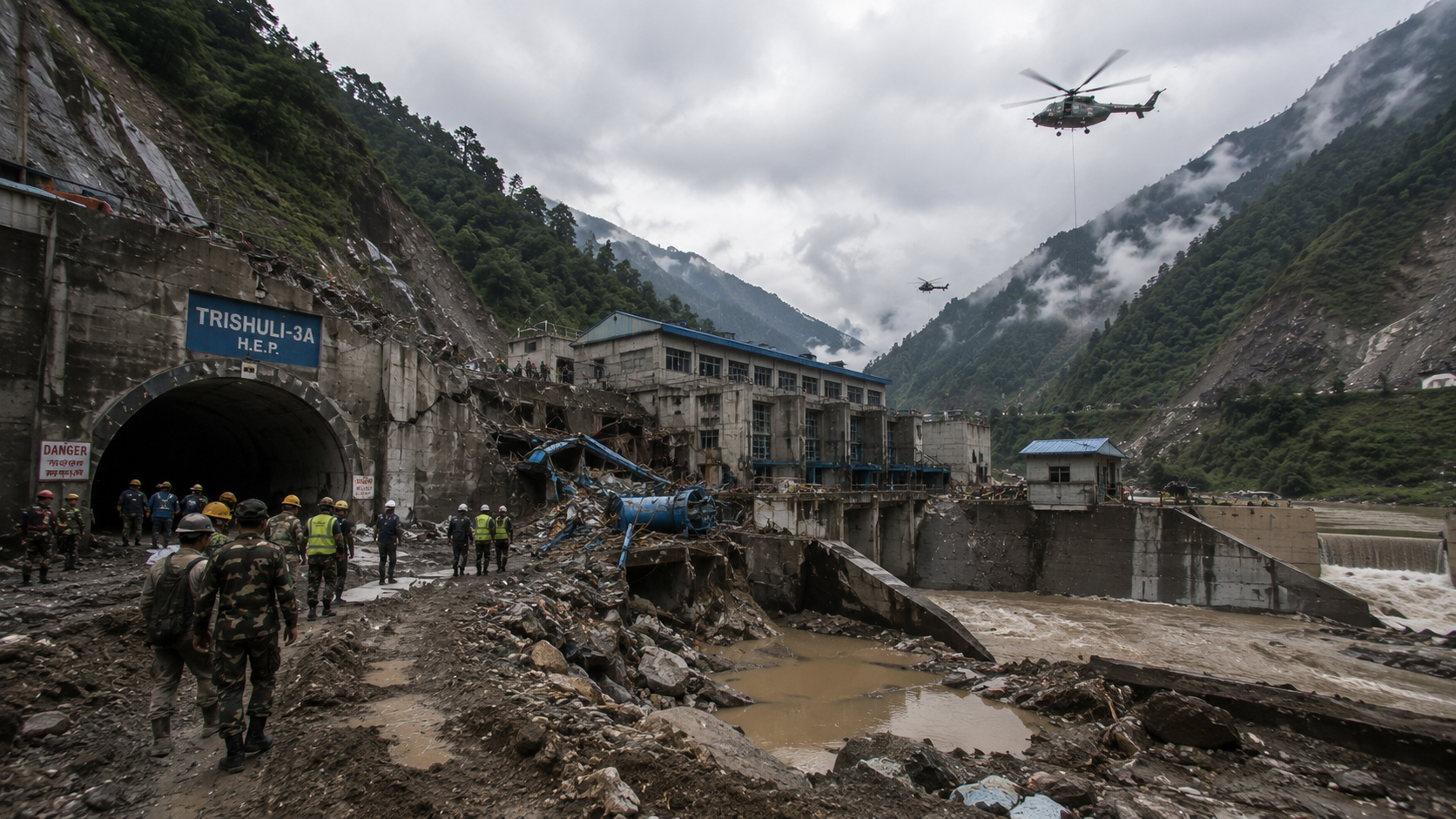
And damaged hydropower facilities.
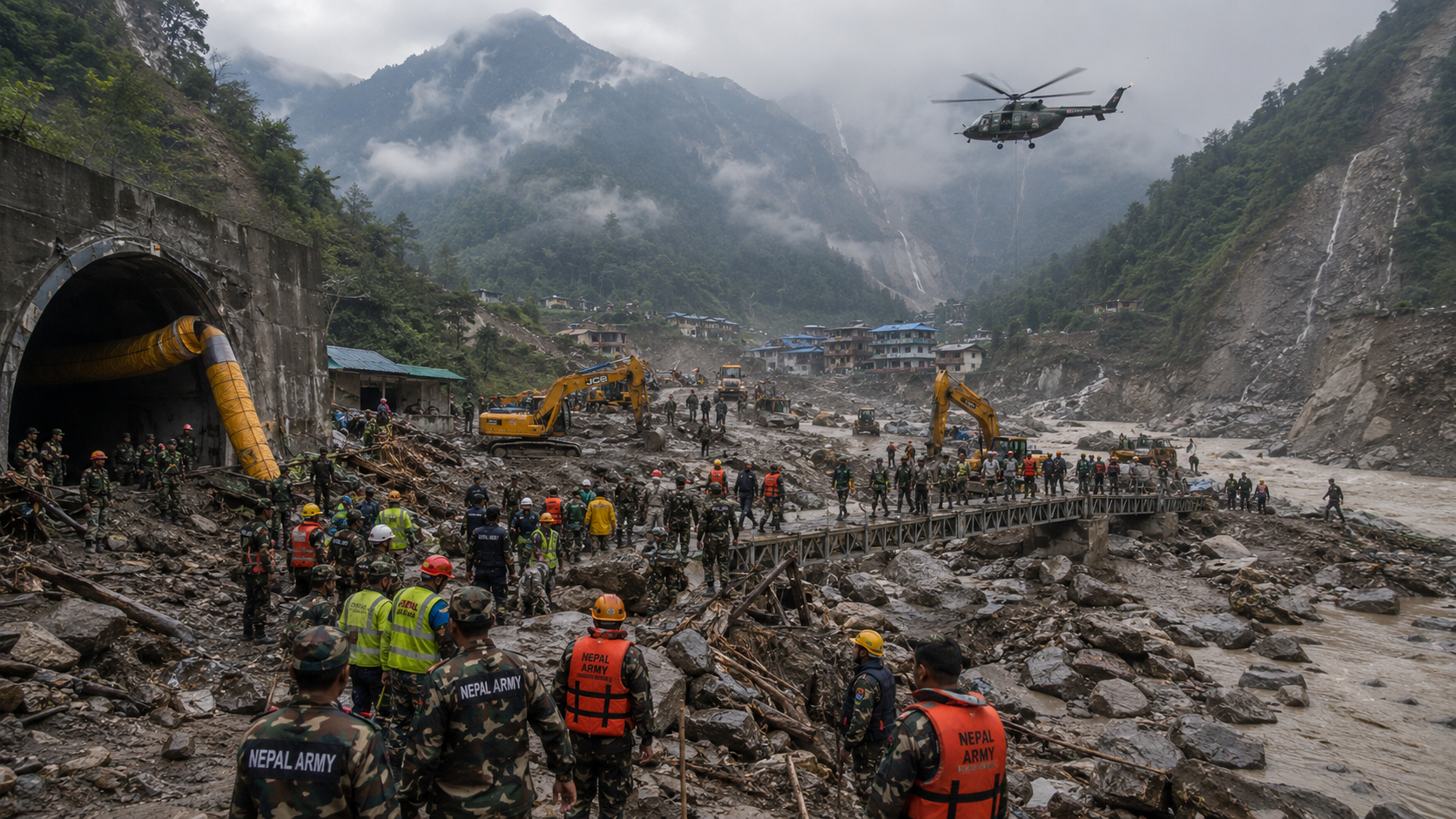
Reuters reports that specialized teams from Nepal, India and China are using helicopters, heavy machinery, excavators and temporary bridges to reach isolated areas.
More than 9,200 personnel have been deployed for search and rescue, road clearance, emergency treatment and the management of casualties.
But technology and manpower still have limits.
One rescue worker told Reuters that entering one tunnel at a hydropower site was not humanly possible because of the conditions, requiring bulldozers and excavators instead.
That is something easy to forget while watching disaster coverage from a comfortable room.
A map can show you where people are trapped.
A satellite can show you the damage.
But someone still has to physically reach them.
🖼️— SEARCH AND RESCUE
💔 The Missing Are Often the Hardest Part of the Story
Deaths can eventually be counted.
The missing create something different.
Uncertainty.
Thousands of families are still waiting for answers.
Reuters currently puts the number of missing at around 4,000, including hundreds of foreign nationals.
And this creates a terrible situation for families.
Imagine calling someone's phone again and again.
No answer.
You check social media.
Nothing.
You contact a rescue centre.
No information.
You travel to another town.
Still nothing.
Perhaps someone tells you that your relative may have been seen.
Then another person says they were not.
Hope rises.
Hope falls.
This is the psychological side of disasters that is rarely captured by satellite images.
One Reuters report published today described the heartbreaking case of a family searching for a 21-year-old man for four days before discovering that his body had already been recovered.
Sometimes the hardest part of a disaster isn't knowing what happened.
It is not knowing.
🏔️ What Caused This Disaster?
The immediate trigger was a glacier-related collapse.
But the larger environmental question is much more complicated.
Nepal's Prime Minister Balendra Shah has linked the disaster to risks associated with a warming planet, calling for greater international attention to climate-related disasters in the Himalayan region.
That doesn't mean every flood can simply be labelled “climate change” without careful scientific analysis.
But it does mean something important is happening.
The Himalayas are warming.
Glaciers are changing.
Mountain lakes and unstable slopes can create new hazards.
And communities living downstream can be exposed to risks they may never have faced at the same scale before.
This changes the disaster-preparation equation.
You cannot prepare for tomorrow using only yesterday's climate assumptions.
⚡ Nepal Has Another Problem: Hydropower
There is an economic story hidden inside the disaster.
Nepal has invested heavily in hydropower.
The country's rivers and mountains offer enormous potential for electricity generation, and hydropower is central to Nepal's plans for economic development and electricity exports.
But the flood has now created a serious question:
What happens when the infrastructure built to take advantage of Himalayan rivers becomes vulnerable to changing Himalayan conditions?
Reuters reports that about 639 people remain stranded at several damaged hydropower stations, while 279 workers have already been rescued from hydropower projects.
Another Reuters report today says the floods have damaged enough hydropower capacity to wipe out roughly 10% of Nepal's electricity generation capacity, temporarily forcing the country to stop electricity exports and import power from India.
That's an enormous economic consequence.
A natural disaster has suddenly become an energy-security problem.
🖼️— DAMAGED HYDROPOWER INFRASTRUCTURE
🌍 This Is Not Just Nepal's Problem
This is where I think today's story becomes much bigger.
The Himalayas don't belong to one conversation.
They are part of a region that influences water, agriculture, electricity and ecosystems across Asia.
Millions of people downstream depend on Himalayan rivers.
So what happens when mountain environments become less predictable?
The effects can travel far beyond the mountains.
Water systems can be disrupted.
Hydropower can be damaged.
Agriculture can be affected.
Tourism can suffer.
Road networks can be cut.
Trade routes can be interrupted.
And governments can suddenly find themselves dealing with enormous reconstruction bills.
Reuters estimates that rebuilding Nepal's disaster-damaged infrastructure could cost around $4–5 billion, according to reporting on the economic consequences of the disaster.
For a country like Nepal, that is not a small number.
It is a national economic challenge.
🤖 Could Better Technology Have Saved More Lives?
This is the question I keep coming back to.
We already have:
🛰️ Satellites
🚁 Drones
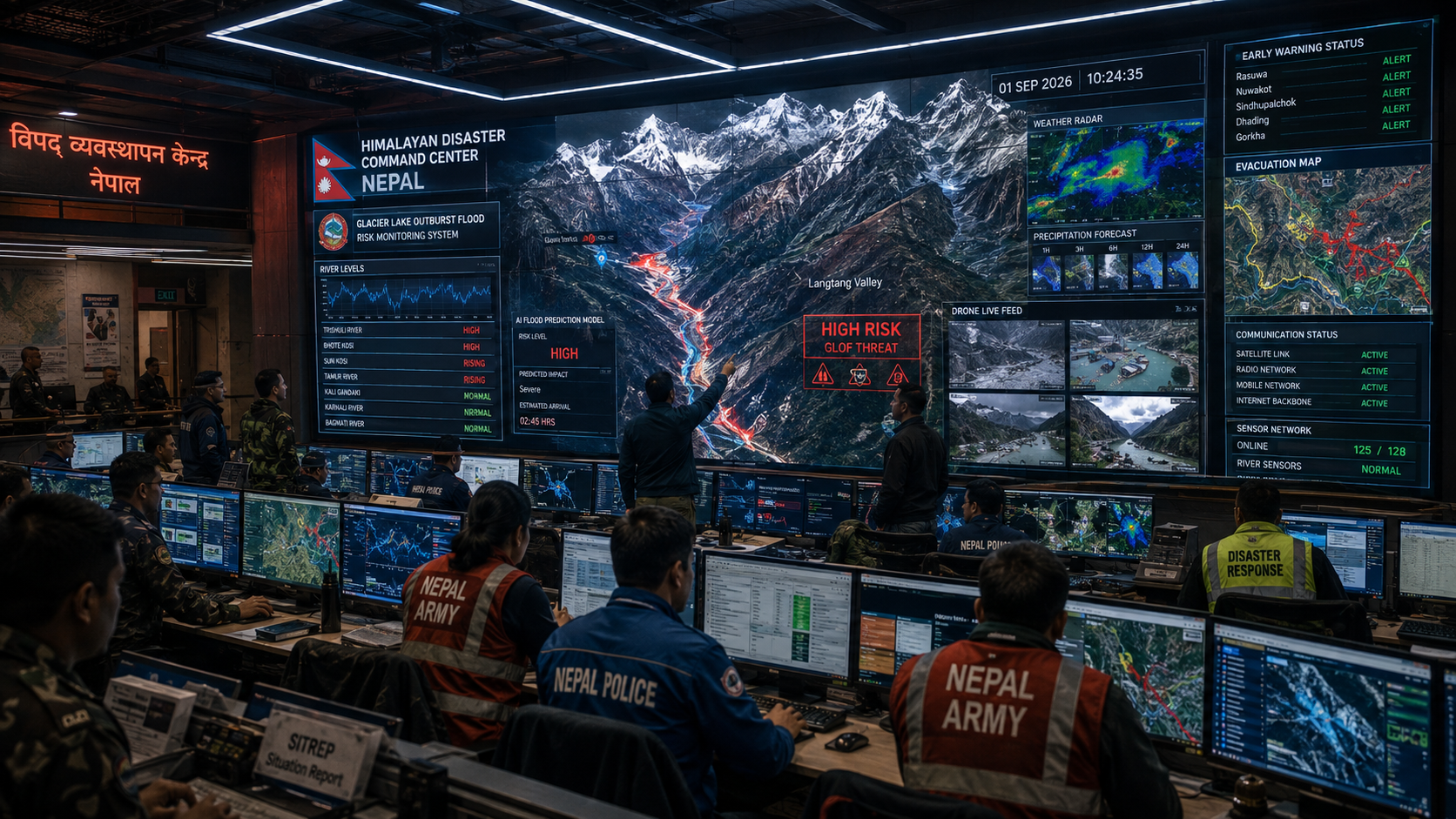
🤖 Artificial intelligence
📡 Weather radar
📱 Smartphones
🗺️ Digital mapping
🌊 Water-level sensors
So why are disasters still so devastating?
The answer is that technology itself isn't enough.
You need:
Good data.
Reliable communication.
Local warning systems.
Trained people.
Evacuation routes.
Emergency equipment.
Money.
And most importantly:
Time.
A warning that arrives 30 minutes early can be life-changing.
A warning that arrives two minutes late may be nearly useless.
🖼️— AI EARLY WARNING SYSTEM
📢 One Warning May Have Saved Hundreds of Lives
And here is a fascinating detail from the disaster.
Reuters reported that a last-minute flood warning helped save more than 900 students at a school in Nepal.
A school official said someone rushed inside shouting that the flood was coming, allowing the students to escape.
Read that again.
More than 900 students.
One warning.
Think about the implications.
We often imagine life-saving technology as something futuristic.
Maybe an AI satellite system.
Maybe a sophisticated sensor network.
Maybe a military-grade communication system.
But sometimes...
A person shouting:
“The flood is coming!”
can be just as powerful.
This is why disaster resilience is not only about technology.
It's also about people listening and acting quickly.
🧠 The Real Lesson: Preparation Is More Important Than Prediction
We spend a lot of time asking:
“Can we predict the next disaster?”
But maybe the better question is:
“Are we prepared if prediction fails?”
Because no prediction system will ever be perfect.
A sensor could fail.
A communication tower could go down.
A storm could behave unexpectedly.
A glacier could collapse in a place nobody expected.
A road could disappear.
So resilient communities need multiple layers of protection.
Warning.
Evacuation.
Communication.
Emergency shelters.
Backup power.
Satellite connectivity.
Search-and-rescue teams.
Medical support.
And trained citizens.
The goal should not be perfect prediction.
The goal should be fewer lives lost when prediction is imperfect.
🛰️ What Role Should AI Play?
AI could potentially become extremely useful in mountain disaster management.
Imagine combining thousands of data points:
Glacier movement.
Temperature.
Rainfall.
River levels.
Satellite images.
Mountain-lake volume.
Ground deformation.
Road conditions.
And historical patterns.
An AI system could identify unusual combinations that humans might overlook.
Then officials could receive a simple warning:
High downstream flood risk.
Evacuate vulnerable settlements.
Close this road.
Move rescue equipment here.
That could save lives.
But there is a danger.
People could become too dependent on algorithms.
An AI system is a tool.
It is not a substitute for local knowledge, experienced rescue teams or human judgement.
The future probably belongs to a combination:
AI + satellites + sensors + local people + trained emergency responders.
Not AI alone.
🖼️— HOPE AFTER DISASTER
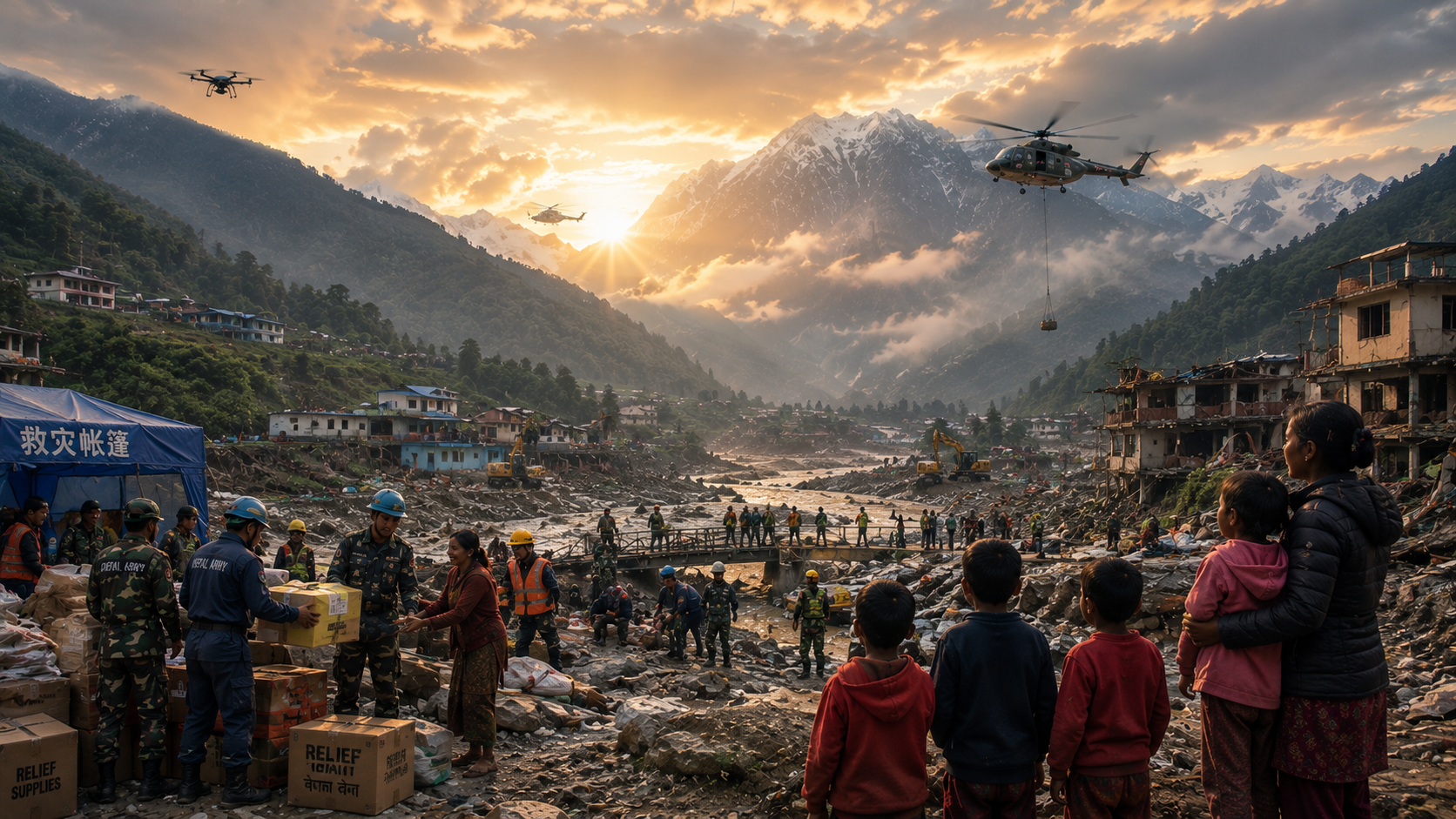
❤️ Behind the Numbers Are Thousands of Stories
It's easy to write:
1,003 dead.
4,000 missing.
11,000 rescued.
But perhaps we need to pause before moving on to the next headline.
One person who died was someone's child.
Someone was someone's father.
Someone was waiting for a phone call.
Someone had just started a career.
Someone had plans for tomorrow.
And today, those plans are gone.
At the same time, thousands of survivors are beginning a completely different journey.
Finding shelter.
Finding food.
Finding relatives.
Finding work.
Finding documents.
Finding a way home.
And eventually...
finding a way to rebuild.
That is the real meaning of recovery.
It isn't simply repairing roads.
It is rebuilding lives.
🌱 Can Nepal Rebuild Better Than Before?
This may be the most important opportunity hidden inside this tragedy.
Rebuilding exactly what existed before may not be enough.
New infrastructure should potentially account for:
Changing glacier conditions.
Extreme rainfall.
Flood pathways.
Mountain instability.
Emergency access.
Redundant communications.
Safer hydropower design.
Early-warning technology.
And better evacuation planning.
A disaster can destroy infrastructure.
But it can also expose weaknesses that were already there.
The challenge is deciding whether to rebuild those weaknesses...
or fix them.
🤔 NOW I WANT YOUR OPINION
I want to turn this article into an actual discussion.
- Do you think climate change is making Himalayan disasters more dangerous, or do we still need much more scientific evidence before making that conclusion?
- Should governments allow major hydropower projects to be built in areas that could face future glacier-related floods?
- If you were given a large disaster-prevention budget for Nepal, where would you spend it first?
Early-warning systems?
Drones?
Helicopters?
Roads?
Hydropower protection?
Evacuation shelters?
Or something else?
And here's the question I really want to hear your answer to:
Would you trust an AI warning telling you to leave your home immediately because a glacier flood may be coming—even if you could not see any danger yourself?
Would you leave?
Or would you wait for human confirmation?
Tell me why.
I'd genuinely love to hear different perspectives.
💬 LET'S MAKE THE COMMENTS PART OF THE STORY
Don't just comment:
“Very sad.”
Tell me what you learned.
Tell me what surprised you.
Tell me what you think governments should change.
Tell me whether technology can really protect communities from disasters like this.
And most importantly, share your own country's perspective.
Pakistan, India, Bangladesh, Nepal and many other countries across Asia are connected through geography and water systems.
A lesson learned in one country can potentially help another.
🌍 FINAL THOUGHTS
The Himalayan disaster began with a sudden collapse of ice and rock.
Then came water.
Then mud.
Then destruction.
And now comes the long and painful process of recovery.
But perhaps the biggest story of September 1, 2026 is not simply that Nepal has lost more than a thousand people.
It is that the mountains are giving the world another warning.
The environment is changing.
Infrastructure is being tested.
Weather extremes can overwhelm communities.
And the cost of waiting until disaster arrives can be enormous.
The question is whether governments and societies will act before the next warning becomes another tragedy.
Because we cannot control every glacier.
We cannot control every storm.
We cannot stop every flood.
But perhaps we can control something else:
How prepared we are when nature suddenly changes the rules.
And maybe that is the lesson Nepal is giving the rest of us today.
🙏 THANK YOU FOR READING
Thank you so much for spending your valuable time reading this article.
I truly appreciate every reader who stops, thinks and shares an honest opinion.
You don't have to agree with me.
You don't have to agree about climate change.
You don't have to agree about hydropower.
You don't have to agree about AI.
Just bring your own reasoning to the discussion.
❤️ Thank you for being part of the conversation.
Stay Informed | Think Clearly | Grow Continuously 🚀
📌 TODAY'S SOURCES
The main facts in this article are based on Reuters reporting published September 1, 2026. Reuters reports that Nepal's confirmed death toll has crossed 1,000, around 4,000 people remain missing, more than 11,000 have been rescued, and more than 9,200 personnel are involved in rescue and recovery work. The disaster followed a glacier collapse on August 26 and severely damaged remote communities and hydropower infrastructure.
Reuters also reported today that the disaster has damaged roughly 10% of Nepal's electricity-generation capacity, while separate reporting highlighted how a last-minute warning helped save more than 900 students.