India Non-Ferrous Metals Market Size, Revenue Analysis, Latest Trends and Growth Report 2026–2034
India Non-Ferrous Metals Market Outlook
The report titled "India Non-Ferrous Metals Market Size, Share, Trends and Forecast by Type, Application, and Region, 2026–2034" provides a comprehensive analysis of the Indian market, covering its size, growth trajectories, macro-economic drivers, regional demand clusters, and other critical metrics defining the domestic smelting, refining, and downstream manufacturing ecosystem.
How Big is the India Non-Ferrous Metals Market?
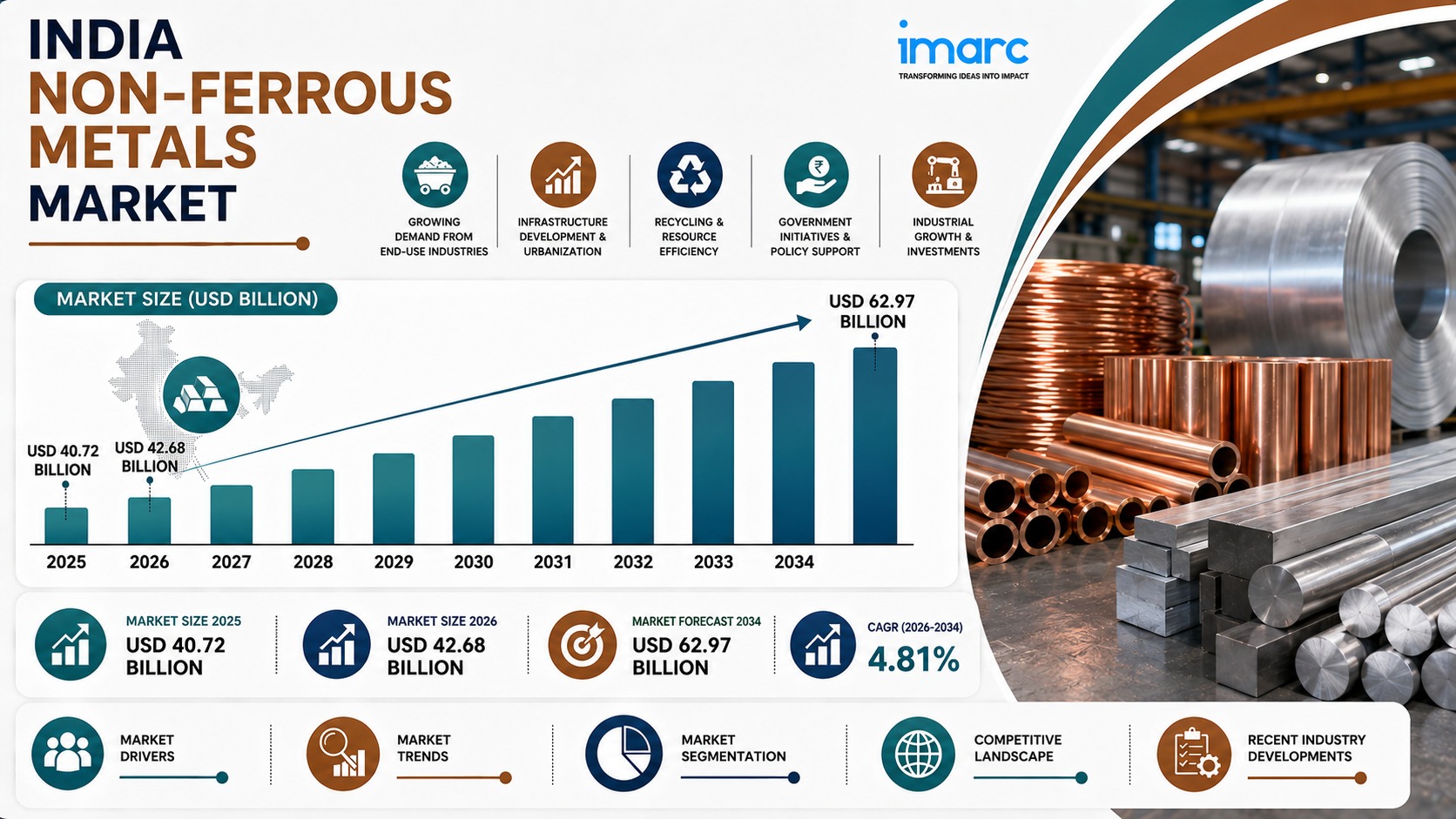
The India non-ferrous metals market size increased from USD 40.72 Billion in 2025 to USD 42.68 Billion in 2026. Looking forward, IMARC Group expects the market to reach USD 62.97 Billion by 2034, exhibiting a steady compound annual growth rate (CAGR) of 4.81% during the 2026–2034 forecast period. The sector is experiencing a monumental structural shift, moving from basic commodity extraction toward the production of highly specialized, low-carbon alloys designed to fuel India's renewable energy and electric mobility transition.
Emerging Trends in the India Non-Ferrous Metals Market:
- Aluminum Intensity in Green Building Construction: Driven by India's strict Energy Conservation Building Code (ECBC) and the Bureau of Energy Efficiency's star-rating programs, commercial real estate developers are rapidly adopting high-performance aluminum building envelopes. The specification of thermally broken aluminum window systems and reflective facades can improve a building's energy efficiency by up to 30–50%, acting as a massive demand catalyst in metropolitan corridors.
- The Rise of "Green" Low-Carbon Aluminum: Facing strict global ESG mandates and the impending European Carbon Border Adjustment Mechanism (CBAM), top-tier Indian smelters are aggressively decarbonizing. Manufacturers are increasing their captive renewable energy capacities (solar and wind hybrids) to produce low-carbon aluminum, allowing them to secure premium global export contracts and appeal to eco-conscious automotive OEMs.
- E-Waste "Urban Mining" and Secondary Copper Recovery: India's structural deficit in primary copper ore has sparked a massive pivot toward the circular economy. Large-scale, formal e-waste recycling and copper recovery facilities are being established to extract high-purity copper and precious metals from discarded electronics, significantly reducing the reliance on imported copper concentrate and dampening geopolitical supply shocks.
- Battery-Grade Nickel and Lithium Processing Ecosystems: As the domestic EV battery manufacturing supply chain matures, traditional non-ferrous players are diversifying their portfolios. There is a surge in greenfield investments targeting the refining of imported lithium, cobalt, and nickel ores into battery-grade precursor chemicals to feed India's burgeoning gigafactory pipeline.
- Digital Twin and AI Optimization in Smelting: To maximize yields and reduce energy consumption, heavy metal conglomerates are deploying Industrial IoT and AI-driven digital twins of their smelting pots. These predictive algorithms autonomously adjust alumina feeding rates and voltage in real-time, drastically reducing the massive electricity overhead traditionally associated with primary metal extraction.
Request a Sample Copy of this Report: https://www.imarcgroup.com/india-non-ferrous-metals-market/requestsample
Growth Factors Driving the India Non-Ferrous Metals Market (2025–2026)
- Strategic Sovereign Push for Copper Import Substitution: India's transition to clean energy relies fundamentally on copper. The strategic vulnerabilities exposed by heavy reliance on imported copper cathodes have led to massive federal and private sector interventions. Mega-scale coastal copper smelters are being rapidly operationalized to bridge this structural deficit, anchoring domestic supply for national grid modernization.
- The EV Lightweighting Supercycle: The electric vehicle revolution acts as a dual-growth engine for non-ferrous metals. While an EV requires roughly three to four times the copper of an internal combustion engine (for wiring harnesses and motors), battery weight constraints force automakers to aggressively substitute heavy steel chassis components with high-strength, lightweight extruded aluminum structural parts.
- Massive Scale-up of Renewable Energy Grids: India's ambitious target to install 500 GW of non-fossil fuel capacity demands an unprecedented upgrade of the national transmission grid. This translates directly into immense, non-discretionary procurement volumes for aluminum overhead transmission conductors, zinc for galvanizing transmission towers, and highly conductive copper for wind and solar farm inverters.
- High-Speed Rail and Metro Modernization: The rapid expansion of India's railway infrastructure—specifically the rollout of Vande Bharat trains and multi-city underground metro networks—is driving massive consumption of specialized aluminum alloys for rolling stock carriage shells and continuous copper contact wires for overhead electrification systems.
- Aggressive Brownfield Smelter Expansions: Rather than solely investing in greenfield projects that face prolonged land acquisition and environmental clearance delays, market leaders are executing aggressive brownfield expansions at their existing aluminum and zinc smelters. This strategy allows them to scale capacity and capitalize on current demand spikes with significantly lower capital expenditure and faster turnaround times.
How will the India Non-Ferrous Metals Market Evolve in the Coming Years?
The India non-ferrous metals market is structurally engineered for robust, continuous expansion through 2034. It is transitioning from a traditional heavy industry into an advanced materials sector strictly aligned with global decarbonization and smart-city infrastructure.
The market generated a revenue of USD 42.68 Billion in 2026 and is projected to reach an impressive USD 62.97 Billion by 2034, compounding at 4.81% annually. While aluminum maintains absolute volumetric dominance due to its ubiquitous application in construction and packaging, copper will decisively lead the growth trajectory. As India localizes its EV components and renewable energy hardware, securing domestic base metal refining capacity will remain the ultimate national priority.
Explore the Full Report with Charts, Table of Contents, and List of Figures: https://www.imarcgroup.com/india-non-ferrous-metals-market
Deep-Dive Segment Insights
- By Type: The market spans Aluminum, Copper, Lead, Tin, Nickel, Titanium, Zinc, and Others. Aluminum commands the absolute largest share at 41.8% (2025), reflecting its universal application across construction, automotive, and power sectors. Copper is the second-largest (24.6%) and the fastest-growing segment, driven entirely by its indispensable role in electrification and renewable power generation.
- By Application: Segmented into Automobile Industry, Electronic Power Industry, Construction Industry, and Others. The Construction Industry leads with a 36.4% share in 2025, supported by massive demand for aluminum facades, structural zinc galvanization, and copper wiring. The Automobile Industry follows closely (28.7%), surging rapidly as passenger vehicles demand roughly 20-25 kg of aluminum per unit, a number climbing sharply with EV adoption.
- By Region: Geographically mapped across North India, West and Central India, South India, and East and Northeast India. West and Central India act as the undisputed market leaders, holding a 38.2% share in 2025. This supremacy is anchored by the region's dense concentration of primary smelting bases, robust metal trading infrastructure, and massive automotive clusters in Maharashtra and Gujarat. South India (22.4%) is experiencing a distinct surge in copper demand, driven by Bengaluru's IT hardware manufacturing and emerging data center infrastructure.
Competitive Landscape & Key Company Insights
The Indian non-ferrous metals market exhibits moderate-to-high concentration. The competitive landscape is absolutely dominated by a handful of massive, vertically integrated, multi-billion-dollar conglomerates that control the value chain from mining rights to finished extrusions.
Key industry participants actively shaping the competitive environment include Aditya Birla Management Corporation Pvt. Ltd. (Hindalco), Vedanta Limited, NALCO India, Hindustan Copper Ltd., and Maan Aluminium Ltd.
To defend their market leadership, giants like Vedanta and Hindalco are aggressively focused on deep vertical integration, securing captive raw material sources, and maintaining their position on the lowest quartile of the global cost curve. To combat global volatility, they are heavily investing in expanding their high-margin, downstream value-added product (VAP) portfolios—such as specialized automotive alloys and aerospace extrusions—insulating their revenues from the cyclical swings of primary metal commodity pricing.
Latest Recent Developments in the India Non-Ferrous Metals Market (2025–2026)
- Vedanta Aluminium's Mega Billet Expansion (February 2026): Solidifying its position as India's premier aluminum producer, Vedanta successfully expanded billet production capacity at its Jharsuguda operations in Odisha to a massive 830,000 tonnes per annum (KTPA). By adding 250 KTPA of new capacity equipped with advanced global casting technology, Vedanta is aggressively targeting the booming domestic demand for high-strength extrusion profiles used in modern construction and automotive lightweighting.
- Hindalco’s Massive Smelting and Recycling CapEx (August 2025): At its 66th AGM, Hindalco unveiled one of its most ambitious expansion strategies to date. The conglomerate announced the expansion of its Aditya aluminum smelter by 180,000 tonnes and the Mahan smelter by 360,000 tonnes, alongside an 850,000-tonne greenfield alumina refinery. Crucially, its Dahej copper smelter is undergoing a 300,000-tonne expansion, making it the world's largest single-location copper smelter outside China. Concurrently, the company is constructing India's first dedicated large-scale e-waste and copper recycling facility at Pakhajan.
- Adani’s Kutch Copper Plant Operationalization (June 2025): Marking a massive milestone for India's import substitution goals, the Adani Group officially began processing ores at its Kutch Copper plant in Mundra. Starting with an initial capacity of 500,000 tonnes per annum (tpa) and ramping up amidst global concentrate shortages, the facility aims to double production to 1 million tonnes by 2029. This mega-smelter significantly reduces India's critical dependence on imported copper cathodes, directly supporting the domestic renewable and EV supply chains.
Customization Note: If you require any specific information not covered within this report's scope, we will provide it as part of the customization.
Request Report Customization: https://www.imarcgroup.com/request?type=report&id=21749&flag=E
Frequently Asked Questions (FAQs)
Q1. What is the current size of the India non-ferrous metals market?
The India non-ferrous metals market size increased from USD 40.72 Billion in 2025 to USD 42.68 Billion in 2026.
Q2. What is the projected market size by 2034 and the CAGR from 2026 to 2034?
The market is projected to reach an impressive USD 62.97 Billion by 2034, expanding at a steady compound annual growth rate (CAGR) of 4.81% during the 2026–2034 forecast period.
Q3. Which metal type holds the dominant market share in India?
Aluminum commands the absolute largest share (41.8% in 2025), heavily driven by its extensive and versatile applications across the construction, transportation, and power transmission sectors.
Q4. Which application sector commands the highest demand?
The Construction Industry leads procurement (36.4% share in 2025), fueled by continuous urbanization and the heavy specification of aluminum extrusions and structural zinc in modern commercial real estate.
Q5. Which region leads the non-ferrous metals market in India?
West and Central India act as the definitive market leaders (commanding a 38.2% share in 2025), anchored by their immense concentration of primary smelting facilities and the massive automotive manufacturing hubs in Maharashtra and Gujarat.