Investigation into life on the moon Europa becomes more complex.
in Popular STEM2 days ago

Investigation into life on the moon Europa becomes more complex.


Souce


Plans to determine whether life exists on Europa—currently the prime candidate for the search for extraterrestrial life—are becoming complicated. Mars has not yet been ruled out, however; if life emerged in Martian oceans—which we know existed for hundreds of millions of years (possibly up to a billion years)—it would have coincided with the time life was emerging on Earth.

In theory, if all the necessary elements for life are present, along with the requisite energy and materials for the reaction to occur, life should have arisen on Mars—even if only in bacterial form. If life did emerge on Mars, it is logical to assume it would have migrated to subsurface layers—much like on Earth—into the liquid water layers known to exist beneath the Martian surface. Significant bodies of liquid water, or aquifers, are believed to exist at depths of two to three kilometers; life on Mars could have taken refuge there, or perhaps beneath the icy polar caps.


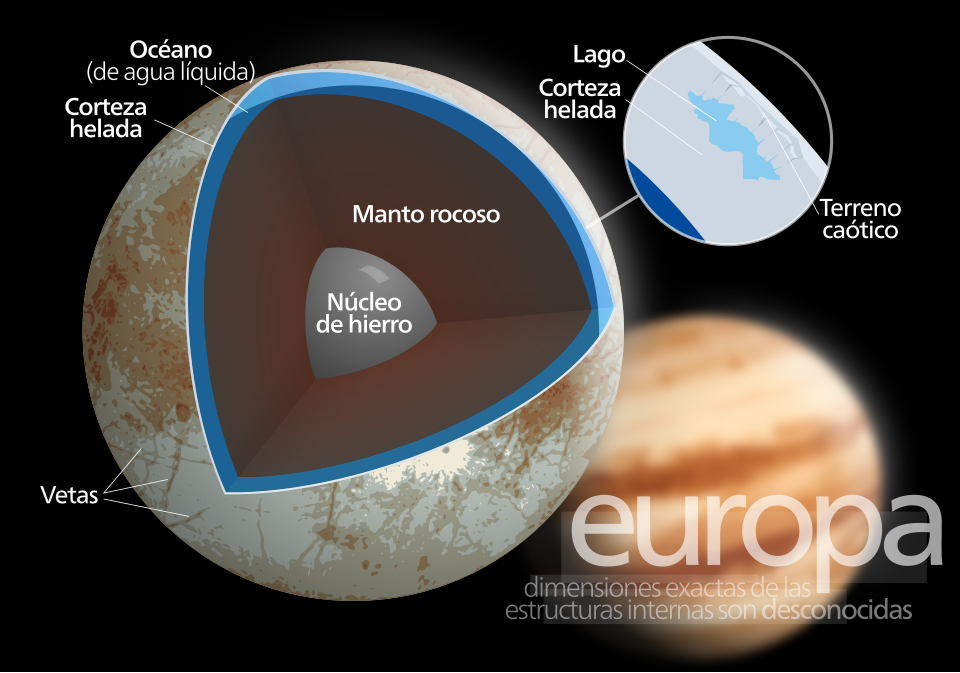
So, Mars has not yet been officially written off, but Europa is a different case. Europa is unique because its water ocean is enormous—truly gigantic. It contains more water than all of Earth's oceans combined. This ocean lies beneath an icy crust, which is highly advantageous given that Europa is bombarded by lethal radiation from Jupiter; an astronaut standing on the surface would receive a fatal dose in a day or less. Beneath that icy crust, however, there is no such danger—partly because water serves as an effective radiation shield (a useful fact to keep in mind in the event of a nuclear war).


Europa is a tad smaller than our Moon, yet it is still enormous; the water—those vast oceans—has essentially existed there for billions of years. Consequently, if life did emerge on Europa, it wouldn't have been cut short like on Mars—where oceans were lost, leaving perhaps only bacteria in deep aquifers. Here, life has had time to evolve within Europa's oceans. What might be down there? That remains a great mystery.


Souce


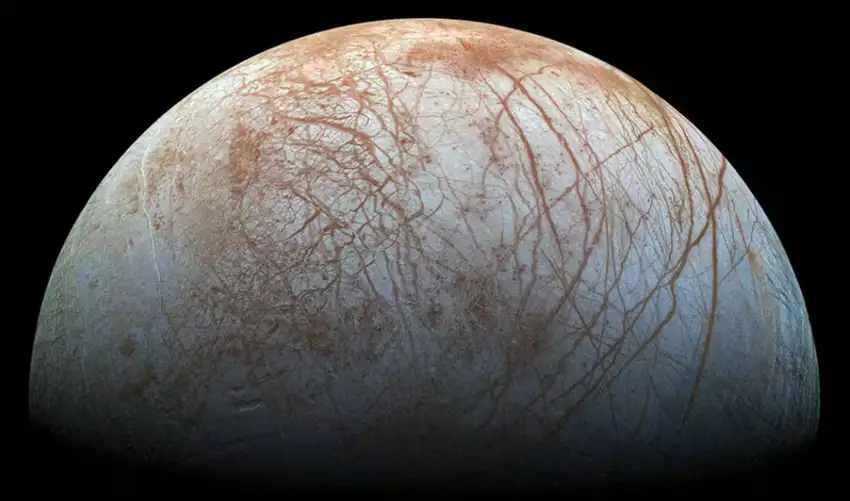
The red patches and streaks are salts—salts from the ocean's interior that welled up through cracks and were subsequently baked by Jupiter's radiation. What does the new research say? Essentially, it suggests there is a way to determine what lies within those oceans without the monumental task of transporting drilling equipment; attempting to drill through Europa's icy crust—which is over 10 kilometers thick—would be madness. After all, drilling through the ice in Antarctica is already difficult enough—consider lakes like Vostok, which have been sealed beneath the ice sheet for millions of years, yet remain incredibly hard to reach.


Imagine traveling to Jupiter with all the necessary machinery and equipment and drilling down 10 to 20 kilometers to reach the ocean. There are two options: one is to analyze material near the fissures—material suspected of having been ejected from the ocean floor—and the other, which was under study, involves pockets of ocean water that might have risen. This could happen because crustal plates aren't strictly fixed; they move, crack, and fracture, and it is believed that pockets of ocean water sometimes rise to depths potentially accessible to machinery sent to Jupiter.


However, recent research—and the findings announced in this statement—indicate that this will be very difficult. What were previously thought to be pockets of rising ocean water—features visible in images as lakes or pockets, suspected to exist beneath certain fissure zones and thought to be ocean water that had seeped close to the surface—turn out not to be.


The study published in *Nature Astronomy* suggests otherwise; while such a scenario might occur in very specific cases, the features currently detected—suspected pockets of liquid water near the surface—do not appear to be water from the subsurface global ocean lying deep below. Instead, they seem to be pockets of water formed within Europa's crust—essentially water ice that has simply melted in that area. So, the situation is complicated.


Study Source


The images without reference were created with AI
Thank you for visiting my blog. If you like posts about #science, #planet, #politics, #rights #crypto, #traveling and discovering secrets and beauties of the #universe, feel free to Follow me as these are the topics I write about the most. Have a wonderful day and stay on this great platform :) :)


! The truth will set us free and science is the one that is closest to the truth!


Sort:  

Congratulations!

Your post has been selected and upvoted by the SteemPro Team 🚀

Explore more on SteemPro:
🌐 https://www.steempro.com
🎮 Play SteemHeights: https://www.steempro.com/games/steem-heights
💬 Join our Discord: https://discord.gg/Bsf98vMg6U

💪 Supporting the growth of the Steem ecosystem together.

🟩 Vote for witness faisalamin:
https://steemitwallet.com/~witnesses
https://www.steempro.com/witnesses#faisalamin

steempro-cover-black.png
This is an automated message.