Is it one of the Millennium Problems?

in Popular STEM • 5 days ago

Is it one of the Millennium Problems?


Some of the world's greatest mathematicians dedicated their entire lives to finding an answer, until—just a few days ago—an artificial intelligence appeared to find the solution; this may well mark the beginning of a new era in science.


On September 8, 2026, OpenAI announced that an internal system had found a solution to the Navier-Stokes existence and smoothness problem. This is one of the seven Millennium Prize Problems—considered some of the most significant unsolved challenges in mathematics. Each carries a $1 million prize, yet the problem's significance extends far beyond the monetary reward.


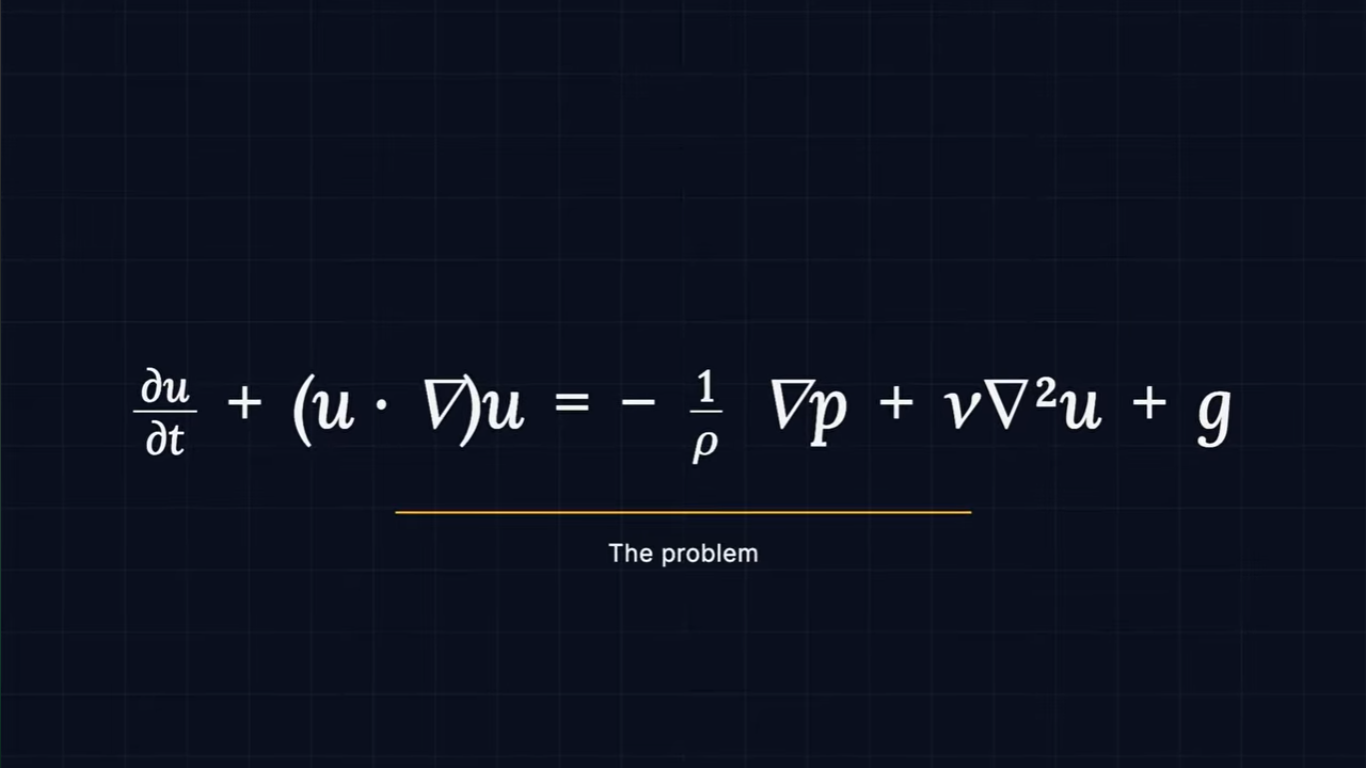
The Navier-Stokes equations describe virtually everything involving fluid motion—from ocean currents and air flowing over an airplane to hurricane turbulence and blood flow within the human body. They are used daily in engineering, physics, meteorology, and computing; the issue, however, is that there remains a question regarding them that no one has yet been able to answer definitively.


Imagine a completely stable fluid as it evolves. Does that smooth behavior continue forever, or is there a moment when the equations themselves undergo a mathematical collapse? That is what mathematicians call a singularity.


OpenAI claims to have found proof that such a collapse can occur; according to the company, there is a specific configuration in which a small vortex begins to elongate, spin faster and faster, and concentrate energy until it produces a singularity in finite time. And no, this does not mean a real-world whirlpool could reach infinite speed; it means the mathematical model ceases to remain regular—and it was precisely that possibility that had remained an open question for decades.


But there is a part of this story that may be even more important than the proof itself. Why didn't OpenAI simply put a chatbot in front of the equation and ask it, "Solve this"? Instead, it created something completely different. At the start of the experiment, various groups of artificial intelligences began tackling multiple mathematical problems simultaneously.


First came an unexpected breakthrough involving the Euler equations—a related problem—which caused researchers to completely shift their strategy; then, something unprecedented occurred. OpenAI mobilized nearly 10,000 artificial intelligence agents working simultaneously, with each group exploring a different path. Some formulated hypotheses, others attempted to refute them, and some drafted proofs, while a system named Codex gathered the best discoveries and redistributed that knowledge so new agents could pick up where the others left off.


It was almost like watching thousands of human researchers collaborating at once—except that they were all artificial intelligences. Approximately 88 hours elapsed from the start of the operation to the discovery of the solution; during that period—specifically regarding the Navier-Stokes equations—these agents exchanged nearly 2.7 million messages and generated approximately 130 billion tokens.


Then came a second stage: the entire proof was converted into Lean—a formal verification system that checks every logical step of a mathematical proof. That formalization took another 17 hours using GPT-6 Extra. However, it is important to note that this does not mean the problem is officially resolved yet. The Clay Mathematics Institute itself stated that the Navier-Stokes problem appears to have been solved, but noted that the full analysis of the proof will still undergo the standard evaluation process by the mathematical community.


In other words, a scientific process is still underway—and perhaps that makes the whole thing even more interesting—because regardless of the final outcome of that evaluation, this experiment revealed a completely new possibility. Until now, we envisioned artificial intelligence as a tool used by scientists in a specific way:


The researcher would ask a question, and the AI ​​would assist with the calculations. Now, a different possibility has emerged: thousands of artificial intelligences working together, exploring different hypotheses, sharing discoveries, and collectively building knowledge. It is in this context that some are asking whether an entire community of artificial agents has managed to tackle a problem that defied generations of mathematicians.


The images without reference were created with AI
Thank you for visiting my blog. If you like posts about #science, #planet, #politics, #rights #crypto, #traveling and discovering secrets and beauties of the #universe, feel free to Follow me as these are the topics I write about the most. Have a wonderful day and stay on this great platform :) :)


! The truth will set us free and science is the one that is closest to the truth!


Sort:  

Congratulations!

Your post has been selected and upvoted by the SteemPro Team 🚀

Explore more on SteemPro:
🌐 https://www.steempro.com
🎮 Play SteemHeights: https://www.steempro.com/games/steem-heights
💬 Join our Discord: https://discord.gg/Bsf98vMg6U

💪 Supporting the growth of the Steem ecosystem together.

🟩 Vote for witness faisalamin:
https://steemitwallet.com/~witnesses
https://www.steempro.com/witnesses#faisalamin

steempro-cover-black.png
This is an automated message.