Mini-universe created to measure time

in Popular STEM • 3 hours ago

Mini-universe created to measure time


Souce


A physicist at the University of Birmingham in the United Kingdom created a miniature universe using 24,000 atoms, demonstrating something that appears to contradict our most fundamental understanding of reality: the passage of time can be described without the need for an external clock.


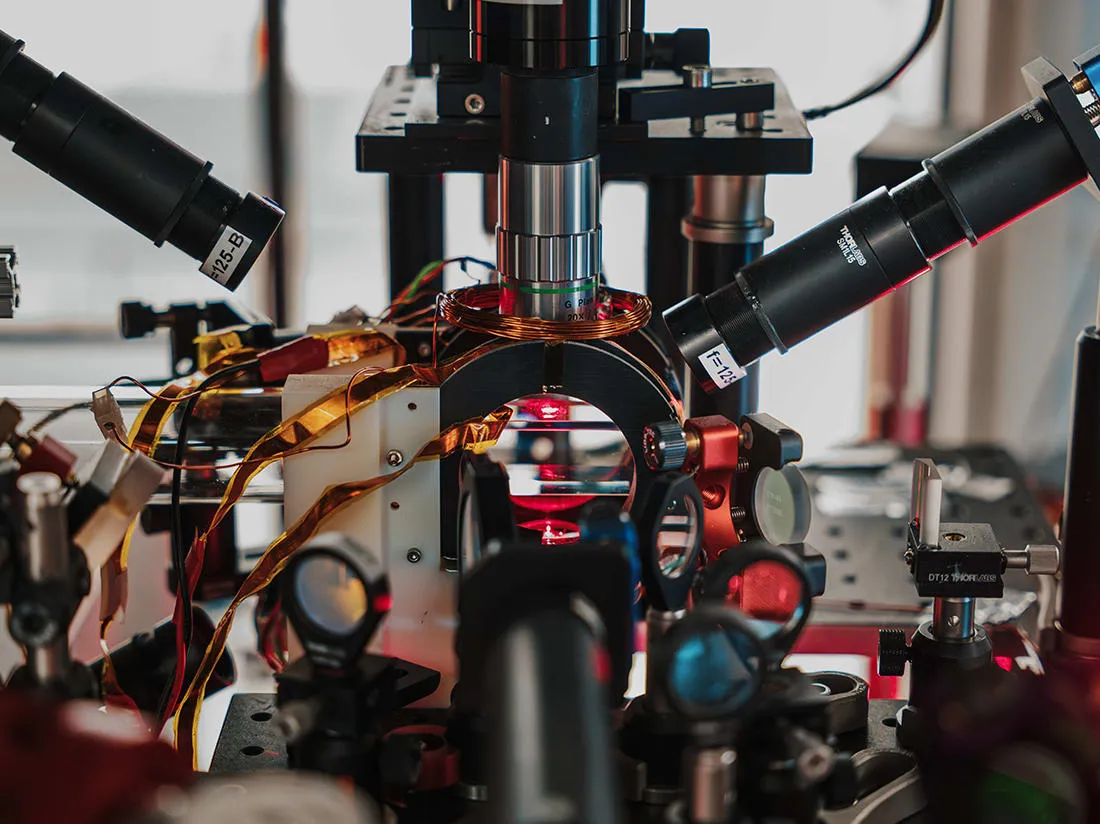
The experiment was conducted by Professor Giovanni Barontini and published in the scientific journal *Physical Review Research*. To carry out the study, the researcher cooled thousands of rubidium atoms to temperatures extremely close to absolute zero. He then confined these particles within a virtually isolated quantum system, divided into two regions by a barrier created using laser light.


One of these regions could be observed directly, while the other functioned as an unobserved sector. As the atoms moved between the two regions, the distribution of the particles shifted; it was precisely this variation that allowed the researcher to construct an internal measure of the passage of time. The observed system underwent cycles of expansion and contraction—reminiscent, in a simplified way, of the "Big Bang" and "Big Crunch" concepts associated with the expansion and potential collapse of a universe.


Even during those cycles, the researcher managed to establish the sequence of events using only information from the system itself; this approach is known as "entropic time" because it relies on changes related to entropy—a physical quantity associated with the distribution of a system's states. This discovery is highly significant as it touches upon one of the greatest dilemmas in modern physics: while relativity describes time as part of spacetime, certain approaches to quantum gravity allow for the formulation of the universe's state without an external clock.


But if there is no clock outside the universe, how can we define the passage of time within it? Barrontini’s experiment demonstrates that one possible answer lies in the transformations occurring between the components of a quantum system. The researcher also showed that this internal measure can be incorporated into a version of the Schrödinger equation to reproduce the observed evolution of particles. This does not mean that scientists have proven time to be an illusion, nor does it resolve how time functions in the actual universe; however, for the first time in a controlled experiment of this kind, it has been possible to quantitatively test an idea that, for decades, remained primarily within the realm of theoretical physics.


This opens a new path for investigating a seemingly simple question that still lacks a definitive answer: ultimately, what is time?


Official website


The images without reference were created with AI
Thank you for visiting my blog. If you like posts about #science, #planet, #politics, #rights #crypto, #traveling and discovering secrets and beauties of the #universe, feel free to Follow me as these are the topics I write about the most. Have a wonderful day and stay on this great platform :) :)


! The truth will set us free and science is the one that is closest to the truth!