The Kawasaki robot takes the next step.
in Popular STEM • 24 days ago

The Kawasaki robot takes the next step.



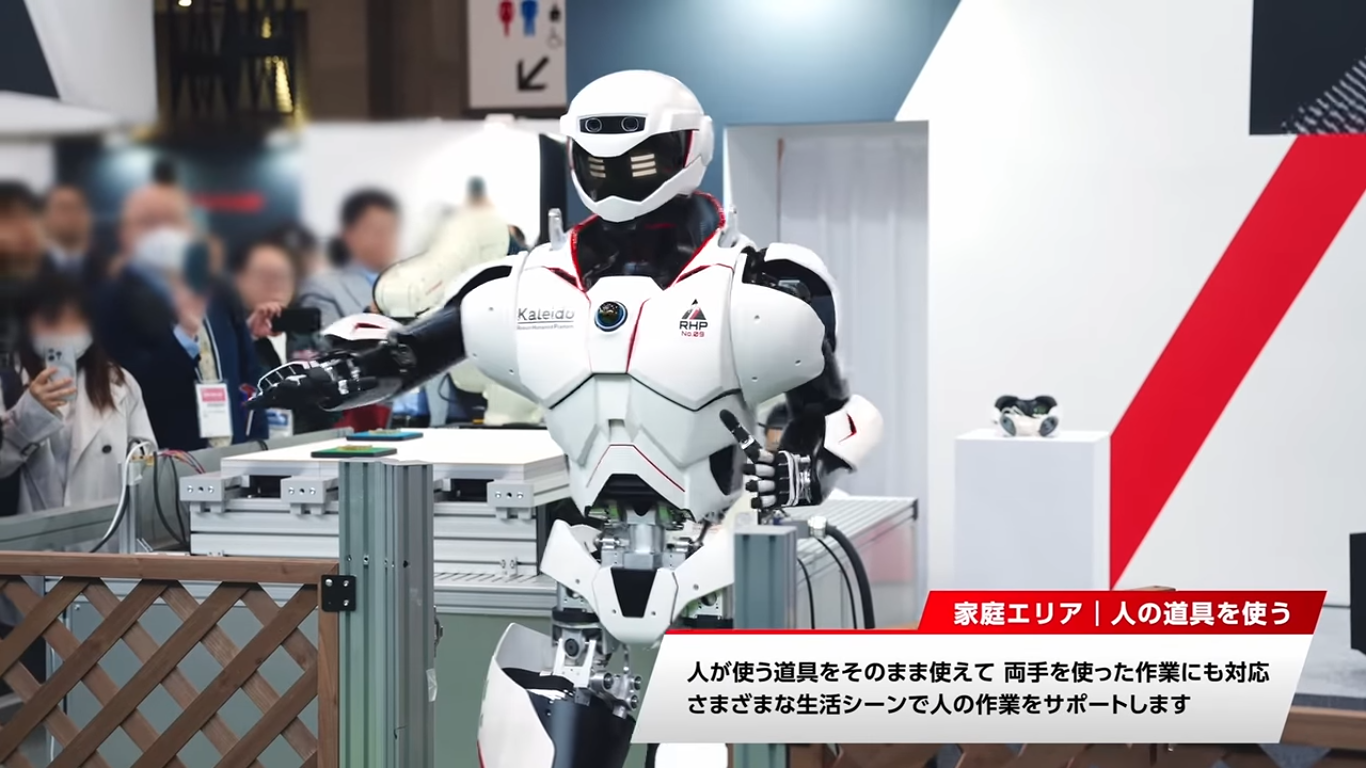
After more than a decade of developing its own humanoid robot, Kawasaki is preparing for a major shift: it aims to make the Kaleido 9 increasingly independent of human control. The company began developing the humanoid in 2015, and it has since gone through several generations.


The latest version, the Kaleido 9, can walk autonomously and use sensors—such as LiDAR—to map its surroundings, determine its location, and identify people, obstacles, and even steps nearby. However, there is a vast difference between walking alone and working alone; when it comes to executing more complex tasks, the Kaleido 9 still relies heavily on teleoperation or human supervision—and that is precisely what Kawasaki intends to change.


The company announced a partnership with the Japanese firm Noetra to integrate a "physical AI" platform into the humanoid, adopting a strategy that begins with a hybrid system. Initially, control of the robot is shared between the human and the AI; a person might execute or guide specific parts of a task while the AI ​​learns to interpret the environment and control the necessary movements. As the system improves, the plan is to gradually shift a greater share of decision-making to the machine itself.


The initial planned applications are relatively simple, such as patrolling industrial facilities and transporting parts within factories and warehouses. Subsequently, Kawasaki aims to move toward more complex activities, including assembly tasks. The company is already in discussions with potential clients in the automotive and semiconductor sectors to understand where humanoids of this type could be truly useful, though it is important to put the timeline into perspective.


Kawasaki is not claiming that Kaleido has suddenly become a fully autonomous humanoid; the integration of this new technology is slated to begin around 2030—initially involving operations that are still human-assisted or partially human-controlled—while the goal of achieving robots capable of working autonomously in less structured environments is targeted for around 2040. Furthermore, Kawasaki is collaborating with Nvidia on "physical AI" technologies to enable increasingly complex autonomous movements.


All of this highlights one of the greatest challenges in the race to develop humanoids: while building legs capable of walking, arms capable of carrying objects, and hands capable of manipulating tools is already extremely difficult, a greater challenge remains—enabling the machine to understand on its own what needs to be done in a constantly changing environment. Perhaps this is precisely why the next major evolution in humanoids lies not merely in building better bodies, but ultimately in giving those bodies the ability to decide how to use themselves.


Sorry for my Ingles, it's not my main language. The images were taken from the sources used or were created with artificial intelligence