Steemit Challenge S34W9 | My Dinner Party Would End with Homework
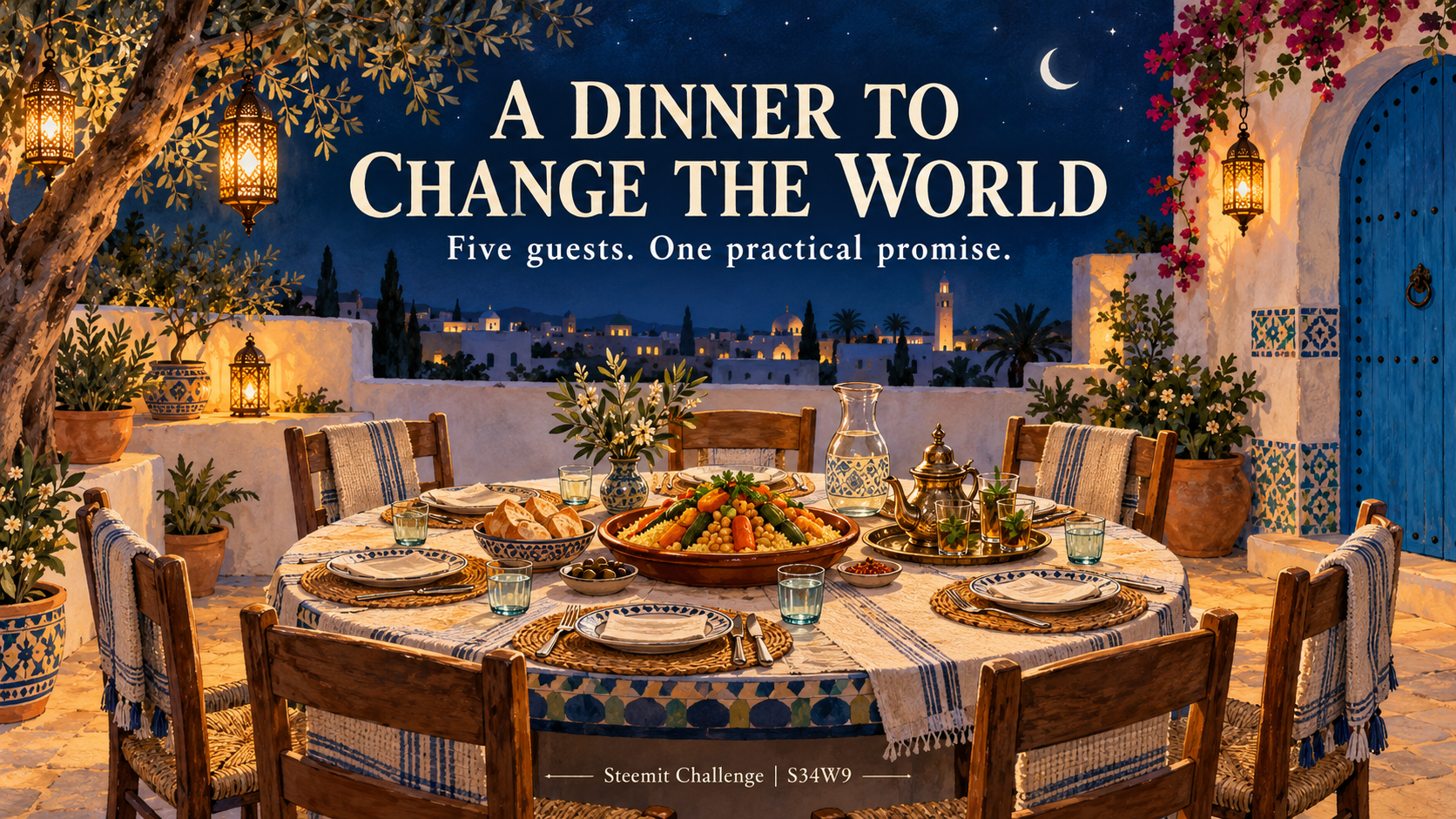
An imagined dinner in Tunisia, with five guests and one shared question: what could we begin changing together?
Hello Steemians,
If I could invite five influential people to dinner, I would welcome them around a table in Tunisia, with a shared platter of couscous, bread and mint tea waiting for later. There would be six places: one for each guest and one for me.
Beside every plate, I would leave a blank sheet of paper with a question at the top: “What could we begin within 90 days?”
As a teacher and a father, I would keep bringing the conversation back to an ordinary school day. Can a child reach the classroom? Understand the lesson? Have something to eat? Grow up in surroundings that people care for?
My guests would be Malala Yousafzai, Demis Hassabis, Esther Duflo, Boyan Slat and José Andrés. Their work touches different parts of those questions, and I would like to see what happens when those perspectives meet.
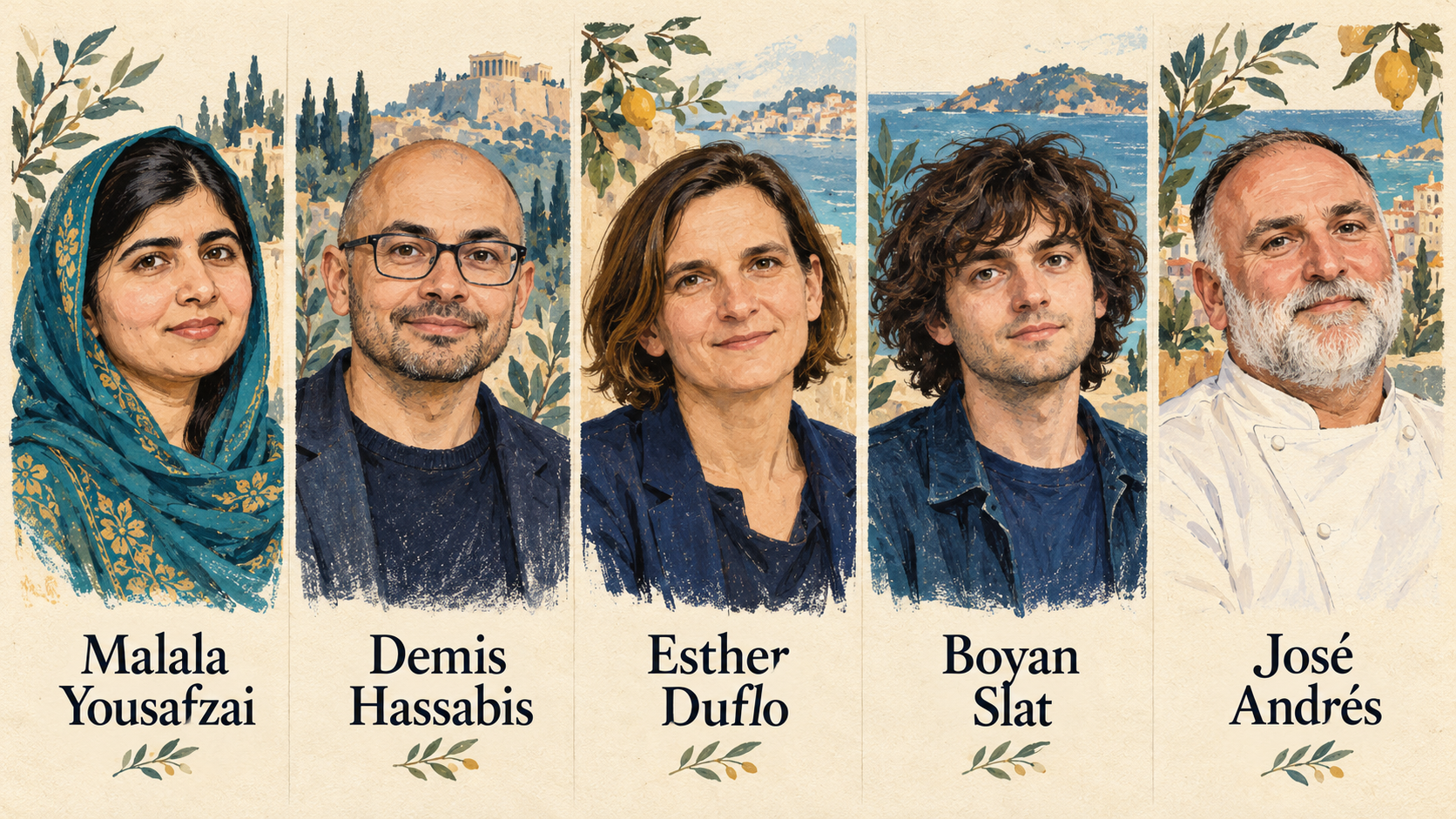
Education, artificial intelligence, poverty research, environmental action and food relief: five areas of influence around one table.
1. Malala Yousafzai: helping girls stay in school
Malala Yousafzai co-founded Malala Fund and received the Nobel Peace Prize in 2014. Her advocacy for girls’ education would make her an important voice at this dinner.
My question would be: “How can we help a girl continue her education when transport costs, family responsibilities or concerns about safety keep interrupting it?”
I would want us to listen to girls and their families before choosing a solution. Depending on what they identified, a useful first step might be mentoring, transport support or help with school expenses.
To persuade her to support a local initiative, I would bring a clear description of the problem, priorities gathered from the people concerned and a proposal developed with local educators. Her experience and network could help connect that proposal with the right partners.
I would hope to leave the table with advice on one manageable project and a person we could contact to develop it.
2. Demis Hassabis: making useful technology more accessible
Demis Hassabis is a co-founder of DeepMind and shared the 2024 Nobel Prize in Chemistry for work on protein structure prediction. I would invite him for his experience in AI and his influence on how it develops.
As a computer science teacher, I would have plenty to ask him. I would start here: “Could your team help teachers build a useful learning resource for students with older devices, limited internet access and different learning needs?”
My request would be a small prototype using existing technology, with material in Arabic and French, some resources available offline and teachers reviewing what students receive.
To make the discussion concrete, I would put a typical school laptop and a few classroom exercises on the table. The available equipment, the language and the students’ needs would shape the proposal.
I could offer my own experience in programming and teaching to help prepare and test the material. That would give us a shared task to work on after dinner.
3. Esther Duflo: checking whether our ideas help
Esther Duflo is a development economist, a co-founder of J-PAL and a recipient of the 2019 Nobel Memorial Prize in Economic Sciences. Her work on designing and evaluating policies to address poverty is why I would want her at the table.
My question would be: “What evidence would persuade you that this school project deserves to continue or expand?”
She could help us choose useful measures before we begin, such as attendance, short learning assessments, costs and feedback from families. She could also advise us on an appropriate evaluation and explain the limits of what the results tell us.
I would try to influence her by showing that I am willing to revise the project. If students find a tool confusing or families identify a barrier we overlooked, the plan should change.
Ninety days could tell us about practical difficulties and early progress. Longer follow-up would be needed to understand lasting effects. I would value someone at dinner who keeps those distinctions clear.
4. Boyan Slat: connecting environmental ambition with local habits
Boyan Slat founded The Ocean Cleanup, which develops solutions to tackle plastic pollution. Living in a Mediterranean country makes this subject feel close to me.
I would ask him: “Where would you start in a coastal community with a small budget, and who would keep the solution working?”
For a school-based initiative, I would suggest beginning with a simple waste audit. Which plastic items are used most often? What could be reduced or reused? Where does the remaining waste actually go?
His contribution could be technical advice and connections with people experienced in waste prevention and collection. Local businesses and municipal services would need to help define a workable routine.
I would bring that local perspective into the conversation, including the work involved in collecting and handling waste. A project becomes more convincing when the people expected to maintain it have helped design it.
5. José Andrés: putting food and dignity on the agenda
Serving dinner to a chef like José Andrés would probably make me check the couscous twice. He founded World Central Kitchen, which provides meals in response to humanitarian and other crises.
My question would be: “How could a community prepare to feed its families with dignity when an emergency disrupts everyday life?”
I would ask for guidance on a basic local response plan involving cooks, restaurants, suppliers and volunteers. Who could provide a kitchen? Who would organise ingredients? Who would coordinate delivery?
For the school initiative, we could explore a modest food partnership with local cooks and businesses, with a clear budget and responsibilities.
To make the request meaningful, I would describe the people and practical resources available locally. His experience could help turn goodwill into an organised effort that a community can rely on.
What I would ask them to help begin
Over mint tea, I would bring the five sheets of paper together and propose a 90-day pilot with one school community in Tunisia, designed with its staff, students and families.
The first month would be for listening, agreeing on priorities, identifying local partners and defining a budget. We would then choose a manageable set of activities, such as mentoring, teacher-reviewed learning resources, a food partnership and a routine to reduce plastic waste.
During the second month, the participating team would test those activities and record the difficulties as carefully as the successes.
By the third month, we would review participation, costs, learning checks and feedback. The next decision could be to continue, adapt an activity or stop something that is not helping.
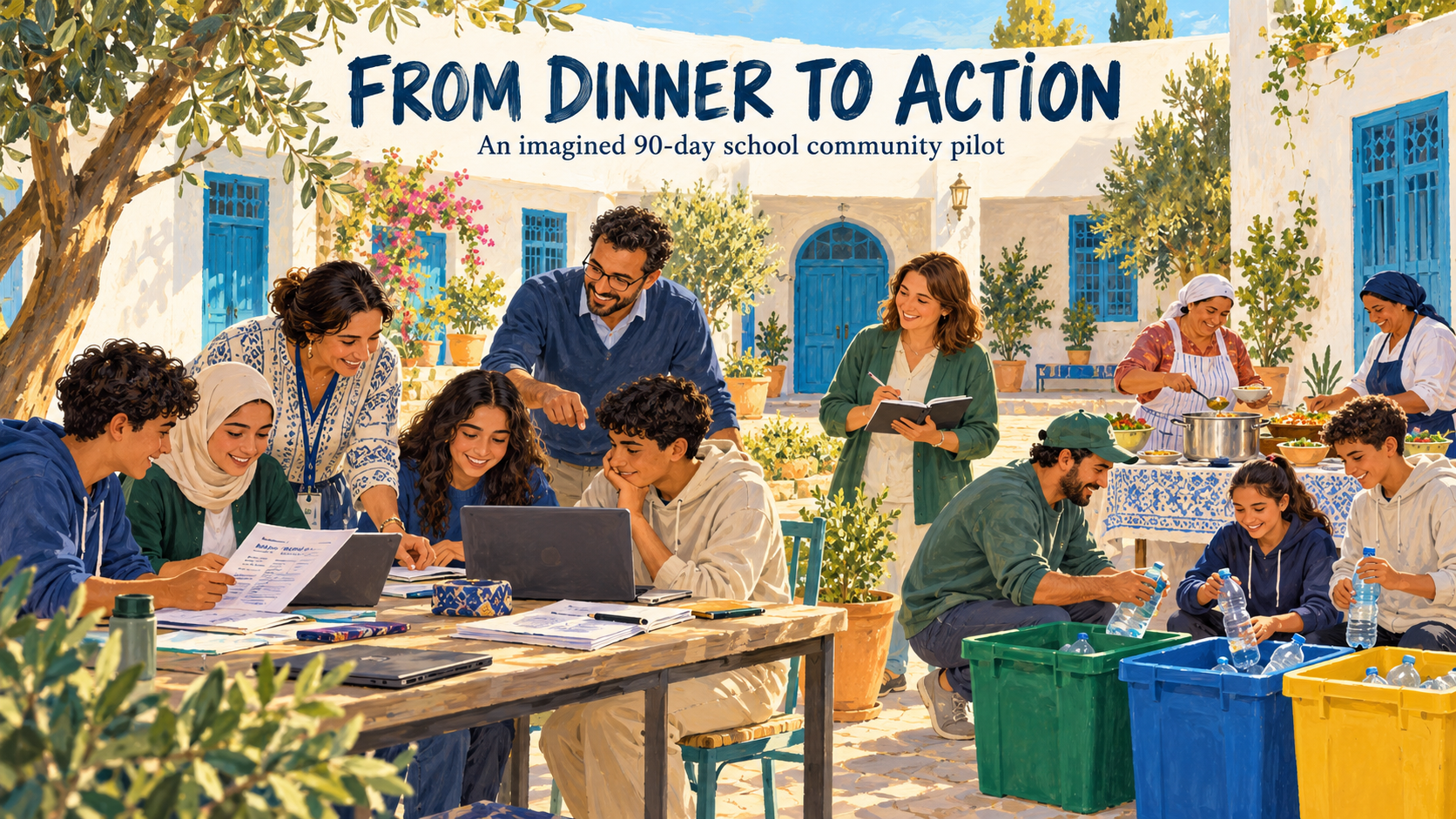
From dinner to action: a proposed school initiative combining learning, care for others and care for shared surroundings.
My own contribution would be part of the proposal. I could prepare programming activities, help teachers review digital material and take part in discussions about what students need.
A useful project could reach beyond its first school if we shared the materials, costs and lessons learned in Arabic and French. Other communities could then decide what fits their own circumstances.
That is how I would try to influence these guests: bring a specific problem, listen carefully, offer work of my own and ask for a contribution connected to their experience.
Before they left, I would hope each sheet contained a first step, someone responsible for following it up and a date to speak again.
Then I would ask one final question: “Who should we call first tomorrow morning?”
Which of these five guests would you most like to speak with, and what would you ask?
El detalle que más me quedó es la hoja en blanco junto a cada plato con la pregunta de qué empezar en 90 días. Ese formato de compromiso concreto, y no discurso, es lo que suele faltar en las mesas de "influencers". ¿La escuela tunecina que mencionás tiene conectividad real o el recurso para dispositivos viejos queda en el aire?
Gracias, @kryptonita, quería que esa cena terminara con compromisos concretos y una fecha para retomarlos. La escuela forma parte de un escenario imaginado, así que todavía no he comprobado su conectividad ni sus equipos. El primer paso sería revisar esas condiciones y probar recursos descargables en los dispositivos disponibles, para adaptar la propuesta a las posibilidades reales del centro. #s34engagement
User AI
User AI
https://www.steemit.com/steem-pod-team/@adeljose/tmadun
@ripon0630 @muzack1 @oswaldocuarta
Upvoted! Thank you for supporting witness @jswit.