How to Generate Article Outlines That Map to Search Intent
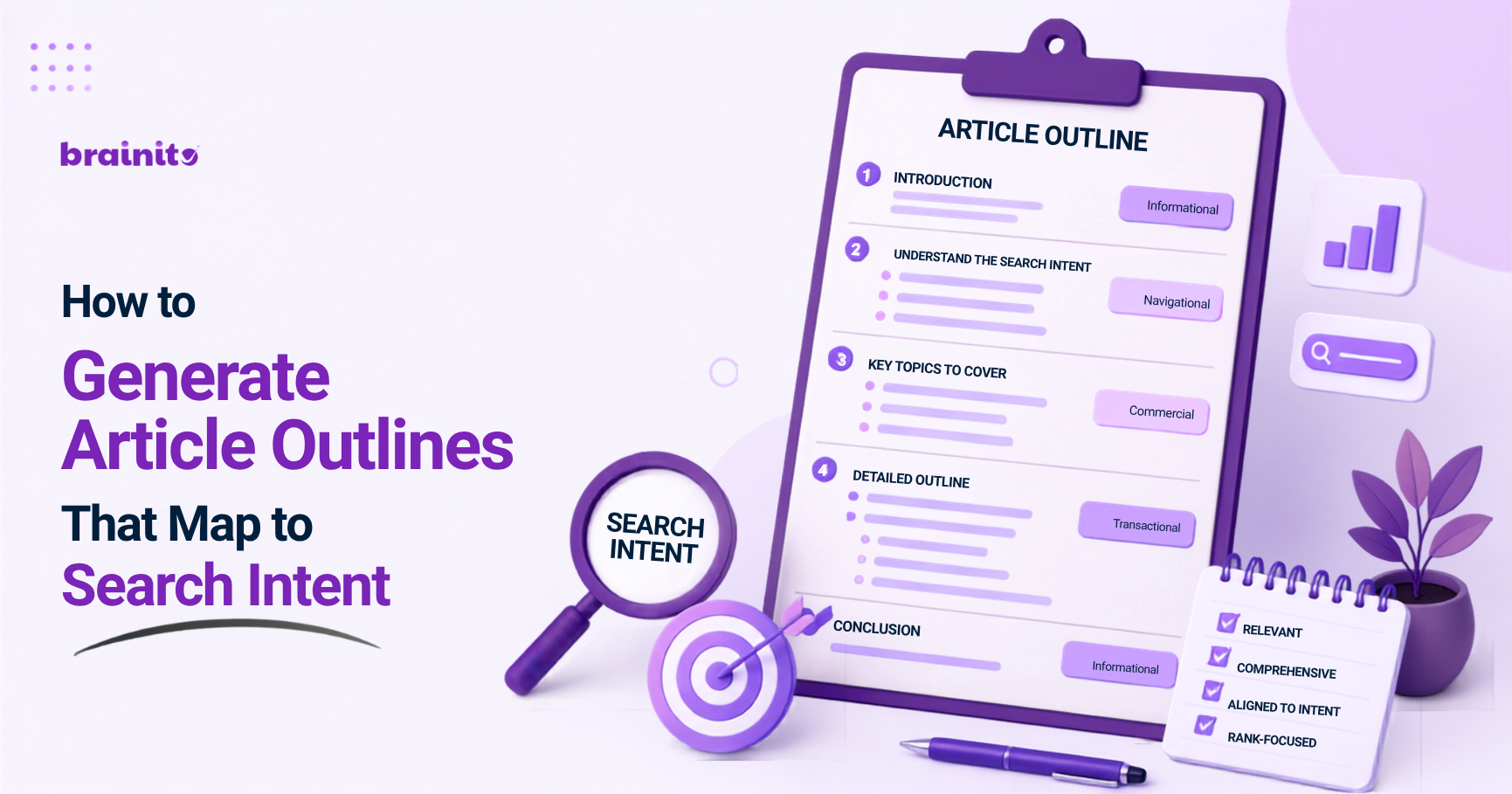
A poorly optimized article can be well-written but fail to address the intent behind the search query that led the user to it. Search intent indicates the user’s purpose for searching and categorizes a query as seeking information, purchasing a product, comparing options, finding how-to guides or walkthroughs, and so on.
Having an article outline based on search intent will ensure the article addresses the user’s needs appropriately. Below are several steps for outlining an article based on search intent.
Step 1: Determine the Search Intent Behind The Query
To prepare an outline for an article based on search intent, the author should first be able to identify what type of search intent is behind it. Search intent can be broadly categorized into informational, commercial, navigational, transactional, and other types that do not conform to these categories.
For instance, a search query “how to create a marketing budget” falls under informational intent, while the search for “best marketing budget tools” can be seen as commercial intent. The outline should address the informational intent that the article has.
Step 2: Research Similar Articles And Their Headings
Before developing an outline, it is essential to research and analyze similar articles and their headings. After determining a search intent, the author should look out for similar articles by searching the search query, going through the first few search results, seeing what topics and questions the existing articles address, and what they lack.
The author should not necessarily follow the headings of similar articles, but they should be aware of what Google deems relevant for a specific query. For instance, if most articles addressing a particular search query are opinion-based pieces, a tutorial will not be relevant to the search intent.
Step 3: Determine The Related Questions And Topics
Having analyzed the existing articles, the author will be able to determine the related questions and topics that should be addressed in the prospective article. The related questions can be phrased in the form of headings and subheadings. For instance, for a topic on affiliate marketing, some of the related questions can be “how commission rates work”, “how affiliate marketers set rates”, “what is a good commission rate”, and “how to maintain healthy profit margins”.
In relation to one topic, there are multiple supporting questions that can be derived. Addressing these questions in one cohesive article will make the article more comprehensive.
Step 4: Organize The Identified Topics Into Logical Categories
Logical categorization of the identified topics and questions is critical to developing a coherent outline. The author should organize the information in a manner that follows the logical sequence of a search and fits the purpose of the search query. The author should also avoid including unrelated topics just because they contain relevant keywords for the search intent. The primary objective of an article is to ensure that it matches the search intent, and any deviation from that will make the article irrelevant to the searcher’s needs.
Step 5: Identify Additional Keywords That Can Be Integrated
After developing a list of topics that can be covered in the article, the author should look out for additional related keywords that can be integrated. Related keywords can be the variations to the topic, the specific terms, questions, and other entities that are relevant to the topic. Placing the keywords throughout the article should be done organically, and the author should avoid keyword stuffing. Since an outline is a skeleton of an article, it can integrate related keywords without forcing them into the text.
The search engine will be able to identify the relevance of the article based on the coverage of the topic and the inclusion of related keywords in the headings and subheadings. Therefore, an effective outline will be comprehensive in its coverage of the topic, avoiding the repetition of the same keywords in different headings.
Step 6: Determine The Appropriate Depth For Each Section
It is critical to recognize that not every search query requires a 3,000-word comprehensive article. Depending on the search intent, some queries require shorter and more concise answers, while others may need a detailed guide and a lengthy discussion. For instance, while the search for “what is a marketing budget” would need a brief explanation, the search for “how to prepare a marketing budget” will require more extensive coverage, including examples, mistakes to avoid, and other similar topics.
To determine the extent of coverage for each section, the author can refer to the existing articles on the topic. The number and breadth of the sections in the author’s prospective article should be adequate to answer the search query without adding too much superfluous information.
Step 7: Make Sure The Outline Is Useful To The Author
An effective outline is more than just a list of headings and subheadings. It should also give a brief description or specification of what needs to be covered under each heading. This will make the outline even more useful to the author, minimizing the inclusion of irrelevant fluff and ensuring that there is enough information to answer a specific question.
A properly structured article’s outline should be based on search intent. This requires understanding the purpose of the search and analyzing the existing search results. Additionally, the article’s outline should be organized logically, include related keywords, and avoid unnecessary fluff that does not serve a specific purpose. By following these steps, the article will be highly relevant to the searcher’s needs and will rank higher in search results.
Creating such outlines can be time-consuming, especially for the author, who has to research the search intent and related topics. The Brainito Outline Generator can help the author identify the appropriate topics and produce an outline that will facilitate creating articles according to the target audience’s needs.
Written by:
Brainito Intelligence
www.brainito.com