When should you restore sneakers instead of replacing them?
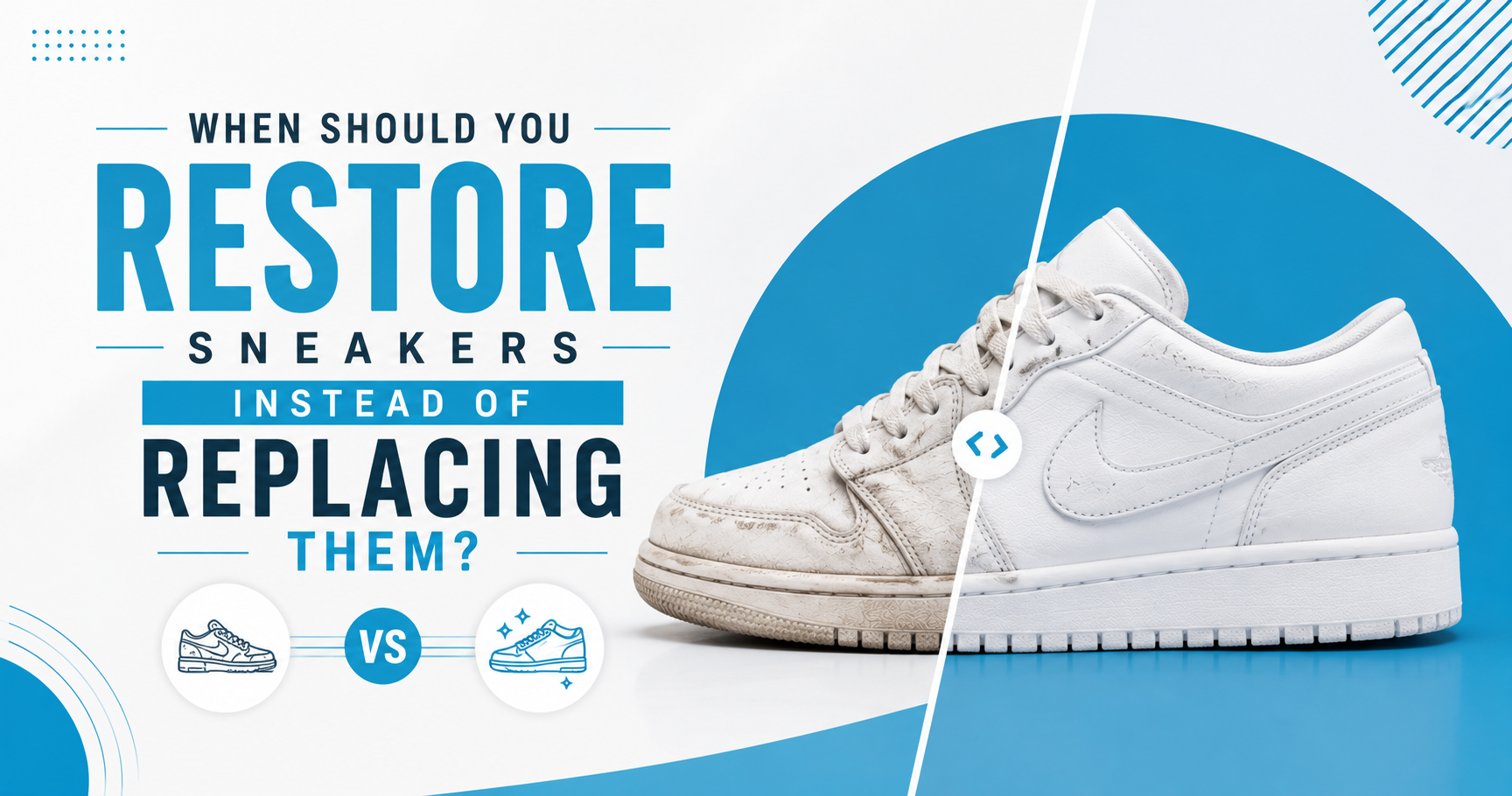
A favorite pair of shoes can get to a point where cleaning them is no longer a sufficient solution. Their soles may yellow, their paint may peel, their glue may separate, or years of wear could change the shape of the sneaker
At this stage, most people opt to buy an entirely new pair. However, if the shoes are collectible, expensive, discontinued, comfortable, or sentimental, it may be worth restoring them instead. The question is not whether the shoes are old or look old, but rather whether the issues with it can be resolved, the value of the pair, and whether restoration is a better option than a full replacement.
Step 1: Determine Cosmetic Wear Versus Structural Wear
First of all, it is essential to differentiate between cosmetic and structural wear and determine which of the two the shoes have sustained. Stains, dirt, scuff marks, fading, and yellowed soles are generally simple to restore.
Other issues, such as separated soles, faulty stitching, cracked midsoles, broken eyelets, or significantly worn fabric, are more serious and require a closer examination. If the sneaker has multiple structural issues, it is probably best to invest in an entirely new pair. On the other hand, if it only has a few structural problems, repairing it may be an option.
Step 2: Calculate the Value of the Sneaker
It is also crucial to calculate the value of the footwear to compare the cost of its restoration to the price of buying a new pair. This calculation becomes more complicated when the sneaker is discontinued, limited edition, collectible, hard to resell, or sentimental. In these cases, there may not be another pair of shoes that one is as fond of; it may also be expensive to purchase a similar pair.
For designer footwear, professional restoration is usually the best option since replacing it would be significantly more expensive than restoring it. Other than that, the cost of the restoration service should be justified by the value of the shoes. If the footwear is a common running shoe, a $300 cleaning may be too expensive. However, if it is an uncommon or designer pair, the same price may be worth considering.
Step 3: Consider Whether the Issues Are Repairable
The third step is to consider whether the issues with the shoes are repairable. While minor issues, such as scuff marks, oxidation, and yellowed soles, should be simple to address, significant structural problems, such as separated soles or broken eyelets, are more challenging. It is essential to get honest and specific answers from the restoration service about the particular issues with the sneaker before investing in the service. Ideally, the service should offer to restore any minor cosmetic problems and repair any structural issues. A few examples of restoration include sole whitening, oxidation, paint, and reglue. The Sneakky service can recommend the best solution for a particular fabric and issue.
Step 4: Think About Whether It Is Worth Replacing the Footwear
When determining whether to restore or replace the pair of shoes, it is essential to remember that a common running shoe can usually be replaced with another pair that is similar in price and has almost the same qualities. Therefore, if the sneaker has significant structural issues and there is no replacement for it in the local store or online, one should consider restoring it. On the other hand, if the shoes are easy to replace, it may be more practical to buy a new pair of footwear.
Another thing to consider is the sentimental value of the pair. For example, some people buy a sneaker to celebrate a particular achievement, such as running a marathon. For these people, replacing the footwear with another pair of shoes is not an option, even if it is more practical.
Under these circumstances, restoration becomes an especially valuable and necessary option. The same considerations apply to limited edition and discontinued pairs of shoes.
Step 5: Compare the Prices of Restoration and Replacement
Under no circumstances should one compare the price of restoration to the price that one has paid for the footwear. Instead, it should be compared to an assumed replacement price for the shoes. If the restoration service offered $X to repair the pair, and the value of the shoes is $Y, it should be beneficial to buy a new pair of shoes if the value of $Y is lower than $X. At the same time, if the value of $X is greater than $Y, it is worth repairing the pair of shoes instead. The replacement price should also include the benefits of restoration: the ability to wear a familiar pair of shoes and an opportunity to reduce the number of footwear items that end up in landfills. For collectors of limited edition, discontinued, or designer footwear, restoration should also help keep the functionality of the familiar pair of shoes at a reasonable level without the need to buy another pair in the short term.
When Routine Care is Necessary
Not all worn-out sneakers require restoration. Some only need basic routine care before they are sent to a professional cleaning service. Sneakky Klean offers a professional sneaker cleaning service that is perfect for removing day-to-day dirt and stains and works on a variety of materials, such as leather, suede, nubuck, rubber, and others. If a pair of shoes only has minor issues, routine care and a professional cleaning service may be enough to remove it without the need for restoration.
When Restoration Services are Necessary
On the other hand, if the sneakers have oxidation, paint damage, or other significant issues, professional restoration services might be the best option. When looking for a professional service, the consumer can search for restoration local services to learn more about the options and compare prices. It is essential to understand precisely what restoration local services can and cannot do and what they know about the particular fabric and structural issues of the pair.
Summary
A professional restoration service is only worth the investment if the pair of shoes has a significant value, and the issues with it are repairable. If the issue with the sneaker is trivial, it is probably best to clean it at home, and if the pair is common, has significant structural issues, and is cheap to replace, it may be best to purchase a new pair instead of investing in an unnecessary restoration service. Restoration is a great opportunity for collectors of limited edition, discontinued, or designer footwear, or individuals who simply want to get more out of their favorite pair of shoes.
About Sneakky Klean
Sneakky Klean offers professional cleaning, restoration, and protective care of your sneakers with store service in New York and Miami and mail-in service nationwide.
A Practical Rule of Thumb
The best sneaker care practices are dependent on the state of the pair. It is essential to address cosmetic issues as early as possible and use gentle products that are suitable for the fabric of the shoes. If one is unsure about what to do in a particular situation, it is always possible to contact one’s local professional sneaker restoration service to get specific advice on how to avoid unnecessary expenses in the future. If the shoes have a reasonable value, a professional assessment can help ensure that minor issues do not escalate into a major restoration project.
What to Ask Prior to Restoration
Prior to restoration, it is essential to make sure that the service is prepared to address all of the cosmetic issues with the pair of shoes, address any structural problems with it, and contact the customer if any unforeseen issues arise. The customer should also ask whether the restoration service will leave any parts of the shoe unaltered, whether the service will reach out to the customer in case of additional issues, and whether working on the shoes is going to affect its care in the future.
A Discussion at the Start of Restoration is Essential
A transparent discussion at the beginning of the restoration process ensures that the customer has realistic expectations. Under no circumstances should restoration fix the visible problems with the sneaker and pretend that years of wear have not affected the fabric.
A Maintenance Reminder
A basic maintenance cycle is simple: spot cleaning, removing dirt, addressing minor issues, eliminating moisture, and a proper storage setup. When a pair of shoes starts to show more severe signs of wear and tear that cannot be resolved at home, it should either be brought to a professional cleaning or restoration service instead of being exposed to excessive household chemicals.
That way, the sneaker’s appearance and structure will be preserved, and the unnecessary replacement of the pair will be avoided.
A More Realistic Viewpoint
The best sneaker care practices are dependent on a number of factors, such as the type of the pair, its value, and the nature of the issues that it has sustained. Most people find that it is best to maintain their sneakers on a regular basis, address minor problems before they become major ones, and bring the footwear to a professional cleaning service when necessary. These practices help keep the entire collection of shoes in excellent condition, as opposed to waiting for a full-scale restoration project for a pair of shoes to appear.
The Most Appropriate Level of Care
A professional restoration service is the best option in the situations when the sneaker’s fabric, material, and value make any other type of experimentation inadvisable. With the right amount of care, restoration, and cleaning, sneaker owners can maximize the potential of their collection and continue enjoying their favorite pairs for as long as possible.
Before Getting Started
Prior to making any final conclusions, it is essential to take a look at the sneaker and analyze it carefully. One should consider whether the upper part of the footwear is damaged, whether the fabric of the upper part is stable, whether the soles are structurally sound, whether the pair can be repaired, and whether the footwear is difficult to replace. If the majority of these factors have a positive answer, the restoration project is a viable option. If the majority of them are negative, a new pair of shoes can be a better alternative to an expensive and unnecessary restoration project. In most cases, a professional inspection can simplify the process significantly.
A Particular Consideration for Collectors
Prior to being put in the storage, a collector should ensure that the upper part of the sneaker is dry, the soles are clean from foreign dirt, the laces are in an appropriate condition, and the sneaker is not being crushed by other pairs of footwear. After these measures are taken, the collector can rest assured that their collection is well-maintained and ready for the next inspection in a few months’ time. This entire process should be routine and last less than an hour for one pair.