SteemVM v0.0.3 — SBD Bridging, Price Oracle, and Validator Accountability
Hi everyone 👋
SteemVM is the EVM app-chain bridged to the Steem main-chain — bridged STEEM is the native gas token, contracts run in a real Ethereum Virtual Machine, and a quorum of bonded validators (not a trusted relay) secures every deposit and withdrawal. If you've used the STEEM ↔
asteembridge or deployed a contract with MetaMask against chain-id 8163, you've already used it.
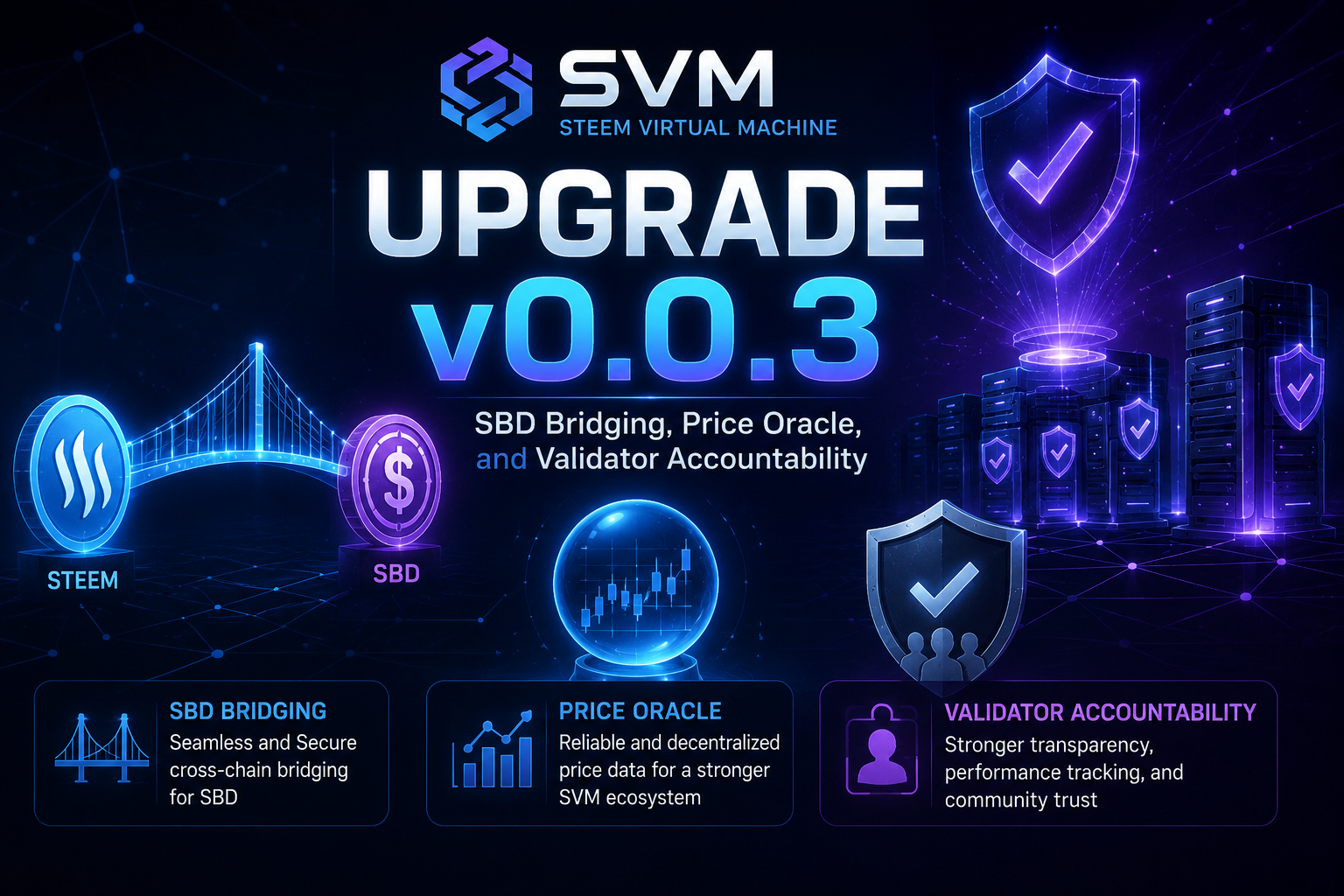
v0.0.3 is our biggest release yet. It brings SBD onto the chain as a first-class bridged coin, adds a validator-run price oracle, introduces a single accountability system that keeps every validator honest across all of their duties, and reshapes the fee economics so that stakers actually earn. It ships as one coordinated governance upgrade that every node swaps to at the same block — with near-zero downtime thanks to cosmovisor.
Let me walk you through everything, in detail.
1. SBD is now bridgeable — meet asbd
Until now the bridge only moved STEEM. v0.0.3 adds Steem Dollars (SBD) as a second native bridged coin on SteemVM, called asbd.
- Send SBD to the gateway account with the same memo convention you already use for STEEM, and validators mint you
asbdon SteemVM at a 1:1 peg (3-decimalmillisteem→ 18-decimal on-chain, exactly like STEEM). asbdis exposed to the EVM as a dynamic ERC-20 precompile at0x…0901, so wallets and contracts see it as a normal token with propername/symbol/decimalsmetadata.balanceOf, transfers, DeFi — all just work.- Bridging out
asbdworks the same as STEEM: your coins are burned on SteemVM and a withdrawal request is recorded for validators to relay back to Steem.
Importantly, the SBD peg stays 1:1 — the price oracle (below) is for smart-contract consumers and future peg logic, it is never a mint input. One SBD in always equals one asbd out.
SBD bridging is feature-gated: the off-chain oracle software only starts attesting SBD deposits once the chain is actually live on v0.0.3, so nothing can mint asbd before the chain knows how to.
2. A small bridge fee — that goes 100% to stakers
Every bridge-in and bridge-out now carries a tiny bridge fee (0.25%). Here's the part that matters: the whole fee is routed to staking rewards.
- On a deposit, the full amount is minted, you receive 99.75%, and the 0.25% fee flows into a dedicated
bridge_rewardaccount. - Each block, that account is swept into the fee collector and paid out by the distribution module — 100% to validators and their delegators, at each validator's configured commission. Nothing leaks to anywhere else.
- It's multi-denom: STEEM bridging grows
asteemrewards, SBD bridging growsasbdrewards.
So the fee isn't skimmed off to an operator — it becomes real, claimable yield for everyone who stakes. The gateway operator backs it with custody and forgoes the fee themselves.
3. The STEEMBLACKHOLE — one place coins are born, one place they die
We introduced a special module account, STEEMBLACKHOLE, that makes the token supply auditable at a glance.
- Every bridged coin is minted into the black hole first, then sent out to you — so on-chain a deposit reads as a transfer from the black hole, not a bare mint you can't trace.
- The black hole is also the only place coins are ever burned. Once per block it burns its entire balance. Bridge-out returns, the burn portion of tx fees, and anything else meant to disappear all funnel through this single sink.
One mint origin, one burn sink. If you want to reduce supply, you can literally send coins to the black hole address and watch total supply drop next block.
4. Fee economics: 50% stakers / 25% community / 25% burned
Ordinary transaction fees (including EVM gas) are now split three ways every block:
- 50% stays for stakers,
- 25% goes to the community pool (governance-controlled funding),
- 25% is burned (via the black hole).
Combined with the bridge fee from §2, validators and delegators now have two real, native reward streams — a healthy, deflation-aware fee model rather than fees vanishing into a single bucket.
5. Withdrawals you can actually confirm
Bridging out used to end at "requested." Now the loop is closed:
- When the gateway pays your withdrawal on Steem (memo
svm-withdrawal <id>), validators attest the payout, and at the ⅔ threshold the withdrawal flips REQUESTED → PROCESSED with the Steem payout txid recorded on-chain. - A new processed-withdrawals query lets you see exactly which withdrawals have been paid, while requested-withdrawals stays the "still to pay" queue.
Full transparency on both sides of the bridge.
6. A validator-run price oracle (x/oracle/data)
This is a big new capability. SteemVM validators now collectively publish on-chain exchange rates for pairs like STEEM/USD, STEEM/SBD, and SBD/USD.
How it works — commit-reveal, so nobody can copy:
- Each voting period (~1 hour), a validator submits a prevote — a hash committing to its prices without revealing them.
- The next period it reveals the actual prices plus the secret salt; the chain checks the hash matches.
- The chain takes the power-weighted median of all revealed votes. Median (not average) means a minority can't drag the price around, and it's weighted by stake so it reflects real economic backing.
Reading prices from contracts: a read-only precompile at 0x…0902 exposes getPrice("STEEM/USD") and getPrices() to the EVM. Rates come back as standard 18-decimal fixed-point, so a Solidity rate / 1e18 recovers the human number. We ship the IOracleData.sol interface so you can drop it straight into a contract.
This unlocks price-aware DeFi, future peg mechanisms, and on-chain analytics — all sourced from the same validators that already secure the bridge, with no external trusted feed.
7. One accountability system for everything (x/oracle — unified slashing)
Validators now have two jobs: attest bridge events and vote prices. v0.0.3 introduces a single parent engine that scores both duties together and enforces participation — this is the safety heart of the release.
- Each validator gets one combined score per slash window:
w_price · (price accuracy) + w_bridge · (bridge attestation rate). - Opportunity-based & fair: you're only judged on events that actually finalized while you were bonded, and duties with nothing to do that window are simply excluded. An honest node that misses one sporadic event is not punished.
- The anti-masking
DutyFloor: here's the clever part. A validator that votes prices perfectly but attests none of the bridge events is still slashed — you cannot hide total absence from one duty behind a great score in the other. A naive pooled counter would let a validator coast on price votes while ignoring the bridge; the DutyFloor closes that hole. - Fall below the threshold (or flat-line any active duty) and you're jailed and slashed, once per window.
All validator oracle messages — bridge attestations, payout confirmations, price votes — are gas-free (within a per-block cap), so doing your job costs nothing, but not doing it costs you. The result: a bridge and a price feed that stay live because it's economically irrational to slack off.
8. The off-chain oracle software
The node's companion oracle process got three upgrades, all feature-gated to self-activate once v0.0.3 is live:
- SBD deposit extraction — scans gateway transfers for both STEEM and SBD, tags the asset, and broadcasts the right attestation.
- Withdrawal-payout detection — watches the gateway's outbound Steem transfers and attests payouts so withdrawals reach PROCESSED.
- Price feeder — runs the commit-reveal cycle each voting period, with a hash that exactly matches the on-chain check. (The concrete market data sources are configurable and intentionally deferred for now — the machinery ships ready.)
9. How the upgrade rolls out — cosmovisor, zero drama
v0.0.3 is a coordinated governance software-upgrade. Every validator swaps to the new binary at the same block height, so there's no fork and no scramble.
- The node now runs under cosmovisor. Any time before the upgrade height you just
git pull && docker compose down && docker compose up -d. The node pre-stages the new binary (version-guarded) and keeps running the old one. - At the upgrade block, cosmovisor swaps automatically with essentially no downtime. No action needed at the exact block.
- The whole thing is order-independent and repeatable — pull whenever is convenient in the window, vote yes on the proposal, and you're done.
scripts/propose.sh submits the upgrade proposal; validators vote yes; the chain does the rest.
⚠️ Important for new / re-syncing validators
Because of a compiled-in bridge fix, a fresh node must state-sync, not replay from genesis (a from-genesis replay will halt on a historical block). Use scripts/statesync.sh — it bootstraps a new node against live snapshot providers in one command. This is documented in Instructions/README.md.
10. Under the hood: a cleaner module layout (nothing breaks)
We reorganized the code so the bridge and the new oracle modules live together as a family under x/oracle/:
x/oracle/bridge— the Steem bridge (moved fromx/steembridge)x/oracle/data— the price feedx/oracle— the unified slashing engine
This is purely a source-code refactor. The on-chain module name and storage stay exactly the same (steembridge), message formats are unchanged, and the bridge precompile stays at 0x…0900. Your accounts, balances, names, and integrations are completely unaffected — nothing on-chain changes because of the move.
TL;DR
- 🪙 SBD bridging as native
asbd(ERC-20 at0x…0901), 1:1 peg - 💸 0.25% bridge fee → 100% to stakers, multi-denom
- 🕳️ STEEMBLACKHOLE: one mint origin, one burn sink, auditable supply
- ⚖️ Tx fees split 50% stakers / 25% community / 25% burned
- ✅ Withdrawals confirmable on-chain (REQUESTED → PROCESSED)
- 📈 Validator price oracle with an EVM precompile at
0x…0902 - 🛡️ Unified slashing across bridge + price duties, with an anti-masking floor
- 🚀 Cosmovisor rollout — pull anytime, auto-swap at the upgrade block
- 🔁 New validators must state-sync, not replay from genesis
This release turns SteemVM from "a bridge with an EVM" into a validator-secured economic layer for Steem: two bridged assets, a native price feed, real staking yield, and accountability that keeps it all running.
Questions, feedback, or want to run a validator? Drop a comment below. 🙌
If you value proactive development for STEEM ecosystem, please consider supporting my witness: blaze.apps