News Analysis: Alleged Violations of the Journalistic Code of Ethics in Online Media Reporting in Aceh (Indonesia)
The report published by ajnn.net contains potential violations of the Code of Journalistic Ethics (KEJ), particularly regarding the accuracy of information, the clarity of sources, impartiality, and the distinction between facts and allegations.
Article 1 of the Code of Journalistic Ethics states: Indonesian journalists shall be independent, produce accurate and balanced news, and act without malicious intent.
Issues identified in the aforementioned report include:
The headline does not align with the content of the report.
The headline reads, "Aceh Regional Police Investigate Alleged Corruption in 2024 PON Funds and Fictitious Grants by the Aceh Youth and Sports Agency (Dispora)." However, the body of the report focuses on matters such as the investigation into alleged corruption involving Aceh KONI (National Sports Committee of Indonesia) funds for the 2024 PON XXI preparations, a report by Gerak Aceh concerning the management of PON-related goods and assets, and alleged state financial losses related to the management of assets and grants by Aceh KONI.
There is no adequate discussion regarding the alleged fictitious grants by the Aceh Youth and Sports Agency—a significant topic in the context of the reported corruption allegations. Furthermore, there is no detailed clarification as to whether the Aceh Regional Police are indeed investigating these alleged fictitious grants.
The headline creates the impression that the Aceh Regional Police are actively investigating two distinct, clearly defined matters; yet, the text fails to explain the connection—if any—between the investigation into KONI funds, the alleged fictitious grants, and the Aceh Youth and Sports Agency.
In the absence of additional information to support the headline, this potentially violates the principle of accuracy as stipulated in Article 1 of the Code of Journalistic Ethics.
The identity and capacity of the source are unclear.
The second paragraph of the ajnn.net report states, "This information was confirmed by an official from the Aceh Regional Police last Sunday." However, no further information is provided to substantiate the identity of the source or the veracity of the information conveyed to the ajnn.net reporter. The text states, “Other sources mention that investigators questioned a former official from the Aceh Youth and Sports Agency twice in connection with the matter.”
The report does not clarify whether these sources were authorized to provide such information, whether they had direct knowledge of the investigative process, or whether the information from these sources had been independently verified.
While the use of anonymous sources does not constitute a violation of the Code of Journalistic Ethics (KEJ), critical information—such as the existence of an investigation or the questioning of an individual—requires multi-layered verification.
In legal reporting, a clear distinction must be made between a preliminary inquiry (penyelidikan), a formal criminal investigation (penyidikan), the questioning of witnesses, and the naming of a suspect. The report mentions an "investigation" and the questioning of a former official, but it remains unclear whether this individual was questioned as a witness or in another capacity. Such questioning should not be interpreted as evidence that the person in question has committed a criminal offense.
The report lacks balance; there is no confirmation from the parties implicated in the story.
The report only includes a statement from the Coordinator of Gerak Aceh, Askhalani. Relevant parties that should have been approached for comment include:
a. A designated source within the Aceh Regional Police (Polda Aceh).
b. Representatives from the Aceh National Sports Committee (KONI Aceh).
c. The Aceh Youth and Sports Agency.
d. The management of the PON Organizing Committee (PB PON) mentioned in the report.
Although the police are cited as a source, they merely confirmed the existence of an investigation, without providing further details regarding the findings or the status of the case. Given that the report alleges state financial losses and "fictitious" grants—claims that could potentially damage the reputations of the institutions or individuals involved—the affected parties should have been given an opportunity to respond to the allegations, in accordance with the Code of Journalistic Ethics (KEJ).
Article 3 of the Code of Journalistic Ethics (KEJ) states: "Indonesian journalists shall always verify information, report in a balanced manner, refrain from mixing facts with judgmental opinions, and uphold the principle of the presumption of innocence."
Article 3 requires journalists to verify information, report in a balanced manner, refrain from conflating facts with judgmental opinions, and uphold the presumption of innocence.
A potential issue in the news report lies in the inclusion of a statement by Askhalani: “They collectively devised and participated in various activities by utilizing grant budget allocations that were, in fact, fictitious.”
This statement contains serious allegations—namely, suspected collusion and involvement in activities described as fictitious. It must be acknowledged that including a direct quote from a source does not, in itself, constitute a violation of the Code of Journalistic Ethics (KEJ). Journalists are permitted to report allegations made by sources, especially when they pertain to the public interest.
In this case, two aspects warrant consideration. First, have these allegations been verified against reports, audit findings, transaction records, or other relevant sources? The report merely presents the claims made by Gerak Aceh without providing the results of any such verification.
Second, can the reader clearly distinguish between the accuser’s allegations, the findings of authorized institutions, and established facts? In this report, various figures regarding financial losses and claims about fictitious grants are presented in close proximity without adequate clarification as to the verification status of each.
This situation could lead readers to assume that all the allegations have been officially confirmed, even though the text does not indicate this to be the case.
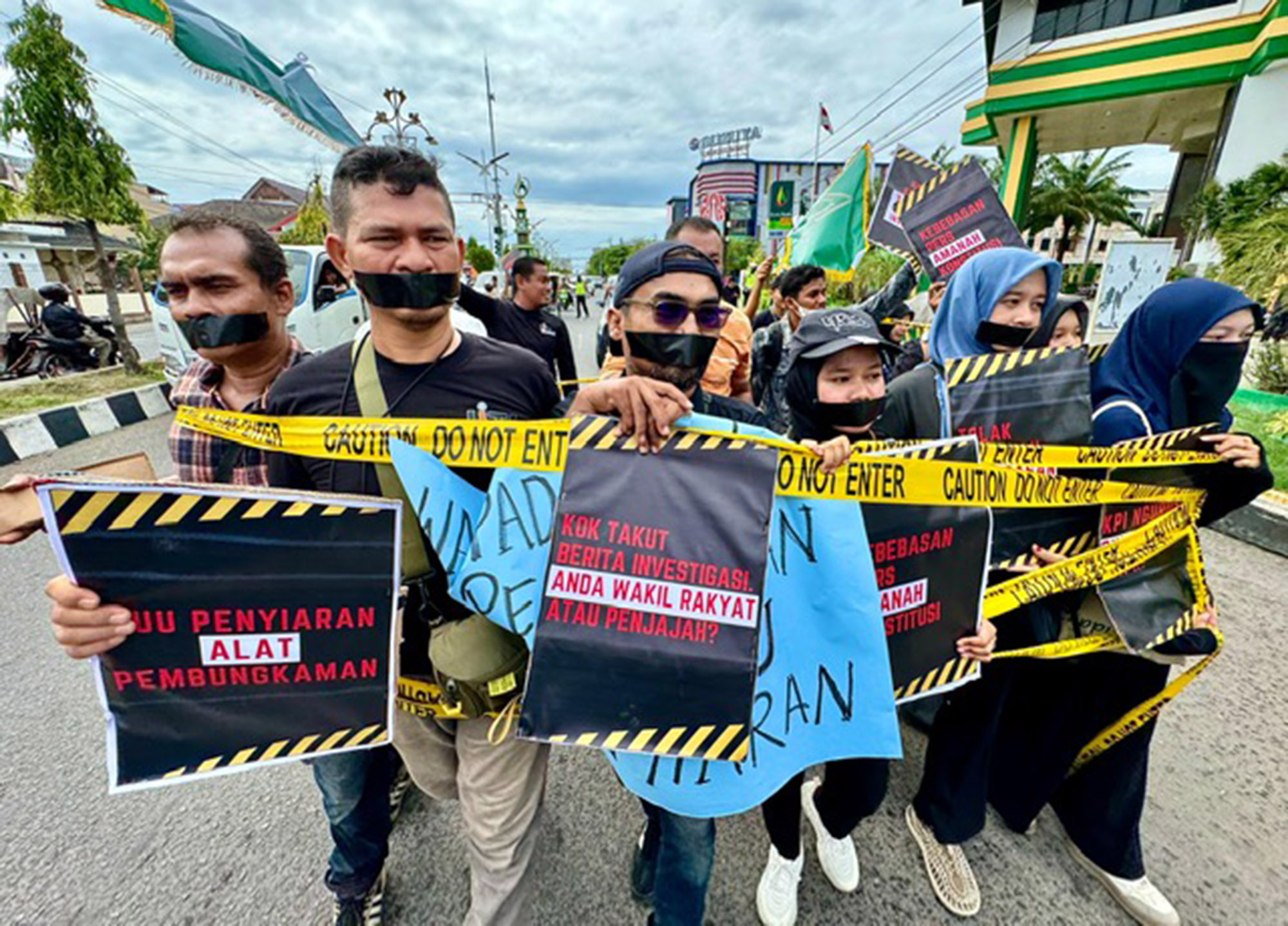
Article 4 of the Code of Journalistic Ethics (KEJ) states: “Indonesian journalists shall not produce false, slanderous, sadistic, or obscene news.”
The report by ajnn.net contains several sections that require specific verification to ensure they do not constitute false reporting or slander. Key questions requiring such verification include:
a. Has the Aceh Regional Police (Polda Aceh) truly initiated an investigation, as reported?
b. Have investigators indeed questioned a former official from the Aceh Youth and Sports Agency (Dispora Aceh) twice?
c. Are the figures—Rp35.9 billion, Rp55.9 million, Rp14.5 million, and Rp11.2 billion—derived from verifiable and credible documents?
d. Are the allegations regarding fictitious grants based on audit findings, public reports, or merely the claims of the accuser?
Article 10 of the Code of Journalistic Ethics (KEJ) states: “Indonesian journalists must promptly retract, correct, and rectify erroneous or inaccurate news, accompanied by an apology to the readers, listeners, and/or viewers.”
In the case of the ajnn.net report, this obligation would apply if it is subsequently proven that the headline, the status of the investigation, the credibility of sources, the identities of those questioned, or the data presented are inaccurate.
Furthermore, there are several typographical errors—such as “PErtandingan,” “seharsunya,” “pertanggngjawabkan,” “dari dari,” and “memamfaatkan”—which indicate a lack of thorough editing. Although this does not constitute a violation of Article 10, the error points to editorial weaknesses that must be addressed.
This concludes the report and analysis regarding the coverage by ajnn.net, which is suspected of violating the Code of Journalistic Ethics (KEJ) and therefore warrants further investigation. We thank the Press Council for its attention to this matter.[]