Can the Steem Virtual Machine (SVM) Help rescue STEEM ?
Steem was once a pioneer. Launched in 2016, it introduced the idea of rewarding content creators and curators directly on-chain through “Proof of Brain.” At its peak in early 2018, STEEM traded above $8.50, giving the project a multi-billion-dollar valuation during the last major bull market.
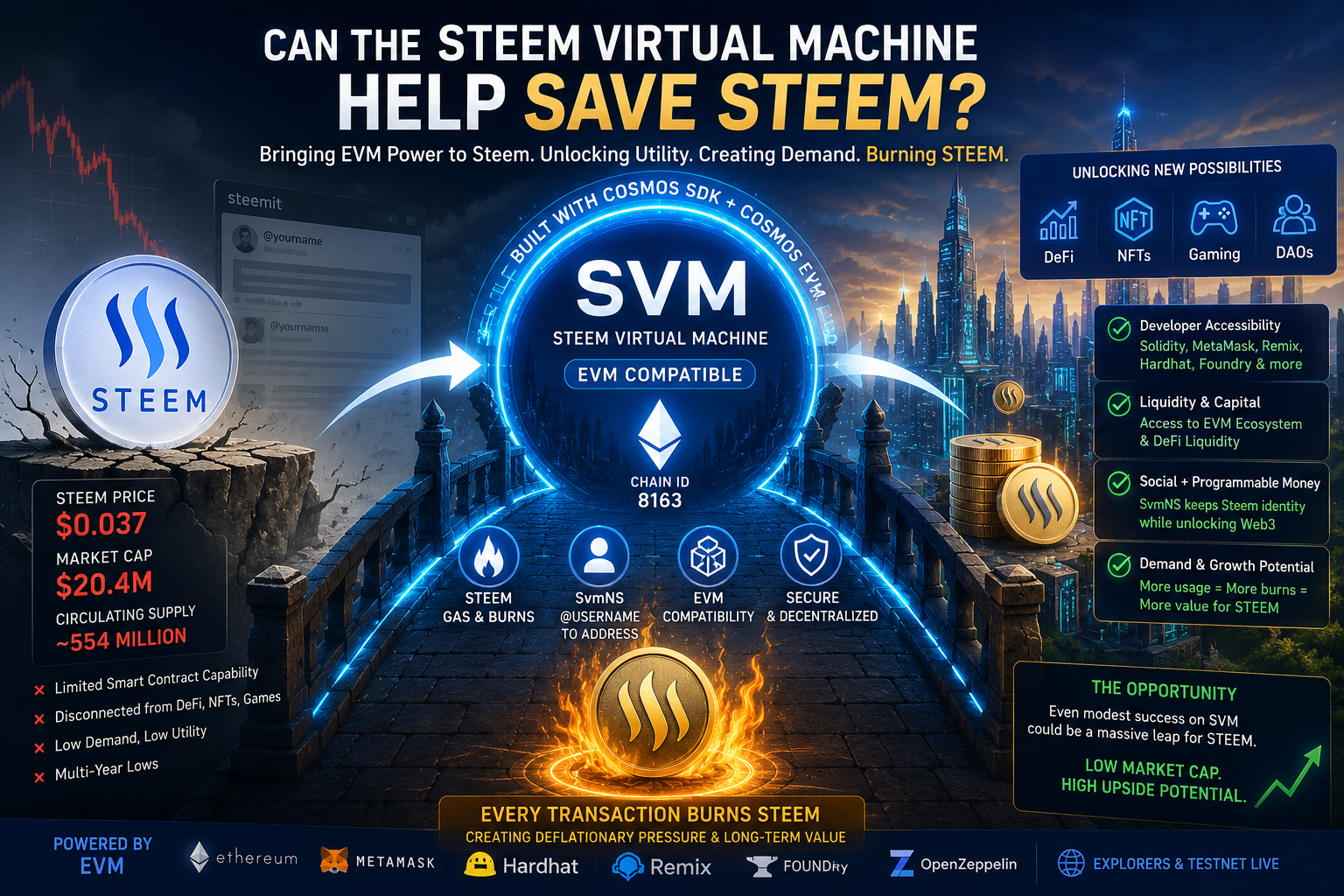
Today the picture is very different. As of early August 2026, STEEM trades around $0.037 with a market capitalization of approximately $20,400,000. Circulating supply sits near 554,000,000 tokens. The token has spent much of the recent cycle near multi-year lows. Activity on the social layer continues, but the lack of modern smart-contract capabilities has left Steem largely disconnected from the biggest sources of capital and developer talent in crypto: DeFi, NFTs, games, and programmable finance.
This is where the Steem Virtual Machine (SVM) enters the conversation.
What SVM Brings to the Table
SVM is an EVM-compatible blockchain built with the Cosmos SDK and the official Cosmos EVM module. Its key design choices are deliberately aligned with Steem:
- STEEM is the native gas token
- Every transaction burns STEEM, creating ongoing deflationary pressure
- SvmNS maps Steem usernames (@yourname) to EVM addresses through validator consensus — making the experience familiar for existing Steem users
- Full compatibility with Ethereum tools (MetaMask, Remix, Hardhat, Foundry, etc.)
- Chain ID 8163, live explorers, and public testnet infrastructure already available
In short, SVM aims to give Steem an Ethereum-style execution environment without forcing the main chain to abandon its social DNA.
Why EVM Layers Have Become Standard for Non-EVM Chains
Many non-EVM ecosystems eventually added EVM-compatible sidechains, parachains, or layers for the same reason: access to developers, liquidity, and ready-made applications.
Here are concrete examples with recent figures:
| Project | Base Chain | EVM Layer | Approx. DeFi TVL (recent) | Notes |
|---|---|---|---|---|
| Rootstock (RSK) | Bitcoin | EVM sidechain | $74,000,000 – $100,000,000 | Longest-running Bitcoin EVM sidechain. Secured by high percentage of Bitcoin hashrate. Provides real BTCFi utility. |
| Bitlayer | Bitcoin | EVM sidechain / L2 | Hundreds of millions at peak periods | One of the larger Bitcoin EVM projects; uses BTC as gas in design. |
| Merlin Chain | Bitcoin | EVM sidechain | $100,000,000+ at earlier peaks | ZK-focused Bitcoin EVM layer with broad DeFi and NFT activity. |
| Core | Bitcoin | EVM sidechain | Hundreds of millions | Satoshi Plus consensus combining Bitcoin hashrate with PoS. |
| Aurora | NEAR | EVM on NEAR | $3,000,000 | Brought Solidity developers to NEAR. Helped expand the ecosystem in earlier cycles. |
| Moonbeam | Polkadot | EVM parachain | $2,000,000 – $2,200,000 | Served as a major Ethereum-compatible gateway and liquidity router within Polkadot for years. |
| Neon EVM | Solana | EVM on Solana | $75,000 | Allows Ethereum contracts to run with Solana performance characteristics. |
| XRPL EVM Sidechain | XRP Ledger | EVM sidechain | $25,741 | Launched 2025, uses XRP as gas, Cosmos SDK based, bridged via Axelar. |
| Oasis Emerald | Oasis | EVM ParaTime | $191,000 – $228,000 | Public EVM environment on Oasis with ROSE as gas. |
| Milkomeda C1 | Cardano | EVM sidechain | Near $0 (largely deprecated) | Early attempt to bring Solidity to Cardano; activity has declined sharply. |
| inEVM | Injective | EVM layer | Modest / early stage | EVM compatibility layer for the Injective ecosystem. |
These projects did not all achieve massive, sustained TVL. Market conditions, competition, and execution quality matter. However, the pattern is clear: non-EVM chains repeatedly choose to add EVM compatibility because it lowers the barrier for the largest pool of smart-contract developers and opens the door to existing DeFi and NFT protocols.
Bitcoin’s market capitalization is approximately $1,260,000,000,000. Multiple EVM layers on Bitcoin (Rootstock, Bitlayer, Merlin, Core and others) have collectively attracted hundreds of millions in capital at various points. NEAR Protocol carries a market capitalization of approximately $2,150,000,000 – $2,200,000,000. Even smaller EVM layers have at times attracted tens or hundreds of millions in capital during stronger market periods.
The Steem Opportunity Is Asymmetric
Steem’s current $20,400,000 market capitalization is tiny by crypto standards. This works both ways.
On the negative side, it reflects low attention and limited utility beyond the social layer.
On the positive side, even relatively modest success on SVM could move the needle dramatically.
Consider the mechanics:
- Gas demand + burns — Every smart-contract interaction consumes and burns STEEM. Sustained usage creates continuous buy pressure and reduces supply.
- Developer accessibility — Solidity developers can deploy existing or new applications without learning an entirely new stack.
- Social + programmable money — SvmNS keeps Steem’s unique identity system while unlocking DeFi, NFTs, games, and DAOs.
- Low starting valuation — Reaching even $50,000,000 – $100,000,000 in combined ecosystem value or meaningful TVL would represent a multiple of the current market capitalization, especially if burns accelerate.
No one can guarantee adoption. Many EVM sidechains have struggled to maintain momentum after initial hype. Success depends on a working bridge, reliable infrastructure, real applications, and community support.
Yet the strategic logic is the same one that led Bitcoin, NEAR, Polkadot, Solana, Cardano, XRP Ledger, Oasis, Injective and others to pursue EVM compatibility: the largest developer and liquidity networks in crypto still revolve around the EVM.
A Realistic Path Forward
SVM is currently in public testing. The critical next steps include a secure bridge design, broader validator participation, documentation, and early applications that actually use STEEM as gas.
If those pieces come together, Steem would no longer be limited to content rewards and social interactions. It could offer a full programmable layer while keeping STEEM at the center of the economy through fees and burns.
Steem does not need to become the next Ethereum. It needs a credible path to greater utility and demand for its native token. An EVM-compatible environment with built-in burns and native social identity mapping is one of the clearer paths available.
The market has already shown that non-EVM chains will reach for EVM tools when they want to expand. Steem now has its own version of that tool in SVM.
Whether it becomes a meaningful catalyst depends on execution and community follow-through. But given Steem’s current valuation and the proven demand for EVM access across the industry, the upside case is real.
The question is no longer whether EVM compatibility matters.
The question is whether Steem will successfully use it.