Why EVMs Are the Rails of a Multi-Trillion Onchain Economy
Wall Street is no longer “watching crypto.” It is buying the plumbing.
This week made that unmistakable. S&P Global agreed to acquire OpenZeppelin — the firm whose open-source contracts have underpinned more than $37 trillion in onchain transfers, including most of the largest stablecoins and tokenized funds. A day earlier, Circle flipped on Arc, an EVM-compatible Layer 1 where gas is paid in USDC, settlement is sub-second, and the founding validator set includes BlackRock, DTCC, Visa, Mastercard, ICE, and Standard Chartered. Meanwhile, tokenized real-world assets sit around $46–47 billion, with Ethereum still holding roughly half of that market and EVM chains and L2s absorbing the rest of the institutional flow.
Those three facts are not separate stories. They are one thesis: the next financial system will be programmable, 24/7, and mostly written in Solidity.
Wall Street just bought the compiler of onchain finance
Credit ratings used to stop at the issuer: reserves, cash flow, legal structure. That is no longer enough.
When treasuries, funds, and deposits live in smart contracts, the code is part of the credit file. OpenZeppelin’s library is the default template for ERC-20s, access control, upgrades, and vaults. S&P is not buying a crypto brand. It is buying the ability to rate technology risk the same way it rates issuers — because banks will not put multi-billion products on rails they cannot audit in a language their counsel already understands.
That language is the EVM.
OpenZeppelin did not become the standard because Ethereum won a purity contest. It became the standard because millions of developers, thousands of audits, and a decade of battle-tested patterns all live in one execution environment. When S&P absorbs that stack, it is institutionalizing EVM security as market infrastructure.
Circle did not launch “a chain.” It launched an EVM settlement venue
Arc is the tell.
Circle could have built a custom VM. It did not. It shipped EVM compatibility on Reth, Malachite consensus, USDC as gas, and permissioned but public-facing validators from the core of TradFi. Uniswap, Aave, Morpho, tokenized funds like BUIDL and USYC, and more than 100 apps went live on day one because they could redeploy, not rewrite.
That is the institutional preference revealed in public:
- Familiar wallets and custody
- Familiar auditors and OpenZeppelin patterns
- Familiar compliance hooks
- Immediate DeFi composability for collateral, liquidity, and 24/7 secondary markets
Stablecoins were the first multi-trillion onchain product class. RWAs are the second. Both scale fastest where the contract layer is already a standard, not a science project.
Onchain RWAs are an EVM liquidity problem, not a chain-maxis problem
Tokenized T-bills, private credit, gold, and funds are still small versus global markets — tens of billions versus tens of trillions. The direction is not small.
Ethereum remains the largest RWA venue by value. EVM L2s such as Arbitrum lead by number of RWA assets. New “RWA chains” keep launching with EVM execution anyway, because issuers want one legal wrapper, one token standard, and one set of DeFi venues that already know how to lend against that token.
The multi-trillion path is not “every asset on one L1.” It is:
- Tokenize on a standard (ERC-20 / ERC-4626 / permissioned variants)
- Rate the issuer and the contract
- Settle in stablecoins on rails banks will validate
- Reuse the same contracts across L1s and L2s that speak EVM
That is how a $46B market becomes a $4T market without forcing every bank to hire a new programming culture.
Why EVM wins the multi-trillion layer (even if other VMs win niches)
1. Standards compound.
OpenZeppelin + Solidity + ERC token specs are the SWIFT-plus-ISDA of crypto. You do not rip out the messaging standard after S&P just bought the reference implementation.
2. Talent is the real bottleneck.
Institutions hire Solidity shops, not “new-VM specialists,” at the volume required for funds, payments, and collateral ops.
3. Composability is the product.
A tokenized T-bill that cannot plug into lending, FX, and treasury bots is just a slower database. EVM DeFi is where that plug already exists.
4. New chains keep choosing EVM.
Arc is the latest proof. When the issuer of USDC builds its own L1, it still speaks Ethereum’s machine. That is network effect, not nostalgia.
5. Risk markets need one surface area.
Ratings, audits, incident response, and onchain surveillance all get cheaper when most value sits in one bytecode format.
Other environments will keep winning specific jobs: ultra-high-throughput order books, privacy, or app-specific performance. That does not dethrone the settlement and contract standard. The internet did not need one website. It needed TCP/IP. Onchain finance is converging on EVM the same way.
The picture in one sentence
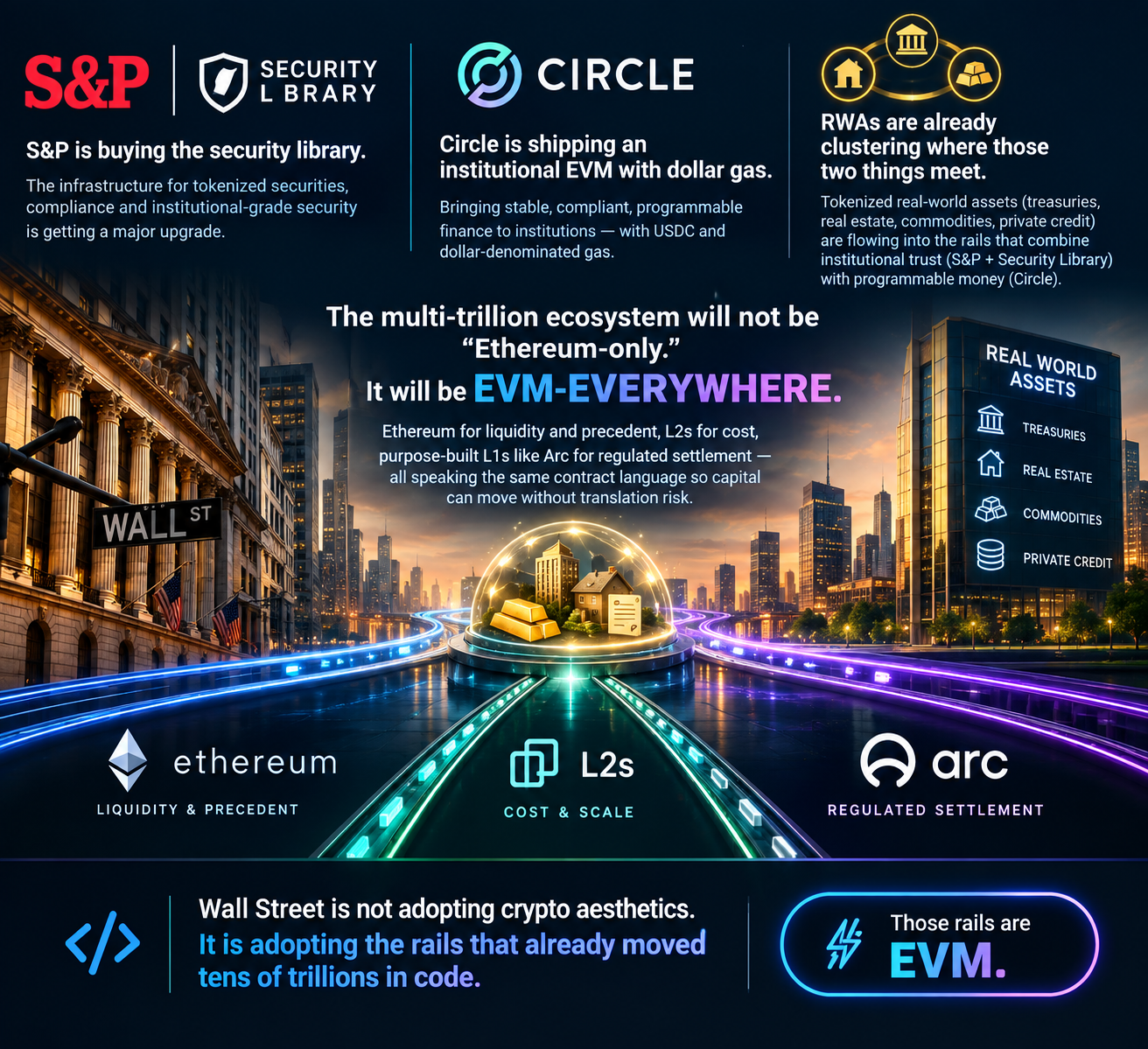
S&P is buying the security library. Circle is shipping an institutional EVM with dollar gas. RWAs are already clustering where those two things meet.
The multi-trillion ecosystem will not be “Ethereum-only.” It will be EVM-everywhere: Ethereum for liquidity and precedent, L2s for cost, purpose-built L1s like Arc for regulated settlement — all speaking the same contract language so capital can move without translation risk.
Wall Street is not adopting crypto aesthetics. It is adopting the rails that already moved tens of trillions in code.
Those rails are EVM.