SVM Testnet: Infrastructure Transparency, Network Resilience & Final Mainnet Preparations
1. Current Status of the SVM Testnet
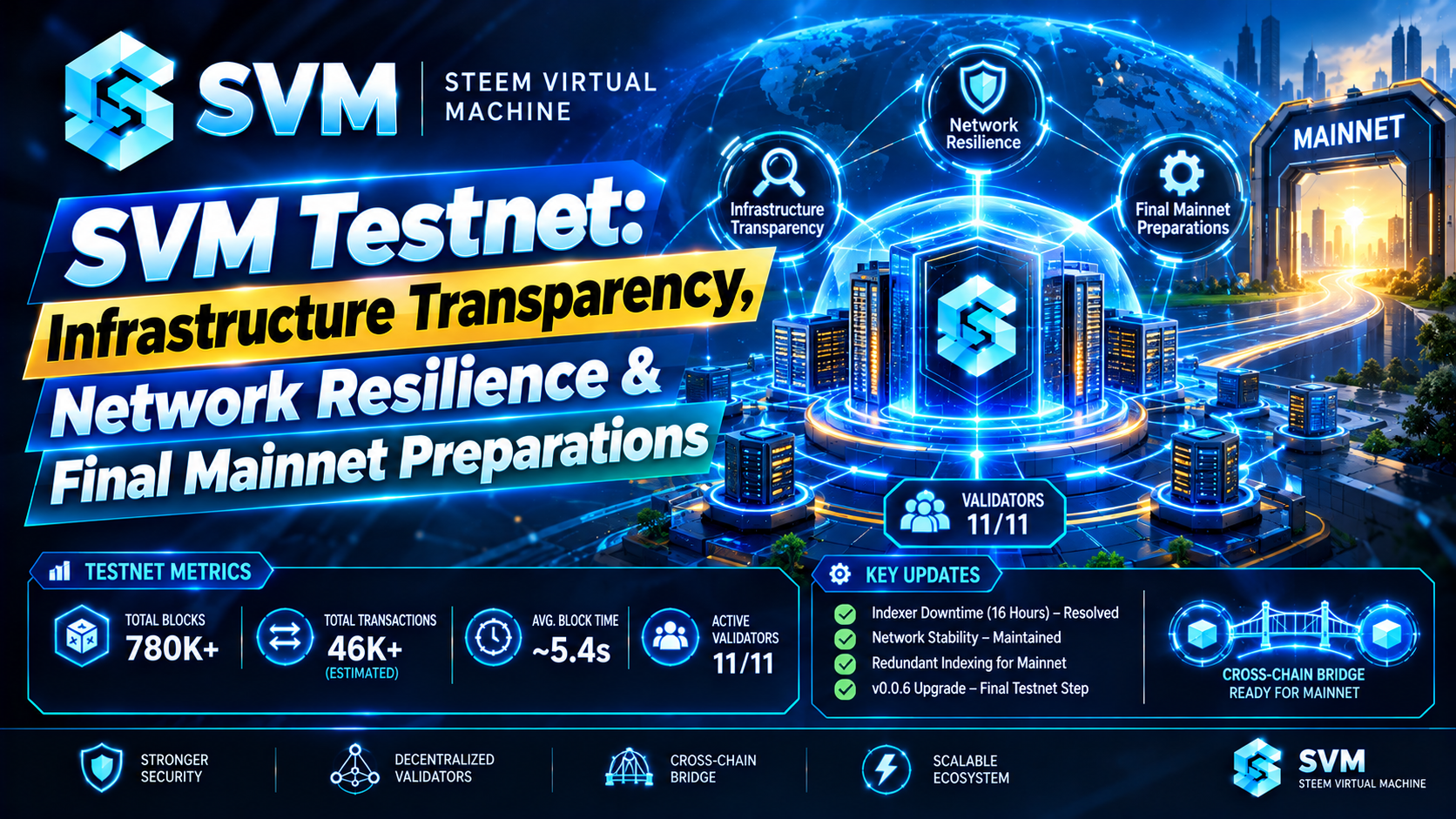
The Steem Virtual Machine (SVM) Testnet has surpassed the milestone of 780,000 blocks produced. According to recent updates, the network's consensus layer remains stable, and all 11 validators are active and online.
Current Network Statistics
| Metric | Current Status |
|---|---|
| Total Blocks Produced | 780,657+ |
| Total Transactions | 46,200+ (approx.) |
| Average Block Time | ~5.4 seconds |
| Active Validators | 11/11 |
| Validator Uptime | All validators online |
Features introduced in v0.0.5—such as identity hardening, an enhanced consensus mechanism, and validator-operated oracle clients—are playing a crucial role in maintaining network stability.
2. 16-Hour Downtime of the Blockscout Indexer
Recently, the SVM’s Blockscout indexer and explorer interface experienced a downtime of approximately 16 hours. This was caused by unexpected hardware or hosting provider-related issues affecting the VPS that hosts the indexer.
What Was Affected?
- The Blockscout block explorer was temporarily unavailable.
- Access to blockchain data via the indexer and explorer was interrupted.
- Reliance on a single server created a "single point of failure" for the read layer.
What Remained Unaffected?
According to the latest updates:
- The core blockchain consensus remained operational.
- Validators continued to produce blocks at intervals of approximately 5.4 seconds.
- Transaction processing and instant finality remained intact.
- Smart contracts and oracle price feeds for the Sherpa Protocol continued to function on-chain.
- No chain data was lost, and the network state remained fully intact. Following the resolution of the VPS issue, the indexer was restarted and synchronized with the current chain tip.
3. Consensus Layer vs. Read Layer
This incident highlights the distinction between two critical components of blockchain infrastructure.
| Aspect | Consensus Layer | Read Layer |
|---|---|---|
| Function | Block production and network consensus | Querying and displaying blockchain data |
| Examples | Validators and consensus mechanisms | Blockscout, indexer, and explorer APIs |
| Impact of this incident | Remained operational | Down for approximately 16 hours |
| Primary risk | Consensus failure | Reliance on a single indexer server |
In other words, a block explorer being down does not mean the blockchain itself has stopped. However, since reliable explorers and APIs are essential for users, ensuring their availability is crucial.
4. Redundant Indexing Plan for Mainnet
Drawing from this experience, plans have been announced to build more resilient infrastructure for the Mainnet.
Proposed enhancements include:
- Operating multiple indexer nodes across different cloud providers.
- Distributing infrastructure across various geographic regions.
- Ensuring an alternative indexer remains operational if one VPS fails.
- Improving the availability of the explorer and frontend APIs.
- Developing a redundant indexing architecture with a target of 99.99% uptime.
A 99.99% uptime is a stated goal, not a claim that it has already been achieved. Reaching this target will require the effective implementation of redundancy, monitoring, and failover mechanisms.
5. v0.0.6 and Mainnet Launch Preparations
Following the recovery of the indexer, the SVM team’s primary focus remains on preparations for the Mainnet.
The upcoming v0.0.6 upgrade has been designated as the final coordinated software upgrade for the Testnet. This will be followed by a network snapshot and the transition to the Mainnet.
Key upcoming steps:
- Publication of technical documentation for v0.0.6.
- Release of governance proposals and validator staging instructions.
- Preparation and coordination of the final software upgrade. 4. Completing the necessary verification and infrastructure preparations for the Mainnet.
- Advancing the network snapshot and Mainnet transition process.
6. Testnet Disclaimer
SVM is currently in the Testnet and Mainnet preparation phase. Tokens and assets on the Testnet are used solely for testing consensus, EVM execution, and bridge infrastructure. They should not be considered to have any real-world financial value.