SVM Testnet: Proposal 3 Goes Live with Active Feemarket & First Fee Burn
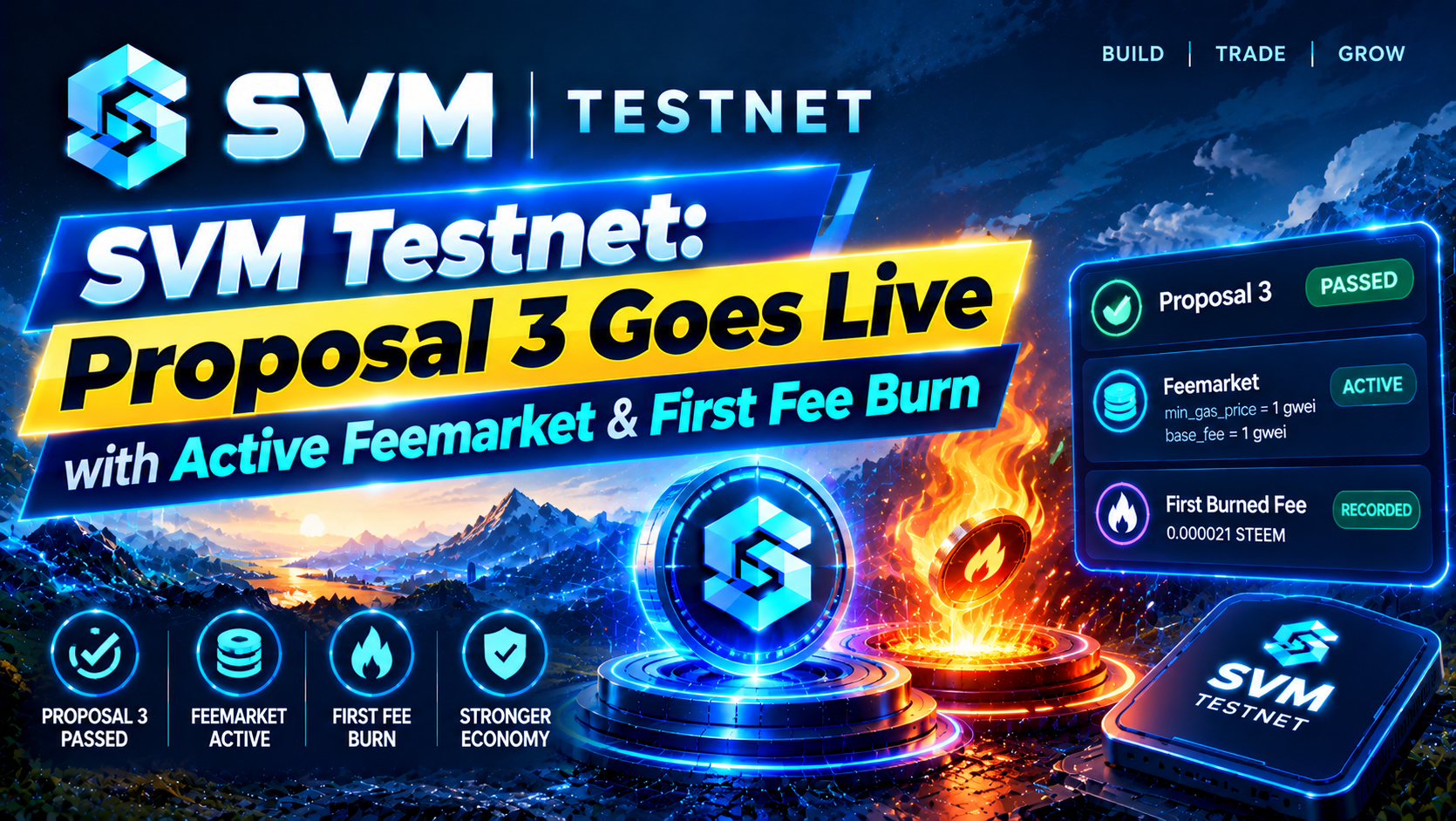
Proposal 3 has successfully passed and been executed on-chain for the SVM Testnet. This has activated the fee market's minimum gas price, and the EIP-1559 fee-burn mechanism is now operational.
Consequently, the "0 gas" phase of the SVM Testnet has ended; every EVM transaction now incurs a minimum base fee, a portion of which is permanently burned.
Proposal 3 Successfully Implemented
The key changes introduced by Proposal 3 are now live:
min_gas_price→ 1 gweibase_feefloor → 1 gwei- 1 gwei = 1,000,000,000 asteem per gas
- A minimum base fee now applies to every EVM transaction
- EIP-1559 fee-burning mechanism is active
- The 1 gwei floor is compatible with the existing default gas configurations of validators and oracle nodes
As a result, no changes to validator or oracle configurations were required during the upgrade, and network operations continued seamlessly.
First Burned Fees Recorded
Proof of the first actual transaction involving a fee burn following the implementation of Proposal 3 has been recorded.
Transaction Details
| Metric | Value |
|---|---|
| Value Transferred | 100 STEEM |
| Total Transaction Fee | 0.000023625 STEEM |
| Gas Price | 1.125 Gwei |
| Gas Usage | 21,000 / 21,000 |
| Burned Fees | 0.000021 STEEM |
A total of 0.000021 STEEM was burned from a standard 21,000-gas EVM transfer. This demonstrates that the fee-burn mechanism is now actively functioning as part of transaction processing.
Transaction:
https://evmscan.steemscanner.com/tx/0x949a70f64f8501f760376ec3fcf2f005872fc0860424adcf3f5492e83476336e
How Fee Burn Works
Previously, the absence of a minimum floor for the EIP-1559 base fee meant it could decay to zero over time.
As a result:
- EVM transactions could effectively become zero-fee
- The 25% fee-burn mechanism failed to actually burn any STEEM
- The economic barrier against network spam was lowered
Following Proposal 3:
Minimum gas price = 1 gwei
Consequently, EVM transactions now carry a base fee, a specific portion of which is burned.
This enhances the economic model of the SVM Testnet and integrates a real-world fee mechanism into the testnet's transaction activity.
Why This Change Matters
1. Economic Sustainability
A zero-fee transaction model does not provide a viable long-term economic mechanism. Activating the fee burn introduces a deflationary component linked to transaction activity.
2. Spam Prevention
The non-zero gas floor reduces the opportunity for network spamming via the submission of countless free transactions on the EVM layer.
3. Validator & Oracle Alignment
The 1 gwei floor aligns with the default gas price settings for validator nodes and oracle clients.
As a result, the implementation of Proposal 3 required:
- No changes to validator configuration
- No changes to oracle configuration
- No network downtime
Current SVM Testnet Statistics
| Metric | Current Status |
|---|---|
| Total Blocks | 492,000+ |
| Total Transactions | 30,600+ |
| Average Block Time | ~5.3 seconds |
| Active Validators | 8 |
Alongside network economic changes, consensus, bridge, and oracle infrastructures are operational.
Development Status
At this stage, key infrastructure components of the SVM Testnet are gradually reaching full maturity:
- Proposal 3 successfully executed
- Fee market is now active
- EIP-1559 fee burn implemented
- First burned fees recorded
- Network infrastructure stable
- Security hardening complete
- Validator and oracle operations ongoing
- SVM App frontend being prepared for public release
What's Next
The next major milestone is the finalization and public release of the SVM App frontend.
Through the SVM App, the broader community will be able to easily:
- Access Sherpa Protocol liquidity pools
- Perform token swaps
- Explore DeFi functionalities within the SVM ecosystem
- Interact with the Sherpa Protocol
In essence, with the infrastructure, security, and economic layers largely ready, development focus is now shifting toward the user-facing SVM App.
Overall Progress
SVM Testnet development has reached a critical stage:
Stable Infrastructure → Security Hardening → Sherpa Deployment → Governance Upgrade → Active Fee Market → Fee Burning → SVM App Public Release
The execution of Proposal 3 is particularly significant, as it has activated not only the technical infrastructure of the SVM but also the network's economic mechanisms.
Testnet Disclaimer
SVM is currently in the testnet phase.
The bonded STEEM, transactions, and generated tokens used here are solely for testing consensus and the EVM execution layer. Neither this chain nor its assets hold any real-world monetary value.