The Biggest Mistake Crypto Traders Make During Volatility
Crypto volatility isn't new.
Prices can move 5%, 10%, or even more in a matter of hours. News breaks, liquidity changes, traders rush into positions, and suddenly the market looks completely different from what it did earlier in the day.
For many traders, this is where the biggest mistake happens.
They react to volatility instead of understanding it.
A sharp move doesn't automatically mean there's an opportunity. Sometimes it's the beginning of a trend. Sometimes it's a liquidity event. Sometimes it's leverage being flushed from the market.
The difficult part is knowing the difference.
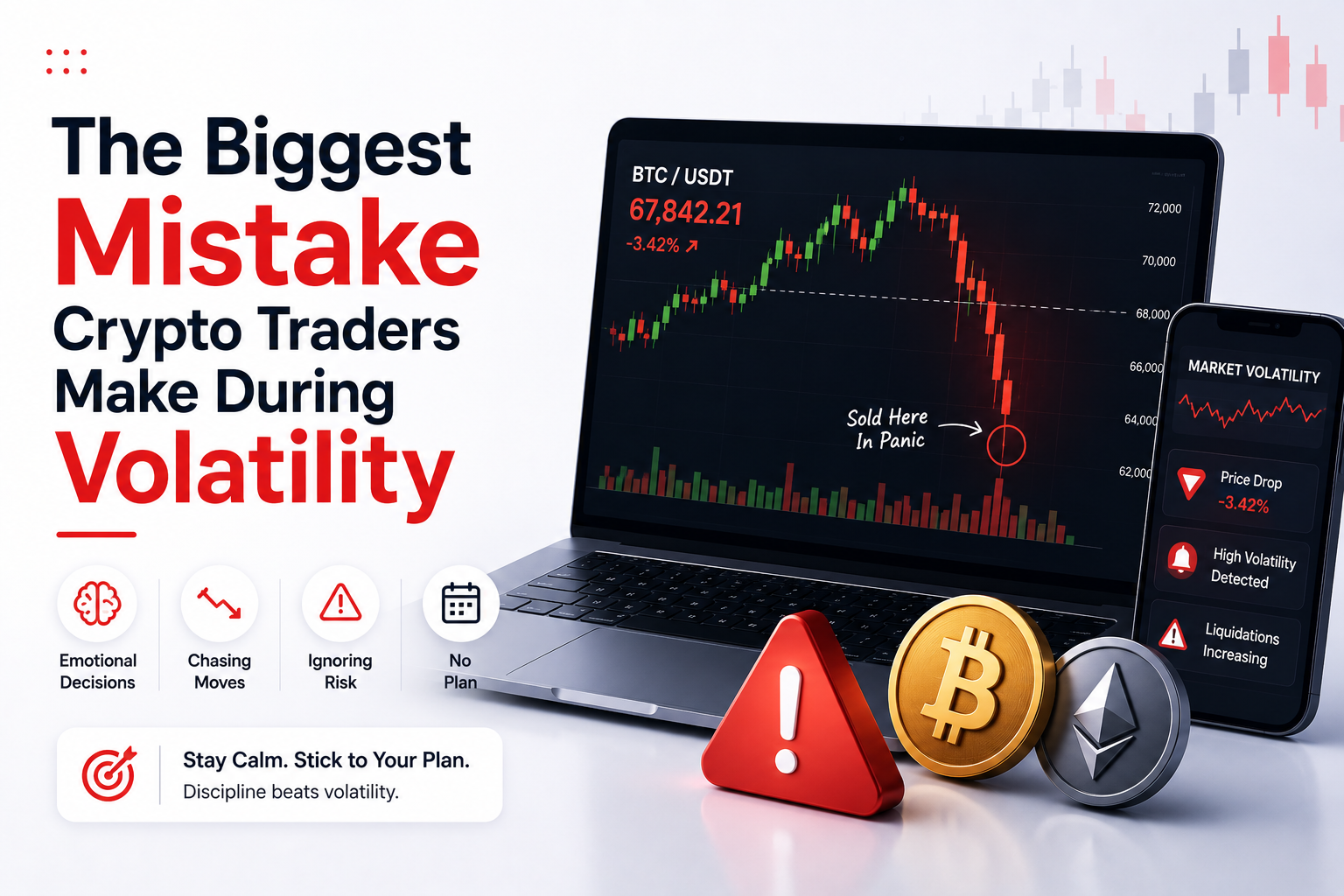
Volatility Makes Traders Want to Act
When markets are calm, it's easier to follow a trading plan.
During volatility, everything speeds up.
Bitcoin suddenly moves. Altcoins follow. Social media fills with predictions. Trading signals start appearing. Everyone seems to have an opinion about what happens next.
That's when FOMO can take over.
A trader sees a large green candle and enters because they don't want to miss the move. Another sees a sudden drop and sells because they expect things to get worse.
Neither decision necessarily comes from analysis.
They're reactions.
And reacting during extreme volatility can be expensive.
The Problem With Looking at Price Alone
Price is the most visible piece of market information, but it's only one piece.
Imagine a cryptocurrency suddenly jumps 12%.
On a chart, it looks bullish.
But what's behind the move?
Maybe trading volume has increased significantly.
Maybe liquidity has disappeared.
Maybe a major announcement was released.
Maybe short positions are being liquidated.
Maybe derivatives positioning has changed dramatically.
Or maybe the move is happening in a relatively thin market where a smaller amount of capital is moving the price more than usual.
The chart tells you what happened.
The rest of the market data can help explain why it happened.
Liquidity Can Change the Entire Trade
Liquidity becomes particularly important during volatile markets.
When liquidity is deep, traders can generally execute larger orders without moving the market as much.
When liquidity becomes thin, even relatively small orders can create sharp price movements.
This can lead to:
Higher slippage
Faster price swings
Wider spreads
Difficult exits
False breakouts
Sudden reversals
That's why experienced traders don't simply ask where an asset is trading.
They also consider how much liquidity is supporting that price.
Don't Blindly Follow Crypto Trading Signals
Crypto trading signals can be useful during volatile markets because they can help traders identify unusual activity or potential setups.
But a signal shouldn't automatically become a trade.
A signal might identify a breakout, for example, but traders still need to understand the conditions behind it.
Is volume supporting the move?
Is liquidity healthy?
Is there relevant news?
What is happening with open interest?
Are funding rates becoming extreme?
Are large liquidations taking place?
This is where the difference between a crypto trading signal and broader crypto trading intelligence becomes important.
A signal gives you something to investigate.
Context helps you decide whether it deserves your attention.
Derivatives Data Can Reveal What the Market Is Doing
During periods of high volatility, derivatives data becomes especially useful.
Metrics such as:
Open interest
Funding rates
Liquidations
Long and short positioning
can provide additional insight into how traders are positioned.
For example, a rapid increase in open interest while prices are moving aggressively may indicate that leverage is entering the market.
That doesn't automatically mean the price will reverse.
But it tells you something important:
The market is becoming more heavily positioned.
And highly leveraged markets can become vulnerable to sudden moves in either direction.
News Can Matter More Than the Chart
Crypto markets react quickly to information.
A regulatory announcement, exchange update, token unlock, protocol development, macroeconomic event, or major partnership can completely change market conditions.
During volatility, traders who only watch price can miss the catalyst behind the move.
This is one reason real-time crypto market intelligence is becoming increasingly important.
The goal isn't to consume every headline.
It's to identify the news and events that are actually relevant to the market you're trading.
Volatility Doesn't Mean Every Move Is an Opportunity
This is another mistake traders often make.
When volatility increases, the number of visible opportunities increases too.
That doesn't mean the quality of those opportunities improves.
Sometimes the smartest decision is to wait.
If liquidity is poor, market conditions are unclear, or several conflicting signals are appearing at the same time, forcing a trade can create unnecessary risk.
More movement doesn't always mean more opportunity.
Sometimes it simply means more noise.
This Is Where Market Intelligence Can Help
The amount of information generated by crypto markets is difficult for one person to monitor continuously.
Price changes across hundreds of assets.
News from multiple sources.
Liquidity movements.
Derivatives data.
Trading activity.
On-chain developments.
Trying to track everything manually can quickly become overwhelming.
This is where AI-powered crypto market intelligence can become useful.
Platforms such as i5.xyz are focused on bringing different layers of market information together, including market activity, events, liquidity, and derivatives data.
Instead of looking at a crypto trading signal in isolation, traders can use broader intelligence to understand the environment around it.
That doesn't mean AI can predict every market move.
It means AI can help traders process large amounts of information and surface developments that may deserve a closer look.
A Better Approach During Volatile Markets
When the market starts moving quickly, slow down your decision-making process.
Before entering a trade, ask:
What is driving this move?
Is liquidity supporting it?
What does derivatives data show?
Is there a relevant news event?
Does the broader market agree with the move?
Where am I wrong if the trade fails?
These questions don't guarantee a profitable trade.
They simply make it harder to trade purely on emotion.
The Biggest Mistake Isn't Trading During Volatility
Volatility itself isn't the problem.
For many traders, volatility creates some of the most interesting opportunities in crypto.
The bigger problem is trading without enough context.
A sudden price movement can look obvious after it happens. In real time, it's much harder to understand.
That's why modern crypto trading is increasingly moving beyond simple indicators and isolated signals toward broader market intelligence.
The more relevant information you can bring together, the better you can understand the environment you're trading in.
And that may be the real advantage.
Not predicting every move.
Not catching every pump.
Just having enough context to make a better decision before you act.