What Does the Market Know Before the Price Moves?
A token suddenly moves 12%.
The chart lights up. Traders start asking what happened. Social media fills with explanations. News accounts begin looking for a headline that can explain the move.
But here is the more interesting question:
What was happening before the price moved?
The market rarely goes from completely quiet to completely active without anything changing underneath.
Liquidity can shift. Wallets can become more active. Derivatives positioning can change. Trading activity can accelerate. A narrative can begin gaining traction before it reaches the wider market.
None of these things guarantees that the price will move.
But together, they can provide clues about what is changing beneath the surface.
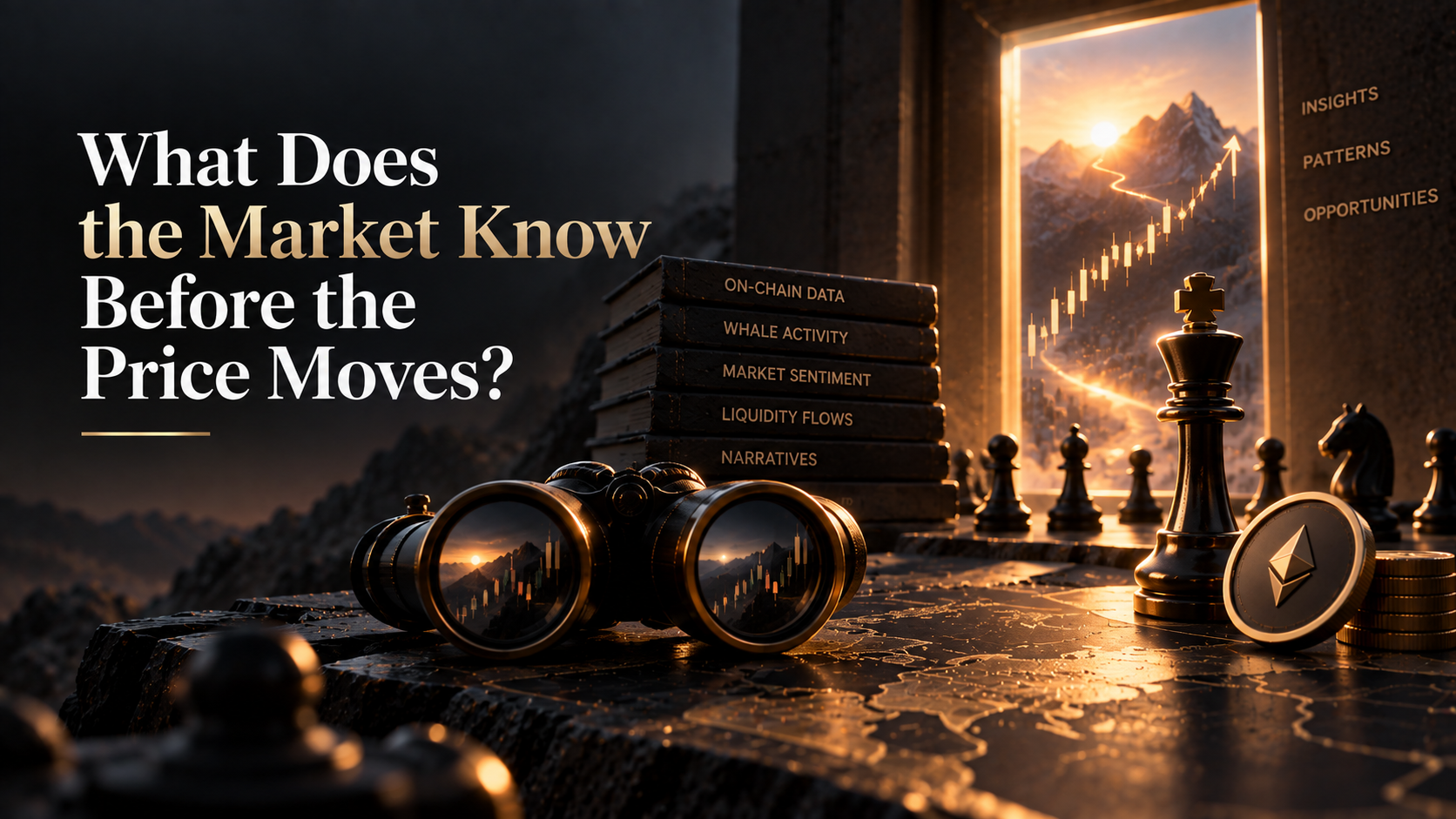
The Chart Usually Gets the Attention Last
Price is visible to everyone.
That is both its strength and its limitation.
When an asset starts moving, the price chart becomes the first place most traders look. It provides an immediate and easy-to-understand picture of what the market is doing.
But price is an outcome.
Before the chart moves significantly, other parts of the market may already be changing.
Think of it like a crowded room.
You may notice when everyone suddenly starts running toward the door. But there may have been conversations, movements, and small reactions happening several minutes before the crowd moved.
Crypto markets can behave in a similar way.
The visible move is not always the beginning of the story.
What Can Change Before Price?
There is no single metric that tells traders what will happen next.
Instead, different types of activity can sometimes provide additional context.
Liquidity
Liquidity can change the way an asset responds to buying and selling pressure.
When available liquidity becomes thinner, relatively smaller orders can have a larger impact on price. When liquidity increases, the same amount of activity may have a different effect.
So a price movement cannot always be understood without looking at the environment in which that movement occurred.
Derivatives Positioning
Futures and perpetual markets can provide another layer of information.
Changes in open interest, funding rates, and liquidations can show that traders are taking on or removing exposure.
Again, these metrics are not predictions.
They are pieces of evidence about how participants are positioned.
A sudden price move accompanied by major changes in derivatives activity can tell a different story from a move occurring with relatively little change in positioning.
On-Chain Activity
Blockchain activity can sometimes reveal changes that are difficult to see from a price chart alone.
Wallet movements, exchange flows, token transfers, and changes in activity across addresses can provide additional information about what participants are doing.
But even here, context matters.
A large wallet transfer does not automatically mean a whale is preparing to sell.
A spike in on-chain activity does not automatically mean bullish momentum.
The useful question is not simply whether activity increased.
It is what changed, and how does it relate to everything else happening in the market?
Sometimes the First Signal Isn't a Signal
This is where crypto market analysis gets complicated.
A trader sees unusual activity and immediately wants to classify it as bullish or bearish.
But markets are rarely that simple.
Suppose a token experiences:
increasing wallet activity
rising trading volume
changing derivatives positioning
reduced liquidity
growing social attention
Individually, each development can be interpreted in several ways.
Together, they create a more interesting picture.
The point isn't to turn these observations into a guaranteed prediction.
It is to recognize that the market may be changing before that change becomes obvious on a price chart.
Narratives Can Move Before Markets Do
Price is not the only thing that can develop early.
Narratives can develop gradually.
A project may begin receiving more discussion across crypto communities. Developers may announce an upgrade. A protocol may experience a change in activity. A new sector may begin attracting attention.
At first, these developments may seem insignificant.
Then the conversation grows.
More traders notice it. More liquidity follows. More accounts begin discussing it. Eventually, the narrative becomes visible in price.
By the time everyone is talking about it, the story may already be well established.
This is why tracking market narratives alongside quantitative data can provide a different perspective.
A market is not just numbers moving on a screen.
It is also people reacting to information.
The Hard Part Is Knowing Which Changes Matter
This is where traders face a familiar problem.
There is simply too much happening.
Hundreds of tokens can experience unusual activity at the same time. Thousands of transactions happen across networks. Derivatives markets constantly change. Social conversations never stop.
Trying to monitor everything manually can create another problem: attention becomes fragmented.
The challenge is no longer discovering that something changed.
It is deciding whether that change deserves attention.
That requires looking for relationships.
Did liquidity change at the same time as volume?
Did derivatives positioning shift alongside price?
Did on-chain activity increase while a new narrative started gaining traction?
Did several independent developments begin pointing toward the same market change?
Those connections can be more informative than any single number.
What If the Important Information Is Between the Data Points?
This may be one of the biggest challenges facing modern crypto traders.
Most platforms are good at displaying individual metrics.
You can see price.
You can see volume.
You can see open interest.
You can see funding.
You can see on-chain activity.
You can see sentiment.
But seeing all of those things separately does not automatically produce understanding.
The real value can come from connecting them.
That is where market intelligence starts to differ from simply having access to market data.
Instead of giving traders another number to watch, the goal becomes helping them understand relationships between events.
The Market Doesn't Have One Memory
Another reason context matters is that markets respond differently depending on what happened before.
The same price movement can have different implications in different conditions.
A 5% move after a major announcement is not necessarily the same as a 5% move occurring during a period of unusually low liquidity.
A sudden increase in volume during a major market-wide selloff is different from the same increase during a period of steady accumulation.
Numbers do not exist in isolation.
They exist inside a market environment.
Understanding that environment can change how the same piece of information is interpreted.
The Next Generation of Crypto Intelligence
Crypto traders already have access to enormous amounts of market information.
The next challenge is making sense of it quickly.
Instead of asking only:
“What is the price doing?”
Traders can increasingly ask:
“What is changing underneath the price?”
That question opens the door to a much broader view of the market.
Liquidity. On-chain activity. Derivatives. Sentiment. News. Narratives. Trading behaviour.
Individually, they are pieces.
Together, they can help describe the environment in which price is moving.
That is the direction in which crypto market intelligence is evolving: not simply delivering more data, but helping traders understand the developments that happen before, around, and alongside the price.
Get Early Access to i5
i5 is building an AI-powered approach to crypto market intelligence designed to help traders understand market activity through broader context rather than isolated data points.
If you want to explore what i5 is building, join the i5 Whitelist for early access and updates.
You can also join the i5 Telegram to follow the latest developments and stay connected with the community.
El post menciona que el token subió un 12 % y sugiere que, previo al salto, la liquidez pudo haberse afinado, lo que el mercado muestra como una mayor volatilidad. Sería útil analizar on‑chain el flujo de wallets activos y el open interest en los futuros para confirmar esa acumulación previa.