How VR is Transforming Medical Education and Patient Awareness Across Global Healthcare Systems
How VR is Transforming Medical Education and Patient Awareness Across Global Healthcare Systems
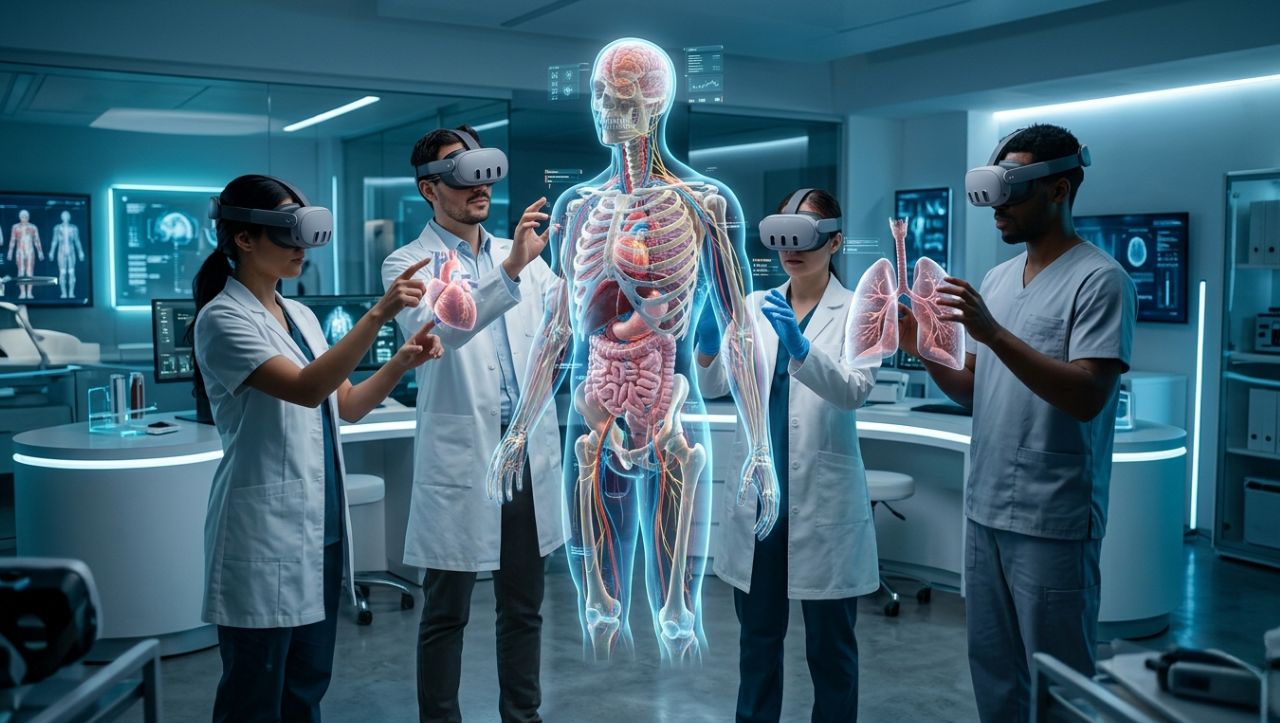
Medical students using VR to explore interactive 3D human anatomy in an immersive training lab
A Growing Gap in Medical Understanding
Healthcare systems across regions such as the USA, UK, Europe, Asia, and the Middle East are facing a persistent challenge: improving both medical education and patient understanding at scale. Despite advancements in clinical technology, the way medical knowledge is delivered especially anatomy and procedure awareness often remains static, text-heavy, and difficult to visualize.
Medical colleges struggle with limited cadaver access, while hospitals face difficulties explaining complex conditions like cataracts or heart stent procedures to patients. This gap directly affects learning outcomes, patient confidence, and treatment compliance.
The Real-World Challenges in Medical Learning and Awareness
Limited Visualization in Traditional Learning
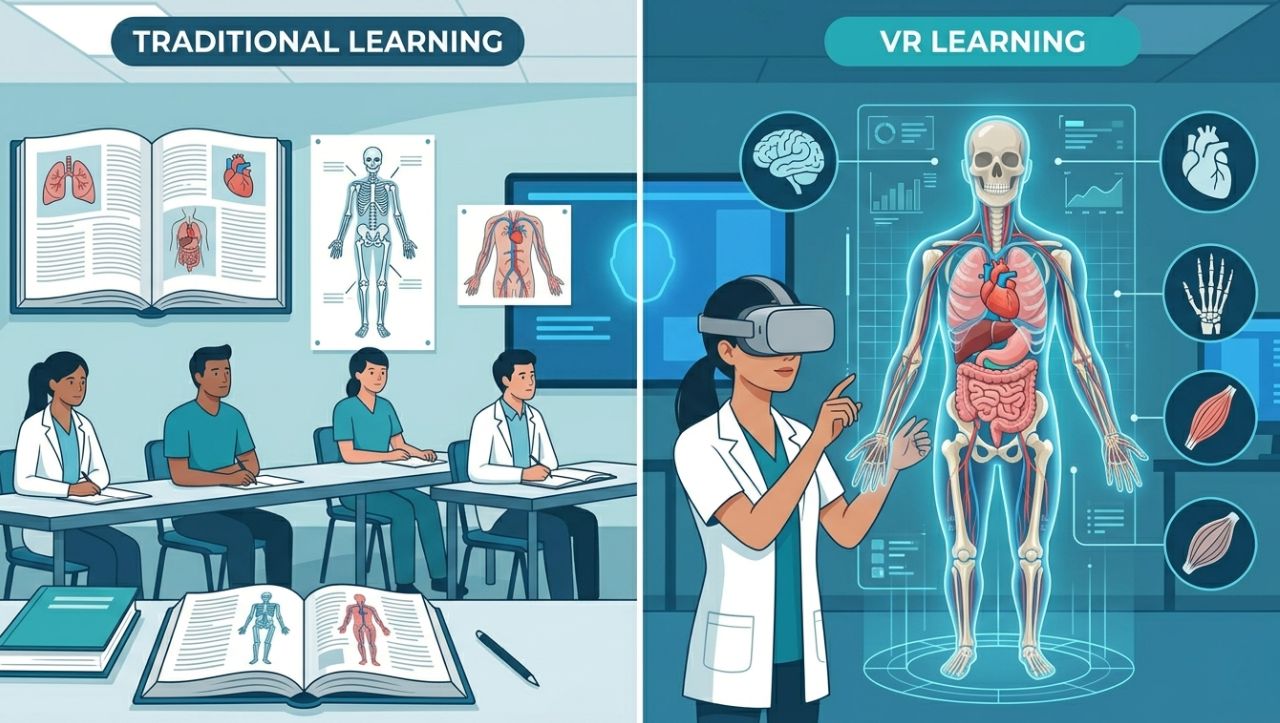
Textbooks and 2D diagrams cannot fully represent complex anatomical structures. Students often memorize rather than truly understand spatial relationships within the human body.Resource Constraints in Institutions
Cadavers, labs, and physical models are expensive and not always accessible — especially in emerging economies or high-demand regions.Low Patient Awareness and Engagement
Patients frequently struggle to understand diagnoses and procedures. This leads to hesitation, anxiety, and sometimes delayed decision-making.Ineffective Communication in Hospitals
Explaining procedures like cataract surgery or stent placement verbally can be inefficient, especially when dealing with diverse patient demographics.
XR-Based Solutions: A Shift Toward Immersive Learning
Extended Reality (XR), including Virtual Reality (VR) and Mixed Reality (MR), is emerging as a practical solution to bridge these gaps.
XR allows users to interact with highly detailed, 3D anatomical structures in real-time. Instead of imagining anatomy from flat images, students and patients can explore systems such as bones, muscles, nerves, and organs in an immersive environment.
For instance, platforms like [MedionXR] (https://medionxr.com/) provide interactive access to:
Hundreds of individual bones with origin and insertion points
Detailed muscular systems with layered exploration
Joint structures for functional understanding
Cardiovascular and nervous systems with dynamic visualization
Beyond education, XR is also being applied to patient awareness programs. Immersive modules for cataract awareness or heart stent procedures allow patients to “see” what will happen inside their body — making abstract concepts tangible.
Business Benefits for Healthcare Institutions
Improved Learning Outcomes
Medical students retain information better when they interact with 3D models instead of passively reading. This leads to stronger conceptual clarity and practical readiness.Scalable Training Infrastructure
VR reduces dependency on physical resources. Institutions can train more students simultaneously without increasing infrastructure costs.Enhanced Patient Trust and Decision-Making
When patients clearly understand their condition and treatment, they are more likely to proceed confidently. This improves conversion rates for elective procedures.Operational Efficiency in Hospitals
Doctors and staff spend less time explaining basic concepts repeatedly. XR modules standardize communication and reduce consultation time.
Become a Medium member
- Competitive Differentiation
Hospitals and colleges adopting immersive technologies position themselves as forward-thinking and patient-centric, which can influence reputation and enrollment.
Industry Applications Across Regions
Medical Colleges & Universities
Institutions in G20 countries and beyond are integrating VR labs to supplement traditional anatomy education. This is particularly useful where cadaver availability is limited.
Hospitals & Specialty Clinics
Eye hospitals are using immersive tools to improve cataract awareness, while cardiology centers are adopting VR to explain stent procedures to patients.
Training & Simulation Centers
XR enables safe, repeatable simulations for complex procedures, helping professionals refine their skills without risk.
Public Health Campaigns
Governments and healthcare organizations can use VR for large-scale awareness campaigns, making education more engaging and accessible.
Press enter or click to view image in full size
Infographic comparing traditional medical education with VR-based immersive learning methods
Use Case: Patient Awareness Through Immersion
In procedures like cataract surgery, patients often hesitate due to fear of the unknown. Traditional brochures fail to communicate what actually happens during surgery.
Immersive VR experiences allow patients to:
Visualize how cataracts affect vision
Understand the surgical process step-by-step
See expected outcomes post-treatment
Similarly, heart stent awareness programs can demonstrate blood flow blockages and how stents restore circulation. This clarity reduces anxiety and improves acceptance rates.
Future Outlook: The Role of XR in Global Healthcare
The adoption of XR in healthcare is expected to grow steadily as hardware becomes more affordable and content more specialized.
Future developments may include:
AI-powered personalized learning paths in VR
Integration with real patient data for case-based learning
Remote XR training for global collaboration
Wider use in preventive healthcare education
As healthcare systems continue to prioritize efficiency and outcomes, immersive technologies will likely become a standard component of both education and patient engagement strategies.
Conclusion
The shift toward immersive learning and awareness is not just a technological upgrade — it is a response to real limitations in how medical knowledge is currently delivered.
By enabling deeper understanding for students and clearer communication for patients, XR is helping healthcare institutions operate more effectively and deliver better outcomes at scale.