Nepal’s future is not just on the ground. It is in the sky — just a few hundred metres above our hills and mountains.
Every monsoon, landslides cut off entire districts. Every winter, fog and weather cancel flights. Every year, people in remote villages wait days for medicine, while tourists and locals still risk their lives on dangerous mountain roads or in small planes flying through cloudy Himalayan corridors. Building more roads through fragile mountains is expensive, environmentally damaging, and never finished. Traditional aviation is costly and has a painful safety record.
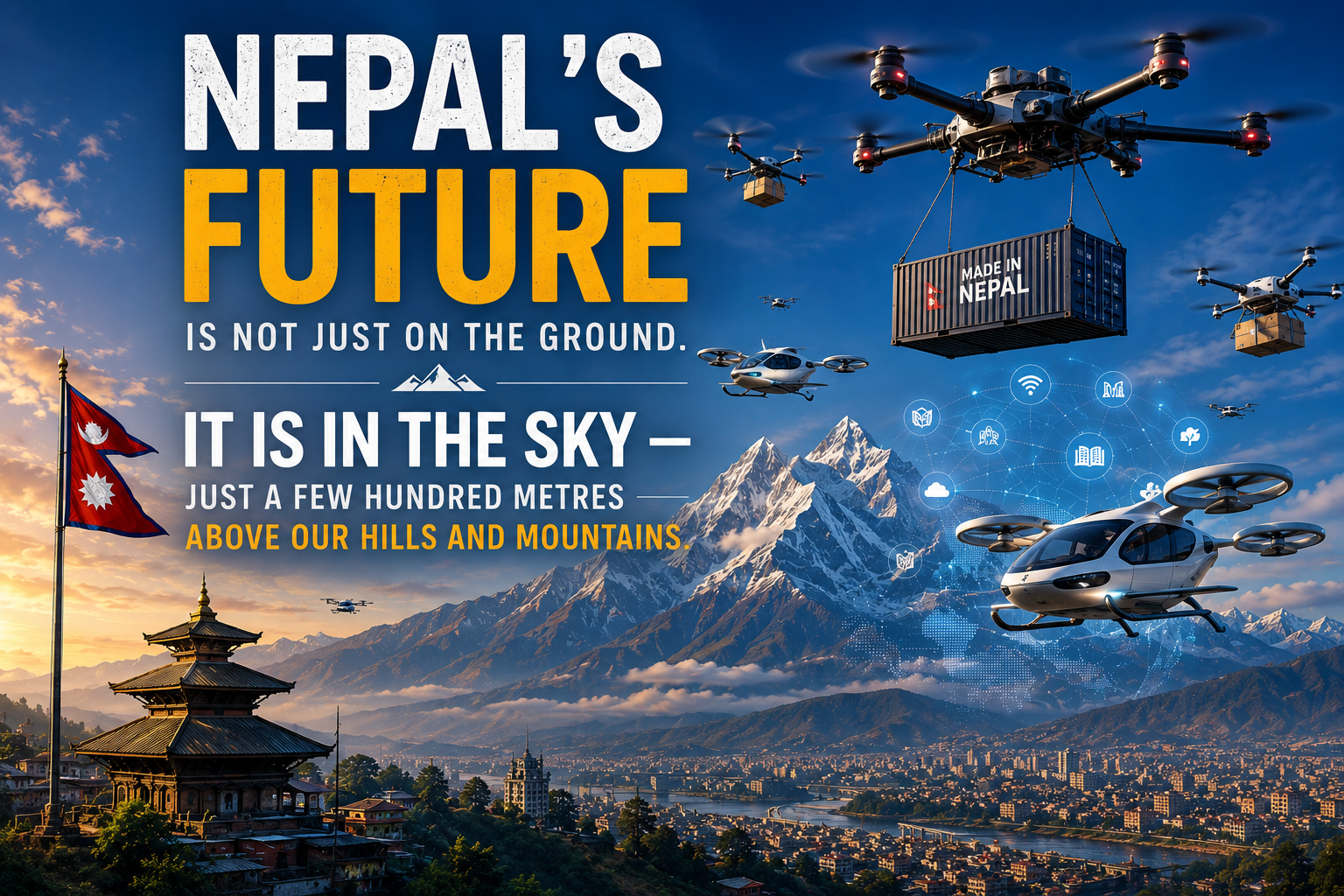
There is a better way already taking shape around the world and, quietly, here in Nepal: the low-altitude economy. This means using the airspace below 1,000–3,000 metres for drones, cargo aircraft, and electric flying vehicles (eVTOLs or “drone cars”) to move people, medicine, food, equipment, and even waste. It is cheaper than carving highways through rock, safer than many current options, and far more reliable when roads disappear under mud or snow.
Why it fits Nepal perfectly
Nepal’s geography is the problem and the opportunity. Distances that take 6–10 hours by jeep can take 20–30 minutes in the air. Hydroelectric power gives us clean electricity to charge electric aircraft. Remote health posts, disaster zones, and high-altitude camps already prove the concept works. Local companies and researchers are building solutions designed for our thin air, cold, and terrain — not imported toys that fail above 4,000 metres.
Drones already saving lives and time
Small and medium drones have been delivering hope for years.
In Pyuthan, cargo drones (modified DJI Matrice 600) collected tuberculosis sputum samples from remote clinics and flew them to hospitals. What used to take two or three days now takes 25 minutes. Hundreds of samples were moved this way, speeding diagnosis and treatment. Similar projects have tested medicine and vaccine delivery.
Drones map land, count wildlife, spray crops, inspect hydropower lines, and help after floods and earthquakes. The World Bank and local groups are training young Nepalis and supporting startups so this becomes a real jobs sector, not just a pilot project.
Heavy-lifting drones: the workhorses of the Himalaya
This is where things get exciting.
Nepali operator Airlift Technology, using DJI FlyCart 30 and FlyCart 100 drones, has hauled oxygen cylinders, equipment, and tonnes of garbage between Everest Base Camp and Camp 1 — work that once risked Sherpa lives on the Khumbu Icefall. One season the FlyCart 100 moved over 10,000 kg of cargo. Similar flights have happened on Ama Dablam.
Local company GarudX (founded by young entrepreneur Adarsha Raj Bhusal) has developed the ATLAX high-altitude delivery drone, tested above 6,000 metres on Lobuche Peak. They also build tactical and search-and-rescue drones designed for Himalayan conditions, including custom batteries that do not fail in extreme cold and thin air.
The Research Center of Low Altitude Economy (RCLAE) in Kathmandu is developing Nepal-made fixed-wing drones and aims for human-carrying drones by 2028, with technical support from a company in China that has a Nepali vice-president (Vikash Nakarmi) working on flying-car systems.
Globally, even larger cargo drones exist or are coming: platforms that can lift 100–300 kg or more over hundreds of kilometres, some with vertical takeoff so they need no runway.
Planes we already know — and what comes next
Nepal already depends on short-takeoff-and-landing (STOL) aircraft: the Twin Otter, Dornier 228, and Let L-410 that serve Lukla, Jomsom, Simikot, and other mountain strips. These planes are the current backbone of remote connectivity, but they still need airports, are weather-sensitive, and carry higher operating costs and risk.
The next generation will mix electric or hybrid STOL aircraft with drones and eVTOLs, reducing fuel costs and noise while keeping the ability to use short or unprepared strips.
Drone cars and flying taxis: from science fiction to NADA Auto Show
“Drone cars” (eVTOLs) take off and land vertically like a helicopter but fly more efficiently like a plane. They are quieter, electric, and many are designed to be autonomous.
- EHang EH216-S (shown in Nepal as Deepal eVTOL at NADA Auto Show 2025 by MAW Vriddhi): two-passenger, fully autonomous, already certified in China. It has 16 rotors, flies at around 130 km/h, and has a range of about 30 km. This was Nepal’s first public display of a flying taxi.
- Joby S4: four passengers + pilot, about 240 km range, 320 km/h, quieter than a car at distance. Among the most advanced Western designs.
Other names to watch: Archer Midnight, Volocopter, BETA ALIA, and Chinese projects including flying cars that can drive on roads then lift off.
Imagine Kathmandu to Pokhara in 25 minutes instead of 6–7 hours, or reaching a remote health post without a dangerous jeep ride. Nepal’s hydro power makes this one of the greenest possible networks on Earth.
What needs to happen now
Technology is moving fast. Policy is not. Drone rules in Nepal still involve multiple ministries, altitude limits, and visual-line-of-sight restrictions that limit real usefulness. Clear, modern regulations, training programs, charging/vertiport infrastructure, and support for local manufacturers like GarudX and RCLAE are essential.
The low-altitude economy will not replace every road or every traditional flight. But for a country of mountains, it is the most practical, affordable, and life-saving layer we can add — cheaper than endless road-building, safer than many current mountain journeys, and reliable when the ground fails us.
Nepal does not have to wait for others to invent this. We already have the terrain that demands it, the hydropower to power it, and young engineers building it. The question is whether we treat the sky as our next highway — or keep struggling on the ground.
What do you think? Should Nepal make low-altitude transport a national priority? Share this if you believe our mountains deserve a better way to connect.