Steem Activity and Rewards
Who Posts, Who Gets Supported, and Where Do the Rewards Go?
An analysis of main-post activity, community participation, Steem Curator and Booming support, and finalized rewards — August 8–21, 2026
Over the years, I have often wondered how activity on Steem is actually distributed.
I regularly see some of the same users publishing several posts per day, sometimes across multiple communities and almost every day. At times, it can look almost like a full-time job.
There is nothing inherently wrong with that. There is nothing wrong with being highly active or earning rewards on Steem.
The question I wanted to investigate was different:
How are activity, support and rewards actually distributed on Steem?
Rather than relying on impressions, I decided to look at the blockchain data.
The Study
The analysis covers August 8–21, 2026, representing 14 complete days (UTC).
During this period I identified:
26,242 main posts
3,610 unique authors
Only root/main posts are included in the primary posting analysis. Comments and replies are examined separately later.
I looked at:
- posting frequency and active days
- activity across communities
- Steem Curator support
- Booming support
- finalized author rewards
- direct self-comments and self-voting
The period was selected far enough in the past for the normal seven-day payout window to have ended. Therefore, the reward analysis uses finalized blockchain author_reward data, not pending payout estimates.
STEEM and vesting rewards are kept separate. For readability, VESTS are also shown in parts of the analysis as Estimated SP. Where STEEM + Estimated SP are combined, this is only a comparison measure for studying reward distribution — not USD and not liquid STEEM.
Curator and Booming Are Different
One distinction became particularly important during the investigation.
Steem Curator and Booming should not be treated as the same support system.
Steem Curator accounts are used by curation teams working with different themes and responsibilities.
Booming works differently because communities nominate posts for Booming support.
For that reason, I track Curator and Booming separately and use Combined Support only when asking whether a post received at least one of the two.
A post receiving both is counted only once in the Combined category.
This distinction becomes important when we later examine why the same authors sometimes receive repeated support.
What the Data Cannot Tell Us
Blockchain data can show what happened.
It can show how often somebody posted, which communities they used, who voted, and what the finalized rewards were.
It cannot tell us why somebody did it.
Therefore:
High posting frequency is not automatically reward farming. Repeated support is not automatically abuse. Large rewards are not automatically evidence that anything improper occurred.
The purpose of this investigation is to identify measurable patterns, not to assign motives to individual users or communities.
Likewise, when I refer to the reward of a supported post, this means the total finalized author reward of a post that received a Curator and/or Booming vote. It does not mean that Curator or Booming supplied the entire reward.
Data & Tools
The analysis is based on publicly available Steem blockchain data.
Part of the data was obtained and verified using SteemWorld.org / Steem Blockchain Data Services (SDS).
Special thanks to @steemchiller for developing and maintaining tools that make detailed analysis of the Steem blockchain possible.
SteemWorld.org — Built with ♥ by @steemchiller
With the methodology established, I started with the simplest question:
Who is actually producing Steem's 26,242 main posts?
Who Is Posting?
During the 14-day period, 3,610 authors published 26,242 main posts.
But activity was far from evenly distributed.
| Posts during 14 days | Authors |
|---|---|
| 1 | 903 |
| 2–5 | 1,155 |
| 6–15 | 1,349 |
| 16–30 | 139 |
| 31–60 | 37 |
| 61+ | 27 |
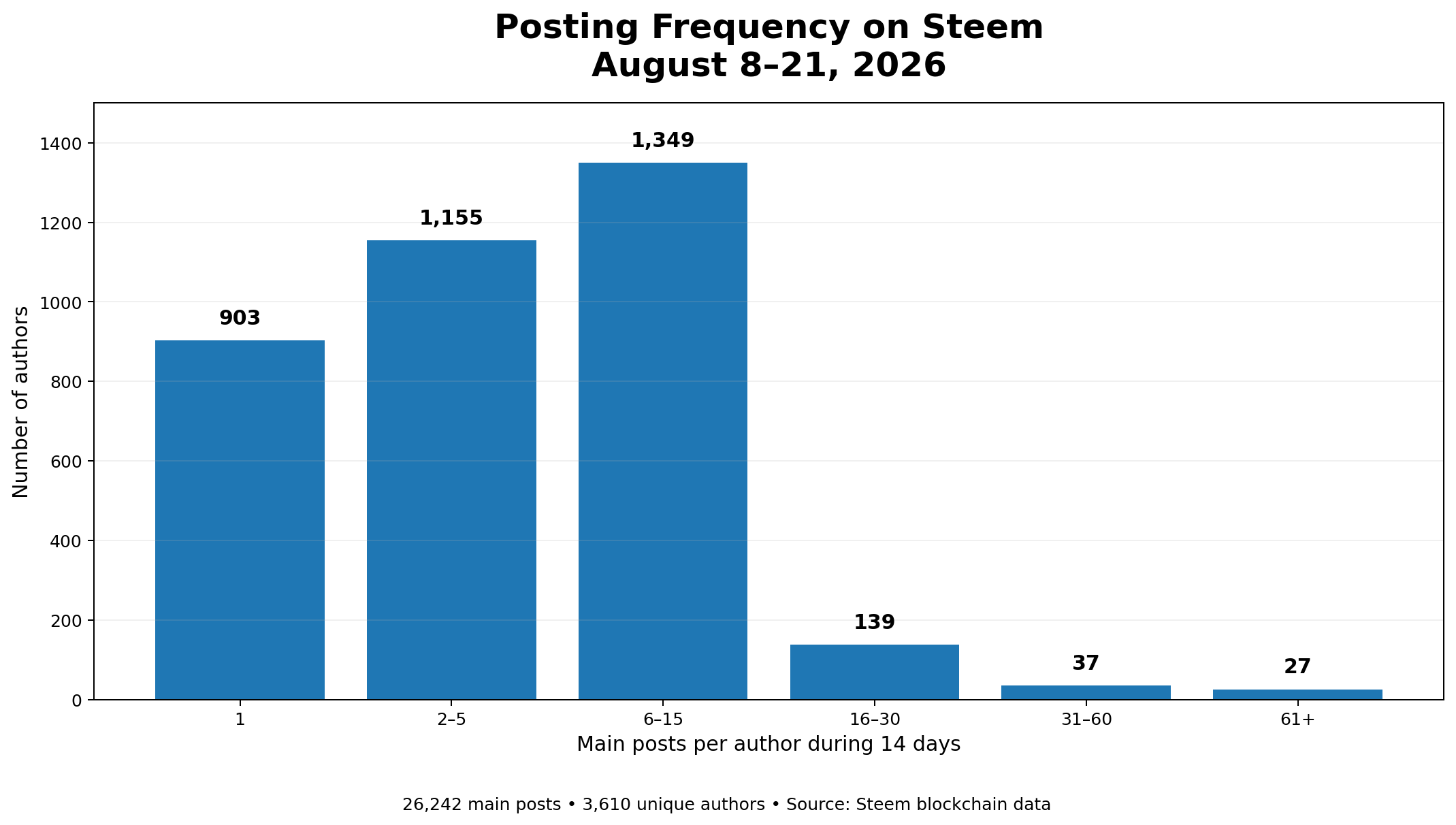
More than 2,000 authors published five posts or fewer, while only 64 accounts published more than 30 posts.
So there is clearly a relatively small group operating at a much higher posting frequency.
But does that group dominate Steem?
Posting Concentration
Ranking authors by number of main posts gives:
| Most Active Authors | Posts | Share of All Posts |
|---|---|---|
| Top 10 | 1,648 | 6.28% |
| Top 20 | 2,533 | 9.65% |
| Top 50 | 4,112 | 15.67% |
| Top 100 | 5,607 | 21.37% |
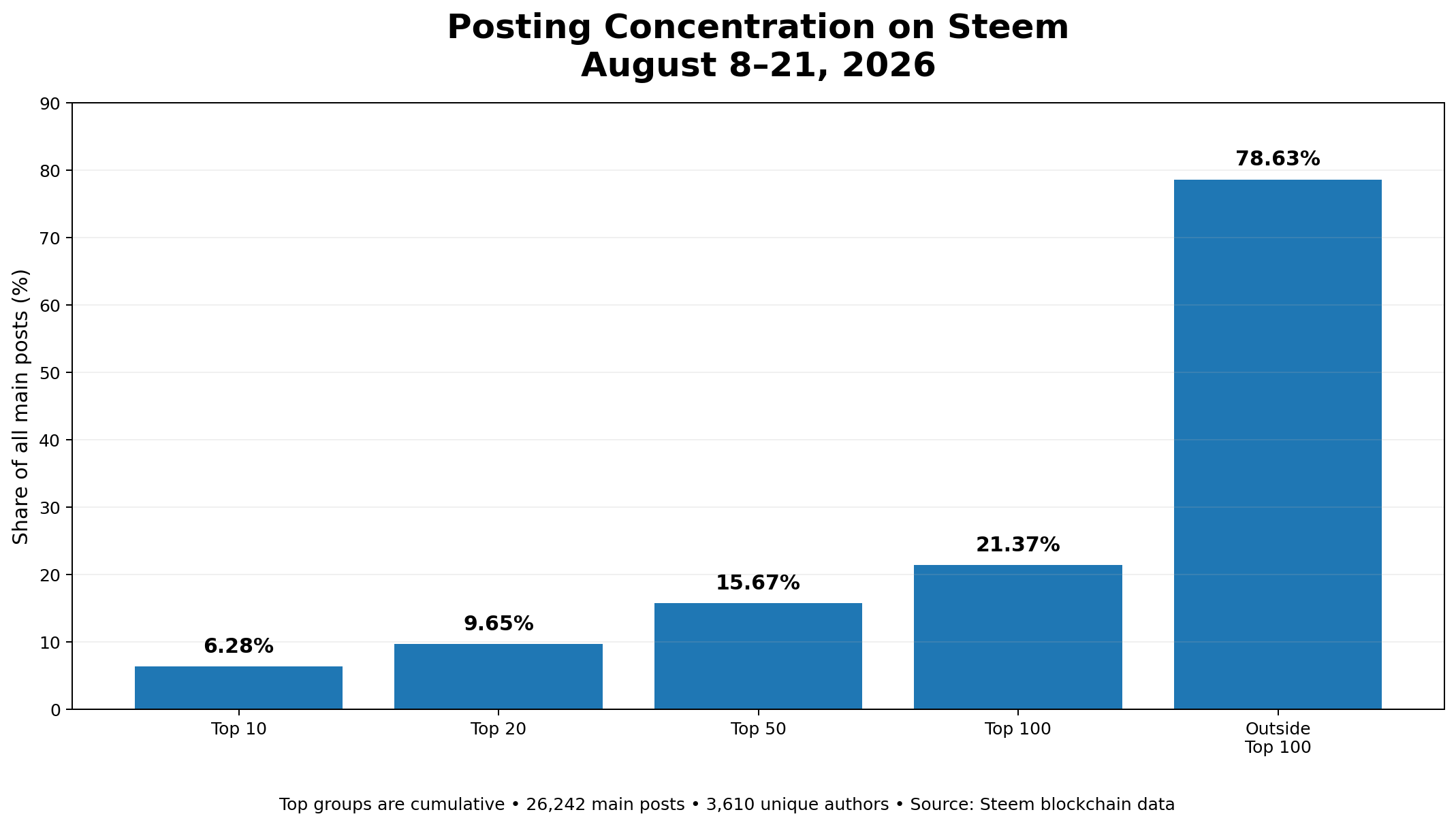
The Top 100 represented only 2.77% of all authors, yet produced 21.37% of the posts.
That is significant concentration, but it also means:
78.63% of all posts came from authors outside the Top 100.
So the data does not support the idea that a handful of accounts produce almost everything on Steem.
The Most Active Accounts
| Author | Posts | Active Days | Avg./Active Day |
|---|---|---|---|
| @web2.support | 450 | 14 | 32.14 |
| @steemburnup | 168 | 14 | 12.00 |
| @sweecee | 151 | 11 | 13.73 |
| @statsexpert | 149 | 14 | 10.64 |
| @haejin | 143 | 13 | 11.00 |
| @tworld | 139 | 14 | 9.93 |
| @abandi | 112 | 14 | 8.00 |
| @playpoker | 112 | 14 | 8.00 |
| @playhighcard | 112 | 14 | 8.00 |
| @playdice | 112 | 14 | 8.00 |
Some of these are game, service, synchronization or system-related accounts rather than ordinary content publishers.
To avoid overstating their effect, I performed a secondary analysis excluding only 15 clearly identifiable system/game accounts.
Together they produced:
1,486 posts — 5.66% of all posts
After this conservative exclusion, 24,756 posts from 3,595 accounts remained.
Posting concentration then fell to:
| Group | All Activity | After Exclusion |
|---|---|---|
| Top 10 | 6.28% | 5.57% |
| Top 20 | 9.65% | 7.90% |
| Top 50 | 15.67% | 12.74% |
| Top 100 | 21.37% | 18.18% |
System/game activity therefore affects the headline numbers, but it does not explain the broader pattern of concentrated high-frequency posting.
Sustained Activity
Frequency becomes more meaningful when we ask whether it continues day after day.
Across all authors:
- 366 were active on all 14 days
- 633 were active on at least 12 days
- 893 were active on at least 10 days
After the conservative system/game exclusion:
| Daily Posting Level | At Least Once | 10+ Days | All 14 Days |
|---|---|---|---|
| 2+ posts/day | 795 | 87 | 30 |
| 3+ posts/day | 278 | 33 | 13 |
| 4+ posts/day | 133 | 19 | 8 |
| 5+ posts/day | 72 | 6 | 4 |
So there are authors maintaining several main posts per day for almost the entire period.
The highest number recorded for a single author in one calendar day was:
39 main posts
This shows that extremely high activity exists, but frequency alone tells us nothing about whether those posts receive support or meaningful rewards.
Moving Between Communities
I also examined how authors moved between recorded Steem communities.
During the 14 days:
544 authors posted in at least two different communities
297 authors posted in multiple communities on the same day
There were 1,081 author/day instances where the same author published in more than one recorded community during a single day.
A technical limitation should be noted: not every post contained an identifiable hive-xxxxx community value, so a missing community value should not automatically be interpreted as posting outside a community.
Still, the overall pattern is clear:
Steem has a broad author base, but within it is a much smaller group publishing frequently, consistently and sometimes across several communities.
The next question is therefore more important than posting frequency itself:
Does this higher level of activity translate into more Steem Curator or Booming support?
Steem Curator and Booming Support
Of the 26,242 main posts, the support distribution was:
| Support | Posts | Share |
|---|---|---|
| Steem Curator | 2,214 | 8.44% |
| Booming | 1,750 | 6.67% |
| Both | 188 | 0.72% |
| Combined | 3,776 | 14.39% |
| Neither | 22,466 | 85.61% |
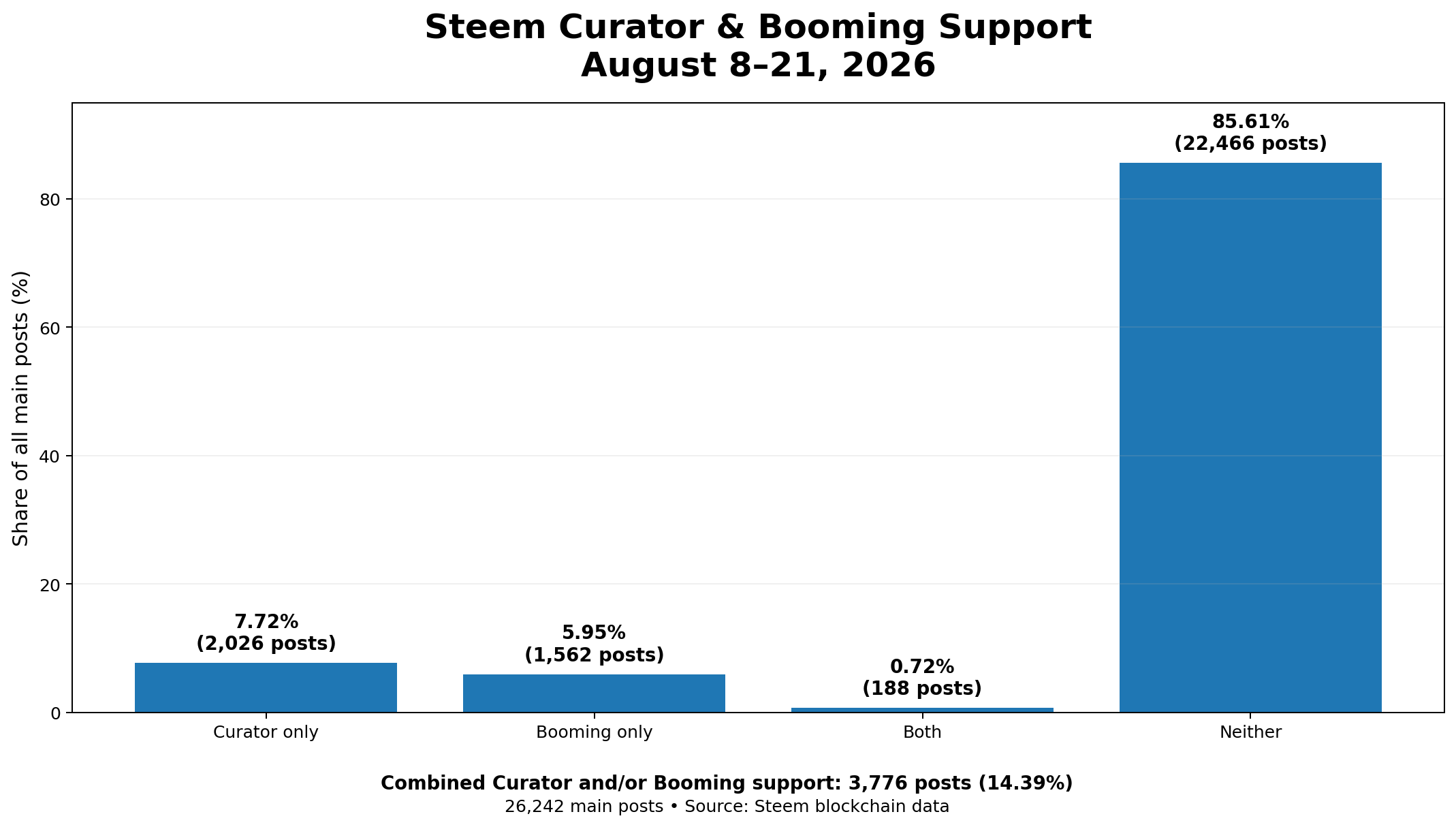
A total of 648 authors received Curator and/or Booming support on at least one main post.
The overlap between the systems was relatively small: 2,026 posts received Curator only, 1,562 Booming only, and just 188 received both.
So Curator and Booming clearly do not support exactly the same content.
Does Posting More Produce More Support?
To test this, I defined a high-frequency group after the conservative system/game exclusion:
- active on at least 10 of the 14 days
- average of at least 3 main posts per active day
This produced 34 authors with 2,586 posts.
Their Combined Curator/Booming support rate was:
14.81%
For all other authors in the non-system dataset it was:
15.30%
This is an important result.
High posting frequency alone did not increase the probability of receiving Curator/Booming support.
The interesting pattern appears within a much smaller subset of highly active authors.
High Activity Combined With Repeated Support
I then looked for authors who were active on at least 10 days, averaged at least three posts per active day, and received support on at least 10 posts.
Eight authors stood out with Combined support rates above 60%:
| Author | Posts | Communities* | Curator | Booming | Combined | Rate | Support Days |
|---|---|---|---|---|---|---|---|
| @narocky71 | 45 | 6 | 20 | 23 | 38 | 84.4% | 14/14 |
| @ride1 | 45 | 5 | 6 | 31 | 37 | 82.2% | 13/14 |
| @jamal7 | 48 | 8 | 10 | 26 | 36 | 75.0% | 14/14 |
| @jannat7 | 46 | 8 | 14 | 19 | 33 | 71.7% | 13/14 |
| @bristy1 | 42 | 6 | 5 | 26 | 30 | 71.4% | 13/14 |
| @bijoy1 | 66 | 12 | 12 | 34 | 45 | 68.2% | 14/14 |
| @limon88 | 42 | 8 | 6 | 22 | 28 | 66.7% | 14/14 |
| @tasonya | 74 | 7 | 18 | 31 | 49 | 66.2% | 14/14 |
*Recorded hive-xxxxx communities.
For six of these eight authors, support occurred on every day of the 14-day period. For the other two, it occurred on 13 of 14 days.
This shows a persistent support pattern, but it does not by itself tell us why the support occurred.
For Booming in particular, the communities turned out to be very important.
The Community Connection
Because communities nominate posts for Booming, I linked Booming-supported posts back to the communities where they were published.
One example illustrates the effect particularly well.
@jannat7 published:
23 posts in hive-174315 → 5 received Booming support
but:
11 posts in hive-113640 → all 11 received Booming support
The same author therefore had very different outcomes depending on the community.
Other examples in hive-113640 included:
- @narocky71: 14 of 14 posts received Booming
- @jamal7: 19 of 20
- @tasonya: 14 of 16
This suggests that community nomination channels are an important part of understanding repeated Booming support.
Rather than simply asking:
“Why does Booming keep supporting the same author?”
a better question is:
“How are Booming opportunities distributed within the communities?”
Booming Distribution by Community
The differences between communities were substantial.
| Community | Posts | Booming Posts | Recipients | Booming Rate | Top 5 Share |
|---|---|---|---|---|---|
| hive-188619 | 609 | 251 | 58 | 41.2% | 21.5% |
| hive-113640 | 271 | 194 | 32 | 71.6% | 42.8% |
| hive-180106 | 339 | 122 | 53 | 36.0% | 34.4% |
| hive-109690 | 346 | 113 | 26 | 32.7% | 46.9% |
| hive-179660 | 273 | 95 | 46 | 34.8% | 33.7% |
| hive-109722 | 127 | 88 | 6 | 69.3% | 88.6% |
| hive-141054 | 124 | 69 | 14 | 55.6% | 82.6% |
| hive-174315 | 234 | 63 | 19 | 26.9% | 61.9% |
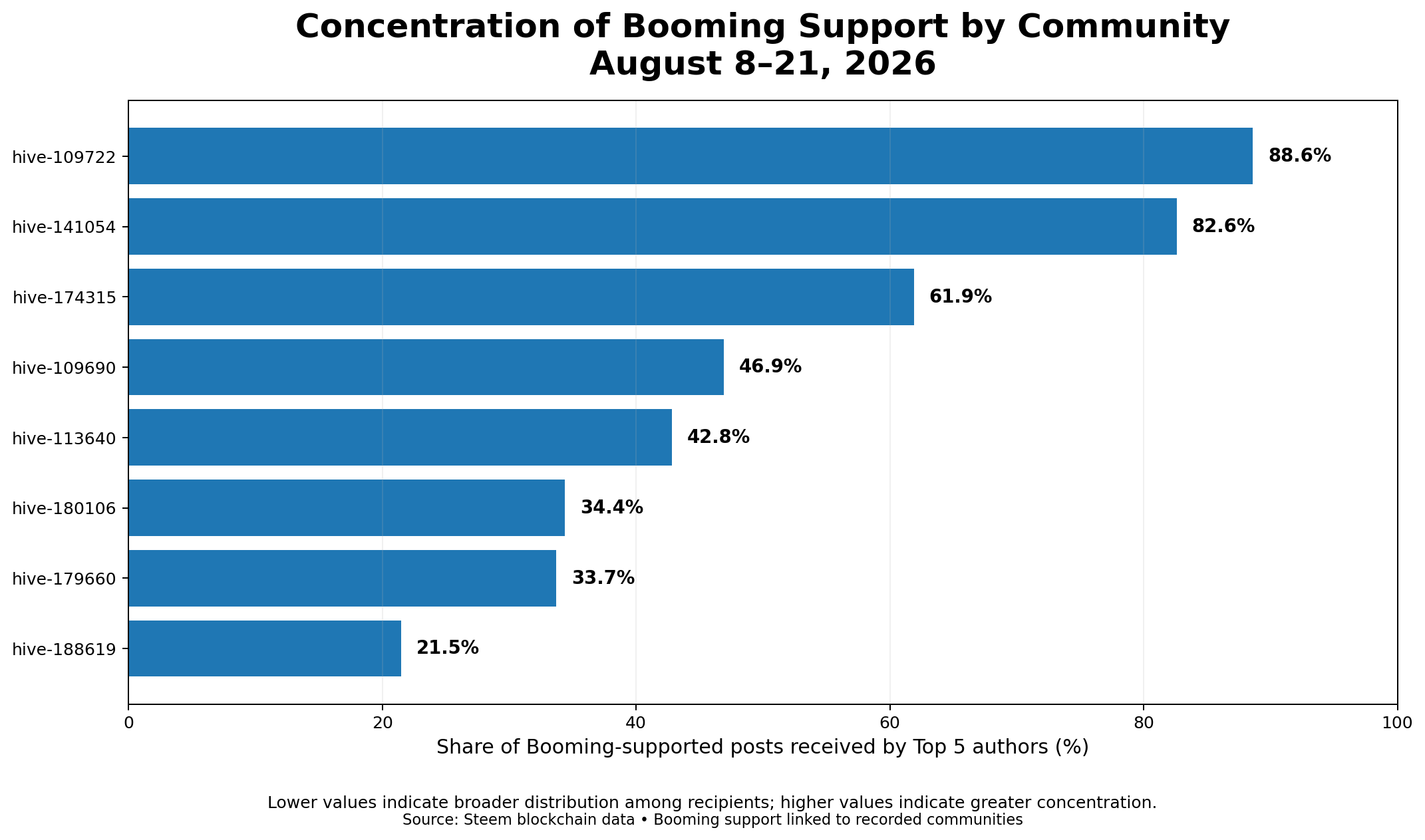
The contrast is clear.
In hive-188619, 58 authors received Booming support and the Top 5 accounted for only 21.5% of supported posts.
In hive-109722, only 6 authors received Booming support and the Top 5 accounted for 88.6%.
So communities appear to use their Booming opportunities very differently.
Some distribute them broadly, while others show much stronger concentration among recurring recipients.
This does not establish wrongdoing. The blockchain data records the resulting votes, not the complete decision-making process behind each community nomination.
It does, however, show that community-level distribution matters when evaluating Booming support.
The Same Authors Across Communities
Some authors also appeared among significant Booming recipients in more than one community.
For example, @bijoy1 appeared among the Top 10 Booming recipients in four different communities during the period, while several other authors appeared in the Top 10 in two communities.
Again, an active author can legitimately contribute good content to several communities.
But it raises an important ecosystem question:
Are limited support opportunities reaching a broad range of authors, or are some highly active users accessing several separate community nomination channels?
The blockchain can show the distribution pattern.
It cannot determine whether that distribution is fair.
And to understand how economically important these patterns are, we now need to connect them to the finalized rewards.
Where Do the Rewards Actually Go?
Posting frequency and support are only part of the picture. The next step was to examine the finalized author rewards.
Of the 26,242 main posts:
17,628 had an author_reward operation
15,951 had a positive finalized author reward
That means approximately 60.8% of all main posts generated a positive author reward.
Across the dataset, finalized author rewards totaled:
183,864.801 STEEM
319,039,619.837 VESTS ≈ 197,068 Estimated SP
As explained earlier, STEEM and Estimated SP are different assets. Where they are combined below, it is only as a comparison measure for analyzing distribution.
Posting More Does Not Necessarily Mean Earning More
Some of the most active accounts illustrate this clearly:
| Author | Posts | Approx. STEEM + Est. SP |
|---|---|---|
| @web2.support | 450 | ~0 |
| @steemburnup | 168 | ~0 |
| @sweecee | 151 | ~0 |
| @statsexpert | 149 | ~51 |
| @haejin | 143 | ~7,778 |
| @tworld | 139 | ~78 |
| @abandi | 112 | ~0 |
| @playpoker | 112 | ~196 |
| @playhighcard | 112 | ~196 |
| @playdice | 112 | ~324 |
| @netscape | 111 | ~31 |
Several accounts published more than 100 main posts but earned very little, while @haejin combined very high posting frequency with substantial rewards.
So:
More posts do not automatically mean more rewards.
Rewards Are More Concentrated Than Posting
When authors are ranked separately by finalized rewards, concentration becomes much stronger:
| Group | Share of Posts* | Share of Rewards** |
|---|---|---|
| Top 10 | 6.28% | 20.75% |
| Top 20 | 9.65% | 31.67% |
| Top 50 | 15.67% | 49.01% |
| Top 100 | 21.37% | 61.78% |
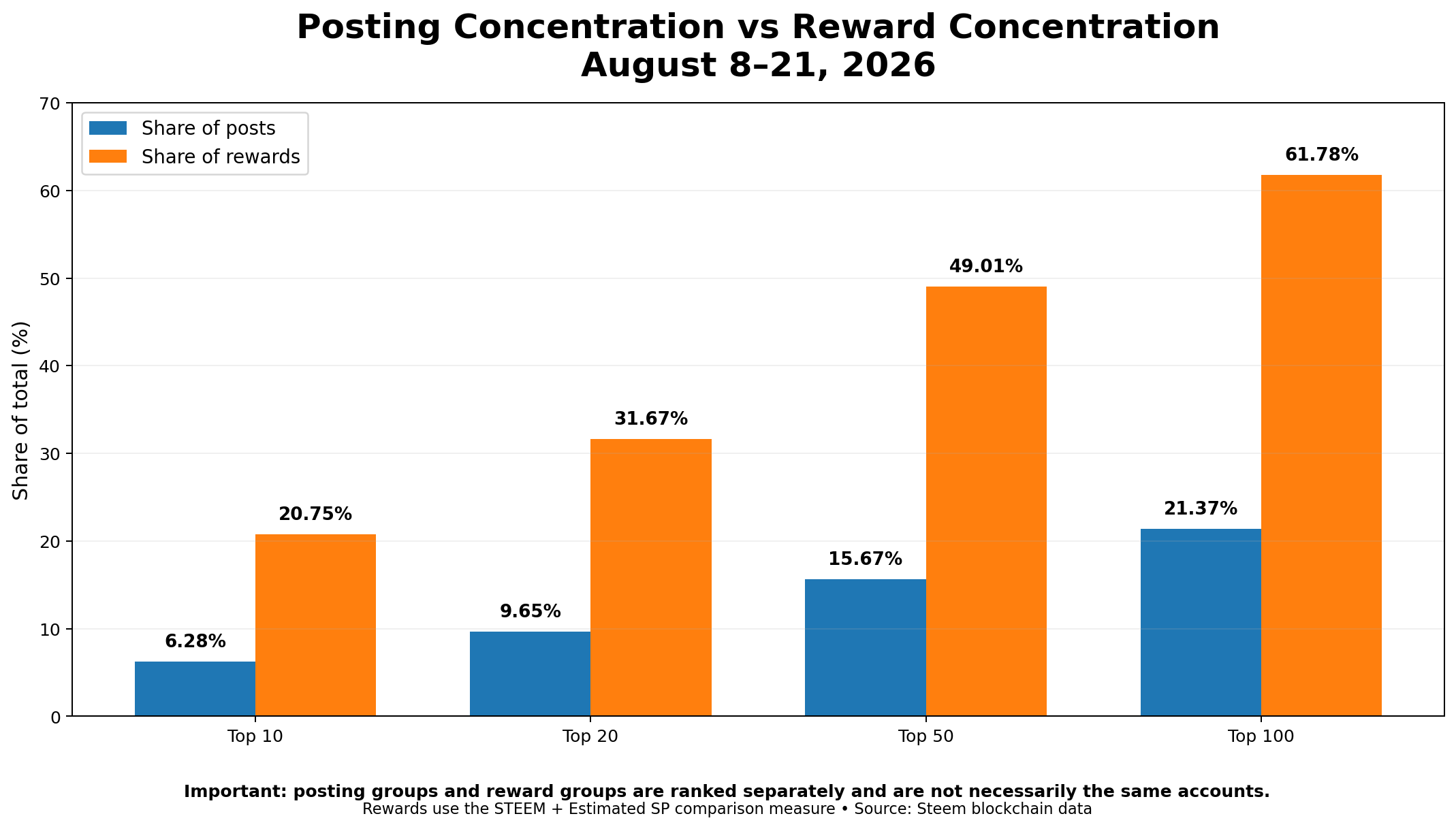
*Ranked by number of posts.
**Ranked separately by reward comparison value.
These are not necessarily the same accounts, so this is not an account-for-account comparison.
What it demonstrates is that:
Content production was much more broadly distributed than rewards.
The Largest Reward Recipients
The Top 10 authors ranked by the STEEM + Estimated SP comparison measure were:
| Author | Posts | STEEM | Est. SP | Approx. Total |
|---|---|---|---|---|
| @rme | 14 | 7,704.7 | ~7,702 | ~15,407 |
| @trafalgar | 12 | 0 | ~8,650 | ~8,650 |
| @haejin | 143 | 3,889.8 | ~3,889 | ~7,778 |
| @puss.coin | 14 | 3,842.0 | ~3,841 | ~7,683 |
| @cjsdns | 14 | 3,722.6 | ~3,722 | ~7,444 |
| @abbc-reports | 14 | 3,548.1 | ~3,547 | ~7,095 |
| @sa-reports | 14 | 3,461.0 | ~3,460 | ~6,921 |
| @boc-reports | 14 | 3,393.7 | ~3,393 | ~6,786 |
| @tfc-reports | 14 | 3,318.2 | ~3,317 | ~6,635 |
| @happycapital | 26 | 2,323.2 | ~2,323 | ~4,646 |
Interestingly:
None of these Top 10 reward recipients had a matched Curator/Booming-supported root post in this dataset.
This is important because it shows that Curator and Booming do not explain all reward concentration.
Steem is a stake-based blockchain, and large stakeholders can exercise substantial voting power independently of these support systems.
For that reason, stake-supported activity and Curator/Booming-supported activity should not automatically be treated as the same phenomenon.
What Is the Economic Effect of Support?
Curator/Booming-supported posts represented:
14.39% of all main posts
but were associated with approximately:
26.50% of the total reward comparison value
Average comparison reward per post was approximately:
Supported: 26.73
Unsupported: 12.46
Supported posts therefore averaged roughly:
2.1× the comparison reward of unsupported posts.
This is an association, not proof of causation.
A supported post may receive many other votes, and the fact that it was supported does not mean Curator/Booming supplied its entire reward.
Curator and Booming Also Look Different Economically
| Support Type | Share of Posts | Share of Rewards | Avg. Reward/Post |
|---|---|---|---|
| Curator only | 7.72% | 18.82% | ~35.38 |
| Booming only | 5.95% | 5.40% | ~13.17 |
| Both | 0.72% | 2.28% | ~46.22 |
| Neither | 85.61% | 73.50% | ~12.46 |
Booming-only posts were relatively close to unsupported posts in average comparison reward.
Curator-only posts represented 7.72% of content but 18.82% of comparison rewards.
Again, these figures describe the total author reward on supported posts, not the exact amount supplied by the Curator or Booming vote.
The Repeatedly Supported Authors
For the eight highly active authors identified earlier, finalized rewards were:
| Author | Posts | STEEM | Est. SP | Support Rate |
|---|---|---|---|---|
| @tasonya | 74 | 1,144.8 | ~1,144.5 | 66.2% |
| @bijoy1 | 66 | 588.6 | ~588.5 | 68.2% |
| @narocky71 | 45 | 371.6 | ~371.4 | 84.4% |
| @jamal7 | 48 | 369.9 | ~369.9 | 75.0% |
| @limon88 | 42 | 360.5 | ~360.4 | 66.7% |
| @jannat7 | 46 | 346.1 | ~346.0 | 71.7% |
| @bristy1 | 42 | 312.1 | ~312.0 | 71.4% |
| @ride1 | 45 | 243.2 | ~243.2 | 82.2% |
For several repeatedly supported authors, more than 90% of their finalized rewards came from posts that received at least one Curator and/or Booming vote.
Examples include:
@narocky71 — 97.4%
@fasoniya — 96.8%
@bdwomen — 96.1%
@ride1 — 95.7%
@ahp93 — 95.6%
@jannat7 — 94.9%
@jamal7 — 92.2%
@limon88 — 91.2%
This does not mean Curator/Booming supplied those percentages of the rewards.
It means those percentages were earned on posts that happened to receive such support.
Nevertheless, it shows that supported posts were economically very important for some authors during the study period.
High Frequency Alone Was Not the Key
The broader high-frequency group produced 2,586 posts, but received support on only 14.81% of them — almost identical to the rest of the non-system dataset.
Their reward share was also far from dominant.
So the data does not support a simple strategy of:
“Post as much as possible and collect the rewards.”
The stronger pattern appears only when high activity, community participation and repeated support occur together.
Before drawing the final conclusions, I also examined one smaller reward-related behavior:
Self-Comments and Self-Voting
I also examined direct comments authors made under their own main posts.
A self-comment is not unusual. Authors may add information, updates or links, and a self-vote does not by itself prove reward-seeking behavior.
During the 14-day period I identified:
1,628 direct self-comments from 150 authors
Of these:
196 were self-voted — about 12%
The analysis covers direct self-comments under the author's own root post, not normal replies to other users in a discussion.
Finalized Rewards
Of the 1,628 direct self-comments:
- 258 generated a positive finalized author reward
- Total rewards: 686.492 STEEM + ~686.36 Estimated SP
- 179 rewarded comments were self-voted
- Self-voted rewarded comments generated 66.423 STEEM + ~66.48 Estimated SP
Although 69.4% of the rewarded direct self-comments were self-voted, they accounted for only about 9.7% of the liquid STEEM reward in this self-comment dataset.
The 69.4% figure applies only to the rewarded direct self-comments analyzed here — not to Steem comments in general.
Frequency Is Not the Same as Economic Impact
Two accounts illustrate this well.
@thoth.test made 140 direct self-comments, self-voted all 140, and 138 generated a positive reward. Yet the total was only about:
0.224 STEEM + 0.28 Estimated SP
By comparison, @graphene-faucet made 44 direct self-comments, self-voted 42, and those 42 generated approximately:
65.518 STEEM + 65.52 Estimated SP
So counting self-votes alone can be misleading.
The meaningful measurements are:
frequency, self-voting rate, and actual finalized reward.
I also appeared in this dataset. @xpilar had 9 direct self-comments, one self-voted, and two rewarded.
That is another reason I do not consider the existence of a self-vote alone to be evidence of improper behavior.
The blockchain records actions, but it cannot establish the intention behind them.
Overall, direct self-comment voting does not appear to be a major explanation for the broader reward concentration found in this study.
What Does All This Tell Us?
We can now return to the question that started this investigation.
I suspected that some of the same users were posting continuously across communities while repeatedly receiving support and rewards.
After analyzing 26,242 main posts, 3,610 authors, community activity, Curator and Booming support, finalized rewards and self-comments, the answer is more nuanced than I expected.
My original impression was partly correct — but the data also challenged some of my assumptions.
Findings and Conclusion
The data both confirmed and challenged my original impression.
There is a relatively small group of users publishing at a very high frequency, often every day and sometimes across several communities.
There is also a smaller subset combining high activity with repeated Curator and/or Booming support, in some cases on 13 or 14 of the 14 days studied.
But the broader claim that “the same people post all day and take all the rewards” is not supported by the data.
78.63% of all main posts came from authors outside the Top 100 most active accounts.
And high-frequency authors as a group had a Curator/Booming support rate of 14.81%, compared with 15.30% for the rest of the non-system dataset.
Simply posting more did not result in a higher support rate.
The Community Question
One of the most important discoveries was the role of communities in Booming support.
Because communities nominate posts for Booming, repeated Booming votes should not simply be interpreted as Booming independently choosing the same authors.
The community analysis showed very different distribution patterns.
In one community, the Top 5 recipients accounted for only 21.5% of Booming-supported posts.
In another, the Top 5 accounted for 88.6%.
This shifts the question from:
“Who is Booming supporting?”
toward:
“How broadly are communities distributing their nomination opportunities?”
Some authors also appeared among significant Booming recipients across multiple communities. That is not evidence of wrongdoing, but it raises a legitimate question about whether limited support opportunities are reaching a broad enough range of contributors.
Rewards Tell a Different Story
Content production was relatively broad.
Rewards were much more concentrated.
The Top 100 authors ranked by posting activity produced 21.37% of all posts, while the Top 100 ranked separately by reward received 61.78% of the reward comparison value.
But Curator and Booming do not explain all of that concentration.
In fact, none of the Top 10 reward recipients had a matched Curator/Booming-supported root post in this dataset.
Stake is clearly a major part of the Steem reward economy.
At the same time, Curator/Booming-supported posts represented only 14.39% of all main posts, but were associated with 26.50% of the reward comparison value.
So access to support can be economically important, even though the data cannot tell us how much of each post's total reward was caused specifically by those votes.
Was My Original Suspicion Correct?
My answer is:
Partly.
The data confirms that some users publish systematically across multiple communities and receive support repeatedly.
It also confirms that some communities concentrate a large proportion of their Booming-supported posts among recurring recipients.
But it does not show that a small group produces most Steem content.
It does not show that posting frequently automatically produces more support.
And it does not show that Curator/Booming is responsible for all reward concentration.
The reality is more complicated.
The Bigger Question
For me, the most important question after completing this analysis is not whether somebody posts “too much” or earns “too much.”
It is:
How widely are opportunities distributed?
When curation and nomination resources are limited, are new authors regularly being discovered?
Do communities rotate support among contributors?
Can somebody new to Steem realistically become noticed and supported?
Or do support opportunities gradually circulate among people who already understand how to access several communities and support channels?
These are questions the blockchain data can help us ask.
But the numbers alone cannot decide what the Steem community considers fair.
A 14-Day Snapshot
This analysis covers only August 8–21, 2026.
Fourteen days are enough to identify patterns, but not enough to claim that those patterns remain unchanged throughout the year.
It would be interesting to repeat the same analysis over several months and see whether the same authors, communities and support patterns continue.
Why I Published This
My intention is not to attack authors, communities or curators.
I have been part of Steem for many years, and I want Steem to succeed.
That is also why I believe we should be able to look critically at our own ecosystem.
The blockchain is public. Instead of relying only on impressions, we can examine the data and discuss what it actually shows.
People may interpret these results differently.
That is fine.
A healthy community should be able to ask difficult questions without automatically treating the questions themselves as an attack.
Final Thought
Earning rewards is not the problem.
Being highly active is not the problem.
Receiving repeated support is not automatically a problem either.
The important question is whether the ecosystem remains open enough that many people have a realistic opportunity to participate, contribute, be discovered and eventually receive support.
Because in the long run, Steem does not grow by circulating attention among the same people.
It grows when new people see a reason to become part of it.
Data period: August 8–21, 2026
Main posts analyzed: 26,242
Unique authors: 3,610
Data & Tools: Steem blockchain data, SteemWorld.org and Steem Blockchain Data Services (SDS).
Special thanks to @steemchiller — SteemWorld.org, Built with ♥


xpilar.witness
Voting for me:
https://steemit.com/~witnesses type in xpilar.witness and click VOTE

Personally, I think one of the most useful metrics we could track would be, "payout per feed placement" and "payout per active feed placement".
If the blockchain is paying for attention, then feed placement count seems like a good place to see if it's "getting its money's worth".
As with any metric, I'm sure there would be some nuance, but if curators wanted to start regulating quality, I think lists of posts with high payouts and low feed placement counts would probably be a good place to start looking.
I keep thinking that one of these days, I'm going to write up some sort of reporting on these metrics and see what it turns up, but so far I haven't gotten to it.
Interesting to see @thoth.test showing up in your reporting. I'm the one who developed it. The account flips the curation model upside down, keeping the curation rewards from its own posts but sending all author rewards out to beneficiary accounts so that authors can continue receiving rewards from their posts after payout time and delegators can get passive rewards without a need for daily posting. I'm not sure why it sometimes receives small author rewards from its posts. Some sort of rounding gaps in the blockchain at payout time, I guess.
Thank you @remlaps. The idea of measuring payout per active feed placement is very interesting. It would approach the reward system from a completely different angle — looking not only at who receives rewards, but also at the potential audience and attention generated by those rewards. This could definitely be worth investigating in a future analysis.
Regarding @thoth.test, now that you mention it, I remember the project and how it works. I had simply forgotten about it when doing this analysis. That also explains very well why the account showed such a high number of self-comments and self-votes while the actual author rewards were extremely small.
Thanks for the reminder and for adding another interesting perspective to the discussion.
Greetings, friend @xpilar.
Interesting report on the Steemcurator and Booming support system, which highlights some aspects that should be taken into consideration.
It's important to try to broaden the reach of curation programs as much as possible, provided that users adhere to the Steemiblog team's conditions, such as: not having power-down enabled, not being a bot system, not supporting AI-generated content, among others.
Now, regarding the point raised by @alejos7ven, last month there were two active Booming accounts supporting games, and one Booming account supporting posts about Steem Atlas. This attracts versatile users who want to publish on these topics to increase their chances of earning rewards. Given the limited number of posts, some curators feel obligated to support them continuously, although not with the same percentage of votes. See the following example.
It can be seen that the user received four "booming" votes in a single day, but from three different curation teams. This could be considered efficient from the user's perspective, but deficient from a community standpoint.
One step forward that has been achieved is the unification of curation programs by topic, especially in the Steem gaming field. This means that only one curator account would be needed to cover the support of the entire community participating in that topic. In other words, curators would have a larger number of users to support them during a given period, and distribute them more effectively.
Thanks to this new support method, we can see that during this period, only two of the users who received the most support remained in the top rankings, but their number of votes decreased by one per day.
It is important to emphasize that as a curator, users should not be omitted simply because they have participated consistently, as long as they maintain an acceptable level of quality in their posts. However, efforts should be made to reach more users.
We hope more users will participate in the activities, so that we can have more options in the selection of content.
I admire this great work, thank you for it.
Thank you @adeljose for the clarification and the examples.
This helps me better understand how the Booming system is working now and also explains some of the patterns I found in the data. My understanding of the community nomination system was outdated.
I also agree that active users should not be excluded simply because they post frequently, as long as the content meets the required quality. The important thing is to give as many users as possible an opportunity to receive support.
Thanks again for adding this valuable information to the discussion.
Hi @xpilar,
A fairly complete report, thank you for taking the time to share all this information with us.
I would like to remind you of something, you mention that booming accounts work with communities, but this stopped being so a few months ago and now they are working like small steemcurator accounts. This is why you see some discord in the number of votes distributed by communities, and by authors, usually these authors who have received many votes from Booming is because they publish many times in steem atlas and speak on steem, projects that generally have the support of Booming
Without a doubt, many authors publish repeatedly in the day, trying to get the greatest possible reward, curiously, the lower price of the STEEM generates the opposite effect, instead of reducing the publications, increases them, but from the same users, trying to match the rewards they obtained before.
Cheers!
Hi @alejos7ven,
Thank you. This is actually a very important clarification.
My understanding during the analysis was that Booming was still operating through community nominations. If that system was changed a few months ago and the Booming accounts are now operating more like smaller Steem Curator accounts, then part of my interpretation of the community data needs to be corrected.
The blockchain numbers themselves would remain the same — the votes, authors and communities are still what the data shows — but the explanation for why those votes were distributed that way could be different.
Your point about Steem Atlas and Speak on Steem is particularly interesting. It may explain some of the repeated Booming support I found, and I would like to investigate that further.
If you have a link to the announcement or guidelines explaining when and how the Booming system changed, please send it to me. I would like to verify it and, if necessary, add a correction/update to the report.
Your observation about the STEEM price is also interesting. A lower STEEM price potentially leading some existing users to publish more in an attempt to maintain their previous reward level would be worth testing with blockchain data over a longer period.
Thanks for pointing this out. This is exactly the kind of discussion I hoped the report would generate.