A2 Milk Market Size, Share and Growth Forecast 2026-2034
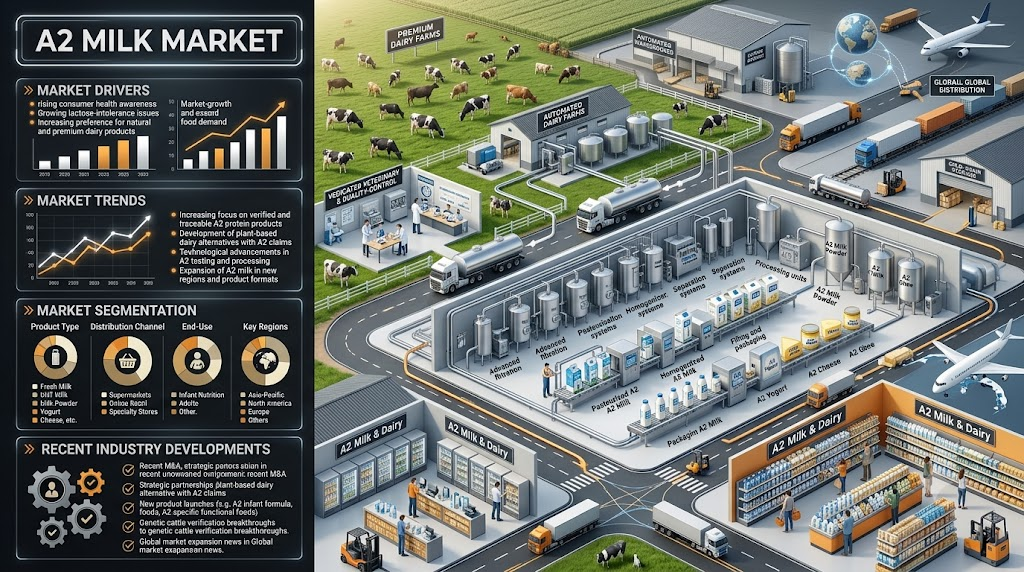
IMARC Group, a leading global market research and management consulting firm, has published its latest market intelligence report on the A2 Milk Market. The global A2 milk market size was valued at USD 17.6 Billion in 2025. It is projected to reach USD 59.5 Billion by 2034, expanding at a CAGR of 13.77% during the forecast period (2026-2034). Growth is being driven by rising consumer awareness of digestive health benefits, growing global prevalence of lactose intolerance, rapid diversification into infant formula, yogurt, cheese and ghee, and expanding e-commerce and specialty retail distribution.
A2 milk has moved from a niche health product into a mainstream premium dairy category within roughly a decade, and that shift shows no sign of slowing. The category's structural tailwinds, gut health awareness, clean-label demand, and the premiumization of everyday dairy, are proving durable rather than cyclical. Infant formula is emerging as the highest-value growth engine, supported by parental preference for A2 beta-casein's gentler protein profile, while liquid milk continues to anchor volumes through daily household consumption. Regional dynamics are shifting too: Oceania's export-led leadership is being challenged by Asia's fast-rising demand base, particularly in China and India, where indigenous A2 breed programs and premium dairy consumption are accelerating in tandem.
A2 Milk Market at a Glance:
- Market Size (2025): USD 17.6 Billion
- Forecast Market Size (2034): USD 59.5 Billion
- CAGR (2026-2034): 13.77%
- Leading End-Use Segment: Liquid Milk, holding 72.2% share (2025)
- Leading Distribution Channel: Supermarkets and Hypermarkets, holding 45.9% share (2025)
- Leading Region: Oceania, holding 30.2% revenue share (2025)
How AI is Reshaping the Future of the A2 Milk Market
- Genomic Herd Identification: DNA-based genomic testing now screens for the A2/A2 beta-casein genotype with accuracy exceeding 99.5%, with the cost of genotyping falling from about USD 80 per animal in 2018 to below USD 15 in 2024, accelerating the pace at which conventional herds convert to certified A2 pools.
- Precision Health Monitoring: Automated milking systems fitted with AI-linked protein composition sensors now track A2 output at the individual cow level, cutting manual testing costs by 60 to 70%. The broader AI-in-precision-livestock market itself is projected to grow from roughly USD 2.7 Billion in 2025 to USD 3.45 Billion in 2026, a 27.9% jump, underscoring how fast this tooling is being adopted across dairy operations.
- Farmer-Facing Decision Support: Natural-language, conversational herd management interfaces, such as the Herdi platform from Herdwatch, are being positioned in 2026 as tools that let farmers query farm data directly rather than parse multiple dashboards, a shift expected to particularly benefit smaller A2 dairy operations first.
Grab a sample PDF of this report: https://www.imarcgroup.com/a2-milk-market/requestsample
A2 Milk Market Trends and Drivers:
Lactose intolerance prevalence remains the category's core demand anchor. According to the National Institutes of Health, roughly 68% of the global adult population experiences some degree of lactose malabsorption, and the condition affects an estimated 50 to 80% of South Americans and 60 to 80% of Ashkenazi Jewish and Western African populations. A2 milk's positioning as an easier-to-digest alternative is driving measurable category switching, and product diversification beyond liquid formats into infant formula, yogurt, cheese and butter is widening the addressable market by an estimated 40 to 50%.
A second structural driver is regulatory and scientific validation. Global infant formula standards continue to tighten: China's State Administration for Market Regulation published new GB 25596-2025 requirements in March 2025, with production compliance mandatory from March 2027, raising the bar for A2 formula makers targeting the Chinese market. In parallel, more than 42 peer-reviewed clinical studies on A2 beta-casein were published between 2022 and 2024, supporting formal health-claim approvals in Australia, New Zealand and South Korea, an evidence base that is increasingly shaping how the category is regulated worldwide.
A third driver, and one that sets up the regulatory picture below, is the widening gap between where A2 supply is concentrated and where demand is growing fastest. Certifying a dairy herd as A2-only takes up to ten years, creating a persistent supply constraint even as Asia-Pacific demand accelerates, which is pulling policymakers in producing and consuming markets alike toward schemes that either expand certified herds or manage import and labeling frameworks.
Global Regulatory, Trade, and Sustainability Landscape Shaping Demand:
- China's GB 25596-2025 Standard: Published March 27, 2025, this national food safety standard tightens essential and optional nutrient requirements for infant formula; full production compliance is mandatory from March 16, 2027, directly affecting A2-based infant formula recipe registrations.
- EU Packaging and Packaging Waste Regulation (PPWR): Dairy trade bodies including the European Dairy Association are actively working through secondary legislation on the PPWR in 2026, a rule set reshaping packaging compliance costs across the EU dairy sector.
- EU Farm to Fork Strategy: Continues to shape dairy sustainability expectations under the European Green Deal, with USDA analysis noting EU cow milk production has declined by more than 800,000 head of cattle since 2019 amid environmental conditionality tied to the Common Agricultural Policy.
- US FDA and Dietary Guidance Shifts: The Whole Milk for Healthy Kids Act of 2025 and updated 2025-2030 Dietary Guidelines for Americans are actively reshaping US dairy demand policy, a shift The a2 Milk Company itself has flagged as a category expansion opportunity.
- Divergent National A2 Claim Frameworks: FSANZ (Australia/New Zealand), the US FDA, and India's FSSAI maintain differing requirements for A2 protein health claims, adding compliance complexity for brands operating across all three markets simultaneously.
Key Government Schemes and Policy Programs Supporting the Industry:
- India, Production Linked Incentive Scheme for Food Processing (PLISFPI): A Rs. 10,900 crore (approximately USD 1.49 Billion) outlay running FY2021-22 through FY2026-27, covering 128 participating companies and 165 applications, including dairy value-added products such as mozzarella cheese; the scheme is projected to generate processed food output worth Rs. 334.94 Billion in its sixth year.
- India, Animal Husbandry Infrastructure Development Fund (AHIDF): A Rs. 15,000 crore (about USD 2 Billion) fund approved by India's Cabinet Committee on Economic Affairs to incentivize private investment in dairy processing and value-addition infrastructure, with a 3% government interest subvention for eligible borrowers.
- United States, Dairy Business Innovation Initiatives (DBI): USDA awarded more than USD 11 Million in January 2026 to four regional DBI centers (California State University Fresno, University of Tennessee, Vermont Agency of Agriculture, and University of Wisconsin) to fund technical assistance and subawards for small and mid-sized dairy businesses, on top of USDA's USD 46 Million AMP-program award to support small dairy farms in February 2026.
- European Union, Packaging and Packaging Waste Regulation compliance support: EU dairy federations are working with packaging partners such as Tetra Pak through 2026 on secondary legislation guidance to help dairy processors meet new PPWR packaging requirements without disrupting export-oriented supply chains.
- China, tightened GB infant formula recipe registration (GB 25596-2025): While not a subsidy scheme, this regulatory registration requirement functions as a de facto market-access program, with over 290 infant formula recipes already re-registered under the prior GB standard cycle, a compliance bar A2 formula importers must clear to retain Chinese shelf access.
A2 Milk Market Industry Segmentation:
By End-Use:
- Liquid Milk (dominant, 72.2% share in 2025, driven by universal household consumption)
- Infant Formula (20.4% share in 2025, the highest unit-value segment)
- Others (yogurt, cheese, butter, and ghee)
By Distribution Channel:
- Supermarkets and Hypermarkets (leading, 45.9% share in 2025)
- Convenience and Grocery Stores (24.6% share)
- Online/Non-store Retailing (fastest-growing, estimated CAGR of 18.2% through 2034)
- Others
By Region:
- Oceania (leading, 30.2% share in 2025, anchored by New Zealand and Australia's A2 breeding infrastructure)
- North America (26.4% share)
- Asia (22.8% share, fastest-growing at an estimated CAGR of 15.8%)
- Europe (14.2% share)
- Others, including Latin America and the Middle East and Africa (6.4% share)
Competitive Landscape:
The global A2 milk market features a mix of global pioneers, national dairy cooperatives, and regional specialists, including The a2 Milk Company Limited, Bega Dairy & Drinks, Lactalis Group, Gujarat Cooperative Milk Marketing Federation (Amul), Noumi Limited, Organic Valley, and Provilac Dairy Farms.
The a2 Milk Company, headquartered in Auckland, reported FY26 group revenue of approximately NZD 1.97 Billion, up more than 12% year-over-year, even as its China-label infant formula sales dipped around 14% due to a fourth-quarter supply chain disruption. Lactalis Group, the world's largest dairy company by revenue, completed a NZD 4.2 Billion acquisition of Fonterra's global consumer and associated businesses on March 31, 2026, integrating 16 manufacturing sites and roughly 4,300 employees across Oceania, Sri Lanka and the Middle East and Africa.
Market Concentration Analysis:
- The a2 Milk Company holds an estimated 35 to 40% global market share (2025) as the category's creator and clear brand leader, while the top four players together account for roughly 52 to 58% of global revenues.
- Regional fragmentation remains pronounced in India, where hundreds of indigenous-breed A2 dairy farms, such as Akshayakalpa and Pride of Cows, operate under regional brands without global scale.
- Consolidation is accelerating through M&A, exemplified by Lactalis's NZD 4.2 Billion Fonterra consumer business acquisition, and is expected to lift top-four market share to approximately 62 to 68% by 2030.
What Does The Full Report Cover?
- Historical performance and future outlook of the global A2 milk market from 2020 to 2034
- Detailed segmentation by end-use, distribution channel, and region
- Competitive landscape mapping of leading and emerging A2 milk companies
- Porter's Five Forces analysis of competitive intensity, supplier power, and buyer power
- Regulatory and trade landscape across major consuming and producing regions
- Technology and value chain analysis, including genomic testing and cold-chain logistics
- Research methodology, forecasting assumptions, and data triangulation approach
Recent News and Developments in A2 Milk Market
- March 2026: Lactalis Group completed its NZD 4.2 Billion acquisition of Fonterra's global consumer and associated businesses, integrating 16 manufacturing sites and about 4,300 employees across Oceania, Sri Lanka, and the Middle East and Africa.
- February 2026: The a2 Milk Company reported 1H26 revenue growth led by 29% growth in the US and 20.3% in China and Asia, with net profit after tax rising 9.4% to NZD 112.1 Million.
- January 2026: USDA awarded more than USD 11 Million in Dairy Business Innovation Initiatives grants to four regional US dairy centers to support small and mid-sized dairy processors.
- February 2026: USDA's AMP program awarded USD 46 Million in grant funds to support Dairy Farmers of America's small dairy farms with conservation-focused improvements.
- August 2026: The a2 Milk Company posted FY26 group revenue of approximately NZD 1.97 Billion, up over 12% year-over-year, with Other Nutritionals growth of 42% driven by kids, seniors and UHT product innovation.
- March 2025: China's SAMR published the new GB 25596-2025 national food safety standard for infant formula, tightening nutrient requirements ahead of a March 2027 compliance deadline that will affect A2 formula recipe registrations.
Note: If you require specific details, data, or insights that are not currently included in the scope of this report, we are happy to accommodate your request. As part of our customization service, we will gather and provide the additional information you need, tailored to your specific requirements. Please let us know your exact needs, and we will ensure the report is updated accordingly to meet your expectations.
Key Questions This Report Answers:
- What is the current size and forecast value of the global A2 milk market?
- What is driving the market's projected 13.77% CAGR through 2034?
- Which end-use segment and distribution channel lead the market today?
- Which region currently dominates, and which region is growing fastest?
- Who are the leading companies competing in the global A2 milk market?
- How concentrated is the competitive landscape, and how is M&A reshaping it?
- What regulatory and trade factors are shaping A2 milk demand across regions?
About Us
IMARC Group is a global management consulting firm that helps the world's most ambitious changemakers to create a lasting impact. The company provides a comprehensive suite of market entry and expansion services. IMARC offerings include thorough market assessment, feasibility studies, company incorporation assistance, factory setup support, regulatory approvals and licensing navigation, branding, marketing and sales strategies, competitive landscape and benchmarking analyses, pricing and cost research, and procurement research.
Media and Sales Contact
IMARC Group
Email: sales@imarcgroup.com
United States: +1-201-971-6302
India: +91-120-433-0800
United Kingdom: +44-753-714-6104