Why Transparent Transaction Records Make Account Activity Easier to Review
Why Transparent Transaction Records Make Account Activity Easier to Review
A useful history should help a user reconstruct what happened without forcing them to guess.
A transaction history can look like a simple list of amounts and dates, but on any digital account it serves a more important purpose: it is an audit trail. When payments, credits, reversals, refunds, adjustments, or other balance-changing events occur, the history should help the account holder understand what happened, when it happened, how much was involved, what status the event reached, and which reference can be used if follow-up is needed.
Information resources such as MyTablePlus account-information hub can be discussed in this broader account-review context without assuming that every interface exposes the same fields. The useful question is not merely whether a history page exists, but whether its records are detailed enough to support verification, comparison, and investigation.
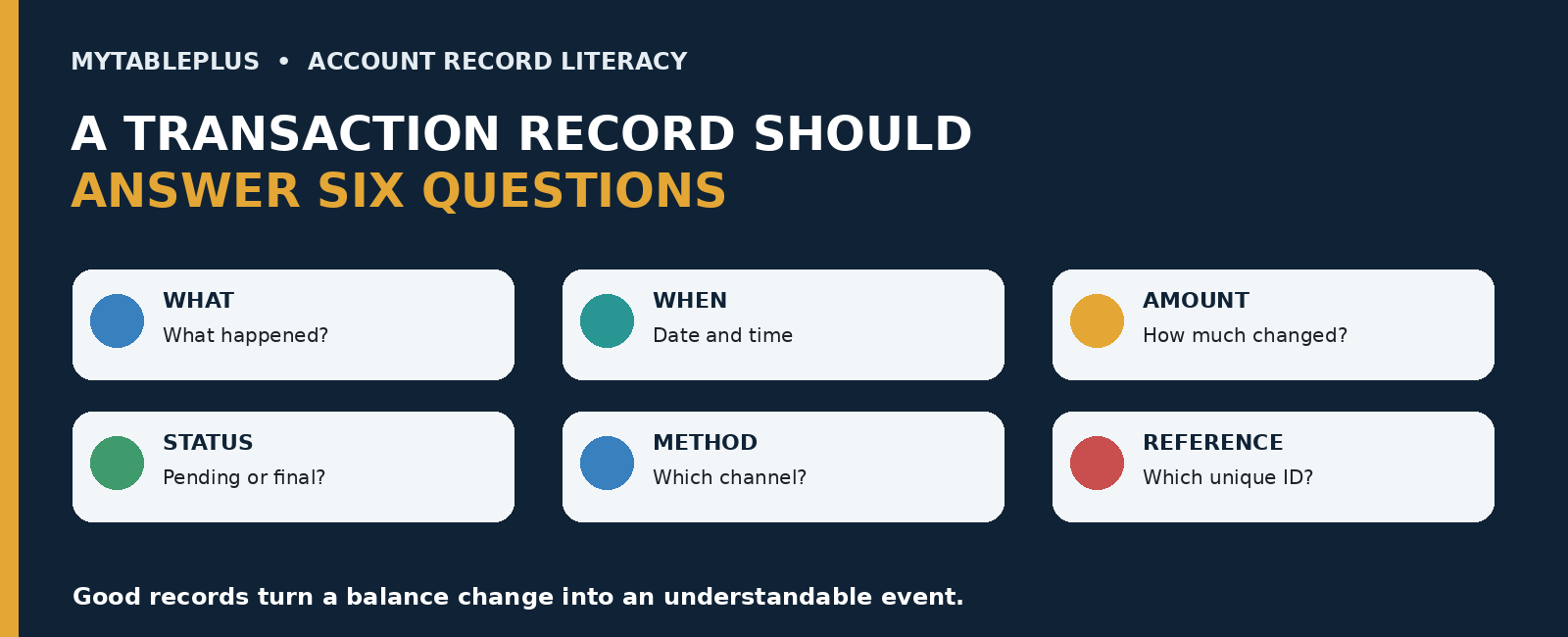
A transaction history should explain events, not just display them
An entry such as “-500” tells a user very little. Was it a completed payment, a pending request, a reversal, a fee, or an adjustment? Clear records reduce that ambiguity by pairing the amount with descriptive context.
Six fields usually do most of the work: event type, date and time, amount, status, method or channel, and a unique reference identifier. The goal is not to expose every internal system field. It is to show enough information for the account holder to reconstruct the event later.
That idea mirrors the purpose of audit records in security practice. NIST describes audit records as information that can support monitoring, analysis, investigation, and reporting. A user-facing history is more valuable when each row can be interpreted after the fact.
Timestamps turn isolated entries into a sequence
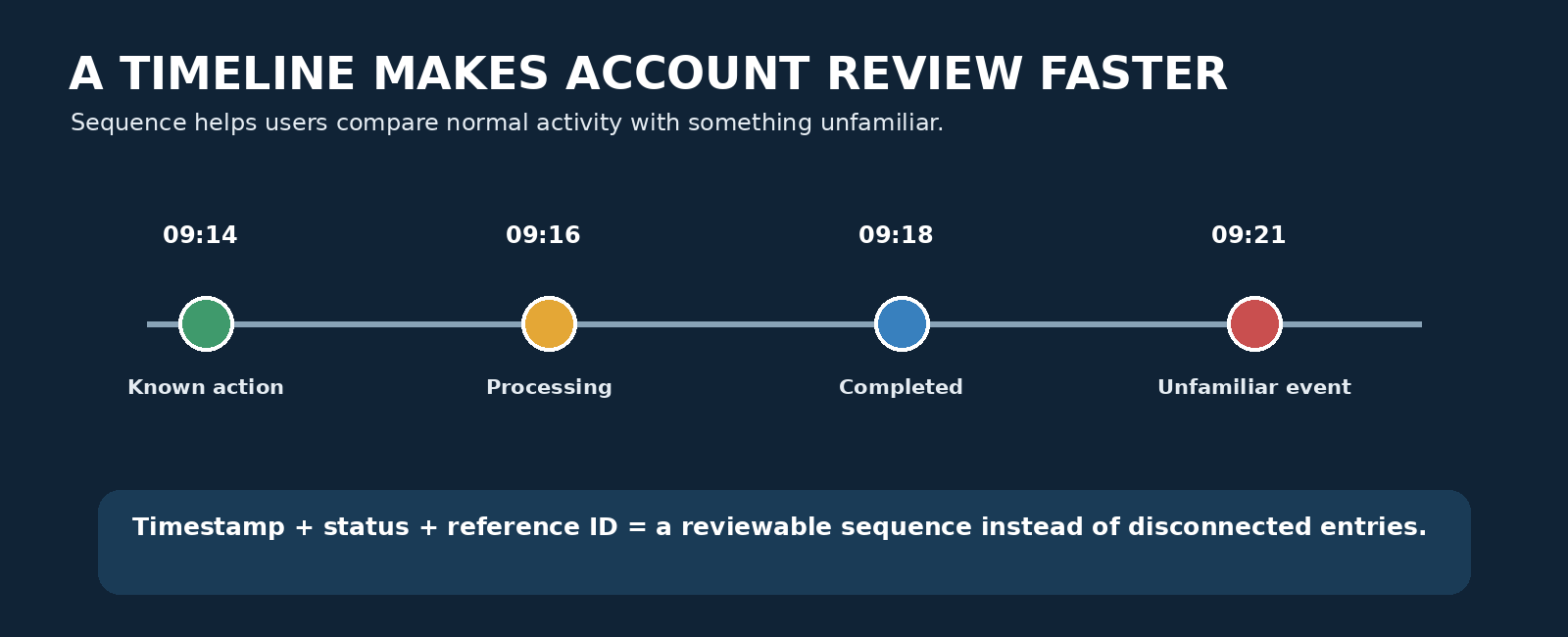
Time becomes especially useful when several events need to be compared. A timestamp can show whether a reversal followed an earlier charge, whether two actions happened only minutes apart, or whether an unfamiliar event appeared while the account holder was inactive.
The displayed time should also be consistent. If an interface uses local time, that convention should be clear. A review becomes harder when users have to guess whether two dates came from different time zones.
Chronology turns disconnected entries into a story. It lets a user compare what the system recorded with what they remember doing.
Status labels must distinguish incomplete and final outcomes
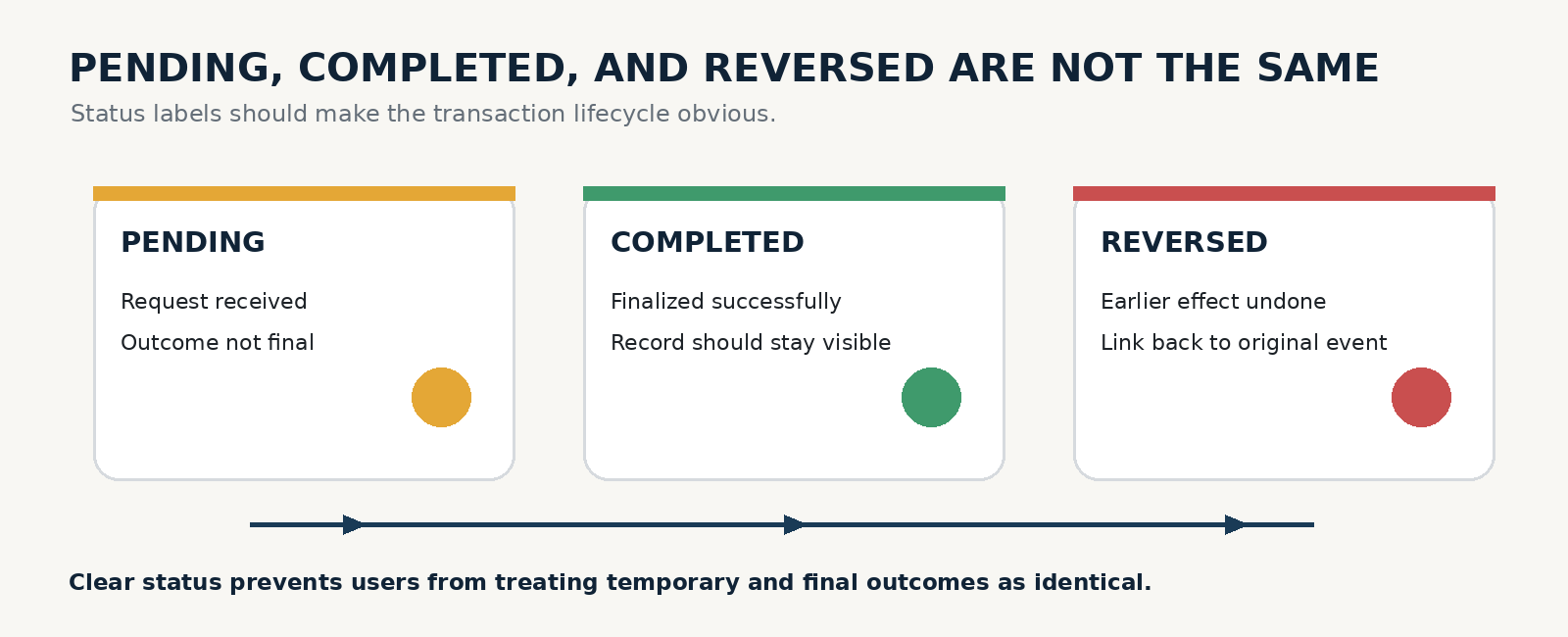
“Pending,” “processing,” “completed,” “failed,” “reversed,” and “refunded” describe different states. When a system collapses them into vague language, users can mistake a temporary event for a final one.
A pending transaction should not look identical to a settled transaction. A reversal should be understandable as the undoing of an earlier event, and a refund should be traceable to the transaction it relates to when the system can provide that connection.
Clear states also reduce duplicate actions. If a user can see that a request is already being processed, there is less reason to repeat the same instruction simply because the interface looked uncertain.
Reference IDs make support conversations more precise
A unique transaction reference gives users and support staff a common identifier. Instead of describing an event as “the payment from Tuesday night,” a person can point to one specific record.
The Bangko Sentral ng Pilipinas shows why this matters in its procedures for disputed transactions. Its rules identify information such as a unique transaction reference, amount, payment or transfer mode, and date and time as minimum information used to identify a disputed transaction.
Not every consumer interface needs to display every internal field used by a financial institution. The principle is what matters: precise identifiers make it easier to separate one event from another and reduce ambiguity during review.
Amount breakdowns should make the final number understandable
A single total may hide useful context. If an event includes a base amount, a fee, an adjustment, or a returned amount, the user should be able to see how the displayed total was formed.
A clear design can show the final amount first and make any relevant components available underneath. When no fee exists, the interface should not imply one. When a fee does exist, it should not be buried in unrelated text.
The BSP’s consumer materials similarly emphasize transparency around fees on electronic payments. More broadly, a transaction record is easier to trust when the user can understand why the final amount looks the way it does.
Good histories help users spot unfamiliar activity
Transaction records also act as a review surface. An account holder may notice an amount they do not recognize, repeated attempts, an unusual time, or a transaction that does not match their own activity.
At that point, the history should provide enough context to compare the entry with receipts, messages, linked services, or another wallet record. GCash, for example, lets users view recent transactions and request a longer transaction history, while its support guidance tells users reviewing unauthorized transactions to check account activity and take account-protection steps.
A record alone cannot prove that an unfamiliar event is fraudulent. Its value is that it gives the user evidence for the next question.
Transaction records are useful only if they can be trusted
Transparency is not simply a matter of showing more information. The underlying record also needs integrity. If important transaction data can be silently changed or deleted, the history becomes less useful as evidence.
OWASP recommends audit trails for transactions with integrity controls that help prevent tampering or deletion. For a user-facing service, that supports a practical expectation: important account history should behave like a durable record, not a temporary notification feed.
Transparency also needs limits. Interfaces should not expose full payment credentials, authentication secrets, or unnecessary personal data. A good record provides useful context without creating a new security problem.
A practical checklist for reviewing account activity
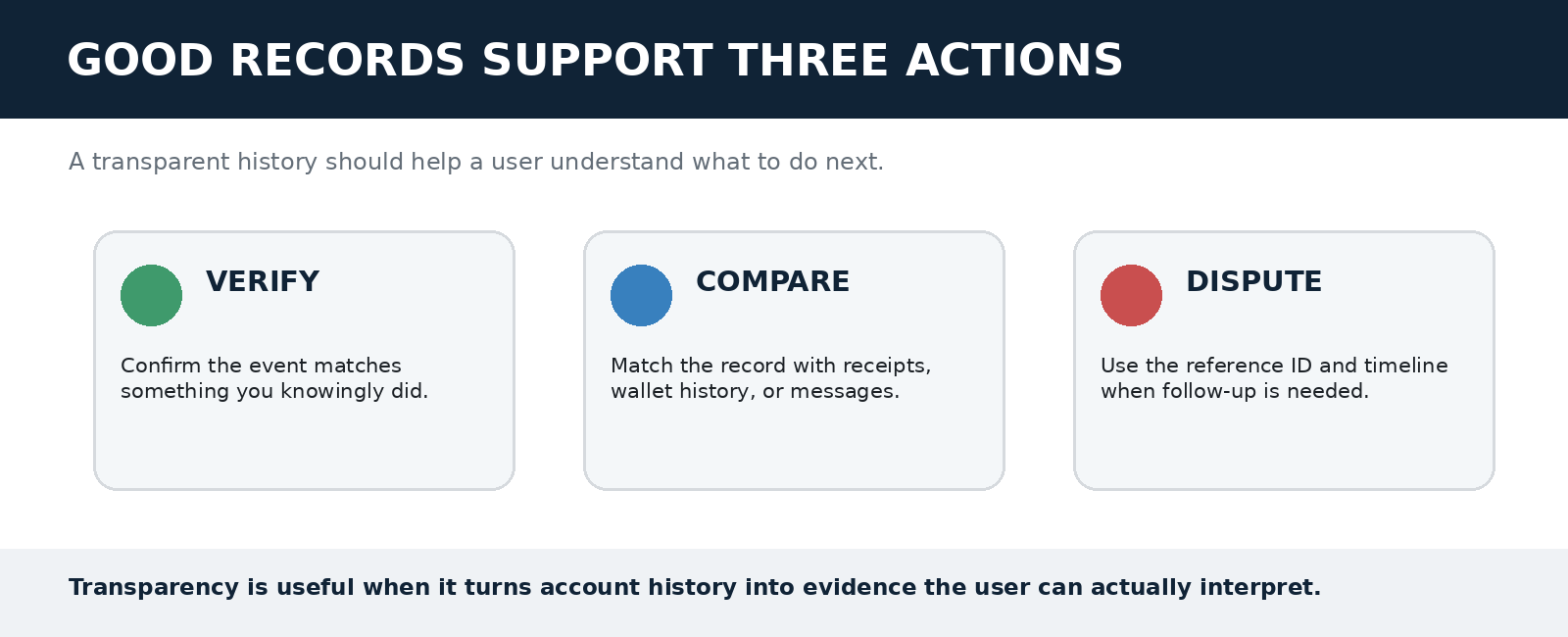
When reviewing a transaction, ask: What type of event is this? When did it occur? What amount changed? What is its current status? Which method or channel is associated with it? Is there a reference number? Does it match something you knowingly did?
If one of those answers is unclear, the record should ideally provide a path to more detail or support. The goal is not to investigate every normal transaction. It is to make unusual activity easier to understand when something does not look right.
Transparent records also make ordinary reconciliation easier because users can compare the history with receipts, external wallet records, confirmation messages, or personal notes instead of relying on memory alone.
Final thoughts
The best transaction histories are quiet tools: most of the time they simply confirm that expected activity happened as expected. Their value becomes obvious when something is delayed, reversed, duplicated, unfamiliar, or disputed.
For informational publishers, including the broader material presented in the TablePlus information overview, the responsible approach is to explain why these records matter without claiming that a particular operator exposes features that have not been independently verified. Users should check the actual service they use for its current transaction fields and support process.
A clear history cannot prevent every account problem. It can replace uncertainty with a traceable sequence of evidence, making account review faster and follow-up more precise.
Sources & References
Bangko Sentral ng Pilipinas — Manual of Regulations for Payment Systems; disputed-transaction identification and verification requirements.
Bangko Sentral ng Pilipinas — Consumer Corner: Fees on Electronic Payments.
GCash Help Center — How to request transaction history.
GCash Help Center — Report unauthorized transactions in my GCash account.
NIST — Guide to Computer Security Log Management (SP 800-92).
OWASP — Security Logging and Alerting Failures / Logging Cheat Sheet.
MyTablePlus — About Us.