1 ACU = 0.09599 USDT - Powering zero-trust, serverless compute by turning everyday mobile hardware into decentralized infrastructure
(Chart by TradingView)
What do you think of ACU price in the next one month? Reply in the comments!
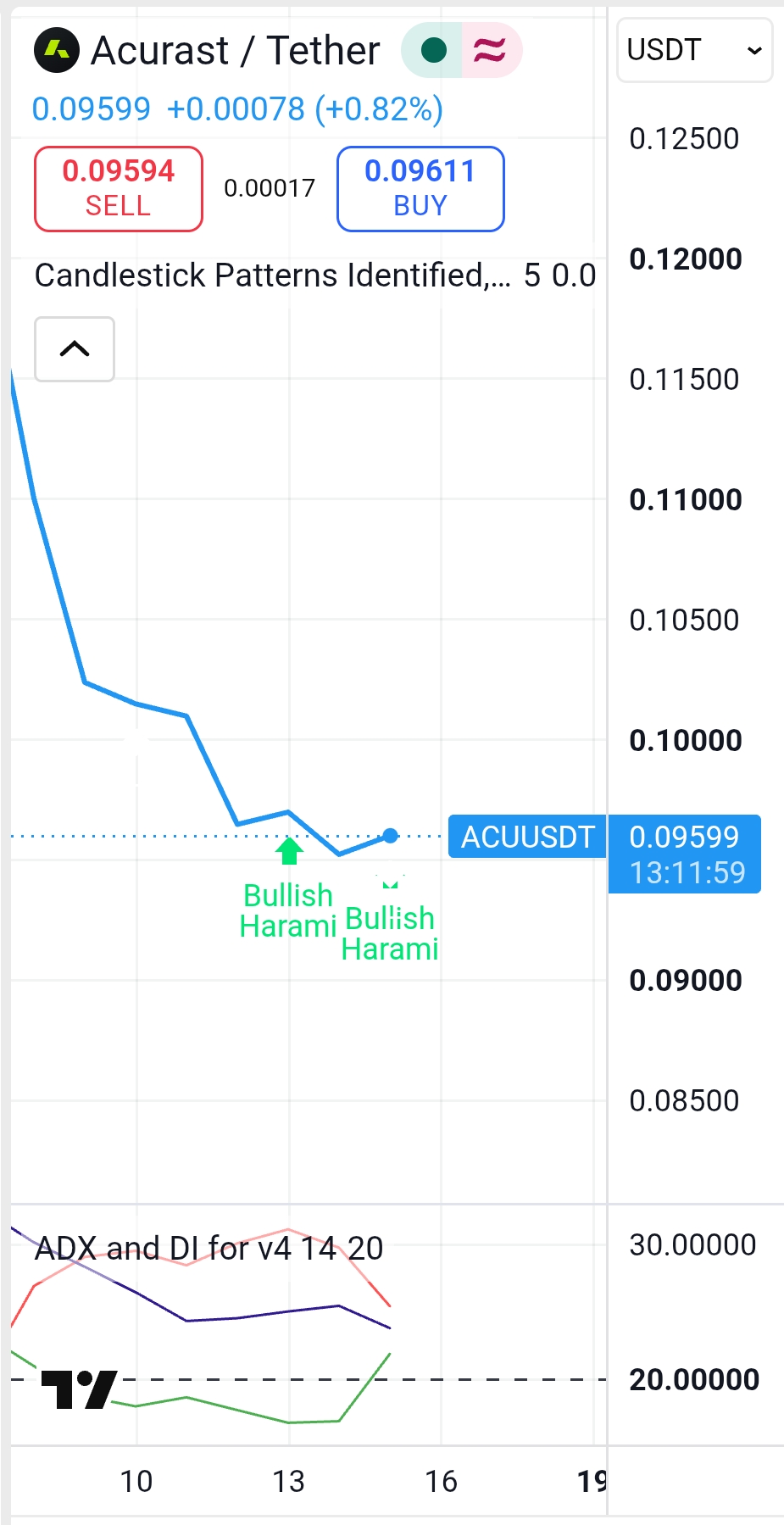
ACU is Acurast Network’s native utility, staking, and governance token; the network is a DePIN for serverless, zero-trust compute. Recently, the Bullish Harami technical pattern has emerged.
Acurast leverages smartphones with TEEs for decentralized compute instead of costly GPUs, using ACU tokens that developers spend and Processors earn for secure mobile processing. Meanwhile, the ADX-DI indicator is still in the negative territory, although started to climb up.
Finally, ACU has a fixed 1B supply with ~70% community-allocated to treasury, liquidity and growth funds; team tokens vest 24–36 months post-cliff, and holders vote on governance.
About Acurast Token (ACU)
The Acurast Token (ACU) is the native utility, staking, and governance asset that powers the Acurast Network. This network functions as a decentralized physical infrastructure network, or DePIN, built for serverless and zero-trust compute.
Instead of depending on costly data-center GPUs or server racks, Acurast coordinates compute supply through mobile hardware. It specifically draws on smartphones that include dedicated Trusted Execution Environments or Secure Enclaves. In this setup, ACU serves as both the medium of exchange and the computational fuel. Developers spend ACU to fund deployments, cover network transaction fees, and run cross-chain off-chain computations. Hardware providers, called Processors, earn ACU by monetizing idle mobile processing capacity and executing tasks securely inside hardware-level enclaves. Developers pay ACU fees into the Acurast Network’s orchestration layer, which then distributes ACU rewards to the Processors operating the mobile TEE hardware.
ACU also underpins network security through a staked compute model and collateralization. Beyond covering transaction gas, Processors and delegators stake ACU into a Staked Compute Pool. This staking aligns economic incentives so that hardware nodes execute tasks truthfully; fraudulent state transitions or malicious behavior trigger slashing mechanisms. The protocol employs a dual incentive structure based on a programmatic emission model that targets an initial base of 5 percent annual inflation. Rewards are allocated across network pillars as follows: 70 percent goes to the Staked Compute Pool to reward stakers and delegators, 15 percent flows to the Community Treasury for ongoing ecosystem expansion, 10 percent is directed to Benchmark Rewards as base compensation linked directly to processor hardware performance metrics, and 5 percent supports Block Producers or Collators who maintain consensus.
The token supports cross-chain interoperability and HyperDrive. Built with native multi-chain capabilities that originated on Substrate and Polkadot architecture, ACU is bridged across EVM ecosystems via LayerZero OFT standards. This design enables off-chain computation outputs to be submitted and verified directly on destination chains such as Ethereum, BNB Chain, and Base.
ACU has a fixed supply ceiling of 1 billion tokens. The tokenomics follow a community-centric distribution in which roughly 70 percent of the total supply is allocated to the community treasury, activation, liquidity, and operational growth funds. Allocations for the core team and early backers are locked under long-term linear vesting schedules that typically run 24 to 36 months after a cliff, helping to reduce short-term supply shocks. In addition, ACU confers voting rights that allow token holders to direct treasury expenditures, adjust inflation parameters, and guide overall protocol governance.
What do you think of ACU price in the next one month? Reply in the comments!
Disclaimer: This info is for educational purposes only and is not financial advice. Cryptocurrencies like ACU are highly volatile with risk of loss—always DYOR and consult a licensed advisor before investing.
Assisted by https://gemini.google.com/.
See also:
- By eliminating downvotes, Blurt ensures users are rewarded based on positive consensus, not through whale punishment. Please join through this link or this link with the invite code "puncakbukit."
- 🌀 SteemTwist — Steem with a Twist
- 🧬 Introducing SteemBiota — Raise, Breed & Evolve Creatures on the Steem Blockchain!
- 🎮 Reversteem — Play Reversi on the Steem Blockchain!
- @steem.amal: Charity At Your Fingertips
- Maximize curation rewards: follow our trail! Maksimalkan reward kurasi: ikuti trail kami! トレイルをフォローし、キユレーション報酬を最大化!
Upvoted! Thank you for supporting witness @jswit.