Affiliate Marketing for Beginners: The Complete A-to-Z Guide to Getting Started in 2026
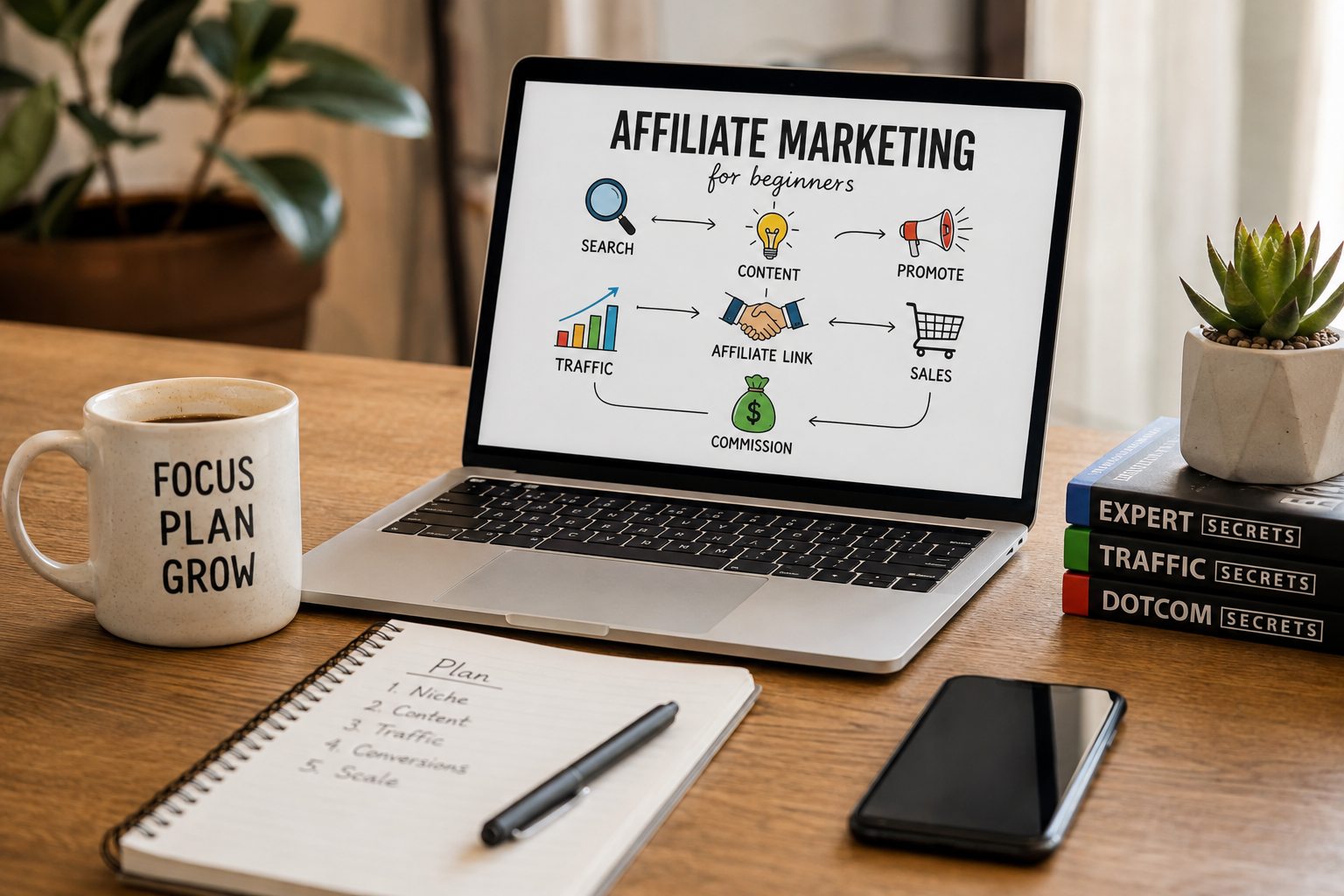
Affiliate marketing remains one of the most accessible online business models in 2026. You do not need to manufacture a product, manage inventory, handle shipping, or build a customer-service department before you can start earning.
Instead, you recommend products or services from other companies. When someone follows your unique affiliate link and completes a qualifying action, you receive a commission.
The concept is simple.
Building a sustainable affiliate business is not.
Competition is stronger, AI has dramatically increased the amount of content being published, search behavior is changing, and audiences are becoming more skeptical of generic recommendations.
That means the old strategy of publishing hundreds of thin “best product” articles and filling them with affiliate links is becoming less effective.
The opportunity in 2026 belongs to affiliates who can combine useful content, genuine expertise, trust, distribution and intelligent monetization.
This guide covers affiliate marketing from A to Z.
A — Affiliate Marketing
Affiliate marketing is a performance-based marketing model.
There are normally four parties involved:
- The merchant — the company selling the product or service.
- The affiliate — the person or publisher promoting it.
- The customer — the person making the purchase or completing the action.
- The affiliate network or tracking platform — the technology that records referrals and commissions.
Imagine you publish an article comparing business laptops.
You recommend a particular laptop and include your affiliate link.
A visitor clicks the link and purchases the laptop for $1,000.
If the merchant pays a 5% commission, you earn:
$1,000 × 5% = $50
You do not earn because somebody visited your website.
You earn because your recommendation helped produce a measurable commercial result.
B — Business Model
Treat affiliate marketing as a business rather than a quick-money scheme.
Successful affiliates build assets:
- websites;
- newsletters;
- communities;
- YouTube channels;
- social profiles;
- rankings in search engines;
- brand authority;
- email lists;
- product expertise;
- audience trust.
A website generating $5,000 per month because it has 300 useful articles, thousands of email subscribers and a recognizable brand is very different from a website making the same amount because one page temporarily ranks in Google.
The first has a business.
The second has a ranking.
Build the first.
C — Commission Models
Not every affiliate program pays in the same way.
Pay Per Sale — CPS
You receive a percentage or fixed payment when someone buys something.
Example:
10% commission on a $200 product = $20
Pay Per Lead — CPL
You earn when someone becomes a qualified lead.
Examples include:
- requesting insurance quotes;
- completing a form;
- scheduling a consultation;
- starting a software trial.
Pay Per Action — CPA
Payment occurs after a defined action.
For example:
- creating an account;
- installing an application;
- subscribing;
- booking a demo.
Recurring Commission
Very attractive for SaaS affiliates.
If a customer pays $100 every month and you receive 20% recurring commission, one referral can potentially generate:
$20 every month
rather than one single payment.
Hybrid Commission
Some programs combine:
- upfront commission;
- recurring commission;
- performance bonuses.
Always understand exactly when and why you get paid.
D — Disclosure
Transparency is non-negotiable.
If you receive compensation when readers purchase through your links, tell them clearly.
A simple disclosure could be:
Disclosure: This article contains affiliate links. If you purchase through one of these links, I may receive a commission at no additional cost to you.
Do not hide this information in your terms and conditions.
The U.S. Federal Trade Commission specifically says material financial relationships should be disclosed clearly and conspicuously, and disclosures should be placed close to the recommendation or affiliate link rather than somewhere readers are unlikely to notice.
Disclosure is not only about compliance.
It increases trust.
E — E-E-A-T
Experience, Expertise, Authoritativeness and Trustworthiness have become extremely important concepts for content publishers.
If you review laptops, demonstrate that you understand laptops.
If possible:
- test the products yourself;
- include original photographs;
- publish benchmarks;
- explain your methodology;
- describe advantages and disadvantages;
- identify who should not buy the product;
- show your professional background;
- cite reliable sources.
Google's own guidance encourages content creators to demonstrate first-hand experience, clear authorship and evidence supporting reviews.
A generic AI article saying:
“This laptop has excellent performance and a great display.”
offers very little value.
A useful affiliate review might say:
“During a 30-minute 4K export in Premiere Pro, fan noise became noticeable and battery life dropped approximately 24%. For desk-based video editing that is acceptable, but frequent travelers may prefer a more efficient model.”
That is experience.
F — Funnels
Visitors rarely follow the same path.
A typical affiliate funnel could be:
Google search → article → comparison → email signup → follow-up email → product purchase
Another might be:
TikTok → YouTube review → website → affiliate link → purchase
Think beyond the final affiliate button.
Ask:
How does someone go from discovering me to trusting my recommendation enough to purchase?
Different stages require different content.
Awareness
Examples:
- What is email marketing?
- How does cloud storage work?
Consideration
Examples:
- Shopify vs WooCommerce
- Best CRM software for freelancers
Decision
Examples:
- HubSpot review
- Best HubSpot alternatives
- HubSpot pricing explained
The closer someone is to making a purchase, the higher the commercial intent.
G — GEO and AI Search
Search is no longer limited to traditional Google results.
People increasingly use:
- ChatGPT;
- Google AI Overviews;
- Google AI Mode;
- Perplexity;
- Gemini;
- other AI assistants.
This has introduced terms such as GEO — Generative Engine Optimization.
Do not overcomplicate it.
Google states that its traditional SEO fundamentals remain relevant for generative AI features and that no special AI markup is required merely to appear in AI Overviews or AI Mode.
What helps?
Create information that is:
- original;
- factual;
- clearly structured;
- easy to understand;
- evidence-based;
- attributable;
- current;
- specific.
Instead of merely writing:
“The best email marketing software is X.”
explain:
- why;
- for whom;
- based on which criteria;
- compared with what;
- under which circumstances another product is better.
That gives search engines and AI systems something useful to extract.
H — Helpful Content
Affiliate content must provide value even if the affiliate links disappear.
That is a useful test.
Ask yourself:
Would somebody still read this article if none of the links earned me money?
If the answer is no, improve the article.
Google explicitly recommends people-first content that provides original information, research, analysis or meaningful additional value rather than simply rewriting what other websites already say.
Avoid:
Product A is amazing. Click here to buy it.
Prefer:
Product A is the strongest option for freelancers who prioritize portability, but users requiring 64 GB of RAM should consider Product B because Product A's memory is soldered.
Useful specificity converts better anyway.
I — Intent
Every keyword represents an intention.
Consider:
“What is a VPN?”
The user probably wants information.
Compare that with:
“Best VPN for traveling in China”
The user is evaluating options.
And:
“NordVPN coupon August 2026”
That user may be very close to purchasing.
Do not judge keywords purely by traffic.
A keyword receiving 200 highly commercial searches can be worth more than one receiving 20,000 informational searches.
Understand the person behind the query.
J — Journey
Do not optimize individual pages in isolation.
Think about the complete user journey.
Suppose your niche is photography.
A reader could progress through:
- How to start photography
- DSLR vs mirrorless cameras
- Best beginner mirrorless cameras
- Canon R50 vs Sony ZV-E10
- Canon R50 review
- Best lenses for Canon R50
- Camera accessories every beginner needs
That single reader can potentially generate multiple affiliate conversions over several years.
This is why building topical authority is more powerful than hunting isolated affiliate keywords.
K — Keywords
Keyword research still matters.
Look for several categories.
Informational Keywords
- how to;
- what is;
- why;
- guide;
- tutorial.
Commercial Keywords
- best;
- top;
- review;
- comparison;
- alternatives.
Transactional Keywords
- buy;
- discount;
- coupon;
- price;
- deal.
Problem-Based Keywords
Often overlooked.
Examples:
- laptop overheating while gaming;
- best microphone for noisy room;
- CRM for small construction company.
Problem-based searches can be extremely valuable because products frequently provide the solution.
L — Landing Pages
A successful affiliate landing page should make decisions easier.
Important elements include:
- clear headline;
- short introduction;
- comparison table;
- recommendations;
- use cases;
- advantages;
- disadvantages;
- specifications;
- original evidence;
- alternatives;
- FAQs;
- disclosure;
- strong calls to action.
Do not make visitors read 3,000 words before discovering your recommendation.
Use a BLUF approach:
Bottom Line Up Front.
Give the answer early.
Then provide the evidence.
M — Merchant Selection
Choosing the right merchants matters as much as choosing the right niche.
Consider:
Commission
Higher is better — but not everything.
Conversion Rate
A merchant offering 30% commission but converting 0.3% of visitors may be worse than one offering 8% and converting 6%.
Average Order Value
5% of $2,000 can be more attractive than 30% of $20.
Cookie Duration
A 30-day attribution window usually offers more opportunity than a 24-hour window.
Refund Rate
High refund rates can destroy affiliate economics.
Brand Reputation
Do not sacrifice your reputation to promote poor companies.
Payment Reliability
A commission means nothing if the company does not pay.
N — Niche Selection
One of the biggest beginner mistakes is choosing a niche purely because commissions look attractive.
A good niche ideally combines:
interest + expertise + commercial demand + content opportunity + monetization
Examples include:
- software;
- business tools;
- electronics;
- travel;
- education;
- home improvement;
- fitness;
- photography;
- web hosting;
- financial products.
Be careful with heavily regulated or YMYL niches such as finance and healthcare. Accuracy, expertise and compliance requirements are substantially higher.
Instead of starting with:
“Technology”
you might start with:
“Business laptops for creative professionals.”
Specific niches make authority easier to build.
You can expand later.
O — Originality
2026 has no shortage of content.
AI can generate another generic “10 best web hosting companies” article in seconds.
Originality therefore becomes increasingly valuable.
Create things others cannot instantly copy.
Examples:
- original testing;
- datasets;
- surveys;
- interviews;
- screenshots;
- benchmarks;
- real pricing comparisons;
- photographs;
- case studies;
- calculations;
- long-term product experience.
Instead of:
“Company X offers good customer support.”
test it.
Contact support five times.
Record response times.
Then publish:
| Test | Response Time |
|---|---|
| Billing question | 4 min |
| Technical support | 18 min |
| Cancellation question | 7 min |
| Weekend support | 22 min |
Now you have information.
Google's review guidance specifically recommends original evidence, measurements and first-hand expertise.
P — Platforms
You do not necessarily need a website to start affiliate marketing.
Potential channels include:
- Steemit;
- personal websites;
- YouTube;
- TikTok;
- Instagram;
- LinkedIn;
- newsletters;
- podcasts;
- Reddit communities where rules allow it;
- Pinterest.
However, I strongly recommend eventually owning something yourself.
Your website and email list are assets you control.
A social media platform can change its algorithm tomorrow.
A marketplace can close your account.
A search ranking can disappear.
Your email list cannot be taken away as easily.
Q — Quality Over Quantity
Publishing more does not automatically produce more traffic.
One exceptional article can outperform 50 weak ones.
AI makes this even more important.
Google warns that using generative AI to produce large numbers of pages without meaningful value can fall under its scaled-content abuse policies.
Use AI as an assistant.
For example:
- brainstorming;
- research organization;
- outlining;
- grammar;
- summarizing your own test results;
- analyzing datasets;
- generating content variations.
But add something uniquely yours.
R — Reviews
Reviews are one of the most effective forms of affiliate content.
But good reviews are balanced.
Bad affiliate review:
“This is an incredible product. It is perfect for everybody. Buy it here.”
Good review:
Best for: Small agencies and freelancers.
Strengths
- easy onboarding;
- strong automation;
- good integrations.
Weaknesses
- becomes expensive at larger contact volumes;
- advanced reporting requires a higher plan;
- unnecessary complexity for very small businesses.
Avoid if: You only need basic email newsletters.
The second review creates trust because it helps people determine when not to buy.
S — SEO
SEO can generate compounding affiliate traffic.
A social media post might bring visitors for a few days.
A strong search result can potentially bring qualified visitors for years.
Focus on:
- search intent;
- topical authority;
- technical SEO;
- internal linking;
- site speed;
- mobile usability;
- structured content;
- original expertise;
- backlinks;
- clear page titles;
- strong descriptions;
- crawlability;
- useful content.
Do not optimize only for keywords.
Optimize for decisions.
T — Tracking
If you do not measure results, you are guessing.
Track at minimum:
- impressions;
- visitors;
- affiliate-link clicks;
- click-through rate;
- conversions;
- conversion rate;
- revenue;
- EPC;
- revenue per visitor;
- revenue per article;
- merchant performance.
EPC — Earnings Per Click
If 1,000 affiliate clicks generate $400:
EPC = $400 / 1,000 = $0.40
Now compare another merchant:
800 clicks generate $720.
EPC = $0.90
The second program may deserve more attention.
Do not optimize purely for commission percentage.
Optimize for actual earnings.
U — User Experience
Affiliate sites often destroy their own conversion rates.
Common problems:
- enormous popups;
- too many advertisements;
- slow pages;
- fake countdown timers;
- misleading buttons;
- endless introductions;
- poor mobile design;
- aggressive affiliate links everywhere.
Your job is to reduce friction.
Visitors should immediately understand:
- what the page is about;
- what you recommend;
- why;
- what alternatives exist;
- what they should do next.
Good UX supports both SEO and conversions.
V — Value
Affiliate marketing works because you add value between the customer and merchant.
That value might be:
Discovery
You introduce a useful product.
Education
You explain how it works.
Comparison
You help users understand alternatives.
Testing
You validate marketing claims.
Curation
You reduce 100 options to five.
Negotiation
You provide an exclusive discount.
Implementation
You teach the buyer how to use the product.
The more value you add, the less replaceable you become.
W — Website
If you build your own website, treat it as a real publication.
Important pages include:
- homepage;
- about page;
- contact page;
- privacy policy;
- affiliate disclosure;
- editorial policy;
- author profiles;
- category pages;
- individual articles.
Create a clear brand.
Do not make the website look like it exists solely to funnel visitors to Amazon or another retailer.
Your website should be useful in its own right.
X — eXperimentation
There is no perfect affiliate strategy.
Test things.
Headlines
Compare:
Best CRM Software
with:
7 Best CRM Platforms for Small Businesses in 2026 — Tested & Compared
CTA
Compare:
Buy Now
with:
Check Current Pricing
Comparison Tables
Try moving them higher.
Merchants
Test multiple programs.
Content Formats
Compare:
- review;
- comparison;
- tutorial;
- video;
- case study.
Small improvements compound.
If you increase:
traffic by 20%;
click-through rate by 20%;
merchant conversion by 20%;
your total improvement is not 20%.
It becomes:
1.2 × 1.2 × 1.2 = 1.728
or roughly a 73% improvement.
That is why optimization matters.
Y — Your Audience
Your audience matters more than the affiliate program.
Do not ask:
“What can I sell?”
Ask:
“What problem does my audience need solved?”
If your audience consists of freelancers, they may need:
- accounting software;
- laptops;
- project-management tools;
- insurance;
- hosting;
- invoicing software;
- productivity applications.
One audience can support many relevant products.
Build around people, not commission tables.
Z — Zero to First Commission
So how should a complete beginner start?
Here is a practical roadmap.
Step 1 — Choose One Niche
Pick something with:
- demand;
- monetization;
- enough subjects to discuss;
- an audience you understand.
Step 2 — Research 20–30 Competitors
Study:
- which topics they cover;
- which affiliate programs they use;
- how they structure content;
- where they get traffic.
Do not copy them.
Look for weaknesses.
Step 3 — Join a Few Quality Affiliate Programs
You do not need 30.
Start with three to five.
Understand:
- commission;
- attribution window;
- rules;
- payout threshold;
- allowed promotional methods.
Step 4 — Choose Your Primary Platform
For example:
website + Steemit + newsletter
or:
YouTube + website
Avoid trying to dominate six social networks simultaneously.
Step 5 — Create Your First Content Cluster
If your niche is email marketing:
Pillar
Complete Guide to Email Marketing
Supporting content
- Best email marketing platforms
- Mailchimp alternatives
- Mailchimp vs Brevo
- How to build an email list
- Email automation guide
- Newsletter examples
- Email deliverability guide
This creates topical depth.
Step 6 — Publish Commercial Content
Do not publish only informational articles.
You need content capable of generating revenue.
Aim for a mix of:
education + comparison + reviews + problem-solving
Step 7 — Add Clear Affiliate Disclosures
Do this from day one.
Step 8 — Build Distribution
Content without distribution can remain invisible.
Use:
- SEO;
- Steemit;
- newsletters;
- social media;
- communities;
- partnerships;
- guest posts;
- video.
Step 9 — Track Everything
Learn which:
- pages generate clicks;
- merchants convert;
- keywords attract buyers;
- calls to action perform best.
Step 10 — Optimize Before Scaling
Suppose Article A receives:
5,000 visitors → 500 affiliate clicks → 30 sales
Before writing another 100 articles, ask:
Can 500 clicks become 700?
Can 30 sales become 45?
Improving existing winners is often faster than creating more content.
The Affiliate Marketing Formula
You can think of affiliate income roughly like this:
Traffic × Affiliate Click Rate × Merchant Conversion Rate × Average Commission = Revenue
Example:
10,000 visitors
× 20% clicking an affiliate link
= 2,000 clicks
× 4% merchant conversion
= 80 customers
× $40 commission
= $3,200 revenue
Now you know what to optimize.
You can increase:
- traffic;
- click-through rate;
- conversion;
- commission.
Each is a separate growth lever.
Common Affiliate Marketing Mistakes
Beginners often make the same mistakes.
Choosing a niche purely for money
You may lose motivation before traffic arrives.
Promoting everything
Trust disappears when every product is “the best.”
Writing generic AI content
AI can accelerate production, but it cannot replace genuine experience and original value.
Ignoring email
Search and social traffic are borrowed.
An email audience is much closer to an owned asset.
Depending on One Merchant
A company can reduce commissions overnight.
Diversify.
Depending on One Traffic Source
Do not build a business that disappears when one algorithm changes.
Hiding Affiliate Relationships
Transparency is better for compliance and trust.
Expecting Immediate Results
Affiliate marketing can scale dramatically, but authority and distribution usually take time.
How AI Changes Affiliate Marketing in 2026
AI is simultaneously making affiliate marketing easier and harder.
Easier
AI can assist with:
- research;
- outlines;
- editing;
- translation;
- data analysis;
- keyword clustering;
- personalization;
- video production;
- workflow automation.
Harder
Everyone has access to similar tools.
That means generic information becomes increasingly commoditized.
The competitive advantage shifts toward:
experience + data + brand + audience + expertise + trust
The winning affiliate will not necessarily be the person who publishes fastest.
It will increasingly be the person whose recommendation the audience believes.
How Much Can You Earn?
There is no reliable universal number.
Some affiliates earn nothing.
Some earn a few hundred dollars per month.
Others build seven-figure companies.
A better question is:
How valuable is the audience I can build, and how effectively can I help that audience make purchasing decisions?
Consider two websites.
Website A:
100,000 monthly visitors
but mostly low-commercial informational traffic.
Website B:
15,000 monthly visitors
searching for expensive business software.
Website B could potentially make substantially more money.
Traffic alone does not equal revenue.
Intent matters.
The Most Important Principle
Affiliate marketing is often presented like this:
Get traffic → add links → make money.
A better model is:
Understand an audience → earn trust → solve problems → recommend appropriate products → receive commission.
The order matters.
Trust comes before monetization.
If every article exists only to push the most profitable product, readers eventually notice.
But if you become the person who says:
“Product A pays me a larger commission, but Product B is actually better for this specific use case.”
you create something far more valuable than an affiliate click.
You create credibility.
And credibility compounds.
Final Thoughts
Affiliate marketing in 2026 is not dead.
It is becoming more professional.
Search engines are demanding better content. AI tools are increasing competition. Users can compare products faster than ever. AI assistants are becoming another discovery layer. Disclosure and transparency remain important.
That eliminates some of the easiest shortcuts.
But it also creates opportunity.
Because while generating content becomes cheap, earning trust remains difficult.
Focus on:
- a specific audience;
- genuine expertise;
- original information;
- useful comparisons;
- honest recommendations;
- multiple traffic sources;
- transparent affiliate relationships;
- strong tracking;
- continuous testing;
- long-term brand building.
Do that consistently and affiliate marketing can become more than a side hustle.
It can become a genuine digital asset.
What About You?
Are you already experimenting with affiliate marketing, or are you planning to start in 2026?
Which niche are you considering — technology, finance, travel, software, lifestyle, crypto, education or something completely different?
Share your experience in the comments. The most useful lessons often come from comparing what is actually working for different creators.