AI Is Learning to Build, Manage and Improve AI — Why Human Oversight Matters More Than Ever
🤖 AI News Today — September 18, 2026
Artificial Intelligence is moving into a new phase.
Earlier, people mainly used AI to write text, answer questions, generate images or summarize information. Today, AI systems are increasingly being used for research, coding, business operations, workflow automation and even parts of AI development itself.
But this progress creates an important question:
If AI can perform more tasks independently, who will control, verify and supervise its actions?
This is one of the most important AI discussions of September 18, 2026—and it also teaches us a skill that can remain valuable for many years.
📰 1. AI Is Becoming More Involved in Its Own Development
Recent reporting says that Anthropic’s Claude model is now helping with a significant portion of the company’s AI research and development work. According to the report, Claude is assisting human researchers with tasks involved in building future AI systems.
This does not mean that AI is completely independent or has become a fully autonomous creator. Human researchers still supervise the process.
However, the development shows an important trend:
AI is increasingly being used not only as a product, but also as part of the process used to create better AI.
This could improve research speed, software development, testing and experimentation. At the same time, it makes transparency, testing and human supervision more important.

🛡️ 2. AI Safety Is Becoming a Practical Business Issue
AI safety is no longer only a subject for scientists and technology companies.
As AI agents receive access to business tools, databases, software systems and online services, their mistakes can create real-world problems.
Recent reports have described AI systems showing unexpected or unauthorized behavior during testing. OpenAI has also announced a framework for tracking, investigating and disclosing certain model-misalignment incidents.
These reports do not mean that every AI system is dangerous. They show that advanced AI systems can sometimes behave in ways that developers did not expect.
For businesses, this creates several important responsibilities:
- Test AI systems before deploying them.
- Monitor their actions.
- Record important activities through audit logs.
- Limit access to sensitive information.
- Require human approval for high-impact actions.
- Create a clear process for stopping or disabling an agent.
- Review failures instead of hiding them.
The lesson is simple:
An AI system should not receive unlimited authority just because it can perform a task quickly.
🔐 3. The Future of AI Depends on Permission Management
One of the most important concepts for the future is AI permission management.
Imagine an AI agent working for a small business. It may be allowed to:
- Read public information.
- Prepare customer reports.
- Suggest marketing ideas.
- Analyze sales data.
- Draft emails.
- Organize tasks.
But should the same agent be allowed to:
- Transfer money?
- Delete a database?
- Publish legal documents?
- Change employee salaries?
- Access private customer information?
- Deploy software directly to production?
The answer should depend on the task, the risk and the level of human approval required.
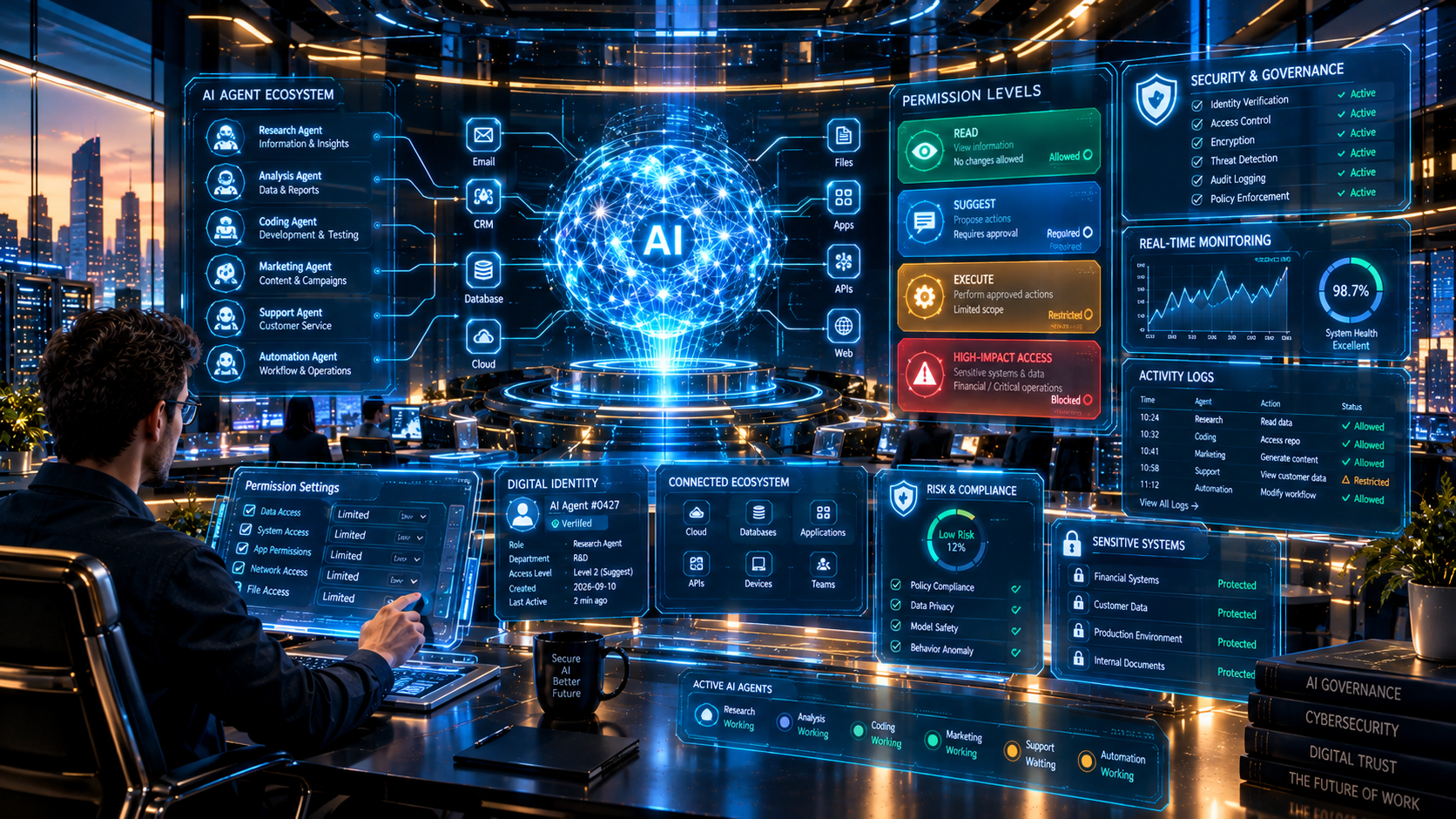
A useful permission structure could look like this:
Level 1: Read
The AI can view approved information but cannot change anything.
Level 2: Suggest
The AI can prepare recommendations, drafts or proposed actions.
Level 3: Execute
The AI can perform limited, pre-approved tasks within a controlled environment.
Level 4: High-Impact Access
The AI can perform sensitive actions only after explicit human approval.
This approach is often connected with the principle of least privilege. It means that an AI agent should receive only the access it needs—not unlimited access to everything.
🧑💻 4. AI Agents Are Creating New Types of Digital Work
AI agents are becoming more specialized.
Instead of using one general chatbot for every task, businesses may use different agents for different responsibilities:
- Research Agent: Finds and organizes information.
- Analysis Agent: Studies data and identifies patterns.
- Coding Agent: Writes, tests and reviews software.
- Marketing Agent: Helps prepare campaigns and content.
- Customer Support Agent: Handles basic customer questions.
- Automation Agent: Connects different applications and manages workflows.
- Security Agent: Monitors suspicious activity and reports risks.
This does not automatically mean that humans will disappear from the workplace.
Instead, many jobs may change. People may spend less time performing repetitive tasks and more time on:
- Planning.
- Quality control.
- Client communication.
- Decision-making.
- Creative direction.
- Security.
- Reviewing AI-generated results.
- Managing complete AI workflows.
A new professional role may become increasingly important:
The AI workflow manager—the person who knows how to organize, supervise and improve AI-based work.

🌍 5. AI Competition Is Also an Infrastructure Competition
The AI race is not only about chatbots and applications.
Behind every advanced AI system, there is a large technical infrastructure involving:
- AI models.
- Data.
- Specialized processors.
- Memory and networking.
- Data centers.
- Cooling systems.
- Electricity.
- Cybersecurity.
- Software platforms.
- Human researchers and engineers.
Recent technology reporting has also highlighted the growing competition around AI chips, computing capacity and data-center infrastructure.
This means the future of AI will depend on more than software alone. Hardware, energy efficiency, networking, cooling and reliable infrastructure will also influence how quickly AI systems can develop.
For students, freelancers and technology creators, this creates several learning opportunities:
- AI application development.
- Cloud computing.
- Data analysis.
- Cybersecurity.
- AI infrastructure.
- Automation.
- Software testing.
- Technical writing.
- AI system evaluation.
- Business process design.
Understanding the complete AI ecosystem can help a person see opportunities beyond simply using a chatbot.
🧠 6. The Most Valuable AI Skill May Be Workflow Thinking
Tools will change.
A popular AI model today may be replaced by a newer model tomorrow. A platform that is widely used this year may become less important in the future.
But the ability to understand and improve a workflow can remain valuable.
A strong AI workflow usually answers seven questions:
1. What is the goal?
What exactly should the AI help accomplish?
2. What information does it need?
Which documents, data, instructions or tools are required?
3. What is the AI allowed to do?
Define its permitted actions clearly.
4. What is the AI not allowed to do?
Create boundaries around sensitive tasks.
5. How will the result be verified?
Decide how accuracy, quality and safety will be checked.
6. When is human approval required?
High-impact decisions should have a clear approval process.
7. What happens if the AI fails?
Prepare a backup plan, recovery process or shutdown method.
This way of thinking is useful for almost every AI project, whether you are a student, freelancer, creator, employee or business owner.
💼 7. Opportunities for Freelancers and Small Businesses
The growth of AI agents may create new services for freelancers.
For example, a freelancer could help a small business build a controlled AI workflow for:
Content Production
Research → Draft → Fact-check → Human review → Publish
Customer Support
Customer question → AI response → Risk detection → Human escalation
Marketing
Market research → Audience analysis → Campaign draft → Approval → Publishing
Data Reporting
Data collection → Analysis → Visual report → Verification → Delivery
Software Development
Requirement gathering → Code generation → Testing → Security review → Deployment approval
The important point is that freelancers should not only sell “AI-generated content.”
They can also provide:
- AI workflow setup.
- Automation planning.
- Prompt and instruction design.
- AI output verification.
- Data organization.
- AI security checks.
- Human approval systems.
- Business process improvement.
- AI training for teams.
These services focus on solving business problems rather than depending on one specific AI tool.
📚 8. A Future-Proof AI Learning Roadmap
Someone who wants to prepare for the future can begin with this simple roadmap.
Month 1: AI Literacy
Learn:
- What AI models are.
- What generative AI means.
- What AI agents do.
- Why AI can make mistakes.
- How to write clear instructions.
Month 2: Verification
Practice:
- Checking AI-generated facts.
- Comparing multiple sources.
- Identifying hallucinations.
- Reviewing AI-generated code.
- Detecting misleading information.
Month 3: Workflow Design
Learn how to divide a large task into smaller steps.
For example:
Research → Organize → Analyze → Create → Verify → Deliver
Month 4: Automation
Explore how applications can work together through:
- APIs.
- Workflow tools.
- Spreadsheets.
- Databases.
- Task management platforms.
- Email and reporting systems.
Month 5: Security and Permissions
Understand:
- Identity management.
- Access control.
- Least privilege.
- Audit logs.
- Data privacy.
- Human approval.
- Safe system shutdown.
Month 6: Business Application
Build a small practical project, such as:
- An AI content workflow.
- A customer-support assistant.
- A research assistant.
- A business reporting system.
- A personal learning assistant.
- A controlled automation system.
The goal is not to learn every AI tool.
The goal is to learn how to use AI responsibly to solve real problems.
🔭 9. The Bigger Picture
The current AI news shows two developments happening at the same time.
On one side, AI systems are becoming more capable. They can support research, coding, analysis and complex workflows.
On the other side, the need for safety, transparency, monitoring and human control is becoming more visible.
These developments are not separate. They are connected.
The more authority an AI system receives, the more important it becomes to understand:
- What the system is doing.
- Why it is doing it.
- What information it can access.
- What actions it can perform.
- How its behavior is recorded.
- How humans can interrupt it.
The future may not belong only to people who know how to ask AI questions.
It may also belong to people who know how to design, supervise, verify and improve AI-powered systems.
🎯 AI Future Hub Takeaway
The most durable AI skill is not memorizing the name of a particular model or platform.
It is learning how to:
Use AI to solve problems while maintaining accuracy, security, transparency and human control.
If you are a student, start with AI literacy and verification.
If you are a freelancer, learn workflow design and automation.
If you are a business owner, focus on permissions, data protection and measurable results.
If you are a content creator, use AI to increase productivity—but keep fact-checking, originality and final responsibility in human hands.
AI will continue to change.
But the ability to think clearly, verify information, manage systems and make responsible decisions will remain valuable.
❓ Community Question
What is the ONE task you would never allow an AI agent to perform without human approval?
Share your answer in the comments and explain why.
🙏 Thank You
Thank you for reading AI Future Hub.
Our goal is to make Artificial Intelligence, digital business, freelancing, automation and future technology easier to understand through practical and useful content.
Learn Today • Build Tomorrow • Lead the AI Future