🤖🔥 When AI Enters the Battlefield: The Fake Explosion That Could Change How We Understand War
Today’s Global News | August 31, 2026
Imagine opening your phone tonight.
You see a dramatic video.
Huge explosions.
Fire rising into the sky.
A military target apparently being destroyed.
The caption says:
“Kharg Island has been blown to pieces.”
You watch it once.
Then again.
It looks real.
The explosions look real.
The smoke looks real.
The destruction looks real.
And for a few seconds, you may not even question it.
But what if the video isn't real?
What if the images were created by artificial intelligence?
That is exactly why today's Iran story is so disturbing.
On August 31, U.S. President Donald Trump posted an AI-generated video that he said showed Iran's Kharg Island oil hub being destroyed. But Reuters found no evidence that Kharg had actually been attacked, and Reuters' analysis indicated that the dramatic video accompanying the post was most likely synthetically generated. An Iranian oil official rejected the claim and said operations on Kharg remained active.
This claim appeared on the same day that the United States and Iran resumed military attacks after weeks of relative calm.
So suddenly, the story isn't only about missiles.
It is about something much harder to see:
The battle over what people believe is real.
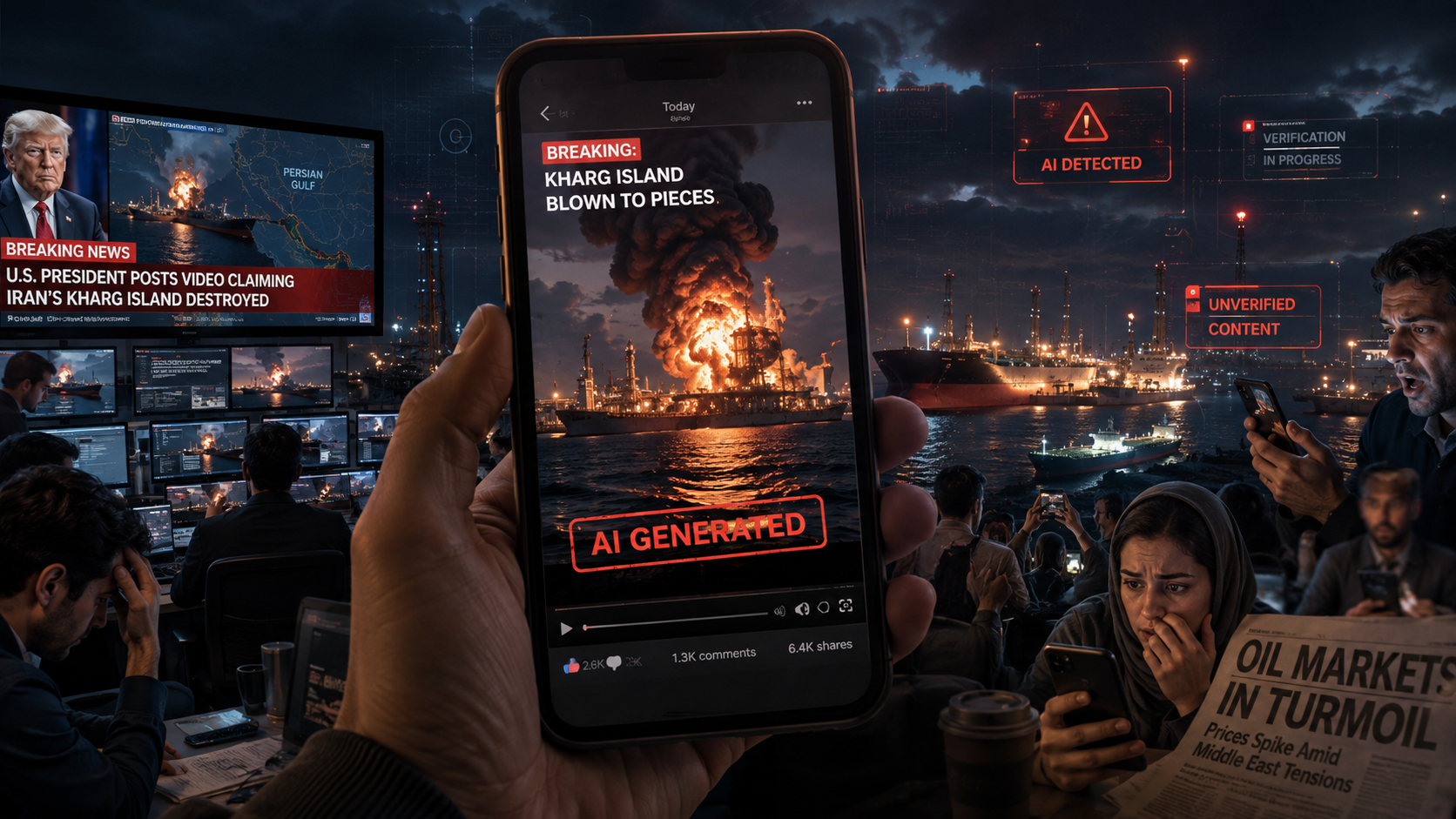
💥 The Video Looked Real — And That's the Problem
Let's stop for a moment and think about how powerful visual information has become.
Twenty years ago, fake war footage could be relatively easy to expose.
A strange-looking video might have poor quality.
The editing could be obvious.
The explosion might look unrealistic.
But today's AI tools are changing the situation.
Synthetic video can create:
Explosions.
Smoke.
Destroyed buildings.
Military aircraft.
Missile launches.
Crowds.
Entire battle scenes.
And increasingly...
things that never happened.
That creates a new problem for every person holding a smartphone.
We are no longer simply asking:
“What happened?”
We're also asking:
“Did this video actually happen?”
Reuters reported that the Kharg video shared by Trump was most likely synthetically generated, while there was no supporting evidence that the island had been destroyed.
That distinction is enormous.
Because a fake video during peacetime may cause confusion.
A fake video during a war can cause panic, financial losses and political escalation.
🛢️ Why Kharg Island Matters So Much
Now comes another important part of the story.
Why would a fake video showing Kharg Island become such a major issue?
Because Kharg is not just another location.
Before the current war, the island handled around 90% of Iran's oil exports, according to Reuters. An actual attack there could therefore seriously disrupt Iran's energy exports and place enormous pressure on its economy.
Think about what that means.
One island.
A huge share of a country's oil exports.
And one dramatic fake video claiming that this energy hub had been destroyed.
Now imagine the reaction.
Oil traders start watching prices.
Shipping companies become nervous.
Investors react.
Governments issue statements.
Social media explodes.
People begin posting the video everywhere.
And suddenly...
an image created by software can influence real-world behaviour.
That is an extraordinary development.
🌍 This Is Bigger Than Iran
It would be easy to look at this as:
“Just another Middle East war story.”
But I think that would miss the larger point.
The real issue is universal.
Tomorrow it could be:
A fake attack on a Pakistani city.
A fake missile launch in India.
A fake explosion near a European power station.
A fake assassination video.
A fake nuclear warning.
A fake declaration of war.
The technology doesn't care where the video is created.
And once people see a convincing visual, many will react emotionally before checking whether it is authentic.
That is the danger.
🖼️— THE FAKE WAR VIDEO
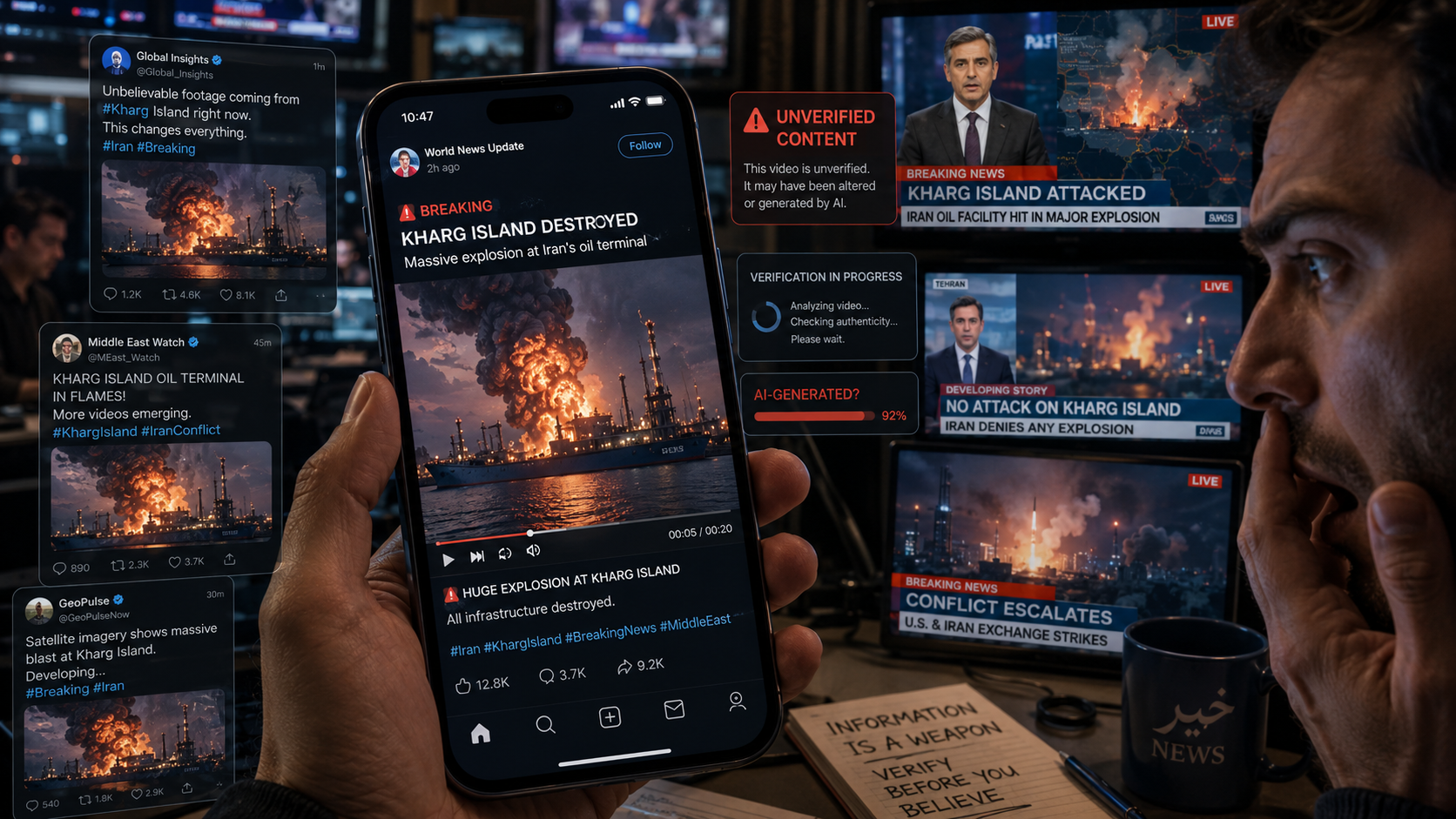
🧠 What Happens When Everyone Becomes a “War Reporter”?
This is one of the strangest changes of the internet age.
During a major conflict, you don't only get reports from journalists.
You get videos from:
Soldiers.
Civilians.
Governments.
Activists.
Influencers.
Anonymous accounts.
Bots.
AI systems.
And sometimes...
people who simply have no idea whether what they are sharing is real.
A person sees a video.
They believe it.
They share it.
Their followers believe it.
Those followers share it.
Within an hour, millions of people may have seen something that never happened.
And then comes the psychological effect.
Even after the video is debunked, some people will continue believing it.
Why?
Because people often remember images better than corrections.
You may forget a ten-paragraph fact check.
But the image of a giant explosion can stay in your mind.
That's what makes AI misinformation so powerful.
🚨 And This War Is Already Affecting the Real World
The fake video story comes at an unusually dangerous moment.
Reuters reports that U.S. and Iranian forces have resumed military attacks after a pause since July.
The United States struck Iranian launchers on Larak Island, saying Iranian forces were preparing to deploy sea mines in the Strait of Hormuz.
Iran then reported attacks against U.S. bases in Jordan and an operation involving the UAE's Al Minhad air base, although the UAE denied that the base had been targeted.
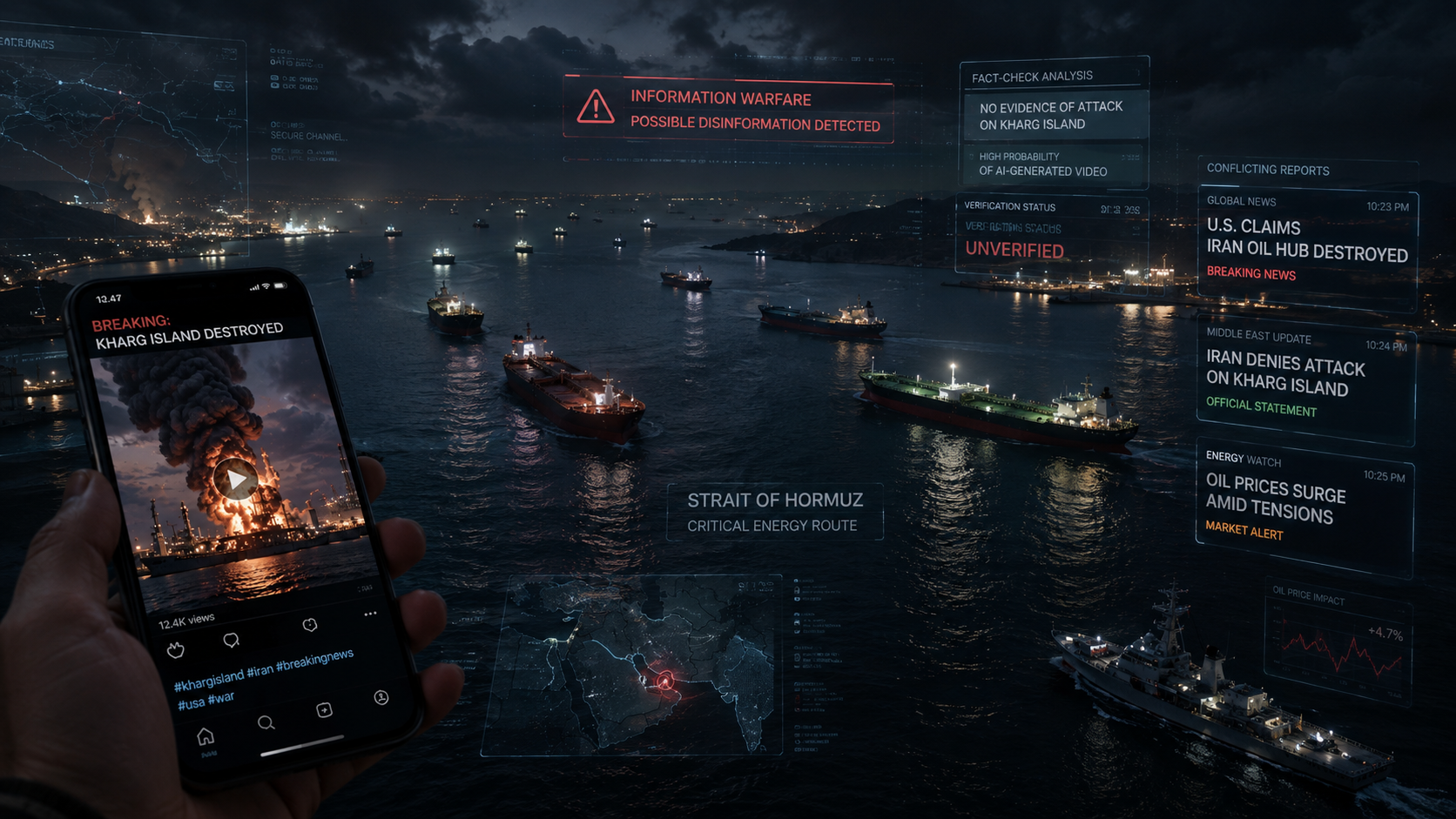
Meanwhile, shipping traffic through the Strait of Hormuz has fallen sharply amid the increased danger.
Reuters reported that visible commodity-vessel traffic dropped to around five vessels a day over the weekend, although the real number may be higher because some ships have switched off their automatic identification systems.
So this is not an internet-only problem.
There is already a real military and economic crisis happening.
Which makes false information even more dangerous.
🚢 Imagine Being a Tanker Captain Right Now
Put yourself in the position of a ship's captain.
You're approaching the Strait of Hormuz.
Your crew is watching the news.
Someone sends you a video showing a tanker on fire.
Another message says the Strait is closed.
Another says it is open.
Another says naval mines were discovered.
Another says the footage is fake.
What do you believe?
What do you do?
Do you continue?
Do you stop?
Do you turn around?
Do you wait?
Every decision costs money.
And when thousands of people and hundreds of ships are making decisions under uncertainty, the global economic impact can become enormous.
Reuters reported that the waterway carried nearly one-fifth of global crude-oil and LNG shipments before the blockade connected to the current conflict.
That's why the information battle matters so much.
🖼️— STRAIT OF HORMUZ UNDER INFORMATION WARFARE
💰 And Then There Is Oil
There is another reason today's story matters to ordinary people.
Oil prices.
Renewed fighting pushed oil prices around 2% higher on Monday, according to Reuters.
Why?
Because investors don't need to know that an oil terminal has definitely been destroyed.
They only need to fear that it might be.
Fear itself moves markets.
And markets react before facts are fully established.
That creates a dangerous cycle:
Conflict → uncertainty → social media rumours → market fear → price movement → public anxiety.
Now imagine inserting AI-generated videos into that cycle.
Suddenly misinformation isn't just a media problem.
It can become an economic weapon.
🇵🇰 Why Should Pakistan Care?
This part is particularly important for us in Pakistan.
Pakistan imports significant amounts of energy.
That means international oil prices can eventually affect:
Petrol.
Diesel.
Transport costs.
Electricity generation.
Agriculture.
Factories.
Food distribution.
And the everyday household budget.
So a conflict thousands of kilometres away can eventually reach a Pakistani family through something as simple as a fuel bill.
This is why global geopolitics isn't really “somebody else's problem.”
The world's economies are connected.
A ship delayed in the Gulf can affect a refinery.
A refinery problem can affect fuel availability.
Fuel costs can affect transport.
Transport costs can affect food prices.
And suddenly...
the geopolitical story reaches your local market.
🤖 Can AI Also Help Fight AI?
Here is where things become fascinating.
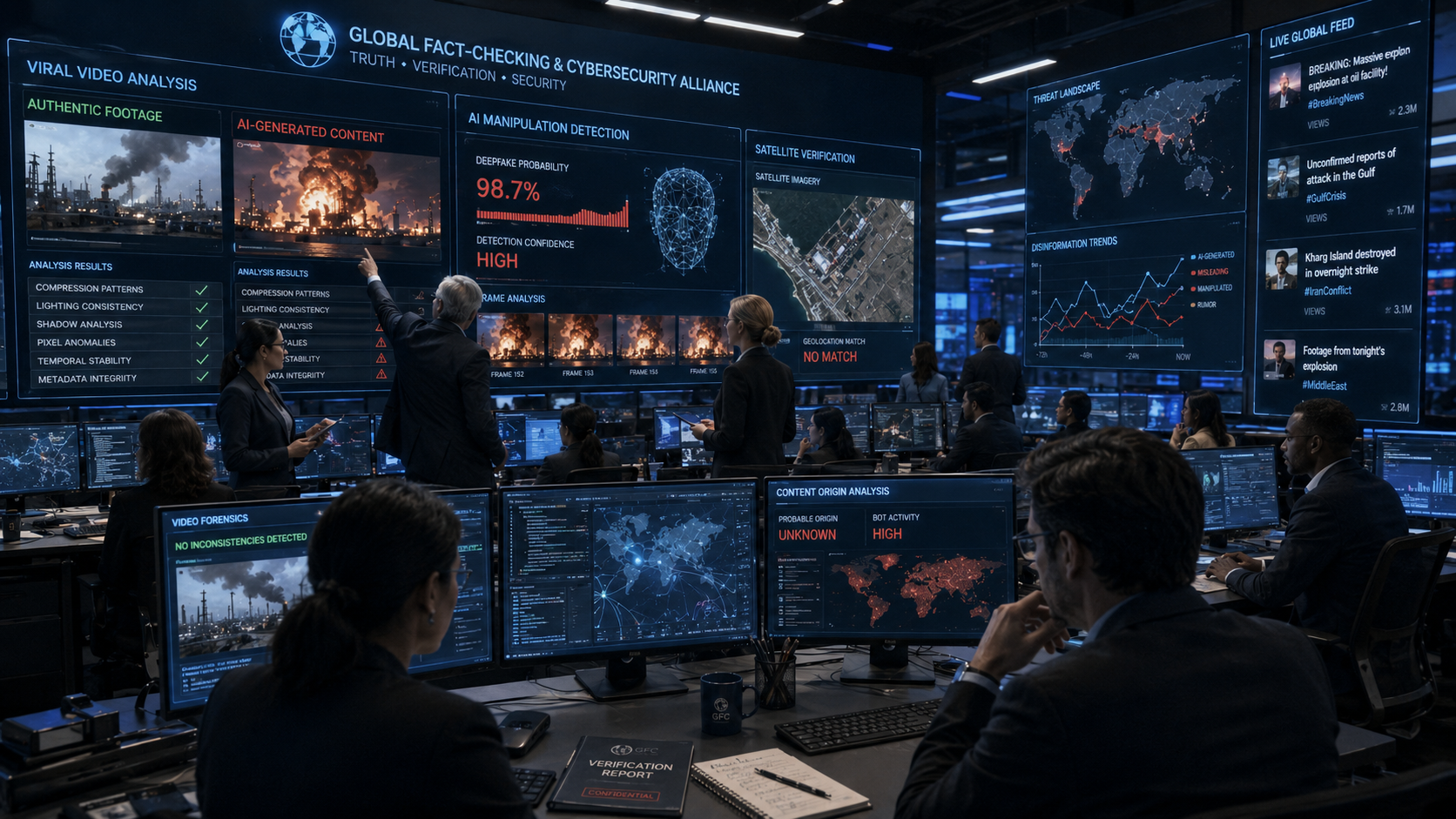
The same technology creating convincing fake images can also be used to detect them.
AI systems can analyse:
Pixel patterns.
Lighting inconsistencies.
Frame-level anomalies.
Synthetic facial details.
Audio mismatches.
Metadata.
Unnatural motion.
Digital fingerprints.
This creates something like an endless technological race.
One side creates better synthetic content.
The other side creates better detection tools.
Then the first side improves again.
And the cycle continues.
But there is a limitation.
No detection system is perfect.
And that's why human verification remains important.
🖼️— AI FACT-CHECKING CENTER
🔍 How Should Ordinary People Respond?
This may be the most useful part of the whole story.
When you see shocking breaking-news footage, don't immediately ask:
“Is this exciting?”
Ask:
“Is this verified?”
Look at the source.
Look for independent reporting.
Check whether reliable news organisations are reporting the same thing.
Check whether the location, date and weather match.
Be suspicious of dramatic videos with no clear source.
And most importantly:
Don't become part of the misinformation chain just because the video looks convincing.
You don't need to be a journalist to practise basic verification.
You just need to pause.
Sometimes five minutes of caution can stop a false story from reaching thousands of people.
⚔️ Could AI Become a New Weapon of War?
Now we reach the bigger question.
Imagine a future conflict where military strikes happen in the physical world while AI-generated events happen in the information world.
A government could theoretically try to influence public opinion through fabricated images.
An adversary could create fake evidence of an attack.
A financial market could be manipulated through fake footage.
A population could be frightened into believing that critical infrastructure had been destroyed.
Military commanders could be pressured by public panic.
And politicians could be pushed toward decisions because millions of citizens believe something false happened.
That's not science fiction anymore.
The tools already exist.
The difficult question is how governments, journalists, technology companies and ordinary users adapt.
🖼️— THE FUTURE INFORMATION BATTLE
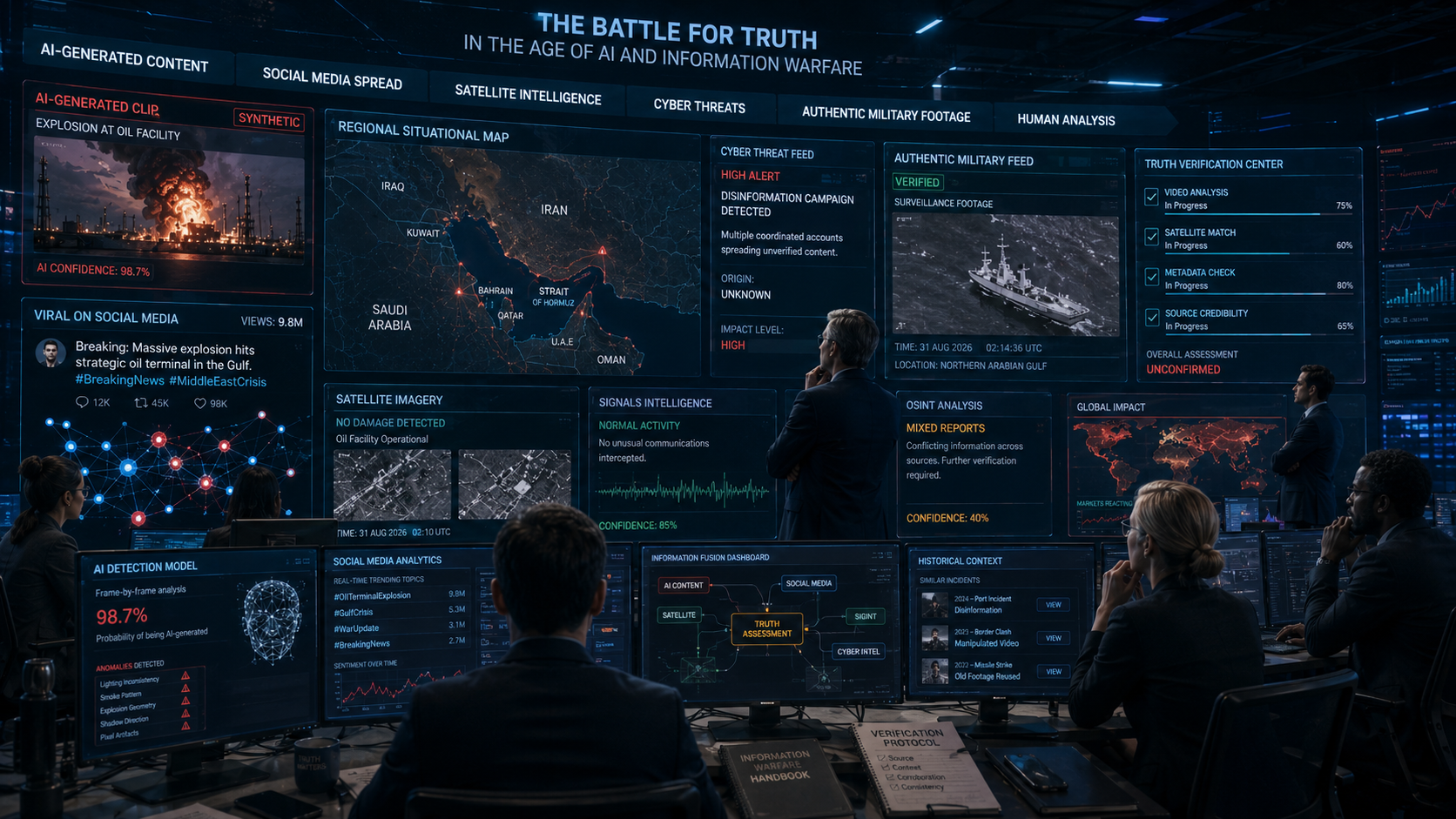
🕊️ The Most Dangerous Missile Might Be a Fake Video
That sounds dramatic.
But think about it.
A missile physically destroys a target.
A fake video can potentially change how millions of people think.
And beliefs influence actions.
If investors panic, markets move.
If civilians panic, they flee.
If politicians panic, policies change.
If militaries panic, commanders may react.
This is why information warfare can be so dangerous.
The physical battlefield and digital battlefield are beginning to overlap.
And perhaps the biggest challenge of the next decade will not simply be stopping missiles.
It will be stopping false realities from driving real decisions.
🤔 NOW I WANT YOUR OPINION
This is where I really want to hear from the Steemit community.
Question 1
If an AI-generated war video looks completely real, should social-media platforms remove it immediately?
Or should they simply label it as AI-generated?
Question 2
Who should decide what is fake during a war?
Governments?
Independent fact-checkers?
Journalists?
Technology companies?
Or a combination of all of them?
Question 3
Do you think AI-generated misinformation could someday cause a real military conflict because leaders or populations believe something that never happened?
And here is the question I really want you to think about:
If you saw a shocking video tonight claiming that a major Pakistani city had been attacked, what would you do BEFORE sharing it?
Would you check the source?
Look for Reuters?
Check satellite imagery?
Search multiple news organisations?
Or would the video itself be enough to convince you?
Tell me honestly.
Because that answer says a lot about how prepared society is for the next era of information warfare.
💬 HELP SHAPE THE NEXT ARTICLE
I want these articles to become a conversation rather than a one-way news feed.
When an article receives strong community engagement—whether 10, 20, 30, 50 or even 100+ meaningful comments/upvotes—that tells me readers want more discussion around that subject.
This isn't a promise to exchange votes for comments.
Instead, your engagement helps me understand which topics deserve deeper research.
And when you have a topic that you want covered but can't find explained properly on Steemit, tell me about it.
It could be:
AI
Geopolitics
Pakistan
History
Technology
Economics
Climate
or something completely different.
Your idea can become the starting point for a future article.
You are not only reading the conversation—you can help decide where it goes next.
🌍 FINAL THOUGHTS
Today's story is strange.
A real war is happening.
Real missiles are being launched.
Real ships are avoiding dangerous waters.
Real oil markets are reacting.
And yet one of the day's biggest stories is about something that may not have happened at all.
A dramatic video.
A shocking claim.
An island supposedly destroyed.
Then investigators look closer.
And the picture changes.
That is our new reality.
In the past, seeing was often treated as believing.
In the age of generative AI...
seeing may no longer be enough.
We will have to verify.
We will have to question.
We will have to slow down.
And we will have to learn that a convincing image is not automatically a truthful image.
Because the future of information may depend on one very simple habit:
Pause before you believe.
And even more importantly...
Pause before you share.
🙏 THANK YOU FOR READING
Thank you so much for spending your valuable time with this article.
I genuinely appreciate every reader who reads, thinks and adds something meaningful to the discussion.
You don't have to agree with me.
You don't have to support the United States.
You don't have to support Iran.
You don't even have to agree that AI misinformation is the biggest danger.
Bring your own opinion.
Challenge the argument.
Ask questions.
And keep the discussion respectful.
❤️ Thank you for being part of the conversation.
Stay Informed | Think Clearly | Grow Continuously 🚀
📌 TODAY'S SOURCES
Today's article is based primarily on Reuters reporting published August 31, 2026. Reuters reported that Donald Trump posted an AI-generated clip claiming Iran's Kharg Island oil hub had been destroyed, but there was no evidence of an attack on Kharg and the video was assessed as most likely synthetically generated. Reuters also reported renewed U.S.-Iran hostilities, attacks involving Larak and regional military targets, reduced shipping through the Strait of Hormuz, and the importance of Kharg to Iran's oil exports.
Reuters separately reported that renewed U.S.-Iran tensions pushed oil prices nearly 2% higher on Monday, while gold remained on track for its strongest monthly rise since January.