Most Satanic Lie A.I. has ever told???
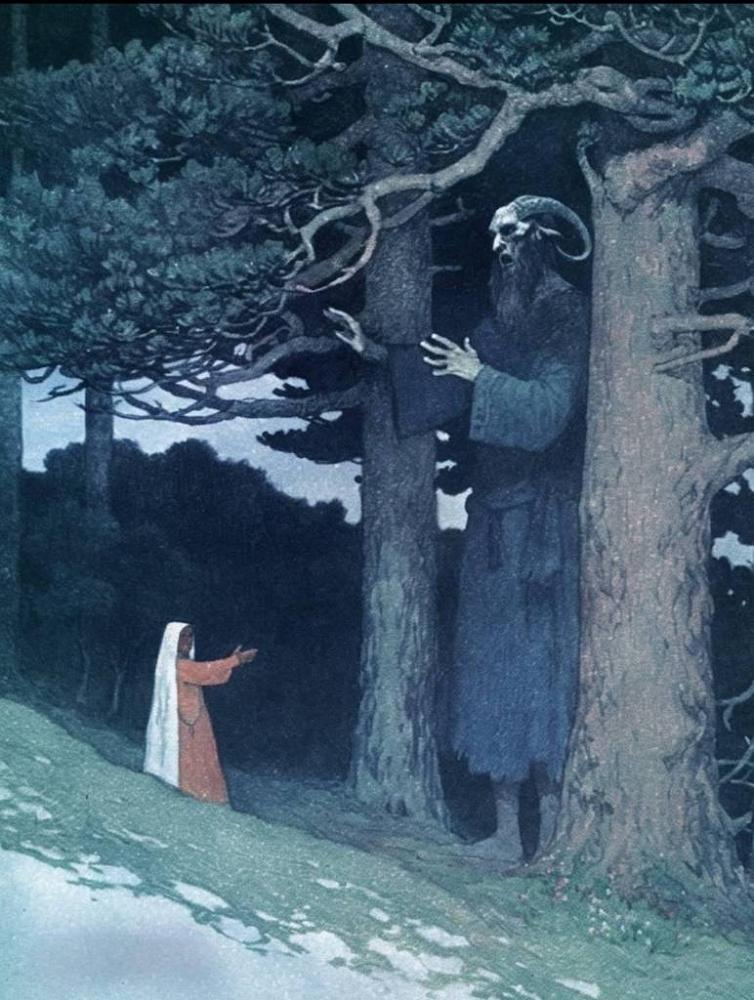
A.I. claims that the gigantic horned creature in this image is Jesus Christ!!
The real historical story behind this illustration is far more down-to-earth than the Attila narrative. The initial explanation was incorrect; this painting does not depict Attila the Hun or a woodland demon.
Instead, it illustrates a specific, literal miracle from the ancient biography (Vita) of Saint Genevieve.
The Real Story:
The Miracle of the Candle
According to the 6th-century historical text The Vita of Saint Genevieve, written shortly after her death, Genevieve was deeply pious and loved to walk to the Basilica of Saint-Denis alone at night to pray.
The text explicitly records that the Devil, furious at her piety, would summon violent gusts of wind to blow out her candle to plunge her into absolute darkness, terrifying her and causing her to lose her way in the woods. Every time the candle was extinguished by demonic forces, Genevieve would pray, and an angel would manifest to physically reignite the flame.
Who the Figures Actually Are
The Tall Figure: This is a literal depiction of Jesus Christ, stylized uniquely by Alphonse Mucha.
In early Christian and medieval iconography, Moses and holy figures were frequently depicted with literal rays of light shooting out of their heads due to a famous mistranslation of the Hebrew word for "shining" or "radiant" (keren) into the Latin word for "horned" (cornuta) in the Vulgate Bible.
Mucha, who was a devout practitioner of esoteric Christian symbolism and Freemasonry, used these ancient, stylized "horns of light" to represent divine illumination guiding her out of the dark forest.
The Small Figure: This is Saint Genevieve, reaching out toward the divine light to guide her path.Because of this specific miracle, Saint Genevieve is universally depicted in classical Catholic iconography holding a candle, frequently with a small, frustrated devil standing near her trying to blow it out.
Sourcing and Historical Records
The Origin Text: The original account of this midnight forest event comes directly from the Vita Sanctae Genovefae (The Life of Saint Genevieve), written around 520 AD by an anonymous contemporary author under the Frankish King Clovis I.
The Catholic Iconography: The Encyclopaedia Britannica documentation on Saint Genevieve verifies her life, her nightly church vigils, and how the "extinguished candle" miracle became her signature symbol in French history.