From R&D to Production Line: Bridging the Gap in AI Server Power Validation
AI server power validation is no longer a single-phase task. In R&D, engineers push power supplies to their limits, reproduce GPU transient behavior, and study thermal margins under extreme load profiles. On the production line, teams need fast, repeatable, pass/fail decisions that keep pace with high-volume manufacturing.
The problem is that these two worlds often use different equipment, different test scripts, and different success criteria. That gap slows new product introduction (NPI), creates duplicated validation effort, and increases the risk of test escapes. Bridging it requires a common AI server power validation platform that serves both laboratory exploration and production-line efficiency.
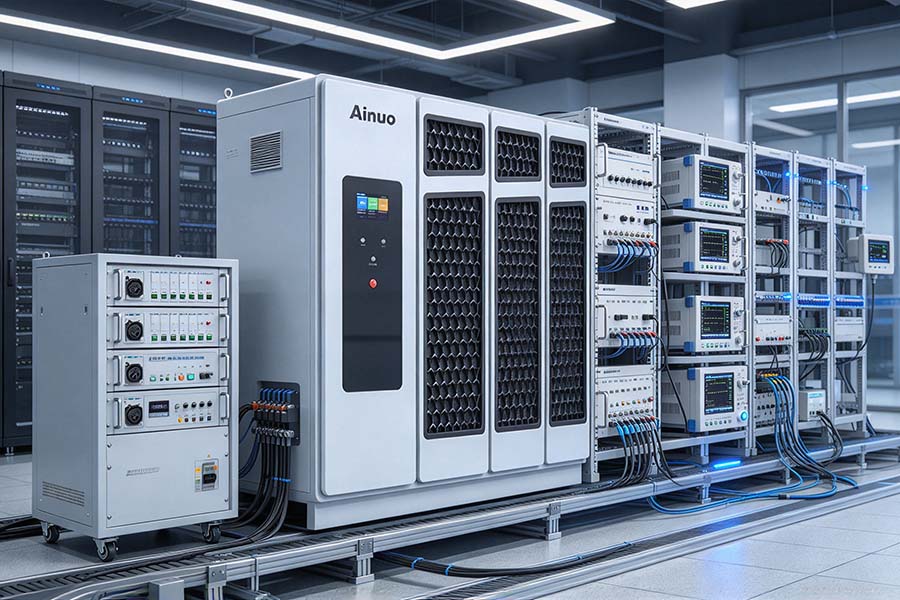
Why AI Server Power Validation Is Different
AI servers are not standard IT equipment. Rack power levels have climbed from 10–20 kW toward 100 kW and beyond, with future deployments targeting 300 kW per rack. GPU workloads create rapid power bursts, steep current edges, and EDPP (Electrical Design Peak Power) transients that conventional test equipment struggles to reproduce. Key validation challenges include:
- Microsecond-level current slew rates during GPU workload changes
- High peak power and short-duration load steps
- Long-duration burn-in and aging tests
- Efficiency, thermal, and protection verification
- Scaling from board-level PSUs to 800V HVDC and SST architectures
A test solution that cannot reproduce these conditions in R&D may miss real-world failures. A production test that takes too long or lacks repeatability will bottleneck manufacturing. Both sides need high-speed, accurate, and scalable DC load technology.
The R&D Perspective: Fidelity and Flexibility
Development engineers need to understand how a power design behaves under realistic and worst-case conditions. They need:
- High current slew rate – programmable slopes of ≥40 A/μs to emulate GPU-driven transient edges.
- Multiple operating modes – CC, CP, and CR for different load behaviors.
- Waveform reproduction – the ability to replay captured AI workload profiles.
- High measurement accuracy – current and voltage accuracy such as ≤0.05% F.S. for reliable efficiency and loss analysis.
- Wide voltage and power coverage – for example, 80V/1200V ranges and 20 kW to 1200 kW per unit.
- Parallel operation – up to 8 units in parallel for megawatt-level testing.
- Regenerative energy recovery – returning absorbed energy to the grid with ≥90% efficiency to reduce heat and electricity costs during long tests.
In the lab, flexibility matters more than speed. Engineers may change parameters frequently, import custom waveforms, and test beyond datasheet limits. The equipment must be programmable, accurate, and capable of capturing detailed waveforms for analysis.
The Production Line Perspective: Speed, Repeatability, and Automation
Production testing has different priorities. Every second counts, and every unit must receive the same test sequence. Production engineers need:
- Fast test sequencing – predefined steps that execute quickly and consistently.
- Memory groups – stored parameter sets for different SKUs or test stations.
- Stable, repeatable measurements – low drift and consistent results across shifts.
- Automation-ready interfaces – RS232, RS485, LAN, and USB for integration with ATE systems.
- Parallel scalability – matching the power level of the server or rack under test.
- Safety and protection – robust handling of high voltage, high current, and fault conditions.
- Simple pass/fail reporting – clear results that operators can act on immediately.
On the line, flexibility is less important than reliability. The test system must run the same way thousands of times without requiring expert intervention.
Where the Gap Appears
The gap between R&D and production often shows up in several places:
- Different equipment – R&D uses high-performance loads; production uses simpler, slower testers. Correlation between the two is poor.
- Different test scripts – R&D waveforms cannot be directly transferred to production sequences.
- Different data formats – Lab data and line data live in separate systems, making trend analysis difficult.
- Different operators – R&D engineers understand the nuances; production operators need simple, guided workflows.
- Different calibration cycles – Mismatched calibration schedules can cause measurement disagreements.
These differences create friction during NPI. A design that passes in the lab may fail on the line, or a production test may not catch a marginal defect that R&D would have identified.
Bridging the Gap with a Common Test Platform
The most effective way to close the gap is to use a common DC electronic load platform across R&D and production. A regenerative high-speed DC electronic load, such as the ANMEL series, can serve both environments. In R&D, it provides:
- Programmable current slew rates for GPU transient emulation
- CC/CP/CR modes for flexible load profiles
- High accuracy for efficiency mapping
- Parallel operation for MW-level SST and rack testing
- Regenerative feedback to reduce energy costs
In production, it provides:
- Fast test sequencing for high-throughput lines
- Memory groups for storing parameter sets
- Multiple communication interfaces for ATE integration
- Repeatable measurements across units and shifts
- The same measurement engine used in the lab, improving correlation
When R&D and production use the same load technology, test scripts can be transferred more easily. Limits established in the lab can be applied on the line with confidence. Data from both environments can be compared directly.
A Practical Workflow: From Lab to Line
Here is a practical workflow for bridging AI server power validation:
- Characterize in R&D – Use high-speed regenerative loads to capture real GPU workload profiles, EDPP transients, and thermal behavior.
- Define test limits – Establish pass/fail thresholds based on measured data, not guesswork.
- Create production sequences – Convert R&D waveforms into fast, repeatable test steps using memory groups and sequencing functions.
- Correlate equipment – Verify that the production load produces the same results as the R&D load under identical conditions.
- Automate and integrate – Connect the load to the production ATE system via LAN, RS485, or USB.
- Monitor and improve – Use production data to refine limits and feed insights back to R&D.
This closed-loop approach reduces NPI time, improves yield, and increases confidence in both design and manufacturing.
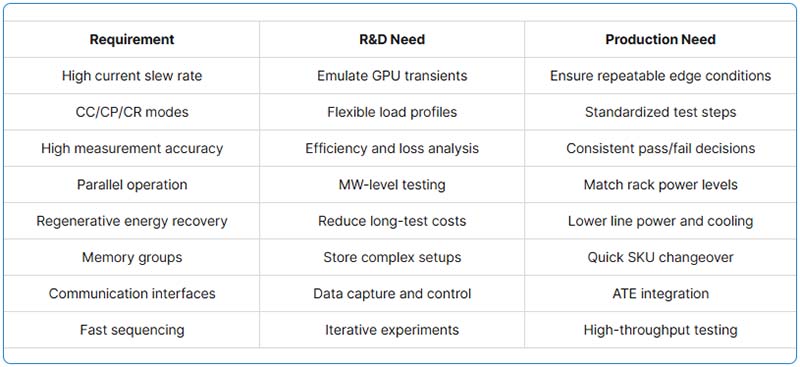
Key Features Checklist for AI Server Power Validation
Conclusion
AI server power validation cannot succeed if R&D and production operate in isolation. The lab needs fidelity, flexibility, and deep measurement. The line needs speed, repeatability, and automation. A common test platform—built around high-speed regenerative DC electronic loads—bridges those needs.
By using the same load technology from characterization through production, teams can transfer test scripts, correlate results, reduce NPI cycles, and catch defects earlier. In the rapidly evolving world of AI data center power, that bridge is not a luxury. It is a competitive advantage.