How AI Meeting Notes Can Turn Conversations Into Actionable Tasks
Priya walked out of a Tuesday client-status call feeling good. The team had agreed on a new delivery date, the client had signed off on a scope change, and someone had promised to send an updated timeline. By Thursday, none of that had happened. One teammate thought the timeline was someone else's job. Another remembered the delivery date differently than the client did. The meeting had produced plenty of notes. It just hadn't produced anything anyone could act on.
That gap - between "we had a productive meeting" and "everyone knows what happens next" - is where AI meeting notes earn their keep. A meeting note tells you what was said. An actionable one tells you what should happen because of it, and who's doing it.
Why Good Meeting Notes Still Don't Guarantee Follow-Through
Most people are decent note-takers. The problem isn't the writing - it's the structure. Decisions get buried in paragraphs alongside side conversations and half-formed ideas. A deadline mentioned in passing looks identical, on the page, to one the team actually committed to. Responsibility often goes unstated: someone says "we should loop in legal," and everyone nods without anyone claiming it.
Documenting a meeting and managing what comes after it are two different jobs. Traditional notes handle the first reasonably well. They rarely handle the second, because turning a paragraph into a task still requires someone to sit down afterward and decide what matters. That extra step is where follow-through quietly falls apart.
What Are AI Meeting Notes?
AI meeting notes combine meeting transcription, summarization, and action-item extraction into one output. Instead of a raw transcript or a hand-written page of bullet points, you get a structured record: who was there, what was discussed, what was decided, and what needs to happen next.
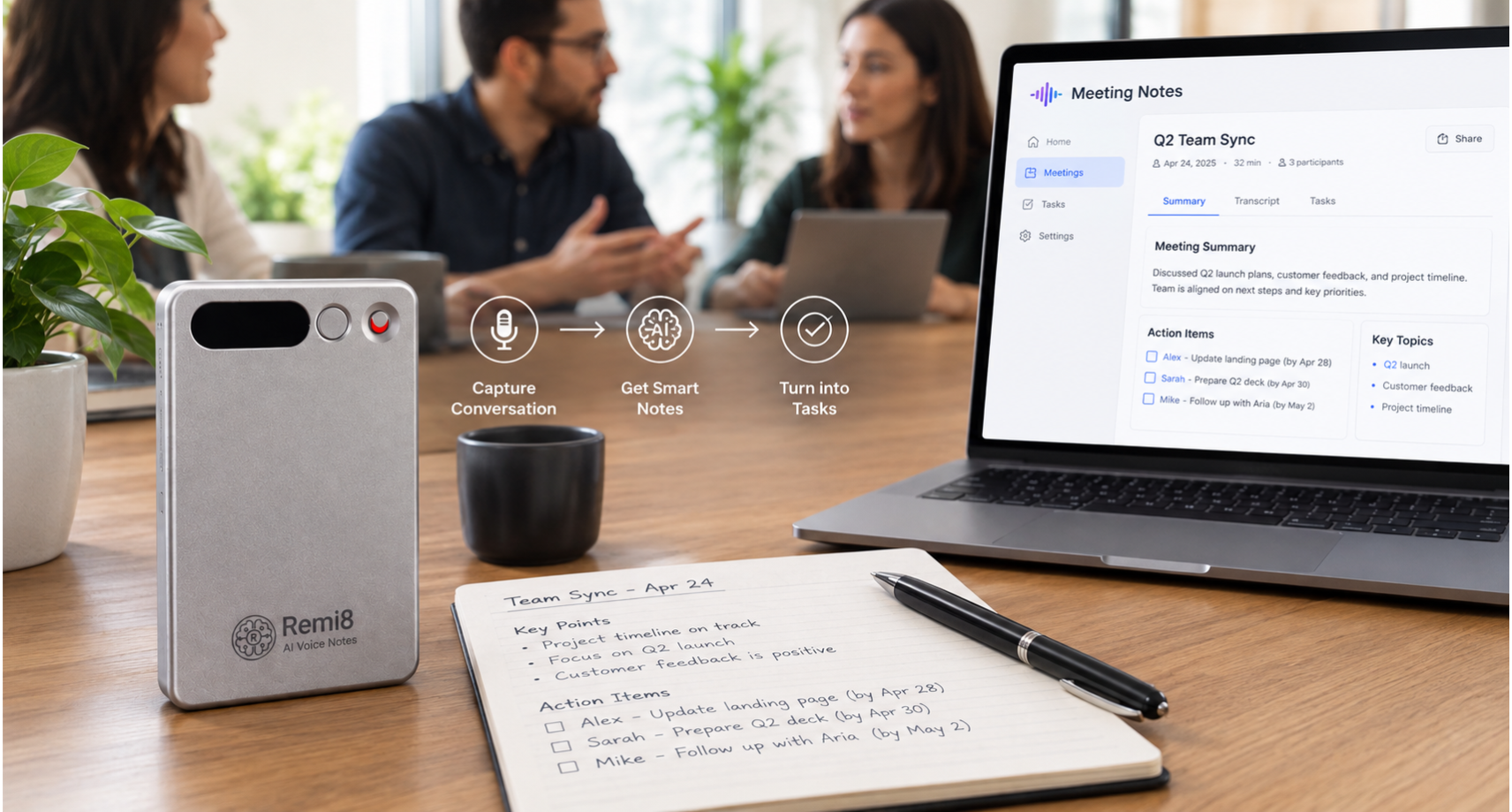
The basic workflow looks like this: record → transcribe → understand → summarize → extract actions. The recording becomes searchable text through AI transcription. From there, the system identifies which parts of the conversation were substantive - a decision, a commitment, a deadline - versus which parts were just discussion. Some tools go a step further, automatically summarizing a video call the moment it ends.
How AI Turns a Conversation Into an Actionable Task
Capture the conversation. Everything starts with a recording - an in-person meeting, a phone call, or a video conference.
Create a meeting transcription. Speech becomes searchable, editable text. Without an accurate transcription, every later step inherits its errors.
Identify the important information. Not every sentence matters equally. AI can flag discussion points that carry weight - a proposal, an objection, a number that changed - and set aside small talk.
Identify decisions. A team might debate three options for twenty minutes and land on one. The debate is context; the choice is the decision. Separating the two matters, because decisions are what people act on later.
Extract action items. This is where a conversation becomes a task. Take a line like "Priya will send the revised timeline by Friday." The useful output isn't the sentence - it's the sentence broken apart: Task: send revised timeline. Owner: Priya. Deadline: Friday. That structure is what makes an action item usable instead of just memorable.
Make follow-up easier. Once action items exist as discrete entries rather than sentences buried in a summary, people can actually track them - check them off, reassign them, or flag ones that slipped.
What Makes a Meeting Note "Actionable"?
A useful meeting note answers a short list of questions: What was discussed? What was decided? What needs to happen? Who's responsible? When is it due? A simple way to think about it: Action + Owner + Deadline + Context. Drop any one of those and the note becomes ambiguous again - "someone needs to follow up" isn't an action item, it's a suggestion. Not every AI meeting-notes tool fills in all four automatically; some require a quick human confirmation.
Real-World Examples of AI Meeting Notes
Project meetings. A team agrees to update a requirements document. Instead of that agreement living in paragraph six of a summary, it becomes task, owner, due date - the shift behind why some project managers say they've stopped scrambling for notes mid-meeting and started actually contributing to the discussion.
Client and sales meetings. A client mentions a scope change, or a prospect raises a pricing objection. Captured well, that becomes a follow-up task tied to that account, not a detail someone half-remembers a week later.
Leadership meetings. Strategy sessions tend to produce energy and clarity in the room, then lose both by the time they reach the rest of the organization. Some managing directors use recorded strategy sessions specifically to close the gap between strategy and ground-level execution.
Team stand-ups. Spoken updates ("I'm blocked on the API," "I'll have the draft Wednesday") turn into a short list of owned follow-ups instead of disappearing once the call ends.
AI Meeting Assistant vs. Traditional Meeting Notes
The traditional workflow is: listen, write, organize, then manually turn notes into tasks, usually after the fact and from memory. An AI meeting assistant workflow is: listen, capture, transcribe, summarize, extract actions, follow up. The goal isn't to eliminate note-taking as a concept - it's to remove the manual translation step where information sits in a notebook until someone has time to convert it into something the team can actually work from.
Where Remi8 AI Fits
Remi8 AI is built around that same capture-to-action idea, framed as capture → understand → find → act. It records meetings and calls, produces AI transcription with speaker identification, generates summaries, and surfaces action items from the conversation. Because the information is searchable, you can also ask a plain-language question about a past meeting instead of scrolling through a transcript. For professionals sitting through several meetings a day, that combination is meant to replace the version of "meeting notes" that lives in three notebooks and nobody's memory - see how it plays out across roles on Remi8 AI's use-cases page.
What AI Meeting Notes Cannot Do?
AI meeting notes are not a substitute for judgment. Transcription accuracy drops with background noise, overlapping speakers, or heavy accents. Ambiguous statements ("we might want to revisit this") can be misread as firm commitments. AI can identify a likely action item, but a person still needs to confirm the task, owner, and deadline are correct - the tool proposes, the team verifies. There's also a consent dimension worth naming: recording a meeting involves other people, so confirm everyone's comfortable with it first, since expectations and requirements vary.
How to Make AI-Generated Meeting Notes More Useful?
Start meetings with a stated objective, not just an agenda topic.
Say decisions out loud so they're easy to distinguish from discussion.
Use names and specific dates when assigning work - "someone" and "soon" don't extract well.
Confirm action items verbally before the meeting ends.
Review AI-generated notes rather than trusting them unread.
Share the final list of actions with everyone who attended.
Conclusion
A meeting isn't really finished when someone closes their notebook or stops the recording. It's finished when the decisions are clear and everyone knows what they're responsible for next. AI meeting notes don't replace that judgment - they remove the manual work of turning a conversation into something the team can act on. If your meetings keep producing notes but not follow-through, that gap is worth closing. Remi8 AI is one practical way to start: record the next meeting and compare its structured summary and action list to the page of notes you'd have written by hand.
FAQ
What are AI meeting notes?
AI meeting notes combine meeting transcription, summarization, and action-item extraction into a single structured record of what happened and what needs to happen next.
Can AI meeting notes create action items?
Yes. Tools like Remi8 AI can identify statements that imply a task, along with an owner and deadline, and present them as discrete items rather than sentences buried in a summary.
How does AI identify action items from meetings?
It looks for language that signals commitment ("I'll send," "we'll follow up by") and pairs it with the owner and timeframe mentioned nearby.
What's the difference between AI meeting notes and meeting transcription?
Transcription is just the word-for-word text of what was said. AI meeting notes add a summary, identified decisions, and extracted action items on top of that transcript.
Can an AI meeting assistant assign tasks?
It can surface who was mentioned as responsible and structure that into a task. Whether it becomes an official assignment still depends on the team confirming it - Remi8 AI and similar tools flag it, but a person makes it official.
Are AI-generated meeting notes accurate?
Accuracy depends on audio quality and how clearly people speak. Remi8 AI and comparable tools generally handle clear, single-speaker-at-a-time audio well, but noisy rooms and overlapping speech increase the chance of errors worth double-checking.