Animal Feed Market Size, Share and Growth Forecast 2026-2034
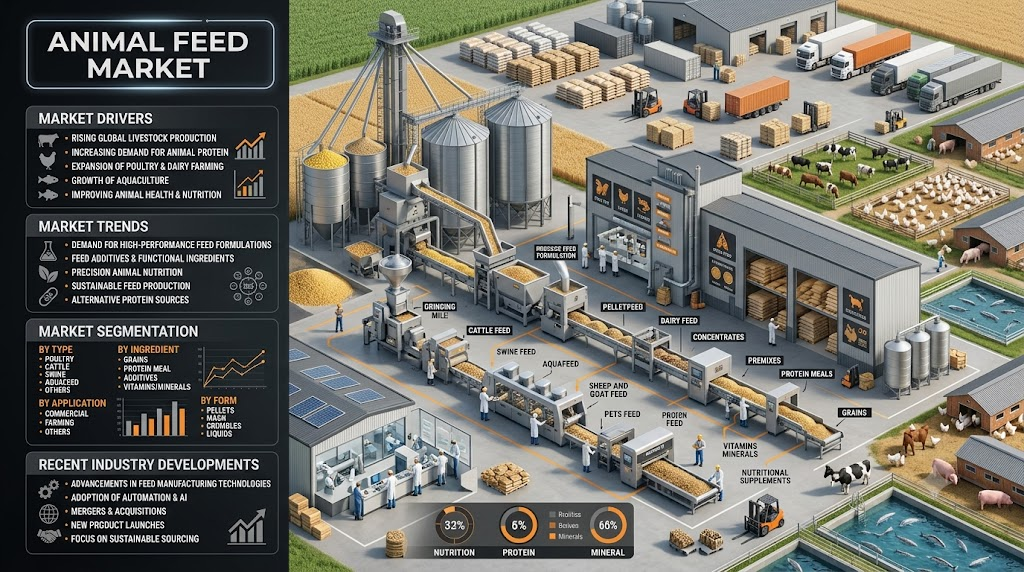
IMARC Group, a leading global market research and management consulting firm, has published its latest market intelligence report on the animal feed market. The global animal feed market size reached USD 548.1 Billion in 2025. Looking forward, IMARC Group estimates the market to reach USD 699.0 Billion by 2034, exhibiting a CAGR of 2.70% from 2026-2034. driven by rising global consumption of meat, dairy, and poultry products, continuous innovation in precision nutrition and feed additives, growing adoption of eco-friendly and methane-reducing feed solutions, and sustained government support for livestock farming and feed production infrastructure.
The market is on a steady growth path underpinned by a rising global population, projected to reach 9.7 Billion by 2050 from 8 Billion in 2022, and the corresponding need for sufficient, well-balanced livestock nutrition to meet global protein demand. Producers are increasingly turning to precision formulations, probiotics, amino acids, and feed acidifiers to improve animal health and feed conversion efficiency, while regulatory frameworks worldwide are tightening standards around ingredient sourcing, labeling, and antibiotic use, pushing the industry toward non-antibiotic and functional feed solutions. Poultry feed continues to anchor demand given the scale of global poultry farming, while cereals remain the dominant ingredient category owing to their affordability and high digestibility across livestock types.
Animal Feed Market at a Glance:
- Market Size 2025: USD 548.1 Billion
- Forecast Size 2034: USD 699.0 Billion
- Growth Rate 2026-2034: CAGR of 2.70%
- Leading Form: Pellets, the largest segment on efficiency, nutrient distribution, and ease of handling
- Leading Animal Type: Poultry (broilers, layers, turkeys, and others)
- Leading Ingredient: Cereals, the primary energy source for livestock diets
- Dominant Region: Asia Pacific, driven by its large livestock population and rising protein demand
How AI is Reshaping the Future of the Animal Feed Market
- AI-Driven Precision Ration Formulation: AI-based feed formulation platforms such as AFOS and BestMix now use linear programming and conversational interfaces to generate least-cost, nutrient-balanced rations in real time, with commercial cattle-nutrition platforms in 2026 documenting 8-18% reductions in feed costs in Iowa State and Kansas State performance studies.
- AI-Enabled Livestock Health and Feed Monitoring: The broader AI-in-precision-livestock-farming market is projected to grow from USD 2.7 Billion in 2025 to USD 8.01 Billion by 2030, with companies including GEA Group deploying AI-driven monitoring systems, such as its CattleEye acquisition, to link real-time animal health data directly to feed adjustments.
- AI-Integrated Feed Manufacturing Intelligence: Nutreco's Chief Digital Officer has highlighted AI's growing role in feed manufacturing decision intelligence, connecting nutrition experts and data scientists to accelerate feedback loops on health, economic, and environmental outcomes across feed mills.
Grab a sample PDF of this report: https://www.imarcgroup.com/animal-feed-market/requestsample
Animal Feed Market Trends and Drivers:
Population growth is a foundational driver of feed demand, with the global population having risen from 2.5 Billion in 1950 to 8 Billion in 2022 and projected to reach 9.7 Billion by 2050, intensifying the need for efficient livestock nutrition to meet global protein requirements. Continuous innovation in feed additives, including probiotics, amino acids, and feed enzymes, is improving growth efficiency and productivity, while economic cycles continue to shape consumption patterns, with researchers estimating a meaningful probability of a US and global recession risk through 2025 prompting shifts toward more affordable feed formulations.
Sustainability considerations are increasingly structural rather than optional. Feed additives that reduce methane emissions, such as Elanco's FDA-approved Bovaer, which cuts methane emissions from lactating dairy cows by approximately 30%, and UPL and CH4 Global's Methane Tamer, which targets up to a 90% reduction in cattle methane output, are gaining regulatory and commercial traction across major livestock markets including India and Brazil. Regulatory frameworks governing formulation, ingredient sourcing, and labeling continue to tighten globally, reflecting a broader push toward transparency, food safety, and reduced environmental impact across the feed value chain.
Government policy is directly shaping the pace and direction of feed industry growth, a dynamic spanning India, the United States, the European Union, and China that is detailed further below. Collectively, national livestock development schemes, sustainable protein initiatives, and feed-efficiency mandates are steering the industry toward higher-value, more resource-efficient production systems worldwide.
Global Regulatory, Trade, and Sustainability Landscape Shaping Demand:
- EU Livestock Strategy and Protein Action Plan: The European Commission's July 2026 livestock strategy and accompanying Protein Action Plan aim to raise the share of EU-grown oilseeds and protein crops used in animal feed from 25% in 2025 to 35% by 2035, reducing the bloc's dependence on imported soy that currently accounts for roughly 96% of its high-protein feed sources.
- US Feed Safety and Research Funding Framework: USDA's FY2026 budget allocates a total discretionary outlay of USD 26.65 Billion, within which the Agriculture and Food Research Initiative earmarks approximately USD 56 Million specifically for animal health and production research, alongside FDA-administered grants to harmonize state and federal animal feed safety regulatory standards.
- China's Livestock Feed Conservation Action: China's Ministry of Agriculture and Rural Affairs' Implementation Plan for Livestock Food Conservation Action targets cutting soybean meal inclusion in compound feed to approximately 10% by 2030, from 13.7% in 2024, through low-protein diet technologies expected to reduce soybean meal and grain use by up to 20 Million Tons.
- India's Feed and Fodder Entrepreneurship Push: India's National Livestock Mission channels a 50% capital subsidy, up to Rs 50 Lakh, toward feed and fodder value-addition units including silage, hay, and Total Mixed Ration production, directly expanding domestic compound feed manufacturing capacity.
Key Government Schemes and Policy Programs Supporting the Industry:
- India, National Livestock Mission (NLM): India's Department of Animal Husbandry and Dairying operates the NLM as a centrally sponsored scheme with a total outlay of Rs 2,300 Crore, offering up to 50% capital subsidy (capped at Rs 25-50 Lakh depending on the unit) for poultry, sheep, goat, pig, and feed and fodder entrepreneurship, having already sanctioned 145 NLM-EDP projects worth Rs 32.91 Crore in subsidy in Uttar Pradesh alone, generating 846 jobs.
- United States, USDA Agriculture and Food Research Initiative (AFRI): USDA's NIFA has earmarked approximately USD 56 Million for FY2026 animal health and production research under AFRI, part of a broader USD 26.65 Billion FY2026 discretionary agriculture budget that keeps core programs including EQIP and REAP active for livestock and feed-related infrastructure investment.
- European Union, Protein Action Plan and Common Agricultural Policy Support: The EU's July 2026 Protein Action Plan, backed by Common Agricultural Policy funding, targets raising domestic protein crop supply for animal feed from 25% to 35% of total use by 2035, complemented by a EUR 5.5 Million Horizon Europe-funded ProFEED project developing sustainable plant-protein feed value chains across 8 countries.
- China, Livestock Food Conservation Action Plan: China's May 2025 Implementation Plan for Livestock Food Conservation Action targets a reduction in feed consumption per kilogram of animal product of more than 7% by 2030 versus 2023, alongside cutting soybean meal use in feed by up to 20 Million Tons through low-protein diet technologies and alternative protein sourcing.
- Gujarat, India, State-Backed Feed Infrastructure Investment: In 2024, a state-backed animal feed facility with a daily production capacity of 800 Metric Tons was launched in Gujarat with an investment of Rs 210 Crore, aimed at supporting farmers, sustainable farming methods, and rural growth alongside milk production advancement.
Animal Feed Industry Segmentation:
The report has segmented the market into the following categories:
Breakup By Form:
- Pellets
- Crumbles
- Mash
- Others
Pellets represent the largest segment by form, offering consistent nutrient distribution, reduced feed wastage, and ease of handling, storage, and transport. Their dense, organized structure improves digestibility and feed consumption across poultry, swine, and aquaculture operations, while advancing pelleting techniques continue to strengthen pellet quality and durability during transport and feeding.
Breakup By Animal Type:
- Swine (Starter, Finisher, Grower)
- Ruminants (Calves, Dairy Cattle, Beef Cattle, Others)
- Poultry (Broilers, Layers, Turkeys, Others)
- Aquaculture (Carps, Crustaceans, Mackerel, Milkfish, Mollusks, Salmon, Others)
- Others
Poultry holds the largest share by animal type, driven by rising global demand for poultry meat and eggs and the sector's reliance on specialized, balanced feed formulations to optimize growth rates and egg-laying capacity. The extensive use of compound feed and continued technological advancement in feed conversion ratios are reinforcing poultry's dominant position in the market.
Breakup By Ingredient:
- Cereals
- Oilseed Meal
- Molasses
- Fish Oil and Fish Meal
- Additives (Antibiotics, Vitamins, Antioxidants, Amino Acids, Feed Enzymes, Feed Acidifiers, Others)
- Others
Cereals dominate the ingredient segment as a reliable, cost-effective energy source across poultry, swine, and cattle feed formulations. Their high digestibility, wide availability, and ease of integration into compound feeds continue to anchor their leadership position, even as demand grows for functional additives such as amino acids and feed enzymes to enhance nutrient utilization.
Breakup By Region:
- North America (United States, Canada)
- Asia Pacific (China, Japan, India, South Korea, Australia, Indonesia, Others)
- Europe (Germany, France, United Kingdom, Italy, Spain, Russia, Others)
- Latin America (Brazil, Mexico, Others)
- Middle East and Africa
Asia Pacific holds the largest regional share, underpinned by its substantial livestock population and countries including China, India, and Japan investing heavily in advanced feed formulations for poultry, swine, and aquaculture. In North America, red meat continues to account for 58% of total US meat consumption even amid a growing shift toward poultry, while Europe's roughly 150 Million Tons of annual milk production and per-cow yields of up to 10,000 kg annually continue to drive demand for high-value dairy feed formulations.
Competitive Landscape:
The report provides a comprehensive analysis of the competitive landscape in the animal feed market with detailed profiles of key companies, including:
- Alltech
- Anova Feed
- Archer-Daniels-Midland Company
- Bunge Global SA
- Cargill Incorporated
- Charoen Pokphand Foods PCL
- Godrej Agrovet Limited
- Nutreco N.V
- Purina Animal Nutrition LLC
Competitive activity is accelerating through platform consolidation: ADM and Alltech formally launched their North American animal feed joint venture, Akralos, in February 2026, combining Alltech's 18 US and 15 Canadian feed mills with ADM's 11 US mills under a single operating platform. Cargill continues to expand through both organic investment and acquisition, including a USD 32 Million expansion of its Temple, Texas feed mill and its October 2025 acquisition of Brazilian animal nutrition company Migplus, reinforcing its position as one of the industry's most active consolidators.
Market Concentration Analysis:
- Fragmented Globally Despite Active M&A: Independent industry assessments place the top five global compound feed manufacturers, including Cargill, ADM, Nutreco, ForFarmers, and Charoen Pokphand, at roughly 26.2% of combined global sales, while the top ten players account for under 20% of total market revenue, reflecting a structurally fragmented competitive base.
- Platform Consolidation Concentrated in North America and Asia: The ADM-Alltech Akralos joint venture and continued Cargill acquisitions signal a shift toward platform-scale consolidation in mature markets, while expansion financing such as the IFC's proposed USD 150 Million loan to New Hope Singapore is extending milling footprints across Vietnam, Egypt, Bangladesh, Cambodia, and Nepal.
- Regional Champions Anchoring Emerging Markets: Companies such as Charoen Pokphand Foods and New Hope Liuhe maintain captive mill networks across breeding, nutrition, and processing in Asia, insulating them from ingredient price volatility in a way that smaller regional players cannot replicate.
What Does The Full Report Cover?
- Complete market sizing with revenue forecasts covering the full 2020-2034 projection period
- Quantified growth driver analysis with impact scoring across form, animal type, ingredient, and regional markets
- Sub-segment breakdowns for pellets, crumbles, mash, swine, ruminants, poultry, and aquaculture feed with individual share data
- Country-level data for the United States, Canada, Germany, France, United Kingdom, Italy, Spain, Russia, China, Japan, India, South Korea, Australia, Indonesia, Brazil, and Mexico
- Competitive and key company profiles with strategic landscape assessment
- Porter's Five Forces, value chain analysis, and technology landscape mapping
- Investment and growth opportunity mapping across precision nutrition, alternative proteins, and methane-reducing feed additives
Recent News and Developments in Animal Feed Market
- February 2026: ADM and Alltech formally launched Akralos, a North American animal feed joint venture combining Alltech's 18 US and 15 Canadian feed mills with ADM's 11 US feed mills, headquartered in Lexington, Kentucky, to strengthen livestock, equine, and specialty animal nutrition solutions.
- March 2026: Cargill opened a new dairy feed plant in Punjab, India, marking a step toward making India more self-reliant in dairy feed production.
- April 2026: The International Finance Corporation disclosed a proposed loan of up to USD 150 Million to New Hope Singapore to expand feed production capacity across Vietnam, Egypt, Bangladesh, Cambodia, and Nepal.
- October 2025: De Heus India inaugurated a new animal feed manufacturing facility in Rajpura with an investment of about USD 17 Million and an initial capacity of 180,000 Metric Tons per year, expandable to 240,000 Metric Tons.
- October 2025: Cargill acquired Brazilian animal nutrition company Migplus, expanding its supplements and balanced feed portfolio in Latin America as part of its broader acquisition strategy across the animal feed and nutrition sector.
- May 2024: Elanco Animal Health received US FDA approval for Bovaer, a feed supplement for lactating dairy cows that reduces methane emissions by approximately 30%, marking a significant step in sustainable animal feed alternatives.
Note: If you require specific details, data, or insights that are not currently included in the scope of this report, we are happy to accommodate your request. As part of our customization service, we will gather and provide the additional information you need, tailored to your specific requirements. Please let us know your exact needs, and we will ensure the report is updated accordingly to meet your expectations.
Key Questions This Report Answers
- What is the current global animal feed market size and what is its projected value?
- Which form, animal type, and ingredient segments hold the largest share in the global animal feed market?
- What are the key drivers of global animal feed market growth?
- Which region dominates the global animal feed market and why?
- How are government livestock and feed-efficiency programs reshaping animal feed investment worldwide?
- Who are the top companies in the global animal feed market and what are their competitive strategies?
- What are the investment and market entry opportunities across precision nutrition, alternative proteins, and methane-reducing feed technologies?
About Us:
IMARC Group is a global management consulting firm that helps the world's most ambitious changemakers to create a lasting impact. The company provides a comprehensive suite of market entry and expansion services. IMARC offerings include thorough market assessment, feasibility studies, company incorporation assistance, factory setup support, regulatory approvals and licensing navigation, branding, marketing and sales strategies, competitive landscape and benchmarking analyses, pricing and cost research, and procurement research.
Media and Sales Contact
IMARC Group
Email: sales@imarcgroup.com
United States: +1-201-971-6302
India: +91-120-433-0800
United Kingdom: +44-753-714-6104